
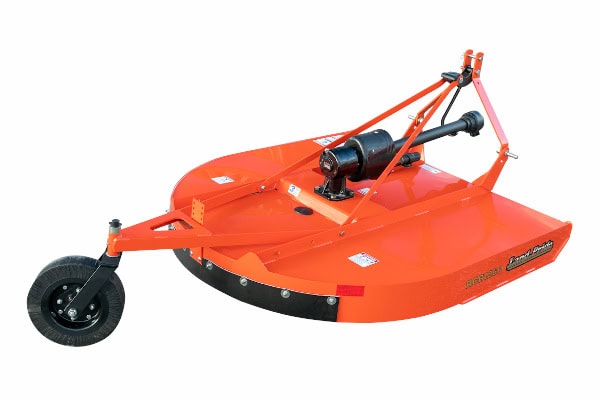
Overview & Specs
The Land Pride RCR1260 is a five-foot rotary cutter for grass, weeds and light brush on a suitably matched tractor. It belongs on the shortlist for maintaining rougher acreage areas where controlling growth matters more than producing a lawn finish. Its role should be defined by the vegetation and ground conditions, not by the word “heavy” in a used-equipment advertisement.
The central buying distinction is between maintaining an area that has already been assessed and attempting to reclaim unknown ground. A cutter with a stated brush capacity is not a substitute for locating wire, rocks, stumps and other hazards. Nor does a wide open deck make it the right tool for every patch that a lawn mower cannot handle.
On This Page
ToggleFive-foot cut, substantially longer complete implement
Land Pride’s RCR12 specification sheet dated April 16, 2024 provides this RCR1260 configuration. The weight includes the shear-bolt driveline, laminated tyre and front and rear guards.
| Specification | RCR1260 |
|---|---|
| Cutting width | 60 inches / 1.52 m |
| Overall width | 64¼ inches / 1.63 m |
| Overall length including tailwheel | 97¾ inches / 2.48 m |
| Listed configured weight | 496 lb / 225 kg |
| Recommended tractor horsepower | 20–60 hp |
| PTO speed | 540 rpm |
| Hitch | Category 1, quick-hitch ready |
| Cutting-height range | 1¼–10 inches |
Keep the source’s “recommended tractor horsepower” label intact. Do not silently relabel it as a measured PTO minimum or confuse it with the separately listed gearbox rating. The exact tractor, driveline and carrying arrangement need checking together.
The length is especially important near trees and buildings. A cutter that clears a narrow opening in a straight line can still sweep toward an obstacle when the tractor turns. Walk through the intended route and leave space for the full mounted combination rather than comparing only cutting widths.
What the one-inch brush statement means for a buyer
The RCR12 product page identifies a one-inch cut capacity and describes grass, weeds and small saplings as intended work. Treat that as a boundary to investigate, not a challenge to approach on every pass. Mixed vegetation, hidden objects and the condition of the cutter still matter.
A property owner can make a more useful inventory than “three acres of rough grass.” Separate maintained grass, dense weeds, small woody growth and areas with uncertain debris. Record where vegetation obscures the ground. That creates a sensible work plan and identifies sections that need inspection or a different clearing method first.
One overgrown corner does not necessarily justify buying a more aggressive tool for all the regularly maintained land. Contracting the initial clearing and owning an appropriate maintenance cutter can be a coherent strategy. Conversely, recurring woody growth beyond the documented duty should change the equipment shortlist.
Do not expect the RCR1260 to make previously rough land immediately suitable for finish mowing. Removing growth and correcting the surface are separate operations. The result after cutting may still include uneven ground or material requiring additional work.
Free-swinging blades and a stump jumper are not immunity from impact
The documented cutting arrangement uses two free-swinging blades and a pan-style stump jumper. That architecture is characteristic of the intended rough-cutting role. It should not be interpreted as permission to deliberately drive over obstacles or assume that impacts are harmless.
For a used purchase, the rotating assembly deserves particular attention. Inspect it under the manufacturer’s shutdown and support requirements with competent assistance. Blade condition, attachment hardware, the carrier and signs of contact or deformation all affect whether the cutter is ready to use.
A seller saying that it “still cuts” does not establish balance, correct parts or sound mounting. Ask what has been replaced and retain the part identification. Do not treat improvised blades or undocumented repairs as an upgrade simply because they appear substantial.
Any unusual vibration or noise during a properly arranged demonstration calls for stopping and diagnosing the cause. It is not a normal feature to accept in exchange for a lower purchase price.
Shear bolt or slip clutch: identify the actual package
The specification lists shear-bolt and slip-clutch protection choices. These are alternative protection arrangements with different inspection and maintenance needs. Neither should be described as maintenance-free, and neither changes the cutter’s permitted vegetation duty.
A shear-bolt arrangement depends on the correct specified replacement part. Substituting a stronger bolt to avoid interruption defeats the purpose of a designed protection point. A slip clutch requires the inspection and servicing described for that assembly; its presence alone is not proof that it will release correctly after storage.
Ask the seller to identify the fitted driveline and supply the applicable instructions. If the advertisement quotes the base weight, confirm whether the actual protection option changes the delivered configuration. A comparison between two cutters should include the equipment supplied, not just the model decal.
For occasional owners, seasonal readiness can matter more than the theoretical convenience of one protection type. Budget time to inspect the machine before the first cutting session, particularly when it has spent months parked. A protection device should be part of the maintenance routine rather than something discovered only after an obstruction is encountered.
Match shaft speed, travel speed and the finish separately
The operator manual calls for the prescribed PTO operating speed and adjustment of travel to conditions. A lower travel speed and a lower PTO speed are not the same change. Use the tractor controls and transmission in accordance with the exact manuals.
This distinction helps explain disappointing demonstrations. A buyer may see an engine that is not heavily loaded yet still receive an uneven cut because the working setup, vegetation or travel speed is unsuitable. More engine horsepower is not automatically the answer.
The PTO versus engine horsepower guide explains the rating labels. For the tractor-side operating choice, the transmission comparison helps frame how conveniently a particular tractor can maintain an appropriate pace.
A useful trial evaluates an acceptable cut across a representative section, including vegetation flattened by tyres and areas needing another pass. Do not judge the machine only by whether the engine continues running or by the distance covered before turning.
Estimate a work window without promising acres per hour
Width gives a starting point for a calculation, not a productivity guarantee. Suppose an illustrative operation uses 1.4 metres of effective width after overlap and an appropriate travel speed of 4 km/h. The theoretical coverage is 1.4 × 4,000 = 5,600 square metres per hour, or 0.56 hectares.
If a hypothetical 65% field efficiency accounts for turns and other interruptions, working coverage becomes about 0.364 hectares per hour. A 0.8-hectare area would then require roughly 2.2 working hours before separate setup and cleanup. These inputs are invented planning assumptions, not measured RCR1260 performance or an operating-speed prescription.
The calculation shows which information a demonstration should collect. If a site has many small corners, the efficiency assumption may be unrealistic. If vegetation requires repeated passes, the area cannot be treated as completed after the first traversal.
For a Canadian owner fitting cutting into a short evening or weekend window, reliable completion of the actual area matters more than an optimistic straight-line rate. A narrower approved tool on an easier route may compete well with a wider attachment that is awkward around obstacles.
Tractor carrying capacity remains a separate check
The cutter projects behind the three-point hitch. Its mass and centre of gravity affect the tractor differently from an equal mass close to the linkage. Use the tractor’s implement and ballast guidance, including the exact measurement point of its lift rating.
A quick hitch also forms part of the geometry. Confirm driveline length, permitted movement and clearance with the actual combination. Aglist’s quick-hitch compatibility guide explains why physically engaging the pins is only the start of that assessment.
Evaluate storage and transport as well as operation. The tailwheel extends the implement’s footprint, and the complete tractor-and-cutter arrangement must fit the available space. Do not discover after delivery that the intended parking bay requires an impractical sequence of disconnected moves.
Canadian seasonal considerations
The first cutting session after a dormant period deserves a fresh site inspection. Snow cover, maintenance activity or other property use can change what is present in an area that was clear last season. Familiarity with the field is useful, but it is not a substitute for checking it again.
Keep the work schedule realistic when growth or ground conditions make a session unsuitable. A cutter does not make wet ground trafficable merely because the vegetation needs attention. Damage caused by the tractor can create a separate repair task that outweighs the convenience of finishing that day.
If cutting is part of a larger land-management plan, define the desired condition and timing for that particular property. This guide does not prescribe a universal mowing calendar for every Canadian region, plant community or intended land use.
Used inspection: price the complete return to service
Start with identification, guards, driveline, hitch and tailwheel. Look for missing shielding, worn connection hardware, oil leakage, cracked structure and evidence of collision. These are inspection categories rather than claims of model-specific failures.
Examine deck condition carefully, including areas hidden by accumulated material. Surface appearance alone cannot establish remaining structural condition. Have a qualified person assess repairs or questionable corrosion instead of assigning value from fresh paint.
The tailwheel assembly affects how the cutter follows the ground. Check its mounting, movement and tyre condition. A complete estimate should include every identified service item, the correct protection components and any setup work required for your tractor.
Compare that total with another ready-to-work option. A cheaper cutter missing a correct driveline may not be cheaper once the full safe package is assembled. Rental or contracted cutting remains worth pricing when the task occurs infrequently.
When a finish mower is the better answer
If the land is established lawn and the priority is a consistent appearance around the home, evaluate a finish mower instead. A rotary cutter can control grass without being the best tool for the desired turf result. The acceptable finish is a requirement to state before shopping.
If choosing the tractor itself remains unresolved, the compact tractor versus zero-turn comparison addresses the broader ownership decision. The RCR1260 makes most sense when rough cutting is a real recurring task for an otherwise useful, compatible tractor.
Frequently asked questions
Does the gearbox rating tell me the minimum tractor size?
No. A component rating and the recommended tractor range are different entries. Preserve the labels and confirm the complete match.
Can I buy by cutting width alone?
No. Overall width, rearward length, configured weight, vegetation duty and driveline requirements can rule out a combination that looks suitable from width alone.
Does a slip clutch allow heavier brush?
No. Protection equipment does not increase the documented cutting duty.
Will it produce a lawn-quality finish?
That is not the best reason to choose it. Define the desired appearance and compare a dedicated finish-mowing arrangement on established turf.
What should a successful demonstration prove?
That a correctly matched, properly maintained combination produces an acceptable result on representative permitted vegetation, with manageable access, turns and completion time. It should not be an impact test or an attempt to exceed the stated capacity.
Share your experience
Help other Canadian buyers — leave a quick review for the
Land Pride RCR1260
There are no reviews yet. Be the first one to write one.

