
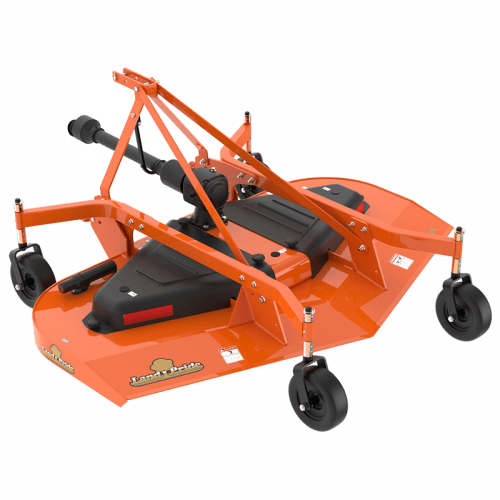
Overview & Specs
The Land Pride FDR2584 is a seven-foot rear-discharge grooming mower for owners whose maintained turf is open enough to benefit from a broad cutting swath. Its main attraction is the possibility of reducing recurring mowing time with an existing compatible tractor. Its main buying risk is paying for width that the route, terrain or tractor cannot use effectively.
Start by measuring the area that can actually be mowed in long continuous passes. Separate narrow strips, trees, beds and awkward corners. A large property may still contain a relatively small area where a seven-foot deck provides a meaningful advantage.
On This Page
ToggleSeven feet of cut requires more than seven feet of access
Land Pride’s August 1, 2022 FDR25 specification sheet lists an 84-inch cut, 87-inch overall width and 812-lb weight for the FDR2584. It specifies a maximum of 60 engine hp, Category 1 mounting and a 540-rpm PTO drive. The documented arrangement has three blades, rear discharge and floating hitch connections.
Use the outside width for the access discussion and the cutting width for coverage. A nominal seven-foot gate is narrower than the documented 87-inch overall envelope. The approach also needs room for alignment and the full tractor-and-mower combination.
Inspect the actual machine and applicable manual when buying used. Older documents and advertisements can show different dimensions or limits. Do not combine an older machine’s configuration with whichever newer number makes the proposed match look easier.
Where the wider deck earns its place
Broad lawns with long runs are the clearest setting in which extra width can reduce passes. The benefit is less certain where the operator repeatedly slows, turns, repositions or leaves sections for a second mower.
Map the route before discussing horsepower upgrades. Mark each constriction and each area that cannot be reached with the proposed combination. Calculate how much work remains after the broad passes are completed.
If a smaller mower can complete nearly the entire property while the wider one leaves substantial trimming, compare total session time. The seven-foot machine may still win, but the result should come from the route rather than the width label.
The FDR1660 guide provides a smaller rear-mower comparison point. The decision is not a simple progression from small to large: it is a question of which complete arrangement fits the maintained area and available tractor.
A width increase is not an equal percentage time saving
Moving from a six-foot cut to a seven-foot cut increases nominal width by about 16.7%. Even with all other factors unchanged, the corresponding time reduction for the same straight-line task is about 14.3%, because time is inversely related to width.
For a hypothetical three-hour working portion, that idealized ratio gives about 2.57 hours, a saving of roughly 26 minutes. Setup, cleanup and trimming remain outside that calculation. These are geometric assumptions, not measured FDR2584 performance.
Now suppose both arrangements also need 30 minutes of fixed preparation and finishing work. Total sessions become 3.5 hours and about 3.07 hours. The same 26-minute saving is a smaller share of the whole session.
If the wider deck adds fifteen minutes of manoeuvring or separate trimming, much of the theoretical advantage disappears. This is why a useful demonstration includes the difficult parts of the property rather than only an uninterrupted straight pass.
Use effective width and an appropriate pace
Nominal cut does not equal effective coverage once overlap is included. Select a realistic effective width from observed operation, then use an appropriate travel pace for the actual turf and machine instructions.
As another planning example, 2.0 metres of effective width at an assumed 5 km/h gives one hectare per hour before interruptions. At an assumed 70% field efficiency, the working rate is 0.7 hectares per hour. A 1.4-hectare area would take two working hours under those assumptions.
If the actual route achieves only 50% efficiency, the rate falls to 0.5 hectares per hour and the same area takes 2.8 hours. The difference is 48 minutes without changing cutting width. Those invented inputs illustrate the importance of layout; they are not an operating-speed prescription.
Measure the result that meets your finish standard. A fast pass that requires recutting is not completed area. Include clipping distribution and missed patches when deciding whether the apparent rate is useful.
Terrain needs a representative trial
A broad deck spans a wider section of ground. The property’s contours therefore deserve attention alongside its total area. A demonstration on a smooth flat field may not answer how the mower fits a lawn with ridges, dips or transitions.
The floating hitch and gauge-wheel arrangement are intended to help the mower follow the surface, but they do not make every abrupt change suitable. Correct setup and appropriate terrain remain necessary.
Include a representative permitted transition in the trial. Observe whether the finished result is acceptable and whether the operator must change the route substantially. Do not use an unsuitable slope or obstacle as a test of the mower’s limits.
If the lawn needs surface repair, assess that separately. Buying a wider grooming mower does not correct ruts or make unknown ground ready for finish mowing. The rotary cutter versus finish mower guide explains why initial reclamation and recurring turf maintenance are different tasks.
The tractor must carry the deck as well as power it
The 60-hp figure in the cited table is an engine-horsepower maximum. It is not a minimum target and should not be substituted for a PTO rating. Preserve the manufacturer’s label when comparing tractor advertisements.
At the same time, the listed 812-lb implement needs an appropriate carrying arrangement. Its position behind the linkage matters. Check the tractor’s relevant lift and ballast guidance, the actual hitch equipment and the permitted transport position.
A quick hitch or adapter forms part of the geometry. The driveline must suit the complete arrangement through its allowed movement. A machine that connects on level ground still needs a proper setup check before mowing.
Use the quick-hitch compatibility guide for the broader questions and the exact mower and tractor manuals for approval. Do not transfer a successful setup from a neighbouring tractor model without checking the differences.
Three blades, one finished result
The deck’s cutting and drive components work as a system. Correct blade selection, blade condition, spindle condition, belt arrangement and deck setup all influence the result. A poor finish should not automatically be blamed on insufficient tractor power.
The specification identifies blade choices, but an option is not universally better because its name sounds more aggressive. Choose the correct documented equipment for the application and retain a consistent approved setup.
On a used mower, ask what has been replaced and obtain the part information. Mixing unknown components can make a demonstration difficult to interpret. The machine should first be restored to the correct serviceable configuration.
The FDR25 operator manual covers inspection and operation. It directs the mower toward turf grass work and emphasizes checking the site and machine. Use those instructions rather than treating a large deck as permission to cut brush.
Rear discharge and the mowing pattern
Rear discharge affects where cut material is directed and how the route can be planned. It does not eliminate the need to manage people, animals, obstacles and the working area.
Inspect the actual clipping result on representative grass. A broad mower can cover ground quickly while still leaving a result that needs additional work if the conditions or setup are unsuitable. Include that follow-up in the time comparison.
Plan the sequence around buildings, paths and areas of activity. A route that looks efficient on paper may be inconvenient at the time of day mowing normally occurs. The best purchase is one that fits the real routine.
Where mowing windows are short, assess whether the wider deck improves reliable completion enough to justify its cost and storage. Avoid assuming that a theoretical rate guarantees finishing before weather changes.
Canadian seasonal scheduling and shared tractor use
A rear mower often shares the tractor with grading, material handling and other tasks. Count the attachment changes expected during the growing season. The wider deck’s working-time advantage may be less important than whether the tractor is available when the lawn needs attention.
Arrange a practical parking and connection location. The implement should be stored according to the manual with enough room to approach and connect safely. A seven-foot deck that blocks access to other equipment can create a recurring inconvenience.
Inspect and service before the first seasonal use rather than waiting until grass growth creates urgency. Keep the site inspection current; a lawn that was clear last season may contain debris after other property work.
Use suitable conditions and the manufacturer’s mowing guidance. The calendar alone does not establish that the grass or ground is ready. A flexible schedule can be part of achieving the desired finish without forcing an unsuitable operation.
Used FDR2584 inspection
Confirm model, serial information and the correct documentation. Inspect the deck structure, hitch connections and gauge-wheel supports for damage, wear or repairs. Distinguish intended flotation from excessive wear rather than assuming all movement is normal.
Have blades, spindles, belt components and driveline assessed with the machine shut down and properly supported. Do not work beneath equipment held only by hydraulics. Missing guards or questionable blade repairs need resolution before a running trial.
Check wheel condition and adjustment hardware. A mower that cannot maintain its intended support and setup may not produce a fair representation of the model’s capability. Price the required restoration rather than buying on paint condition.
These are general inspection priorities, not claims that the FDR2584 has specific recurring failures. The actual findings, service history and correct replacement parts determine the used-machine assessment.
Compare the premium with recurring time saved
Suppose a wider suitable package costs an assumed CAD 1,500 more and saves a verified 20 minutes on each of 18 annual mowing sessions. That is six hours per year. Over five years, the simple premium is CAD 50 per hour saved before financing, maintenance differences and resale.
Those invented cost inputs are not market prices or a recommendation about the value of your time. They show how to connect a premium with a demonstrated benefit. If the actual saving is five minutes per session, the same calculation changes substantially.
Include differences in trimming, attachment changes and storage. If a dedicated mower would replace the whole tractor-based routine, compare complete ownership systems rather than only attachment prices. Aglist’s tractor versus zero-turn comparison addresses that broader choice.
Frequently asked questions
Will it fit a seven-foot opening?
The cited overall width is 87 inches, wider than seven feet. Measure the actual route and allow appropriate manoeuvring space.
Does a 60-hp tractor requirement mean it needs that much power?
The cited entry is a maximum engine-horsepower rating, not a stated minimum. Verify the complete tractor requirements separately.
Will seven feet always beat a smaller mower?
No. Obstacles, terrain, trimming and setup can reduce or reverse the practical advantage.
Can it handle rough brush because it is large?
No. It is a grooming mower for the documented turf application. Size does not expand its intended duty.
When does it make the strongest case?
On a compatible tractor maintaining enough open, suitable turf to produce a demonstrated whole-session saving, with adequate access and storage for the complete deck.
Share your experience
Help other Canadian buyers — leave a quick review for the
Land Pride FDR2584
There are no reviews yet. Be the first one to write one.

