
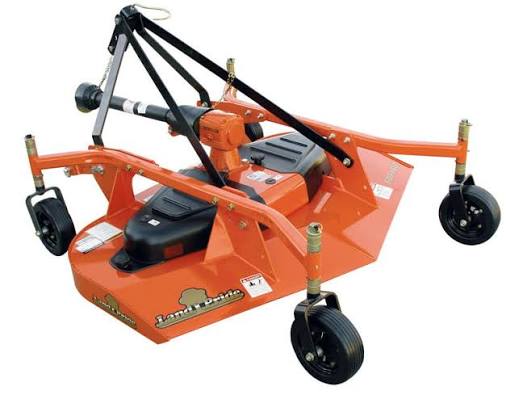
Overview & Specs
The Land Pride FDR1660 is a five-foot rear-discharge grooming mower for established turf behind a compatible tractor. It is most interesting to an acreage owner who already needs the tractor for other work and has enough open lawn to make a rear-mounted mower practical. The buying question is whether the whole mowing routine fits the property, not simply whether the tractor can turn a 540-rpm PTO shaft.
A finish mower should be selected around the result you want to maintain. A yard that is already reasonably smooth and regularly cut presents a different job from rough pasture, woody growth or newly reclaimed ground. The FDR1660 can belong in a sensible lawn-maintenance system without being the right implement for every green area on the property.
On This Page
ToggleThe documented five-foot configuration
Land Pride’s FDR16 specification sheet dated April 17, 2024 lists these FDR1660 figures. Use the applicable documentation for the exact mower being offered, especially if parts or hitch equipment have been changed.
| Specification | FDR1660 |
|---|---|
| Cutting width | 60 inches / 1.52 m |
| Overall width | 62½ inches / 1.59 m |
| Listed weight | 577 lb / 261.7 kg |
| Maximum engine horsepower | 40 hp |
| PTO speed | 540 rpm |
| Cutting-height range | ¾–5¼ inches, in ½-inch increments |
| Cutting blades | Three |
| Hitch | Category 1; quick-hitch compatible |
The power ceiling is expressly labelled engine horsepower. It should not be converted into a PTO figure or treated as an invitation to use any larger tractor at reduced throttle. The tractor must also meet the carrying, driveline and setup requirements of the actual mower.
Why the floating hitch matters
The FDR16 product description identifies floating upper and lower hitch connections and gauge wheels that help the mower follow the surface. That is a significant distinction from treating a rear implement as something held rigidly at one fixed height by the tractor.
The benefit depends on correct setup and a suitable surface. Flotation is not an ability to bridge every sharp hollow or pass over an unknown obstruction without contact. A mower can follow gradual changes while still being unsuitable for a deeply rutted or debris-filled area.
During a demonstration, include the transitions that occur on your lawn: the approach to a driveway, a gentle rise, or a change from a broad open area to a narrower strip. Observe the result without forcing the combination into terrain outside its operating guidance.
If the mower leaves an inconsistent cut, investigate the setup, wheel condition, blades and terrain before concluding that another increment of tractor power is needed. The lawn result depends on more than whether the engine can maintain speed.
Rear discharge changes the route, not the need for care
Land Pride describes rear discharge as spreading clippings behind the mower rather than directing a side windrow. This can be useful when planning a route around landscaped features. It does not mean that people, animals or property can be ignored behind the machine.
Think through where the tractor must travel and where the cut material will remain. A rear-discharge arrangement may simplify some passes, but the owner still needs a suitable exclusion area and the operating precautions in the manual. No discharge layout makes an uninspected lawn free of projectile hazards.
Inspect the actual clipping pattern during a representative trial. A result on short dry grass does not establish how the mower will behave after a missed mowing interval or in different conditions. The acceptable amount of visible clipping is part of the finish requirement, not an afterthought.
If a property includes paths, patios or areas with frequent activity, plan the timing and route around them. A good ownership decision includes the practical working space needed for mowing, not just the machine’s ability to fit through the gate.
Three blades create a maintenance system to assess
The FDR1660 uses a multi-blade deck with a belt-driven arrangement. That means the condition of several cutting and drive components contributes to the final result. A used mower should be assessed as a system rather than judged from the appearance of a single accessible blade.
Correct blades, their condition, spindle condition and the belt arrangement all deserve inspection under the manufacturer’s servicing procedures. A mower that produces a poor finish may need restoration rather than replacement by a more powerful tractor.
The specification lists blade options, but different blades should be selected for a documented application and installed as the correct set. Do not assume that a blade described as high-lift or mulching is universally better for every lawn and grass condition.
Ask a used seller what parts have been fitted and why. A clear maintenance history can help identify whether you are buying a complete ready-to-use mower or a project whose performance cannot yet be judged fairly.
Sixty inches of cut is only one part of a mowing route
Measure the narrowest useful passage, not merely the widest open lawn. Include the tractor, the mower’s outside width and the space required to turn. The mower trails behind the tractor, so its path around an obstacle is not identical to the front tyres’ path.
A rear mower can be attractive on long open runs. Around many trees, beds and small corners, repeated repositioning and separate trimming may dominate. Those observations do not establish a universal winner between rear-mounted and dedicated mowing machines; they show what the property needs you to measure.
Before purchase, draw the mowing route and mark the sections that cannot be completed with the proposed combination. Estimate the remaining trimming work. If a large share of the session still requires another machine, include that time and cost in the comparison.
For the broader choice, Aglist’s compact tractor versus zero-turn guide discusses multi-purpose ownership versus a dedicated mower. The FDR1660 is particularly relevant when a tractor is already justified by other jobs and the lawn layout suits rear-mounted mowing.
Calculate the whole session
Suppose an illustrative route gives 1.4 metres of effective coverage after overlap at a suitable 5 km/h travel speed. The straight-line calculation is 1.4 × 5,000 = 7,000 square metres per hour, or 0.7 hectares. These are hypothetical inputs, not a measured FDR1660 rate or a recommended speed.
At an assumed 70% field efficiency, coverage becomes 0.49 hectares per hour. A 0.6-hectare lawn would take roughly 1.22 working hours. Add a hypothetical 20 minutes for attachment preparation, parking and cleanup, and the session approaches 1.56 hours before any separate trimming.
This makes the effect of obstacles visible. If the actual route achieves only 50% efficiency with the same assumed width and speed, coverage falls to 0.35 hectares per hour. The mowing portion for that lawn becomes about 1.71 hours. Improving the route may therefore matter more than buying a little more nominal width.
Use your own observed times in the calculation. Include the quality standard: a fast pass that requires substantial recutting is not a completed job. For weekly work, small recurring inconveniences can matter more than a feature used only once each season.
Height range is adjustment capability, not a lawn prescription
The listed height range tells you what the mechanism can adjust to. It does not establish the right mowing height for every grass type, season or site. Select the desired turf result separately and confirm that the machine can maintain it under the actual conditions.
The FDR16 operator manual favours dry grass and regular mowing, and explains that tall grass may require a higher initial cut followed by another pass. Those operating considerations are more useful than assuming a low setting will make an infrequently maintained area look like lawn immediately.
For Canadian seasonal ownership, identify the weeks when access to the tractor is shared with other jobs. If the mower must be removed repeatedly for grading or material work, attachment changes become part of the mowing schedule. Convenience can be valuable without inventing a claim that one arrangement always saves a fixed number of hours.
Quick hitch and PTO fit must work together
The FDR1660 is listed as quick-hitch compatible, but compatibility still depends on the complete tractor, hitch and driveline arrangement. The shaft must suit the permitted movement and clear the surrounding equipment. A successful connection on level ground is not the entire setup check.
Use the applicable manuals and competent assistance to establish the correct configuration. Do not shorten or substitute a driveline based on dimensions from another owner’s tractor. Aglist’s quick-hitch guide explains why geometry and PTO compatibility need to be considered together.
The PTO rating guide is also useful when comparing tractor advertisements. A prominently displayed engine figure and the presence of a rear PTO do not, by themselves, confirm the complete mower match.
Inspect a used FDR1660 from the ground up
Confirm model identification and collect the correct manual first. Inspect the gauge wheels, caster movement, mounting areas and height-adjustment parts. An unevenly supported deck can undermine the result even when the cutting components are otherwise serviceable.
Have the blades, spindles, belt, pulleys and guards assessed under the prescribed shutdown and support procedures. Never rely on hydraulic lift alone for an underside inspection. Look for incorrect parts, contact damage, missing shielding and signs that a previous repair did not restore the original arrangement.
Inspect the deck structure and hitch, including the floating connections. Movement intended by the design is different from wear or deformation. A knowledgeable inspection should distinguish those conditions rather than treating every moving joint as a defect or every loose joint as normal flotation.
A controlled demonstration should show the finished cut and any vibration or abnormal noise. If a problem appears, stop and identify it before assigning a repair price. These checks are general purchase precautions, not claims of recurring FDR1660 failures.
Compare ownership with the right alternative
A rear mower quotation should include any required hitch and driveline work, delivery and the service needed before use. Compare that complete cost with another compatible rear mower, a dedicated lawn machine, or a mowing service where appropriate.
If the tractor is already owned for essential year-round work, it is reasonable to assess the incremental mowing cost. If the tractor would be purchased primarily for mowing, the comparison must include its acquisition, storage and maintenance too. Switching between those two accounting approaches can make almost any preferred option appear cheaper.
Do not add a speculative resale premium or fuel-saving percentage to force the decision. The benefits may be simpler: one existing power unit, a manageable open lawn and a satisfactory finish. Where the lawn layout is awkward, a separate mower can remain the better tool even though the tractor is already available.
Frequently asked questions
Can it replace a rotary cutter for brush?
No. Its grooming role should not be expanded into rough clearing because the tractor has spare power. Choose equipment with the documented duty for the vegetation.
Does rear discharge eliminate clipping cleanup?
No. Distribution depends on grass condition, mowing routine and the desired result. Evaluate the actual finish rather than assuming no clippings will remain visible.
Is the lowest setting best for an uneven lawn?
No. Mechanical adjustment range is not a recommendation. Terrain and the appropriate turf height need separate consideration.
Is a larger tractor automatically acceptable?
No. The cited sheet specifies a 40-engine-hp maximum. Follow the applicable limits and complete fitment requirements.
Who should shortlist the FDR1660?
An owner with a compatible tractor, maintained turf, practical open mowing routes and a routine that accommodates attachment changes. Its value is strongest when the complete session works well, not merely when the cutting width looks attractive.
Share your experience
Help other Canadian buyers — leave a quick review for the
Land Pride FDR1660
There are no reviews yet. Be the first one to write one.

