Overview & Specs
The John Deere 4044M deserves a place on a Canadian acreage shortlist when the tractor must do substantial property work but the owner does not need the most powerful engine in the 4 Series. The buying question is whether its attachment package fits the property: a loader for materials, a rear tool for the lane, and a suitable mower or cutter. Paying for unused engine output is less useful than buying the right tools and configuring them properly.
Its open operator station also makes the working season central to the decision. An owner doing mainly summer maintenance faces a different choice from someone clearing an exposed approach before work every winter morning. This guide treats the 4044M as a complete work system and explains where its lower-power position in the range can make sense.
On This Page
Toggle4044M specifications that help make the decision
| Item | Canadian model-page specification |
|---|---|
| Gross engine output | 31.7 kW / 42.5 hp; also expressed as 43.1 PS |
| Engine | Four-cylinder, naturally aspirated Yanmar diesel; 2.189 L |
| PTO power | 33.6 hp with PowrReverser; 32.3 hp with eHydro |
| Transmission choices | 12F/12R PowrReverser or three-range eHydro |
| Implement hydraulic flow | 42.3 L/min |
| Rear hitch | Category 1; 1,135 kg at 24 inches behind link arms |
| Station | Open station |
Source: John Deere Canada’s detailed 4044M specifications, checked October 1, 2026. Use the documents for the particular serial number when buying used. The hp and PS entries are different units, not different engine settings.
Who should consider the lower-power 4M?
Imagine a property where the regular work is maintaining a gravel lane, moving loose materials between storage areas, and cutting vegetation with a correctly matched rear implement. The useful tractor is the one that fits the lane, handles its approved tools and lets the operator position them comfortably. If those requirements are met, a larger engine may not change the job enough to justify its cost.
The 4044M is therefore worth evaluating for buyers who have moved beyond choosing equipment by lawn acreage alone. Separate the property into work areas: maintained grass, rough vegetation, material storage and access roads. Write down the tool needed in each area. This often reveals that attachment compatibility and manoeuvring space matter more than the total number of acres.
It is less convincing when an essential powered implement needs output beyond the applicable PTO rating, or when winter comfort is non-negotiable. Neither problem is solved by hoping the job will be occasional. Put the requirement into the shortlist before comparing finance offers. Aglist’s tractor size guide helps build that initial task list.
Choose the transmission around the way you work
With repeated loader approaches, the operator spends considerable time changing direction and adjusting travel. Test that sequence during a demonstration: approach an approved practice area, stop, reverse and line up again. The important observation is how naturally the controls fit the operator, including footwear and seating position. A short straight drive is not enough to evaluate this part of ownership.
For longer passes with relatively consistent travel requirements, examine the geared alternative just as carefully. Direction selection, gear selection and range selection are separate operations. Do not assume that a hydraulic reversing lever makes every shift automatic or removes all clutch procedures. Read the operating instructions for the transmission being demonstrated.
There is a useful numerical screening example. Suppose an implement manufacturer specifies at least 33 PTO hp. The published versions do not land on the same side of that minimum. That hypothetical comparison does not certify the implement: mass, hitch geometry, driveline and working conditions remain to be checked. It does show why a generic “44-hp tractor” description can lead to the wrong purchase.
The broader hydrostatic, gear and shuttle comparison explains the control differences. Here, the practical step is to put the exact transmission on every quotation and match the attachment requirements to that version.
Loader work: choose the attachment and receiving height together
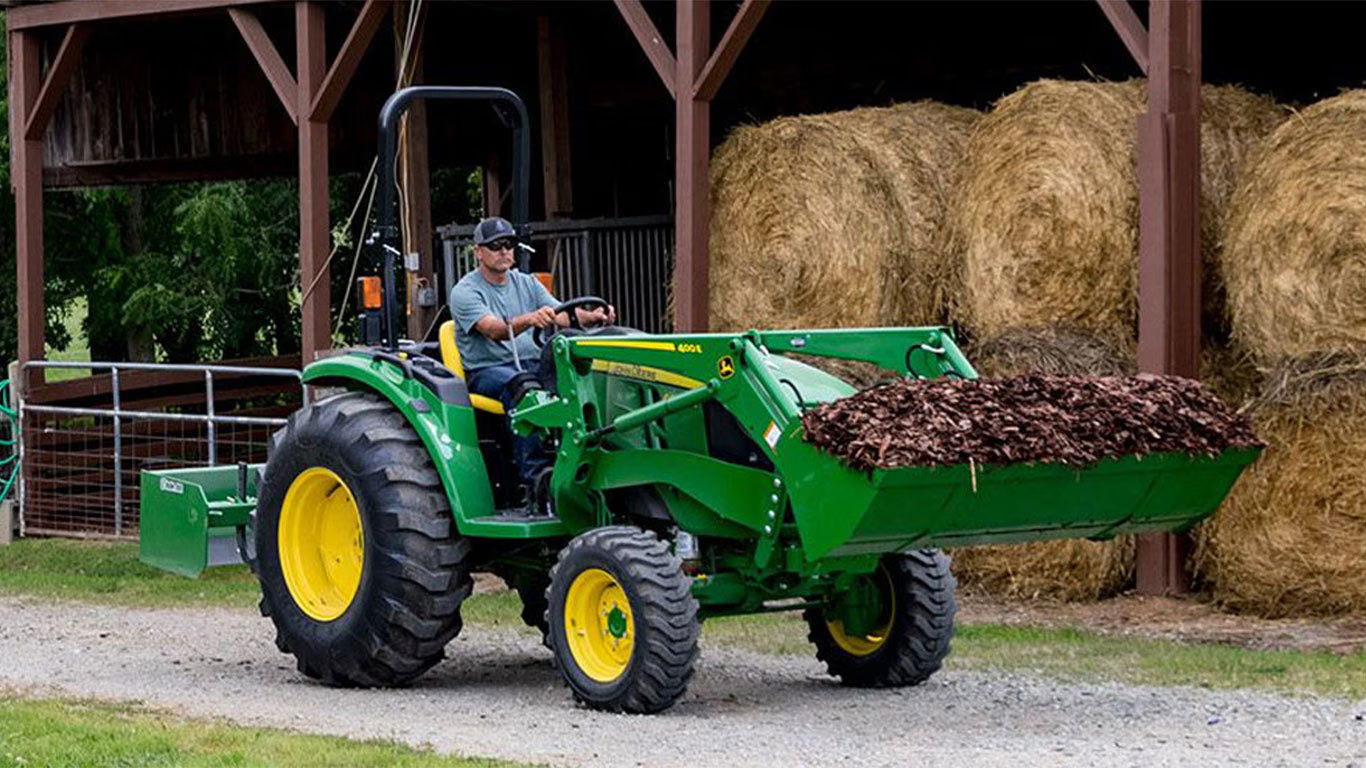
Deere’s 400E loader page includes the 4044M in its tractor table. It lists 1,087 kg at the pivot and 800 kg at 500 mm ahead of the pivot at full height. These are measurement conditions, not a universal pallet weight allowance. The page also identifies a parking kit rather than making loader parking equipment an assumption.
For a farmyard purchase, start with the receiving point. A loader that moves material around a pile may not have the clearance and reach needed to discharge neatly into a particular trailer. Measure the side height and where the tractor can approach. Account for the bucket in its dumping position, rather than comparing only the highest position of the pivot.
For forks, prepare a different description of the job: complete pallet weight, load dimensions, centre of gravity and placement height. Include the fork carriage and any adapter in the configuration. A fork assembly with a large number on its capacity plate does not give the tractor that capacity. The manufacturer’s information must cover the complete arrangement.
Loader removal deserves attention if mowing is frequent. Decide where the loader will be parked, whether that area meets the parking instructions, and how the operator will reconnect it. A package that omits useful changeover equipment can make a low initial quotation inconvenient over the following years.
Rear tools: make a compatibility sheet
List each intended implement with its model, mass, hitch connection, power requirement and hydraulic needs. Then add two practical details often absent from advertisements: its overall length behind the tractor and the space needed to attach it. Those details influence turning around buildings and storing the complete combination.
A Category 1 label is a starting point, not proof that every tool fits every quick hitch. Check the implement’s geometry and any required bushings. For shaft-driven tools, the driveline must suit the actual connection arrangement; adding a quick hitch can change distances. Have the approved setup established before delivery rather than improvising during the first job.
For lane maintenance, choose the tool around the defect. Redistributing loose aggregate, reshaping a crown and breaking up a compacted surface are different tasks. A heavier implement is not automatically the better purchase if the tractor cannot use it within the implement’s requirements. Nor does a rear lift rating tell you how effectively a ground-engaging tool will work in a particular surface.
A useful delivery demonstration covers attachment, transport position, working adjustment and storage. Ask for this with the actual purchased implement. It exposes missing pins, hoses or adjustment range while the equipment can still be corrected as a package.
Hydraulic flow does not tell you which functions are installed
Think of hydraulics as a list of jobs rather than one large flow number. A grapple needs a way to operate its clamp. A rear blade may need separate functions for angle or offset. A powered hydraulic attachment has additional flow, pressure and return requirements. Write each function into the equipment list and identify its control and connection.
Do not treat steering flow as an extra supply available to a tool. Likewise, a quotation mentioning a loader joystick does not establish that all the functions needed by a grapple are included. Test the controls used by the planned attachments, and ask for the installed circuit description in the handover documents.
This matters particularly when comparing a lightly equipped used tractor with a new package. The used machine may still be attractive, but the cost of adding necessary functions belongs in the comparison. A tractor that is cheaper before the attachment plan is complete may not be cheaper when it is ready to work.
Canadian seasons and the open station
For summer work, assess shade, visibility, dust exposure and access with the actual operator. Avoid assuming that an unobstructed view while parked remains equally good with a bucket or rear implement fitted. Walk through the most frequent tasks and note how often the operator needs to look behind or climb down.
For winter, start with the snow destination. A lane with limited storage may need a different strategy from a yard where snow can be pushed aside. Work duration, wind exposure and the operator’s ability to remain comfortable can be decisive. A canopy is not a heated cab, and an aftermarket enclosure should be evaluated on its documented fit and function.
A rear blower also changes the viewing and driving routine. Verify the exact blower’s power, hitch and driveline requirements before selecting it by width. The tractor snowblower fitment guide is a useful companion when assembling that equipment list.
Compare it with a smaller premium tractor, too
The choice is not always between the 4044M and a more powerful 4M. A buyer may prefer a differently equipped John Deere 3039R if its verified operator-station and attachment package suits the property better. Another buyer may find the Kubota L4802 worth evaluating against the same tasks.
Build a comparison with columns for essential implement compatibility, loader job, station, access and delivered equipment. Put price beneath those requirements. This prevents a small horsepower difference from obscuring a more meaningful difference in usability. Use current manufacturer documents for each alternative; the linked model guides help organise the comparison.
Buying used and planning ownership
Record the tractor serial number, loader model, transmission and installed hydraulic equipment before discussing value. Inspect included tools separately. Worn blades, missing guards or incomplete connection hardware can turn an apparently generous package into additional work and expense.
Have a qualified inspection cover operation, leaks, loader pivots and mounts, axle condition, hitch wear and evidence of repairs. Compare service records with the correct manuals. These are inspection priorities, not claims that the 4044M has a particular recurring defect. An hour meter should be considered alongside condition and documented work.
Budget for delivery, required setup, implements, service and storage. If hauling is part of the plan, use the configured weight with loader, tool and ballast; a bare-tractor figure cannot represent the complete transport load. Keep finance terms separate so a longer repayment period does not disguise a higher equipment cost.
Questions buyers ask about the 4044M
Is 43.1 PS more power than 42.5 hp?
Those entries express the same rated output using different horsepower units. Use kW or consistently labelled hp when comparing machines.
Can more engine power fix a loader limitation?
It does not change a loader’s approved load chart, attachment geometry or the tractor’s permitted configuration. Identify the actual limiting requirement before paying for a larger engine.
Should I buy the transmission with the higher PTO figure?
Only after checking the implement requirement and the operating routine. A rating advantage that the tools do not need may be less useful than controls better suited to repeated positioning.
Is a cheap tractor without implements a better deal?
Compare the total ready-to-work package. Necessary tools, hydraulic functions and setup can materially change the result.
What is the strongest case for this model?
A verified attachment plan that meets the work without needing a premium station or more engine output. The purchase succeeds when the complete configuration fits, not when the model number looks sufficiently large.
Share your experience
Help other Canadian buyers — leave a quick review for the
John Deere 4044M
There are no reviews yet. Be the first one to write one.