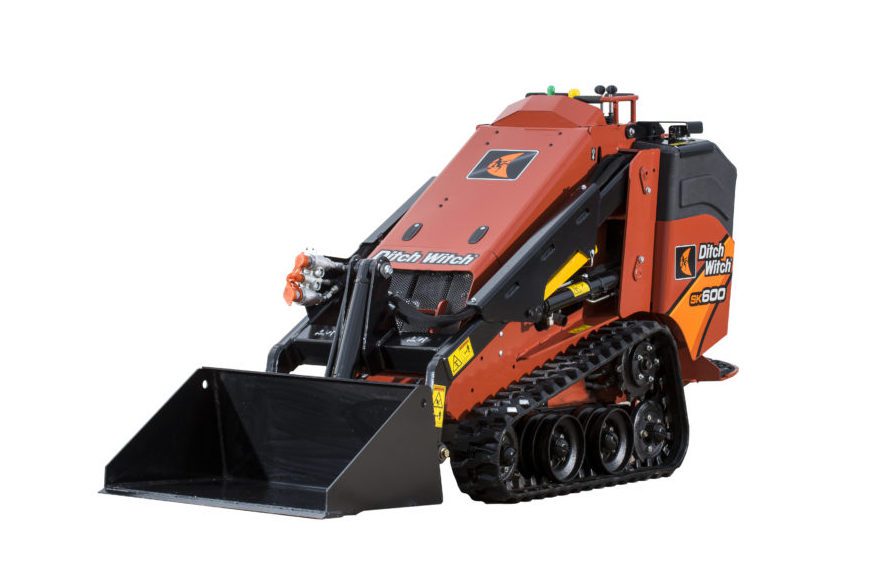
Overview & Specs
The Ditch Witch SK600 makes the most sense when getting a useful machine to the work is harder than finding a machine with more lifting capacity. Its narrow tracked chassis and stand-on layout invite consideration for established yards, landscape renovations and small property projects. The buying decision should begin at the restrictive entrance and end at the actual task, including the attachment, material and operator.
For a Canadian buyer considering a used SK600, identification and condition matter as much as the model name. This guide uses Ditch Witch’s North American specification sheet carrying a 2020 copyright, checked October 13, 2026. It is a reference for the documented configuration, not a statement that every machine offered today has identical equipment or that new Canadian inventory is available.
On This Page
ToggleThe useful specifications, with their limits
| Item | Published specification |
|---|---|
| Machine width | 33.5 in / 850 mm |
| Operating capacity | 600 lb / 272 kg, listed at 35% of tipping capacity |
| Maximum hinge-pin height | 76 in / 1.93 m |
| Machine mass, no attachment and fluids full | 2,418 lb / 1,096 kg |
| Auxiliary flow and pressure | 12 US gpm / 45.4 L/min; 3,000 psi / 207 bar |
| Engine | Kubota D902-E4B diesel, 24.8 gross hp |
Source: Ditch Witch SK600 specification sheet. Its bare-loader length has inconsistent imperial and metric entries, so that dimension is deliberately omitted here. Measure the offered machine and use its applicable operating documentation for a close fit or an operating limit.
Start with the entrance that determines the purchase
A nominal gate size is not a usable opening. Hinges, latches, stops, a post leaning inward and the angle of approach can reduce the passage. Measure the narrowest clear section, then continue along the route. A straight entrance followed immediately by a corner can be more restrictive than the opening itself.
Next add the tool. A bucket, grapple or fork frame may project beyond the tracks. The carried material can be wider again. Buying a narrow carrier and discovering that its everyday attachment defeats the access requirement removes much of the reason for choosing this class of equipment.
Consider a hypothetical opening measured at 36 inches and a bare carrier measured at the published 33.5 inches. Subtraction leaves 2.5 inches in total, not on each side. That arithmetic is not a recommended clearance: it ignores movement, surface irregularity, protrusions and the attachment. It is a reason to evaluate the complete arrangement carefully instead of accepting “fits a three-foot gate” in an advertisement.
Draw the return route as well. After placing soil or a planting container, the machine still needs to withdraw and reposition. A successful empty entry proves much less than a properly planned demonstration of the whole task.
Decide what should arrive through that opening
For landscape renovation, useful output may mean bringing manageable quantities of material close to hand work. The comparison is then with the existing work sequence: delivery position, wheelbarrow trips, shovelling and final placement. A small carrier can be worth owning even when a larger loader handles the roadside delivery.
Conversely, if the essential job is unloading heavy commercial pallets, start with documented pallet mass and geometry. Do not select this machine from its width and then search for a way to make the load fit its rating. Splitting deliveries may be an option only when the material and supplier support a practical, safe process.
For an acreage with one difficult backyard project and otherwise open access, compare renting a suitable narrow machine for that project. An exceptional entrance need not dictate the equipment used for years of mowing, grading or larger material handling.
Operating capacity is not a universal fork allowance
Keep the published rating and its basis together. Tipping capacity describes a different measurement and should not become an alternative working limit. The applicable carrier and attachment instructions govern the permitted arrangement; a buyer should not derive a new allowance from a preferred percentage.
Fork work introduces the attachment’s own mass, the load centre, the position of the material and the required lift. A fork frame’s structural rating can be higher than what the carrier may handle. Both components need to be suitable, and the larger number does not override the smaller system limitation.
For loose material, bucket volume alone is insufficient. Moisture and material type change mass, while an unusually long or uneven load changes handling geometry. Obtain reliable information about the actual load rather than treating every bucketful as equivalent. Aglist’s ROC and tipping-load explanation separates these measurements.
Loading a cart is different from clearing a truck side
The hinge-pin dimension measures a pivot, not the clearance beneath a tipped bucket. A receiving trailer also has a side height, an edge thickness and a landing area. An obstacle beside the trailer can prevent the carrier approaching closely enough even when the vertical dimension initially looks adequate.
Before shopping, sketch the receiver in side view and measure the access beside it. Evaluate the actual bucket’s discharge position and the retreat after unloading. Do not assume that a photograph with the arms raised establishes compatibility with your truck.
Where loading height is the main constraint, compare other machines using the same attachment and receiver questions. More engine output is not the answer to every geometry problem. The lift-path guide provides background without substituting for model-specific dimensions.
A hydraulic-tool carrier, provided the tool is matched
The auxiliary circuit is the relevant supply for a powered front attachment. Ground-drive figures elsewhere in a specification sheet describe another system; they are not extra flow to add to the attachment supply. This distinction matters when comparing a used machine with a trencher or auger included in the sale.
Record the attachment’s exact model, motor variant, required flow range, pressure limits, return arrangement and controls. Also confirm mounting compatibility and the permitted carrier configuration. A familiar coupling plate or two hoses that connect cannot answer every item.
A light-use owner may get more value from one correctly selected powered attachment than from a large collection of unidentified tools. Inspect the included attachments separately and establish which jobs each can actually perform. The hydraulic attachment guide helps organise the comparison.
Plan the project around access and staging
Suppose a permitted material-transfer arrangement takes two minutes per complete cycle and needs 24 trips. The cycling portion totals 48 minutes. If a better delivery point reduces each cycle to 90 seconds, the same 24 trips take 36 minutes. These are hypothetical planning inputs, not measured SK600 performance or approved load quantities.
The example shows why a delivery decision can matter more than a modest change in machine size. Include setup, attachment changes, cleanup and the hand work that remains. A fast carrier waiting for the next manual step does not shorten that step.
For a planting project, distinguish carrying material from preparing the hole and finishing the surface. If powered excavation is involved, establish the site requirements and utility-locate process before work. This buying guide does not provide digging procedures or authorise work around buried services.
Tracks do not guarantee an untouched lawn
Evaluate support and surface finish separately. A machine can travel over a route yet leave marks that the owner considers unacceptable. Turning, repeated passes, carried load and moisture all affect the result. A dry demonstration on gravel cannot settle a wet lawn question.
Mark a planned travel corridor and include any approved protection or restoration in the job budget. Where possible, reduce unnecessary turns and handling by improving staging. These are site-planning decisions, not a promise that one track specification eliminates disturbance.
If lawn finish is the dominant concern, compare the complete work method with an articulated loader or other suitable equipment. The Bobcat L23 guide offers a different machine layout to investigate; it is not an assertion that either platform wins on every surface.
Used SK600 inspection: establish the package you are buying
Begin with readable machine and engine identification, service records and the correct manuals. Resolve undocumented modifications before valuing the machine. A fresh coat of paint or a low displayed hour count does not establish the condition of the drive, hydraulics or attachment connection.
Have a qualified inspection cover the running gear, track condition and tension system, controls, interlocks, platform, lift linkage, cylinders, hoses and mounting mechanism. Request an explanation of what was tested under suitable working conditions and what remains uncertain. This is an inspection scope, not a claim that the SK600 commonly suffers any particular failure.
Keep attachment findings separate. Worn cutting edges, damaged mounting surfaces or unidentified hydraulic components can change the usefulness and value of the offer. Price only the tools you can document and use; surplus equipment is not automatically a saving.
Separate an attachment-only enquiry from a complete-carrier enquiry when contacting support. A local shop may recognise the Kubota engine yet still need different information to identify lift, drive or mounting parts. Keep machine and engine serials together, and identify the supplier for the attachments as well. That preparation turns a future parts request into a specific enquiry instead of relying on the assumption that one familiar engine brand settles support for the entire loader.
Canadian ownership beyond the purchase price
Check storage and transport with the equipped machine. The table’s no-attachment mass is not the complete transported package. Include the bucket, other tools, fitted accessories and everything carried on the trailer, then verify the towing and loading arrangement independently.
For winter, define the actual clearing route and destination for snow before selecting a tool. Narrow access may remain valuable, but later-season banks, visibility and the exposed operating position deserve their own assessment. Follow the machine’s cold-weather instructions; tracks alone do not establish traction on ice.
Obtain local Canadian quotes for the inspected machine, necessary repairs, delivery and the essential attachment package. Compare ownership with rental at realistic use. Do not rely on an assumed resale premium, a guessed repair budget or an unverified claim that a particular task will pay for the purchase.
Questions to resolve before committing
Is the SK600 automatically the best choice for a small property?
No. The restrictive route and recurring tasks matter more than acreage. A property needing sustained mowing or rear implements may be better served by a different equipment system.
Can I use its narrow width to approve a gate crossing?
Use it to start measurement, then assess the actual tool, load, approach and exit. A nominal gate label is insufficient.
Does a bigger hydraulic attachment make it more productive?
Only a suitable, approved attachment that improves the required result is useful. Size and hydraulic demand can instead create incompatibility.
What is a sensible direct alternative to research?
The Toro Dingo TX700 and Bobcat MT100 are relevant category comparisons. Compare their documented configurations, actual access and equipped cost rather than ranking model numbers.
What should the final decision demonstrate?
That this particular SK600, with identified tools and acceptable condition, reaches the recurring work and completes it within the applicable limits. That is a stronger purchase case than compact dimensions considered alone.
Share your experience
Help other Canadian buyers — leave a quick review for the
Ditch Witch SK600
There are no reviews yet. Be the first one to write one.