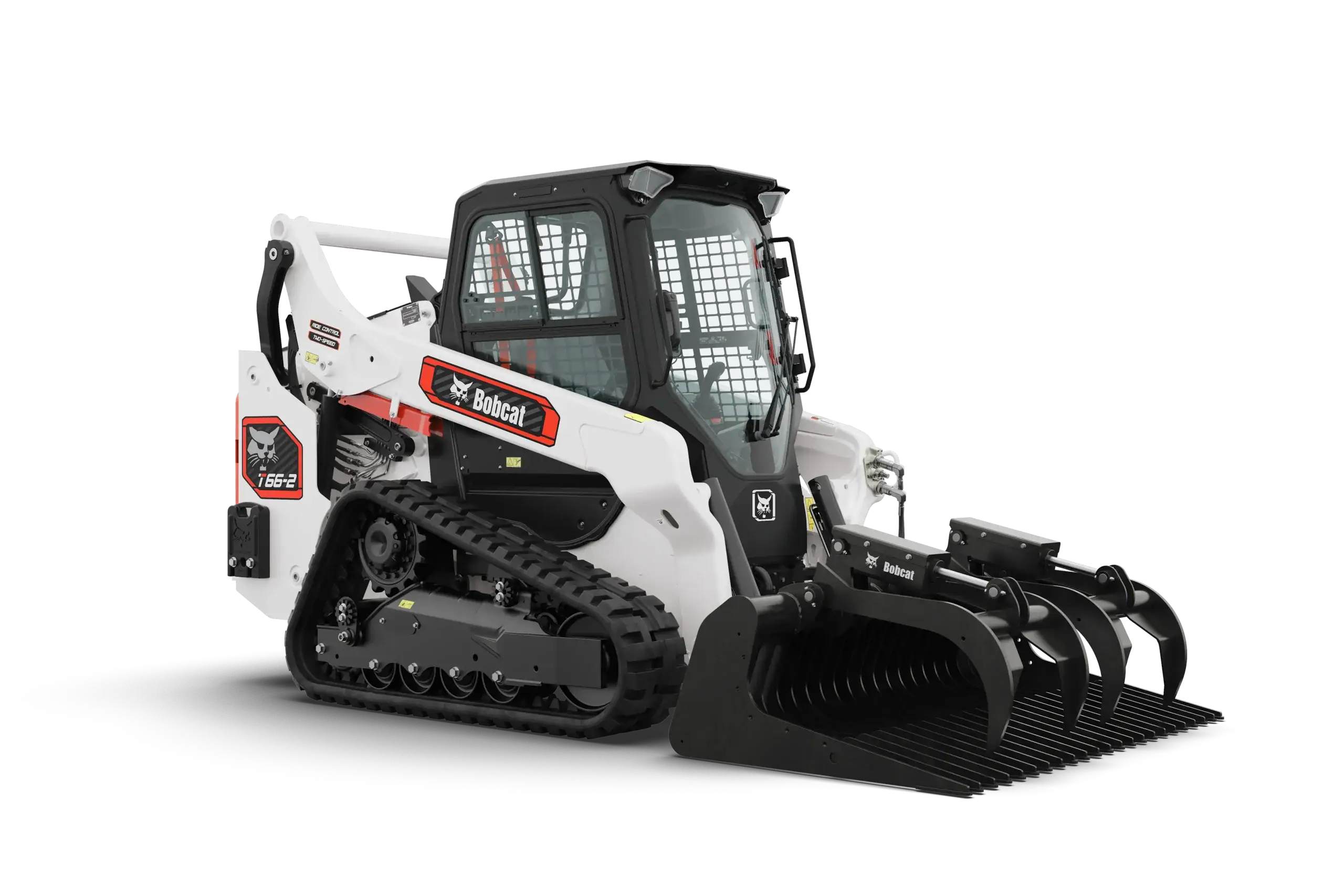
Overview & Specs
The Bobcat T66-2 is best evaluated as a mixed-job compact track loader: a machine that may handle material, carry tools and work across changing sites within the same week. Its North American specification puts it in a different buying position from a loader selected exclusively for heavy hydraulic attachments or maximum loading height. The decision is whether its particular balance fits your recurring work, not whether it has a larger engine number than the next model down.
This guide covers the T66-2 Pro in North America. The discussion is based on manufacturer information and original job-planning examples; it does not report a field test, owner reliability score or Canadian transaction price. Confirm the generation and installed options when comparing it with an earlier T66 or a used loader advertised under a shortened model name.
On This Page
ToggleA specification sheet with the important distinctions left in
| Specification | T66-2, North America |
|---|---|
| Engine output | 74 hp |
| Rated capacity, solid undercarriage | 2,400 lb |
| Rated capacity, torsion suspension | 2,350 lb |
| Tipping load | 6,857 lb |
| Operating weight | 8,560 lb |
| Auxiliary flow, standard / optional high flow | 17.6 / 26.9 US gpm |
| Hydraulic system pressure | 3,500 psi |
| Width / cab height | 67.8 / 80.5 in. |
| Hinge-pin height | 120 in. |
Source: Bobcat’s North American T66-2 page, checked September 29, 2026. Bobcat’s Pro loader brochure describes vertical lift and the 35% basis for the headline compact-track-loader ROC. Configuration-specific documentation takes priority for the machine being purchased.
The useful comparison: T66-2 versus T64-2
Bobcat lists the T64-2 at 68 hp, while its standard and high-flow figures match those listed above. This is an important distinction for an attachment buyer: moving up in engine output does not, by itself, move the published auxiliary-flow ceiling.
That does not make the models identical. It means the reason for paying for the T66-2 should be expressed as a job requirement and investigated in a representative demonstration. If the proposed advantage concerns moving material while operating functions, evaluate that exact sequence under the manufacturer’s procedures. Do not turn the horsepower difference into an unsupported prediction of cycle time, fuel use or annual output.
For a business with varied work, a useful exercise is to divide the last season’s jobs into three groups: work completed comfortably, work completed with an identifiable constraint, and work declined. Put the cause beside each constrained job. A flow limitation, an access problem and an inadequate approved handling envelope are different reasons to change machines. The T66-2 should solve the right one.
Build a weekly work matrix
Instead of starting with options, start with the work sequence. The example below is a planning template, not a claim that any attachment or load is approved for this loader.
| Task | Evidence needed before purchase | What to observe in a demonstration |
|---|---|---|
| Loose-material movement | Material weight, chosen bucket, loading route | Approach, visibility, placement and return travel |
| Pallet delivery | Actual load and approved fork information | Positioning space and view at the required height |
| Powered landscape tool | Exact hydraulic and control requirements | Tool operation in representative material |
| Winter clearing | Attachment, surfaces and snow-storage plan | Visibility, manoeuvring room and relevant cab functions |
Give each task an estimated annual frequency, using your own records where possible. Then identify the non-negotiable task. A machine that handles most jobs well but cannot safely perform a daily handling requirement is not a balanced choice. Conversely, specifying every feature around one speculative job may burden the rest of the business with unnecessary cost.
Include changeovers in the matrix. If the loader moves between forks, bucket and a powered tool several times a day, note where attachments are stored, whether connections remain clean and how much space is available. Improving that layout can be part of the purchase plan. It should not be confused with an inherent productivity claim for one model.
Suspension choice changes the capacity check
The separate solid and torsion ROC entries deserve attention when evaluating a quotation. They describe different configurations, so do not pair the preferred ride package with a capacity figure taken from another version. The relatively small numerical difference does not make it irrelevant if a recurring job is close to an approved limit.
Compare the configurations on a route that represents your actual travel. For a landscape contractor, that might mean repeatedly carrying material between a staging area and the work zone. For a farm, it might involve transitions between yard surfaces. Use an authorised demonstration arrangement and record operator observations at the speeds and loads allowed for the test.
Ask each operator to distinguish ride impressions from placement control. A machine can feel comfortable while still needing evaluation for precise attachment positioning. If there is no opportunity to compare configurations directly, acknowledge that uncertainty rather than assuming an optional suspension must return its cost through a particular percentage productivity gain.
Hydraulic compatibility: specify the tool, then the loader
Keep the selected attachment’s manual beside the machine quotation. The important entries include allowed flow, pressure, connection types, case-drain requirements where applicable, electrical controls and approved carrier arrangements. Bobcat’s hydraulic-matching guidance is a starting point; it does not replace the requirements for a particular tool.
As a hypothetical screening exercise, a tool requiring 24–28 US gpm would direct attention to the high-flow configuration, while one requiring 15–20 US gpm would prompt a standard-flow check. These example ranges are not endorsements of real attachments. Pressure, controls, cooling suitability for the duty and other manufacturer requirements still have to match. A tool that fits mechanically can remain unsuitable hydraulically.
Also consider how the attachment will be used. An occasional short task and a long continuous-duty job should not be treated as the same demonstration. Agree on a representative test with the equipment provider, document the operating conditions and record any unresolved warnings or performance issues. Do not diagnose a hydraulic system from a single subjective impression.
For the broader flow decision, use Aglist’s standard versus high-flow guide. The T66-2-specific takeaway is that the installed hydraulic package must match the work list; the engine rating cannot substitute for that check.
Capacity and lift geometry are separate buying questions
For pallet work, begin with the complete load, its centre of gravity, the fork attachment and the required placement height. Obtain the applicable approved capacity information. The difference between ROC and tipping load matters, but neither number alone supplies a fork rating for an unspecified load arrangement.
For truck loading, measure the receiver and examine the bucket’s discharge position. A hinge-pin height tells you where a pivot can reach; it does not establish how far the bucket lip clears the side or where material lands. Include the approach surface and any obstruction that keeps the loader farther from the receiver than a brochure illustration suggests.
A useful comparison session ends with an answer to a specific question, such as whether the selected bucket can load the actual receiving body through the intended cycle. It should not end with the vague conclusion that the machine “lifts high enough” because the empty arms were raised in an open yard.
Canadian sites: assess the difficult season
When work includes soft approaches, judge the proposed track setup on that requirement rather than relying only on a dry-yard demonstration. Bobcat’s loader selection guidance explains why flotation enters the wheel-versus-track decision. Actual surface effects still depend on conditions, load and how the machine is operated.
Do not assume tracks provide the same advantage on every winter surface. Establish the actual track configuration and winter attachment, then evaluate the job’s visibility and traction requirements. A snow route also changes as storage piles grow. Mark the narrowest later-season passages when deciding whether the machine and attachment combination will remain practical.
Plan a place for inspection and cleaning consistent with the operating manual, especially when the machine returns with material around the undercarriage. Include that time in the workday. Ownership planning should describe who carries out the checks and where, rather than treating maintenance as a line item that happens without labour or space.
Access and transport can overturn a good specification match
Measure the full working combination through gates, around corners and into storage. Attachment width and projection may be more restrictive than the basic machine dimensions. Check overhead obstructions in the travel position and separately in the area where loading occurs. Leave the operating clearances required by the manuals and site conditions; a nominal opening equal to a published width is not a practical access plan.
For transport, list the configured loader, selected bucket, additional attachments and other carried equipment. Use the available payload and ratings of the complete towing setup, not the trailer’s advertised gross rating by itself. Verify the final loaded arrangement with appropriate documentation and weighing. A loader that requires a different transport setup should carry that cost in the comparison from the beginning.
How to compare a used T650 or a wheeled alternative
The Bobcat T650 provides a useful used-market comparison, but it is a separate design and generation. The T595 may also appear in budget-led shortlists. Compare the actual attachments, hydraulic packages, service history and undercarriage condition rather than assigning value from model numbers alone.
If firm yards and frequent transport dominate, include a wheeled candidate such as the S64-2 in the operational comparison. Aglist’s skid steer and track-loader guide explains the broad trade-offs. The relevant question is what you gain on the difficult jobs and what changes across the rest of the year.
Put each quotation on the same basis: machine equipment, attachments, required repairs, delivery and transport changes. An apparently cheaper used loader with an uncosted undercarriage repair is not yet a comparable offer.
Inspection and cost control
Have a qualified inspection cover the complete undercarriage, lift linkage, attachment interface, hydraulics and any evidence of structural repair. Establish serial identity and reconcile hours with service records. These are general used-loader checks, not documented recurring faults of the T66-2.
Inspect included attachments separately and obtain estimates for identified work. Keep a maintenance and wear budget that distinguishes the loader from its tools. For a mixed-job business, record operating hours by major task after purchase; over time, those records will replace broad assumptions about where the machine earns its keep.
Before purchase, test the financial case at a lower utilisation level as well as the expected year. Use local written quotations for service, wear items and financing. This guide does not substitute an invented Canadian price or fuel-consumption figure for those inputs.
Questions to resolve before ordering
Does more horsepower mean more auxiliary flow than the T64-2?
Not in the published standard and optional high-flow figures compared here. Choose the hydraulic configuration against the attachment’s requirements.
Which ROC belongs on the purchase worksheet?
The figure for the installed undercarriage and approved configuration, followed by the relevant attachment-specific capacity information for the actual work.
Can I rely on every online option label?
The current page contains inconsistent presentation of some features, including two-speed travel, and differing ground-pressure fields. Obtain the build specification; this guide does not resolve those discrepancies by guessing.
What makes a good demonstration?
A documented test of the important work sequence with a representative, approved attachment, appropriate conditions and the regular operator. A brief unloaded drive answers only a small part of the purchase question.
When should I choose another model?
When a routine task requires a different approved load envelope, attachment supply, loading geometry or access size. The right mixed-job loader should fit the important recurring tasks without relying on exceptions to its documented limits.
Share your experience
Help other Canadian buyers — leave a quick review for the
Bobcat T66-2
There are no reviews yet. Be the first one to write one.