Overview & Specs
Bobcat E42 Compact Excavator
On This Page
ToggleIntroduction
The Bobcat E42 is a four-ton class compact excavator in Bobcat’s R2-Series, the machine the company recommends as the closest match for owners moving on from the older M-Series E45. At 42.6 horsepower with an operating weight in the 9,830 to 10,666 lb range depending on configuration, it sits in the busy heart of the compact excavator market, big enough for real trenching, footings, and site work, yet still trailerable behind a suitable truck. For a prairie acreage or a working contractor, it is a machine that digs deep, lifts well, and handles the range of jobs a property or a job site throws at it.
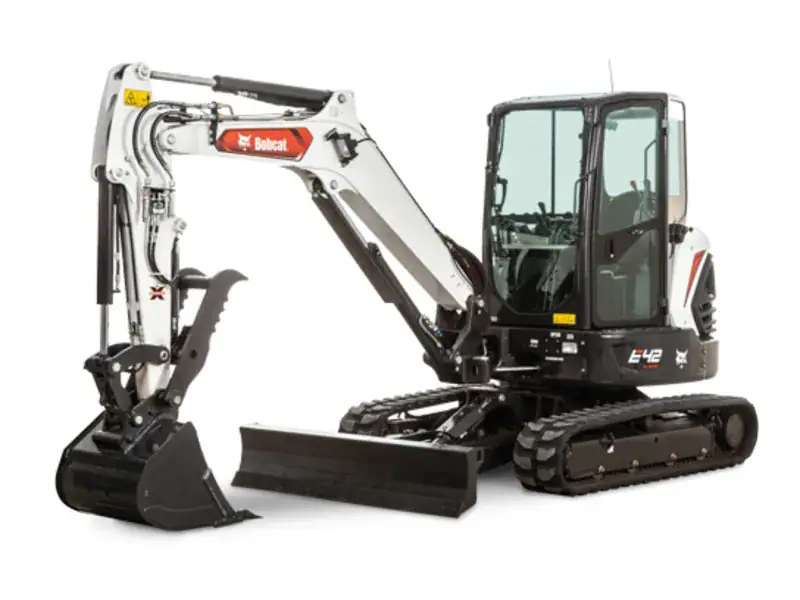
What defines the E42 in this class is its conventional tail swing, which Bobcat balances for better lift capacity and operator confidence, along with a redesigned engine, low-effort joysticks, and an optimized hydraulic control valve for finer grading. It can be configured with a long arm or an extendable arm for more dig depth and reach, and an angle blade for faster backfilling and grading.
On Aglist, the focus is on where the E42 fits in the Bobcat excavator lineup, how the arm and blade options change what it does, and what it offers a Canadian owner through real prairie work.
Key Specifications
| Specification | Bobcat E42 |
|---|---|
| Class | Compact excavator (4-ton class) |
| Series | R2-Series |
| Horsepower | 42.6 hp |
| Operating weight | 9,830 to 10,666 lb (by configuration) |
| Maximum dig depth | 10.4 ft standard, up to 12.7 ft with long or extendable arm |
| Maximum reach at ground level | Up to 20.6 ft |
| Maximum dump height | Up to 13.9 ft |
| Arm digging force | ~5,852 lbf |
| Bucket digging force | ~9,601 lbf |
| Tail swing | Conventional (balanced) |
| Auxiliary flow | ~20 gpm at 3,045 psi |
| Arm options | Standard, long arm, extendable arm |
| Blade | Standard, optional angle blade |
Specifications are drawn from Bobcat and dealer sources and vary by configuration. Confirm exact specs, arm and blade options, and current pricing with your dealer.
The E45 Replacement, and Why That Matters
If you have run a Bobcat E45, the E42 is the machine Bobcat points you to, and the two are close.
With the launch of the R2-Series, there is no exact replacement for the M-Series E45, and Bobcat recommends the E42 as the comparable machine. The two share similar horsepower, operating weight, arm and bucket digging force, travel speed, dig depth, and dump height, with the E42 performing slightly better in arm digging force, bucket digging force, and maximum dump height. In other words, an E45 owner stepping up to an E42 gets a familiar-sized machine with the R2-Series improvements: the redesigned engine, low-effort joysticks, a larger and more durable slew bearing, an improved cooling system, and the optimized hydraulic control valve for finer metering and grading. For anyone who knew the E45, that continuity makes the E42 an easy machine to move to.
Conventional Tail Swing and What It Gives You
The E42’s tail swing is a defining choice, and it is worth understanding against the minimal-swing machines nearby.
The E42 has a conventional tail swing, which means the rear of the house extends beyond the tracks as the machine slews, and Bobcat balances it for better lift capacity and operator confidence. The trade-off against a minimal or zero tail swing machine is that you need more clearance behind the machine when working close to walls, fences, or obstacles, since the counterweight swings out. What you get in return is a well-balanced machine with strong lift capacity for its size, since the counterweight does its job without the compromises a tucked-in tail imposes. For open prairie work, acreage projects, trenching, and site work where you are not constantly working tight against a wall, the conventional tail swing is often the better choice, delivering lift and stability. If your work is mostly in confined spaces, a minimal tail swing machine like the E50 may suit you better, which is a genuine decision worth making by the work you do.
Arm and Blade Options
The E42 is configurable, and the options change what the machine can do.
The standard arm gives a 10.4 ft dig depth, which suits most general work. The long arm and the extendable arm both increase dig depth to as much as 12.7 ft and add reach, with the extendable arm reaching up to 30 inches more than the standard arm and letting you dig and place material with less repositioning of the machine. For deep trenching, footings, or reaching across an obstacle, the extended reach saves time and effort.
The angle blade is the other option worth knowing about. It lets the operator angle the dozer blade left or right up to 25 degrees, which makes backfilling and grading faster and easier, and adds stability when digging on uneven ground. For an acreage owner doing their own grading and backfill, or a contractor moving material efficiently, the angle blade earns its place. Matching the arm and blade to your work is how you get the right E42 rather than a generic one.
How It Performs
The E42 is built to dig and lift with precision, and the R2-Series improvements show in daily use. The redesigned Bobcat engine improves performance and simplifies maintenance, the improved cooling system holds engine compartment temperature in check through hard work, and the larger slew bearing adds durability where the machine takes the most stress. Low-effort joysticks respond easily to input, which reduces fatigue over a long day, and the optimized hydraulic control valve gives finer metering and control for level grading, the kind of finesse that lets you leave hand tools behind on work that needs a clean finish.
Auto-shift travel is a practical touch: the machine transitions its travel motors between high and low range automatically for better tractive effort, so you select a speed and go without manually downshifting, and the directional lug track gives a smoother ride with less vibration when traveling. For a prairie owner, that combination of digging precision, lift capacity, and easy travel makes the E42 a capable all-round machine for property and job site work, from trenching and foundations to landscaping and material handling.
Best Applications
The E42 is a strong fit for:
- Trenching, footings, and foundation work on acreages and job sites
- Owners moving on from a Bobcat E45 who want a comparable machine
- Open-area work where conventional tail swing gives better lift and balance
- Grading and backfilling, especially with the angle blade option
- Deeper digging with the long or extendable arm
For work mostly in tight, confined spaces, a minimal tail swing machine may suit better. The E42’s place is capable, balanced digging and lifting for general prairie and site work.
Bobcat E42 Reviews & Ratings
On Aglist, open the Reviews & Ratings section on this page to see how the E42 performs in real Canadian conditions: how it digs and lifts for its class, how the arm options work out in practice, how the angle blade performs on grading and backfill, and how the R2-Series improvements hold up over time. If you run an E42, your review helps the next prairie owner or contractor choose.
Frequently Asked Questions
How much does the Bobcat E42 weigh? Its operating weight ranges from about 9,830 to 10,666 lb depending on configuration, arm, and options, placing it in the four-ton compact excavator class.
How deep can the Bobcat E42 dig? The standard arm digs to 10.4 ft. With the long arm or extendable arm, dig depth increases to as much as 12.7 ft, and the extendable arm also adds up to 30 inches of reach over the standard arm.
Is the Bobcat E42 the replacement for the E45? There is no exact replacement for the M-Series E45 in the R2-Series, but Bobcat recommends the E42 as the comparable machine. The two are similar in horsepower, weight, and digging forces, with the E42 slightly stronger in arm and bucket digging force and maximum dump height.
Does the Bobcat E42 have zero tail swing? No. The E42 has a conventional tail swing, balanced by Bobcat for better lift capacity and stability. The rear extends beyond the tracks when slewing, so it needs more clearance behind it than a minimal tail swing machine. For confined-space work, the E50 with minimal tail swing may suit better.
What is the horsepower of the Bobcat E42? The E42 produces 42.6 horsepower from its redesigned Bobcat engine, with auxiliary hydraulic flow around 20 gpm at 3,045 psi for running attachments.
What attachments and options does the E42 support? It supports a long arm and extendable arm for more depth and reach, an angle blade that pivots up to 25 degrees for grading and backfill, and auxiliary hydraulics around 20 gpm for running a range of attachments. Confirm specific attachment compatibility with your dealer.
Related
- Bobcat excavator buyer’s guide: how the Bobcat excavator range compares.
- Bobcat vs Kubota vs John Deere excavators: cross-brand comparison in the compact class.
Note: We try our best to keep specs and information accurate, but some details can be missing or different depending on the source. Before you buy, service, or repair equipment, please double-check key specs with the manufacturer, the owner’s manual, or your dealer.
About reviews: Reviews on Aglist are written by real users. We moderate them for spam and abuse, but opinions and claims are still personal, so use them as guidance, not as a guarantee.
Share your experience
Help other Canadian buyers — leave a quick review for the
Bobcat E42
There are no reviews yet. Be the first one to write one.