Overview & Specs
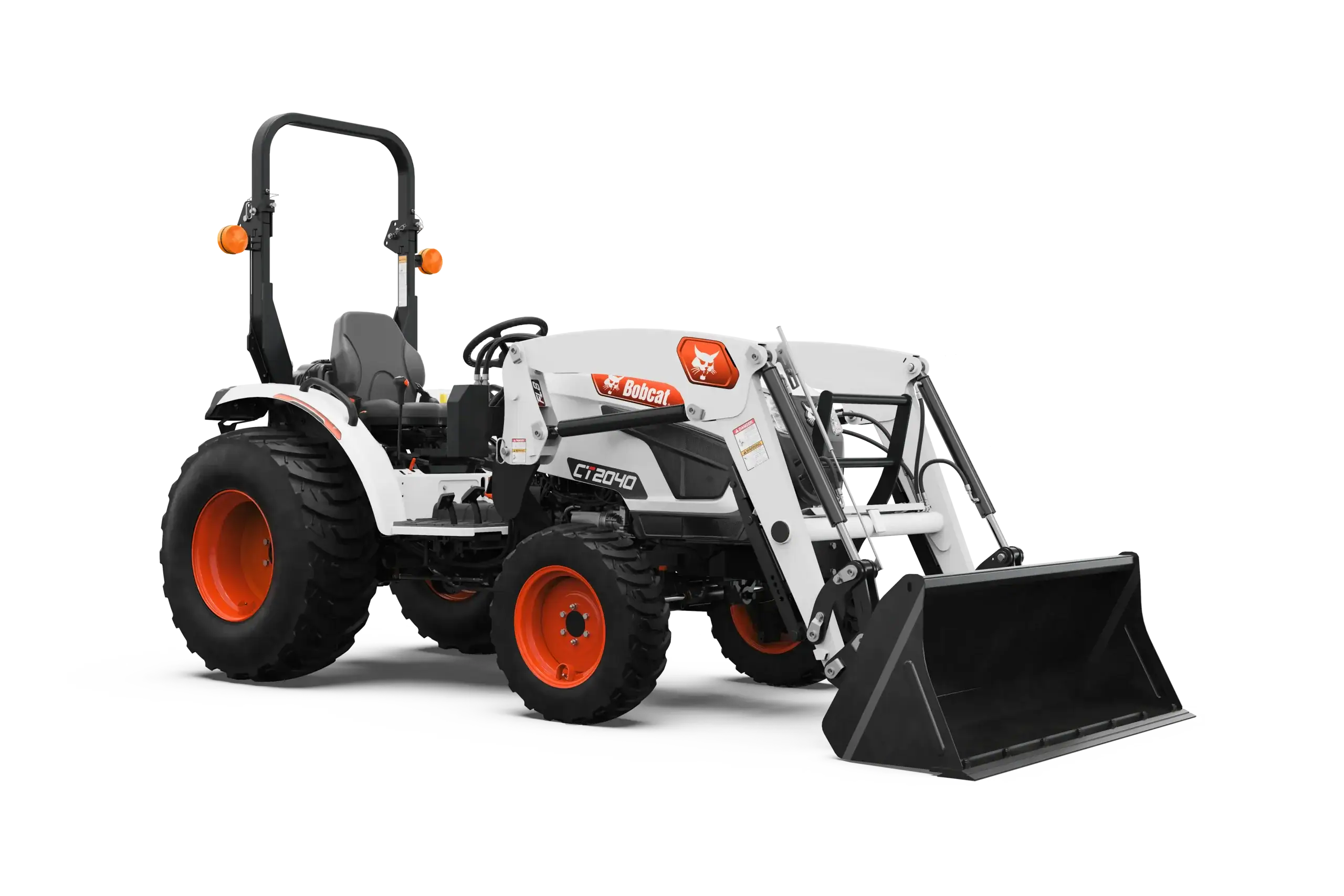
The Bobcat CT2040 deserves attention when powered rear work has become a more important part of an acreage’s workload. A buyer may need an appropriately matched cutter, mower or tiller while still wanting a compact tractor for material movement and lane maintenance. The purchase should start with that implement requirement, because more engine power does not increase every other limit by the same proportion.
For Canadian buyers, the main distinction is between needing more PTO capability and needing a different physical platform. The CT2040 may address the first question for a suitable tool. A heavy rear implement, demanding loading job or essential enclosed operator station can lead to a different shortlist. Keep those requirements separate.
On This Page
ToggleThe specification belongs to a transmission version
| Item | Detailed North American HST table |
|---|---|
| Gross engine / PTO power | 39.6 / 31.9 hp |
| Transmission | Three-range hydrostatic |
| Rear hitch | Category 1 |
| Hitch lift, 24 inches behind lift point | 1,631 lb |
| Implement / steering hydraulic flow | 6.9 / 4.5 US gpm |
| Width / operating weight | 62.4 inches / 3,005 lb |
| Ground clearance | 11.7 inches |
| Rear PTO | 540 rpm |
| Mid PTO | Optional in the model description |
Source: Bobcat’s CT2040 model page, checked October 3, 2026. Its overview mentions manual and hydrostatic choices, while the detailed table displayed here identifies HST. Do not assign these version-specific figures to an unidentified manual or older used tractor.
Start with the powered tool that changes the decision
Suppose rough mowing is becoming a regular job rather than an occasional cleanup. The next step is to identify a cutter suited to the vegetation and desired finish, then establish its tractor requirements. Choosing a tractor from engine output first and assuming a convenient cutting width afterwards reverses that process.
Record whether the implement specifies engine or PTO horsepower, and whether it provides a minimum, recommended range or maximum. Those are different labels. Also include tool mass, hitch geometry, driveline, shaft speed and required configuration. A power match alone does not approve a complete setup.
For an illustrative screen, a hypothetical tool requiring 30 PTO hp falls below the published HST output. That makes further assessment worthwhile; it does not prove the tool can achieve a particular work rate in dense material. A hypothetical 35-PTO-hp minimum would lead to a different result. These invented thresholds demonstrate the method without recommending an unverified attachment.
Assess the regular difficult conditions, not just the easiest demonstration patch. If the proposed implement is outside its documented duty, another tool may be needed even with sufficient tractor power. A larger engine cannot change what a mower or tiller was designed to process.
More power does not erase the hitch boundary
The rear-lift measurement remains a distinct specification. It describes force at a stated location behind the lift point, not a universal implement allowance. Long implements can place their mass differently from compact ones, and the tractor’s required ballast and operating limits still apply.
Make a second worksheet column for carrying and clearance. Check the implement through its approved working and transport positions with the intended hitch arrangement. A quick hitch can change connection distances; the driveline must suit that arrangement rather than merely attach while parked.
For a used tool, identify its actual model and modifications. Added equipment, repairs or missing components can make a sales description inadequate. Inspect the item that will be delivered, not a photograph of a similar new implement.
This separation prevents a common upgrade error: paying for power when the real problem is the size or geometry of the rear tool. If the carrying requirement does not fit, compare another platform instead of assuming the larger engine in the same general class resolves it.
Hydrostatic control and productive ground speed
PTO speed and ground speed answer different questions. The shaft must operate under the implement’s specified conditions, while travel determines how quickly new material reaches it. A hydrostatic arrangement can be useful where the appropriate travel rate changes frequently within a pass.
During a suitable demonstration, observe the complete task: approach, work, turn, reposition and continue. Note the operator’s control reach, visibility and ability to make smooth adjustments after familiarisation. The result should be an acceptable repeatable finish, not one fast run in unusually easy conditions.
Range selection remains important and follows the exact manual. Do not treat a hydrostatic pedal as a substitute for selecting an appropriate range or maintaining the required PTO conditions. Likewise, slowing down is not a way to bypass a manufacturer’s minimum tractor requirement.
If considering a manual version, obtain its own specifications and speed chart. Aglist’s transmission guide explains why the operating routine and available ratios deserve comparison independently of the model badge.
A wider tool only helps when the complete job improves
Working width is attractive because it appears to reduce the number of passes. But an appropriate comparison includes travel rate, turns, obstacles and any repeat work needed to achieve the desired finish. A wider tool can be less convenient between trees or at the end of a short work area.
Consider a hypothetical 48-metre-wide rectangular area. Ignoring overlap, a 1.5-metre tool suggests 32 passes, while a 2-metre tool suggests 24. That arithmetic alone does not establish completion time or suitability. The tractor must first meet the tool’s requirements, and the larger implement may have a different permissible pace or turning routine.
Use the calculation to identify what needs to be demonstrated. Record actual working width after overlap, appropriate ground speed and time lost at each end. Never turn a theoretical coverage advantage into a claim about the CT2040 without observing the approved combination.
For a property with many obstacles, a narrower suitable tool may complete the usable route with less repositioning. For a broad open area, a different package may offer a meaningful gain. The site shape belongs beside the area measurement in the buying brief.
Loader work still requires a separate assessment
Write down the heaviest normal load and where it must be placed. For pallets, include goods, packaging, dimensions and load centre. For bulk material, identify the material and selected bucket. These descriptions are more useful than saying the tractor needs to handle “farm loads.”
The manufacturer table lists loader summary figures, but a complete purchase requires the exact loader, carrier and attachment documentation. Do not convert a maximum-height summary into a fork payload without the measurement position and configuration. Required ballast and the tractor’s operating instructions remain part of the answer.
Measure receiving height and reach. The bucket pivot’s highest position is not clearance below the dumping bucket. A load may clear an edge yet fail to reach a useful discharge point if the tractor cannot approach closely.
Aglist’s loader-capacity guide explains the distinctions. If loading is the dominant task, evaluate the loading system before assigning value to additional PTO power that the job may not use.
Hydraulic attachments: use the implement circuit information
The model table distinguishes steering flow from implement flow. That separation should remain visible when discussing a hydraulic tool. A total-flow number is not an approved continuous supply at an unspecified outlet.
List the required functions: loader lift and tilt, a grapple clamp, rear-blade adjustments or a motor-driven attachment. Identify controls and connections for each. A tractor can have enough pump capability for one task yet lack the valve or return arrangement required by another.
Bobcat’s page lists rear hydraulics as optional. Inspect what is actually fitted and obtain a complete quotation for necessary additions. On used equipment, a photograph of hoses or couplers is not a substitute for a circuit description and functional assessment.
A powered hydraulic attachment also has permitted pressure, flow, return and possibly case-drain requirements. Treat it as a separate matching exercise from PTO equipment. More engine horsepower does not automatically create a higher-flow attachment circuit.
Canadian mowing, garden and winter scenarios
Regular rough-area maintenance
Identify vegetation, terrain, obstacles and the required finish. Select the tool for that duty and verify the complete tractor match. The CT2040 merits comparison when its published PTO capability addresses an actual requirement and the hitch, access and operator arrangement also fit.
Repeated garden or plot preparation
Describe the existing soil condition and the work expected from the implement. A maintained plot is different from establishing a new area. Include the tool’s recommended use and a suitable working pace rather than assuming one width performs equally in all conditions.
Winter access maintenance
Choose where snow will go before choosing the attachment. A rear blower, front system, blade and loader bucket create different mounting and operating demands. Mid-PTO availability does not establish that a specific front snowblower is installed or compatible.
The snowblower fitment guide helps organise those questions. Evaluate exposure and visibility honestly on this open-station tractor. If an enclosed heated station is essential for the work, make that a requirement at the beginning of the shortlist.
Alternatives and the used-machine decision
The Kubota L3902 is another compact to investigate for a similar task-led shortlist. A John Deere 3039R introduces a different equipment and operator-station proposition. Use current manufacturer data for the exact versions rather than comparing rounded engine labels.
If rear carrying or substantial handling is the limitation, broaden the search beyond a power increment. The tractor-size guide can help separate chassis, implement and operator requirements. A good alternative solves the actual constraint, even when its engine number is not dramatically different.
For a used CT2040, obtain serial identity, transmission, loader model and fitted options. Have a qualified inspection assess engine and drive operation, PTO, hydraulics, hitch, axle, mounts and repair evidence. Check maintenance against the correct manual; do not infer emissions equipment or service needs from a neighbouring model.
These are general inspection priorities, not a claim of recurring model faults. Price identified work from an appropriate estimate. Inspect included implements separately, because condition and compatibility can materially change a bundle’s value.
Compare Canadian quotations for complete working packages, with attachments, controls, required ballast, setup and delivery itemised. Include transport and storage. A lower equipment price may be worthwhile, but only after the machine meets the essential job requirements.
CT2040 FAQ
Are these specifications for every CT2040?
No. The table shown is the HST version displayed on the cited North American page. Verify another transmission or older serial separately.
Does extra engine power increase hydraulic flow?
Do not infer that. Use the model’s circuit specifications and fitted equipment.
Can a bigger cutter be chosen from width alone?
No. Check power, duty, hitch, mass, driveline and the complete working route.
Is optional mid PTO the same as a front snowblower package?
No. The drive, mount, controls and exact attachment pairing must also be established.
What makes the CT2040 worth buying?
A recurring powered-implement requirement that fits this configuration while its physical format and open station suit the property.
Share your experience
Help other Canadian buyers — leave a quick review for the
Bobcat CT2040
There are no reviews yet. Be the first one to write one.