Overview & Specs
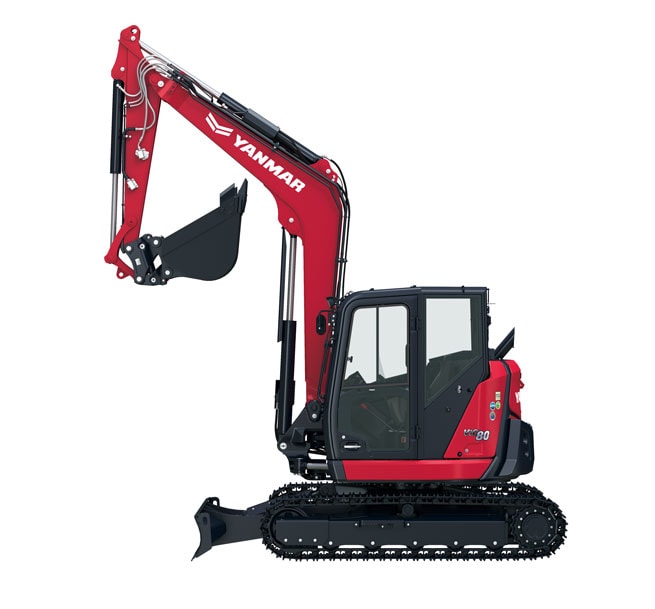
The Yanmar ViO80-7 is a larger compact excavator for buyers who need substantial excavation capability while working around boundaries, buildings and constrained site layouts. Its most important buying qualification is easy to miss: the manufacturer’s zero-tail description does not apply with the additional counterweight option pictured in the latest linked brochure. The exact machine configuration therefore belongs at the beginning of the comparison.
For a Canadian rural contractor, the useful package combines an appropriate working envelope, attachment controls, operator visibility and a realistic delivery arrangement. It should be evaluated as that complete system. This guide concerns the North American ViO80-7, not the earlier ViO80-1A, and uses the February 2026 specification sheet currently linked by Yanmar.
On This Page
ToggleKey references for the current documented package
The ViO80-7 specification sheet supplies these figures and equipment references.
| Item | Published reference |
|---|---|
| Rated engine output | 67.1 hp at 1,800 rpm |
| Cab, rubber-track operating weight | 18,409 lb |
| Cab, steel-track operating weight | 18,453 lb |
| AUX1 / AUX2 at 1,800 rpm | 100 / 70 L/min |
| Display | 7-inch colour display |
| Visibility equipment listed | Right-side and rear cameras |
The circuit figures are separate entries, not a combined 170 L/min attachment promise. Some working-range dimensions contain inconsistent metric and imperial entries, so this guide does not publish a definitive maximum reach from that table. Resolve the matching diagram before a close-clearance or limit-of-reach job depends on it.
The counterweight decision changes the rear-clearance brief
The brochure explicitly qualifies the zero-tail claim when the additional counterweight is fitted. This is more than a footnote for someone buying to work beside buildings. A machine pictured with optional equipment may not deliver the same rear envelope as the base layout used in a general description.
Identify the counterweight on the actual offer and obtain the corresponding dimensions and load information. Do not assume that an optional counterweight is either unnecessary or automatically desirable. Its value depends on the tasks, while its mass and rear projection affect other parts of the ownership plan.
A useful purchase worksheet has separate columns for the base package and the offered equipped package. Record rear clearance, operating mass, attachment assumptions and the applicable lifting chart. This prevents a comparison that takes the most favourable clearance from one configuration and the most favourable handling figure from another.
For a constrained site, sketch the rear movement at the intended machine position. Include fixed obstacles and any route used by supporting equipment. The front attachment and load still require their own space. The tail-swing guide explains why rear layout is only one clearance question.
Cab visibility should be tested in the actual task
Yanmar’s ViO80-7 product page describes a larger glazed area, side and rear cameras and a seven-inch display. Those features should lead to a practical visibility assessment, not an assumption that all blind areas disappear.
Sit in the normal operating position and evaluate the view of the intended working area with the actual bucket and any thumb or specialist tool. Check the display’s usefulness in the relevant light and confirm that camera views are functional. A camera image is supporting information; it does not replace the operating procedures and separation required around the machine.
For Canadian shoulder-season work, inspect the condition of glazing, washer, defroster and climate equipment listed for the package. Visibility can be compromised by a neglected component even when the cab looks presentable from outside. Include these systems in a used-machine assessment and repair allowance.
Consider the full day rather than a short seat trial. Entry and exit, control reach, storage of necessary items and the ability to read information without awkward movement all belong in the decision. The best evidence is the regular operator completing a representative sequence, not a generic comfort claim.
Two-pump load sensing: evaluate coordinated work
The manufacturer identifies the hydraulic architecture as two-pump load sensing, or 2PLS. The buying question is whether the machine performs the required combinations of movement predictably with the intended tools. Architecture explains the design approach but does not establish a fixed productivity gain on every job.
Arrange a demonstration that combines excavation, extraction, swing and discharge in a suitable layout. Then assess low-speed positioning or finishing. A machine can feel impressive during isolated fast movements while the important work depends on controlled transitions.
Do not apply a promotional fuel-reduction percentage to your own annual costs without a comparable baseline and operating evidence. Work mix, idle time, material, operator and completed output all affect the usefulness of such a comparison. If fuel is a major decision factor, collect records for equivalent tasks.
For attachment matching, keep pump capacity separate from the auxiliary circuit ratings. Identify the supplying circuit, the tool’s accepted operating range, return requirements, mounting and mass. Hydraulic capability must be assessed at the documented conditions rather than inferred from engine horsepower.
When the larger compact package earns its place
The ViO80-7 is most persuasive when the work repeatedly requires more than a smaller excavator comfortably delivers, while a compact rear arrangement remains valuable. That may involve excavation around developed sites, repeated loading or an attachment requirement that has been properly matched to the carrier.
Identify the present bottleneck. If a smaller machine spends too much time repositioning, check whether the larger package provides useful reach from suitable positions. If the bottleneck is spoil removal or waiting for trucks, additional excavation capability may leave the delay unchanged.
For an illustrative job, assume two hours of active excavation and one hour waiting for material removal. Even an assumed 20-minute reduction in active excavation changes the total from three hours to two hours forty minutes if waiting stays the same. These are invented planning times, not a ViO80 performance claim. They show why supporting equipment belongs in the comparison.
For rare exceptional work, a separate hired machine may be more sensible than owning a larger package for every routine task. Frequency and mobilisation costs determine the answer. Do not let one ambitious project obscure the access and delivery requirements of the rest of the year.
Working range, buckets and the load destination
Obtain a consistent working-range drawing for the exact machine and attachment arrangement. Mark both depth and horizontal position relative to the correct reference point. The bucket must complete a useful movement, not merely reach a single point at the boundary.
For truck loading, measure the receiving arrangement and the intended discharge position. Clearing the near side is not the same as placing material usefully throughout the body. Repositioning the truck may be straightforward on an open site and difficult on a confined one.
The working-range guide explains these measurement distinctions. It also helps separate geometry from lifting capacity. A machine’s ability to reach an object does not establish permission to lift it; use the applicable chart and approved arrangement.
Select buckets around material and finished dimensions. A large bucket can create additional unwanted excavation or a different handling burden. The bucket guide provides a separate framework for width, volume and tool mass.
Coupler and attachment acceptance
The current brochure lists a double-lock quick coupler. Identify the actual installed unit and its instructions rather than carrying over the procedure from another Yanmar model or an older generation. The mechanism, controls and required verification are part of operator familiarisation.
List every attachment included in the sale and establish its compatibility. A powered tool needs more than a matching mechanical interface; its hydraulic requirements and controls must also be satisfied. A thumb must work with the bucket geometry and clear the machine appropriately through its permitted movement.
Have the important attachment combination demonstrated under suitable conditions. Keep the acceptance record with the purchase documents for future reference. Record tool identity and configuration so that the acceptance result applies to what is actually delivered. A substitute demonstration tool may not answer the same questions.
Transport is a major part of this purchase
The brochure’s operating weight already places the ViO80-7 in a substantially different transport discussion from the smallest mini excavators. Establish the equipped mass, including optional counterweight and tools, rather than relying on an informal size-class name.
Check the complete hauling arrangement and applicable requirements with the actual load. Deck layout, loading geometry, securement provisions and the space for spare attachments matter alongside ratings. A trailer that can carry the machine but cannot carry the required tools may create a second delivery task.
For a contractor moving daily, compare total mobilisation time and cost. For a farm where the excavator remains on site for long periods, contracted delivery may produce a different ownership calculation. Neither pattern should be assumed from machine size alone.
Used inspection and ongoing support
Record exact model and serial identity, tracks, counterweight, coupler, hydraulic circuits and cab equipment. Match those details to the documents used for evaluation. The earlier ViO80-1A should not supply missing figures for a ViO80-7 listing.
Have the undercarriage, front joints, structure and hydraulic system assessed by a competent inspector. Include the camera and display functions, control patterns and any fitted attachment equipment. These are general inspection priorities, not evidence of a recurring defect in this model.
Review maintenance records and establish the practical support arrangement for your location. Confirm any telematics access or subscription terms applicable to the buyer rather than assuming that a new-machine promotional offer transfers automatically.
Compare offers after adding identified repairs, missing tools and transport changes. The asking price is only one part of obtaining a ready-to-work machine. Unresolved configuration details should remain unresolved until documented, even when the price is attractive.
When arranging a demonstration, include the regular operator and the person responsible for transport. They may identify different constraints: one sees tool control and visibility, while the other sees loading geometry and attachment storage. Resolving both before purchase produces a more useful acceptance decision than judging the excavator alone in an open yard.
Comparisons and frequently asked questions
The ViO50-6A guide provides a smaller-package reference when deciding whether the work justifies moving up. Compare the whole task and transport requirement rather than using horsepower as the only dividing line.
Is every ViO80-7 zero tail swing?
The current brochure excludes the additional-counterweight configuration from that claim. Identify the actual equipment before relying on rear clearance.
Do the cameras eliminate blind spots?
Do not assume that. Evaluate the actual views and retain the required operating procedures and separation around the machine.
Can I combine AUX1 and AUX2 ratings?
Not into an assumed single-tool output. Match the required circuit and simultaneous functions to documented capability.
Why are maximum reach figures not repeated here?
The linked document has inconsistent entries. A close-limit purchase needs a resolved, configuration-specific drawing rather than a selectively chosen number.
What should decide between this and a smaller excavator?
The recurring task that the smaller package cannot complete satisfactorily, together with the additional access, transport and ownership consequences. Demonstrate that task before buying the extra capability.
Share your experience
Help other Canadian buyers — leave a quick review for the
Yanmar ViO80-7
There are no reviews yet. Be the first one to write one.