Overview & Specs
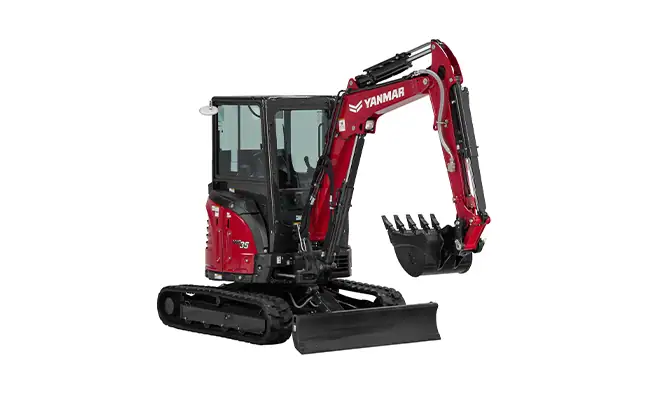
The Yanmar ViO35-6A is a compact excavator to evaluate for repeated digging and finishing work where a very small access machine would impose too many compromises, but a larger excavator would complicate transport or site layout. Its appeal depends on the complete working package: bucket geometry, attachment control, operator station and the space available to reposition. Engine horsepower alone does not explain how well it will fit that role.
For Canadian buyers looking at used equipment, the suffix is especially important. This guide concerns the North American ViO35-6A. Yanmar also has a separately documented ViO35-7; specifications and features should not be transferred between them because the model numbers look related. Record the exact identity of the machine before comparing advertisements or ordering parts.
On This Page
ToggleReference specifications for the 6A generation
The September 2023 ViO35-6A brochure gives the following configuration-specific starting points.
| Item | Published reference |
|---|---|
| Engine power | 24.4 hp at 2,200 rpm |
| Track width | 1,740 mm overall |
| Rubber-track operating weight, canopy / cab | 7,905 / 8,214 lb |
| Steel-track operating weight, canopy / cab | 8,125 / 8,434 lb |
| Digging depth, diagram A | 3,250 mm |
| Blade-down depth, diagram B | 3,440 mm |
| Auxiliary flow | 63.2 L/min at 2,200 rpm |
The two depth entries should remain separate. Using the larger one without its diagram condition can create a misleading comparison with another excavator. Similarly, the range of operating weights reflects real configuration differences; a single headline weight cannot describe every ViO35-6A offered for sale.
Choose it around a repeatable work cycle
A useful way to assess this machine is to follow one recurring job from arrival to departure. For example, a rural contractor might excavate several short sections, reposition, change to a finishing bucket and restore the area. The excavator spends only part of that cycle taking full digging passes. Positioning accuracy and the ability to make useful movements without constant setup changes also matter.
Write down where the current method loses time. Is the smaller machine repeatedly relocating because it cannot reach the next section? Is material waiting because spoil space is limited? Does finishing require excessive hand work? These are different problems, and buying more engine power will not necessarily address them. A demonstration should reproduce the relevant constraint rather than simply show the machine digging in an open pile.
The ViO35-6A’s zero-tail layout is relevant where the rear housing operates near a boundary. It does not remove the front equipment’s swept area or make nearby workers safe by default. Plan the exclusion area and material route around the complete machine. The tail-swing comparison guide explains why rear clearance is only one part of the layout.
Depth and useful reach: avoid the headline trap
There is a difference between reaching a point and carrying out a useful excavation around it. A working diagram can show maximum depth, but the required bottom width, bucket attitude and machine setback determine whether the job fits comfortably. If a task sits close to the machine’s limit, study the diagram at the required horizontal position rather than treating the maximum as available everywhere.
For an illustrative drainage project, the excavation may be comfortably within nominal depth but require the excavator to remain farther from the edge than expected. That extra setback changes the reach requirement. Alternatively, the excavation may fit while the intended spoil position does not. In either case, revising the plan before mobilisation is more useful than discovering the limitation after opening the first section.
Aglist’s digging depth and reach guide gives a method for reading those dimensions. Do not infer that a bucket shown at a distant point can carry any desired load there. Suspended-load work requires the correct lift chart and the actual machine and attachment configuration.
Hydraulic tools: evaluate the circuit at the working setting
The published auxiliary flow is tied to engine speed. That makes it a compatibility reference, not a promise about the flow available at every operating setting or during every combination of movements. Start with the attachment’s requirements and identify which values must be met together, including return and drainage provisions where specified.
A powered tool can fit the mounting interface and still be unsuitable hydraulically. Conversely, a suitable hydraulic range does not establish that the attachment’s mass or geometry is acceptable. Document the full package: tool, coupler, hoses, connectors and controls. This is particularly important when a used machine has acquired equipment from several previous owners.
Yanmar’s ViO35-6A product page describes proportional auxiliary control, ECO mode and auto-deceleration. Treat these as operating features to evaluate rather than evidence for a particular fuel-saving percentage. Test whether the controls support the intended tool and whether the operator can use the desired response consistently.
Consider two different attachment patterns. An occasional hydraulic thumb may be valued mainly for positioning flexibility while sorting varied objects. A powered tool used for extended periods raises additional questions about sustained operation and the approved hydraulic setup. Neither can be selected confidently from engine power or a generic statement that the excavator has auxiliary hydraulics.
Couplers change more than the convenience of bucket swaps
The manufacturer’s page describes a hydraulic quick coupler while retaining manual handling of its safety lock pin. A complete tool change therefore includes the prescribed retention steps, not just operation of a hydraulic control. The actual installed system should be inspected and identified before valuing a used attachment package.
Coupler geometry also belongs in specification comparisons. Published digging-force figures may use different attachment conditions; the brochure and webpage should not be mixed into a single best-looking number. This guide does not use an unqualified force figure to rank the machine. Compare like-for-like manufacturer definitions if force is a deciding factor, then assess the bucket and material involved.
A good practical test includes a digging bucket and the finishing bucket you expect to use. Check the fit, usable movement and visibility of the work. The bucket width and capacity guide explains why a wider attachment is not automatically a faster choice. The desired excavation shape should lead the selection.
The blade and finishing stage
Yanmar lists a four-way blade option for this model. An advertised ViO35-6A should not be assumed to include it. Identify the blade fitted, its controls and its condition, then decide whether the additional movement would serve your work. Options have value when they remove a recurring constraint; their presence alone does not make a machine the better purchase.
For small restoration jobs, think about where loose material will be left and how the excavator will make its final passes. A blade can be useful within an appropriate work sequence, but it does not turn the machine into every kind of grading equipment. Tight access, material distribution and the required finish may still make another tool or machine worthwhile.
Plan the finishing stage while setting out the excavation. Leaving the excavator trapped behind its own spoil pile can force unnecessary travel and surface disturbance. A short sketch of the final exit route often identifies this problem early. That planning benefit applies regardless of blade option and costs nothing in additional equipment.
Cab choice and Canadian operating conditions
The cab and canopy versions should be compared as different working packages. For intermittent summer jobs, the ownership priorities may favour simplicity and access. For repeated work in cold rain or shoulder seasons, the condition of the enclosure and its visibility provisions may carry more weight. Evaluate the actual equipment installed instead of assuming every cab has the same features.
Inspect doors, latches, glazing and controls as carefully as the exterior panels. A cab’s value is reduced when damaged components interfere with visibility or routine entry. On a used machine, a complete and functional operator station can be a meaningful part of the repair budget, even if it contributes little to a short digging demonstration.
Ground conditions also change through the year. A route that supports travel in dry weather may be unsuitable during thaw. Rubber tracks do not establish bearing capacity, and zero-tail geometry does not create traction. Account for access preparation and restoration separately from the machine’s digging capability.
Transport and the equipped weight
Use the appropriate brochure weight to begin planning, then establish the actual load. A cab, different tracks, coupler and carried attachments can distinguish one advertised package from another. Include everything loaded on the trailer and the trailer’s own weight when checking the complete transport arrangement.
Physical fit matters alongside weight. Consider deck space, loading equipment, the transport position of the front end and approved securement points. If a prospective purchase requires a different transport arrangement, include that cost in the comparison at the beginning. Otherwise an apparently modest machine upgrade can create a much larger ownership change.
Buying a used ViO35-6A: inspect for the work you need
Begin with model identification and records, then move through the undercarriage, front joints, hydraulic lines and attachment system. Ask for documented service history and identify unresolved repairs. Do not treat low hours as proof that all components are in good condition, particularly when storage and previous applications are unknown.
Observe controlled movement after normal warm-up. Smooth placement at low speed matters for finishing; a brief demonstration of maximum movement does not answer that question. If a thumb or other tool is included, have the complete arrangement demonstrated appropriately. Record what was checked and what remains an assumption.
For components whose wear you cannot reliably assess, obtain an independent inspection and repair estimate. These checks are general purchase practices, not allegations of a known ViO35-6A defect. A defensible comparison uses the cost of putting each candidate into equivalent working condition.
Shortlisting alternatives and deciding
The Takeuchi TB240 guide provides another compact-excavator buying framework for comparison. Check each candidate’s documented dimensions, actual attachment package and work envelope instead of assuming that adjacent size classes are interchangeable. Dealer distance and parts logistics can be relevant, but confirm the support available for the exact model rather than inferring it from a brand sign.
A decision sheet should separate essential tasks from occasional exceptions. Reject a package that cannot meet a routine access or attachment requirement. For an unusual heavy or deep job, compare rental or subcontracting with the cost of owning a larger machine year-round. This keeps the purchase centred on the work that will actually occupy it.
Frequently asked questions
Can ViO35-7 specifications be used for a 6A listing?
No. Treat the suffix as part of the model identity. Matching a familiar engine-power figure does not establish matching dimensions, controls, weight or attachments.
Is the four-way blade standard on every example?
No. It is listed as an option. Inspect the machine and record what is included in the quotation.
Does auxiliary flow establish hammer compatibility?
It is one required check. Mounting, mass, pressure, return requirements and approved operating conditions must also match the attachment.
Why do weight figures differ between advertisements?
Some may refer to different tracks or operator enclosures. Others may omit the configuration entirely. Compare identified configurations and verify the equipped load for transport.
Should maximum digging force decide the purchase?
Only within a properly defined comparison, and never alone. Bucket geometry, work envelope, site arrangement and control can determine whether the machine suits a recurring task even when a force figure looks competitive.
Share your experience
Help other Canadian buyers — leave a quick review for the
Yanmar ViO35-6A
There are no reviews yet. Be the first one to write one.