Overview & Specs
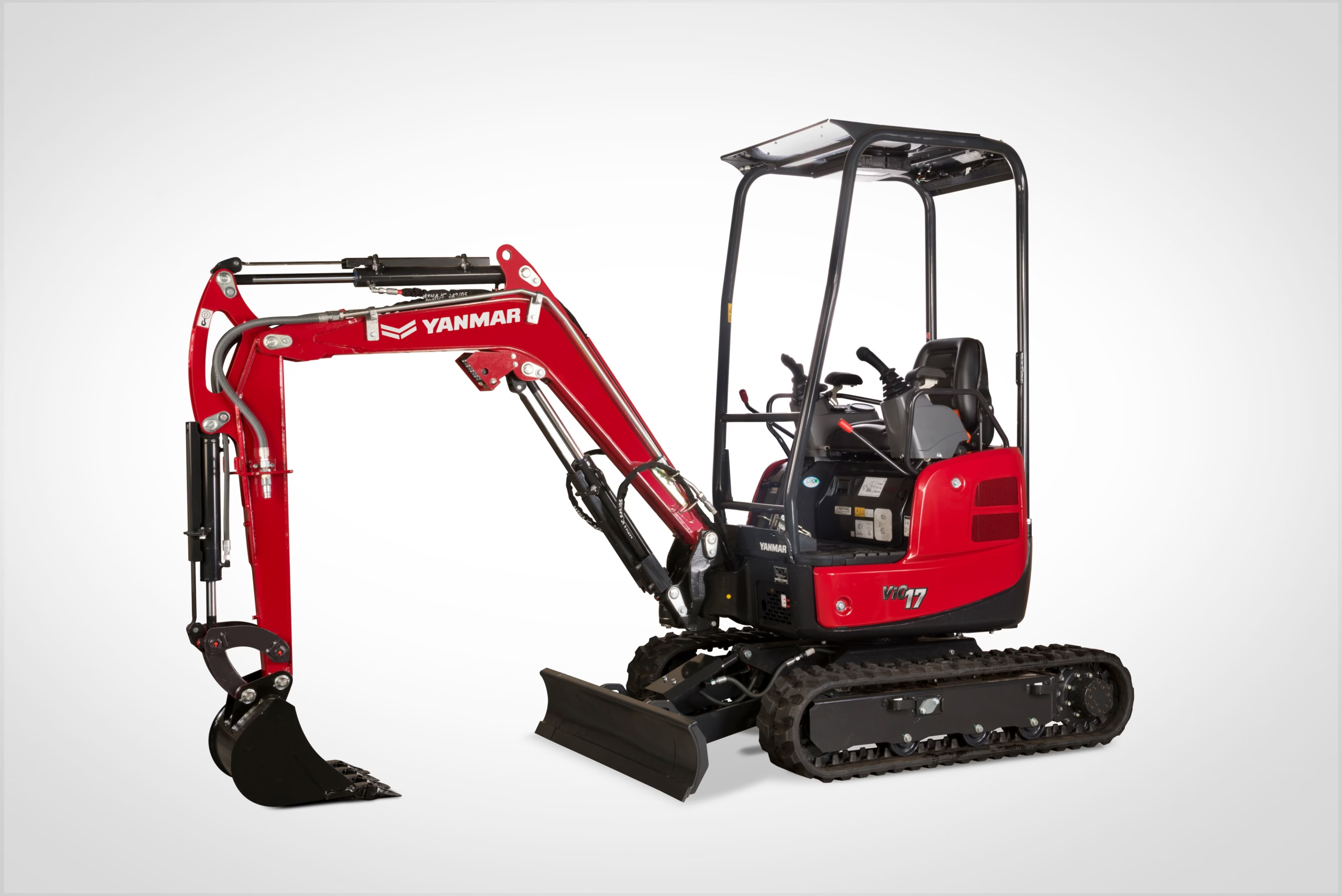
The Yanmar ViO17-1E is worth considering when getting an excavator into the work area is harder than supplying enough engine power. Its useful distinction is the change between a narrow travelling footprint and a wider working stance. For Canadian acreage owners, landscapers and contractors maintaining established properties, that can determine whether a small excavation is practical without removing a fence or disturbing a larger area.
That does not make it a miniature substitute for every larger excavator. The buying decision is whether its access advantage outweighs the smaller digging envelope, attachment choices and material-handling limits on your actual jobs. This guide uses Yanmar’s North American ViO17-1E documentation. The shortened ViO17 name on the manufacturer’s webpage should not be used to combine specifications from different generations or overseas versions.
On This Page
ToggleThe measurements that define this machine
The following reference figures come from the September 2023 ViO17-1E brochure. They describe the documented configuration, rather than a guarantee about an individual used machine.
| Item | Published reference |
|---|---|
| Engine output | 14.5 hp at 2,400 rpm |
| Rubber-track operating weight | 4,023 lb |
| Retracted / expanded track width | 950 / 1,280 mm |
| Rear swing radius | 640 mm |
| Digging depth, dimension A | 2,310 mm |
| Auxiliary flow reference | 32.2 L/min at 2,200 rpm |
Operating weight is a reference for the machine specification, not the total weight of a trailer load. Likewise, the flow figure belongs to a stated engine speed; it does not describe every control setting. Those distinctions matter more than rounding the excavator into a convenient weight class.
Access width and working clearance are different questions
Begin with the entire route from unloading point to excavation. Measure the narrowest opening at track level, but also look above it for gate hardware, roof edges, branches and services. A gate’s nominal size is often less useful than the clear space between its actual obstructions. Allow for turning into the opening: a straight passage and a right-angle approach are different problems.
The expandable undercarriage changes the decision after arrival. A machine that can enter a restricted yard still needs room for its approved working setup, the attachment movement and a spoil location. Sketch the work area with the excavator expanded before deciding that the access measurement solves the job. Otherwise, the operator may arrive at a spot where there is nowhere sensible to place material.
The geometry also qualifies the zero-tail-swing description. Half the expanded track width is 640 mm, matching the listed rear radius. Half the retracted width is only 475 mm. On that simplified centred geometry, the rear radius extends 165 mm beyond a retracted track edge. This calculation explains why a claim about the expanded footprint must not be applied blindly to the narrow configuration. It is not permission to excavate with the tracks retracted; use the machine’s operating instructions for the required setup.
For a broader explanation of what the rear housing does and does not clear, see conventional, reduced and zero-tail excavator layouts. The bucket, boom and load still create a working envelope outside the undercarriage.
Where the ViO17-1E makes practical sense
Repairs within an established property
Consider an irrigation or drainage repair behind a building. The useful outcome is a correctly completed excavation with limited reinstatement, not the largest amount of soil moved per pass. A compact machine may be attractive if it reaches the work directly and allows material to be kept in a controlled area. The access assessment should include how replacement material and removed soil will travel, because the excavator cannot solve a bottleneck shared by every other part of the job.
A narrow bucket can be appropriate when the excavation genuinely needs a narrow cut. It becomes counterproductive if the operator must repeatedly widen the trench to obtain the required working space. Choose the excavation dimensions first, then select the bucket. Aglist’s bucket width and capacity guide explains that distinction in more detail.
Recurring small jobs around an acreage
For an owner who regularly exposes short service runs, cleans accessible shallow features or prepares small planting areas, mobilisation can dominate the job. Keeping a suitably equipped excavator available may be more valuable than buying a larger machine for a rare major project. Record the jobs you completed last year and separate frequent modest excavations from one-time work. Hiring a larger machine for the exceptional task may preserve the benefits of a small everyday package.
There are clear limits. Deep excavations, substantial stump removal and heavy object placement should not be assumed to fit merely because they occur on a small property. Resistance, reach and lifting requirements can be disproportionate to the size of the site. Treat these as separate equipment-selection problems.
Read the digging envelope before choosing by maximum depth
A depth figure marks a point in a working diagram. It does not promise the same reach, bucket attitude or clearance at every depth. Lay out the machine position, the near edge of the excavation and the intended bottom before evaluating the ViO17-1E. Include the location where the bucket will empty. A machine can reach the bottom yet require awkward repositioning to finish a long section accurately.
For example, an illustrative shallow repair may have plenty of vertical depth margin but little room behind the excavator for spoil. That is a site-layout limitation, not an engine-power problem. Changing the spoil arrangement could help more than moving up one model size. Conversely, if the machine must stand far back from the excavation, the required horizontal reach may eliminate it even when the nominal depth looks sufficient.
Do not turn a digging dimension into an object-handling rating. A suspended item requires the applicable lift chart, actual radius, direction and configuration. For choosing the excavation envelope itself, use dig depth versus reach alongside the manufacturer’s drawing.
Attachment selection starts with control and fit
Yanmar’s North American ViO17 product page describes foot-operated auxiliary control and a selectable joystick control pattern. These details are particularly relevant to shared machines. An operator familiar with another layout needs to establish the selected pattern and the auxiliary response before approaching the work. Familiarity with a different excavator is not a substitute for orientation on this one.
For a hydraulic attachment, make a complete compatibility list: mounting arrangement, attachment mass, required flow range, pressure limits, return requirements, hoses and control method. An auger and a thumb ask different things of the machine. Matching a flow number alone does not establish mechanical fit, controllability or an acceptable working load.
For occasional gripping work, compare the complete thumb-and-bucket package rather than ordering a thumb by machine weight class alone. Teeth must meet usefully through the intended movement, and the added hardware must clear the boom and hoses. The mechanical versus hydraulic thumb guide helps frame that choice without assuming either system is universally preferable.
Bucket changes also deserve attention on a small machine. Check the actual coupling system on the offered excavator, the compatible bucket inventory and the prescribed locking check. A low purchase price loses appeal if every useful attachment needs replacement or modification. Do not infer a particular coupler from photographs of another ViO model.
Canadian ownership: access, seasons and transport
A rubber-track machine still needs a suitable travel surface. It can leave marks or disturb weak ground, particularly when turning. Plan protective measures around the actual lawn, paving or yard surface rather than assuming that rubber means no restoration work. During spring thaw, a route that was firm on the inspection day may no longer support the same movement.
For cold-season work, consider the operator’s exposure and the visibility needed for precise excavation. The value of a compact package can be reduced if the intended work routinely takes place in conditions where the operator cannot work comfortably or see the task properly. Evaluate the actual enclosure and weather protection supplied; do not treat an improvised enclosure as equivalent to an approved factory arrangement.
Transport planning should start with an inventory: excavator, fitted bucket, additional tools, fuel and the trailer itself. Weigh the equipped combination and assess the complete vehicle and trailer ratings and applicable requirements. The brochure’s machine weight cannot certify a towing combination. The physical loading arrangement matters too: ramps, deck space, securement points and the folded attachment position must suit the machine.
Inspect the expandable undercarriage when buying used
The feature that makes this model attractive should receive particular attention during inspection. Have the undercarriage expansion demonstrated according to the manual. Observe whether movement is controlled and whether the structure, sliding areas and associated hydraulic components show damage or leakage. Examine the folding blade arrangement and its retaining hardware. A machine permanently left in one position may conceal a fault in a feature you expect to use every day.
Then inspect the rest of the package as a system. Worn track components, damaged hoses near moving joints, loose attachment pins and neglected service records can each change the ownership calculation. These are inspection priorities, not claims that the ViO17-1E has a particular recurring defect. A competent independent inspection is especially useful when a machine’s work history is unclear.
Ask for a controlled demonstration of the tasks that matter to you after the machine reaches its normal operating condition. Watch smooth positioning, simultaneous movements and attachment retention rather than judging only how loudly the engine runs. Record concerns and obtain repair estimates before comparing the purchase with a better-maintained alternative.
How to compare it with another compact excavator
The Takeuchi TB216 is a useful separate compact-machine guide to read when building a shortlist. Compare documented access configurations, operator controls, bucket interfaces and the actual condition of the machines being offered. Do not assume two excavators in a similar size category carry the same tool or fit the same route.
Use a simple job-based comparison sheet. Put your narrowest required access, deepest routine excavation, most demanding attachment and transport arrangement in the first column. For each candidate, record the evidence that it meets those requirements and the exceptions. An exception that occurs weekly should weigh more heavily than an attractive capability you may never use.
Include time spent changing tools, loading and restoring surfaces in the comparison. These are plausible sources of ownership value, but their magnitude belongs to your operation. No universal fuel saving or productivity percentage is assumed here.
Questions buyers often overlook
Can I leave the tracks narrow to save time?
Do not make that an operating shortcut. The required undercarriage position depends on the manufacturer’s instructions and task. The narrow-access benefit should be evaluated together with the space and time needed to establish the correct working configuration.
Does the horsepower tell me which hammer will work?
No. Hammer selection requires an approved machine-and-attachment match, including hydraulic conditions, mass and mounting. Engine power alone does not resolve those requirements or establish acceptable continuous operation.
Should I buy the widest bucket available?
Only if its approved use matches the work. A finishing bucket and a digging bucket have different purposes. Excess width can create unnecessary excavation and handling, while an overly narrow bucket can make a required wide excavation inefficient.
Is a low-hour example automatically the better purchase?
No. Hours should be considered with service evidence, storage, undercarriage condition and the completeness of the attachment package. A missing or damaged component central to your work can matter more than a modest difference in the hour meter.
What should be written into a purchase comparison?
Identify the exact model and serial number, fitted tracks and bucket, coupler details, included attachments, service documentation and any unresolved repairs. That makes quotations comparable and reduces the chance of valuing equipment that is pictured but not included.
Share your experience
Help other Canadian buyers — leave a quick review for the
Yanmar ViO17-1E
There are no reviews yet. Be the first one to write one.