Overview & Specs
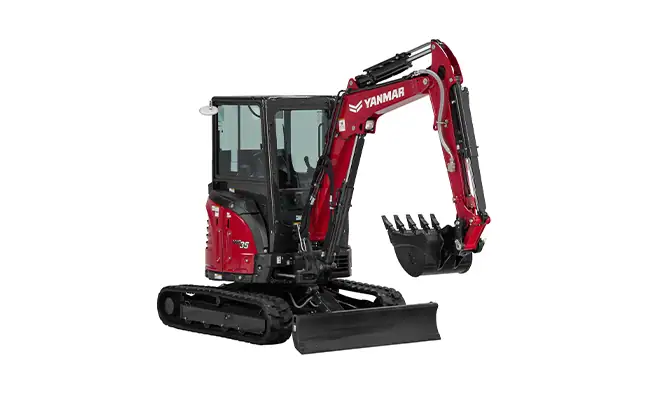
The Yanmar SV40 deserves a close look when an excavator purchase is really a decision about several jobs: digging, positioning an attachment, backfilling and leaving a usable surface. Its blade and hydraulic options can change that package substantially. The best SV40 for a Canadian rural contractor is therefore not necessarily the example with the longest equipment list; it is the one whose installed options solve the work you repeat.
There is also an important layout distinction. Yanmar describes the SV40 as a tight-tail-swing machine, not a true zero-tail model. That difference belongs in the site plan before the machine arrives beside a barn, fence or parked equipment. This guide uses North American manufacturer documentation and does not assume a specific Canadian dealer’s inventory, price or included equipment.
On This Page
ToggleSV40 specifications with their conditions attached
The following figures are from Yanmar’s SV40 specification brochure, carrying a June 2024 specification date.
| Specification | Reference |
|---|---|
| Engine output | 39 hp at 2,400 rpm |
| Overall track width | 1,740 mm |
| Rear swing radius | 990 mm |
| Rubber tracks, canopy / cab | 9,206 / 9,515 lb operating weight |
| Steel tracks, canopy / cab | 9,493 / 9,801 lb operating weight |
| Digging depth A / blade-down B | 3,440 / 3,610 mm |
| First auxiliary circuit | 72.2 L/min at 2,200 rpm |
| Optional second circuit | 38.8 L/min at 2,200 rpm |
The auxiliary figures do not establish simultaneous combined delivery. Adding them together would give a number that this table does not promise. The two depth measurements also describe different diagram conditions and should not be collapsed into one unqualified claim.
Tight tail: quantify the clearance before working near a wall
A simple comparison makes the layout easier to understand. Half the listed width is 870 mm; the rear radius is 990 mm. The difference is 120 mm on a centred, simplified plan view. This shows why the rear housing cannot be assumed to stay entirely inside the track edges.
That calculation is an explanation of the published geometry, not a safe clearance allowance. Ground unevenness, the complete machine configuration, the object beside it and operator movement still matter. An optional counterweight or other fitted equipment must be evaluated using the corresponding dimensions. Never preserve a brochure clearance assumption after changing the machine package.
For work beside farm buildings, mark the actual machine position and the nearby obstacles before considering where the bucket will dump. The rear clearance may be modest while the front working envelope is much larger. A tight-tail machine can still need substantial space for the intended attachment and the material route. Aglist’s tail-swing guide explains these separate envelopes.
Do not pay for a particular rear layout without identifying the restriction it solves. If most work happens in open ground, attachment capability or transport may matter more. If routine work is close to structures, a small dimensional difference can become a daily planning issue.
Blade options: match the movement to the finishing task
The SV40 product page lists standard blade float and optional four- and six-way blades, along with an optional additional counterweight. These choices need to be identified on the actual machine. A generic SV40 advertisement does not establish which blade or counterweight is included.
Start with the material movement you need. A straight pass to push loose backfill into an excavation differs from moving material across the machine’s path or shaping a surface with a crossfall. Additional blade movement may reduce repositioning in some layouts, but its usefulness depends on the permitted operation and the space available to make the pass.
Consider a hypothetical yard repair where the excavator opens a short drainage section, places spoil to one side and then restores the route. If the final blade pass is blocked by the spoil arrangement, more blade articulation will not solve the planning error. Establish the final exit and material sequence first. Then decide which blade movements would improve the work.
During inspection, have every fitted blade function demonstrated according to the operating instructions. Look for damage, leakage, worn joints and controls that do not behave as expected. Price the repair of the installed option rather than valuing it as fully functional because it appears in the listing.
Two auxiliary circuits are not the same as one larger circuit
A second circuit is most relevant when a compatible attachment needs a separately controlled function. It should be selected by the attachment’s hydraulic diagram and operating requirements, not by adding published flow figures. Ask which functions the complete excavator-and-tool arrangement is designed to operate together and under what conditions.
Build an attachment worksheet with separate rows for each function. Record its flow range, pressure limits, return requirements, control type and connection arrangement. Then identify which installed circuit supplies each function. This exposes a missing provision more clearly than a sales description saying the machine has plenty of hydraulics.
An optional circuit on the manufacturer’s list is not evidence that it exists on a used machine. Inspect the hoses, connectors and controls, and obtain documentation for aftermarket changes. A neatly routed hose does not prove that its return path or control arrangement is correct for your tool. Where the attachment is central to the business, make demonstrated compatibility part of the purchase assessment.
A hydraulic thumb is a useful example of a function that needs to be evaluated through its motion and interaction with the bucket. The excavator thumb comparison explains the operational choice. A more complex multi-function attachment requires a more detailed match; the presence of a thumb circuit should not be taken as universal readiness.
Digging and grading should share a coherent bucket package
Choose the digging bucket from the excavation’s required width, soil conditions and approved machine compatibility. Choose the finishing tool for the final operation. Trying to make one bucket serve every stage can be reasonable for occasional ownership, but the compromise should be deliberate. A contractor who changes tasks repeatedly may value a complete, compatible bucket set more highly.
The manufacturer describes a hydraulic quick coupler with manual safety-pin handling. Include the full locking and verification procedure in your work plan. Store spare buckets where they can be approached and changed appropriately, rather than where they happen to fit on the trailer. The coupler’s convenience depends partly on that arrangement.
For used purchases, check every included bucket against the installed interface. Look at pin and locking areas, movement clearances and any repairs. A mismatched collection of attachments can add cost and risk instead of value. The bucket width and capacity guide offers a useful way to compare purpose rather than simply counting bucket sizes.
Where the SV40 package fits Canadian work
Mixed rural construction and maintenance
A machine used for several short jobs can spend considerable time setting up, changing tools and restoring access. Evaluate whether the SV40’s selected blade and attachment configuration reduce those repeated interruptions. A larger excavator may move material faster on an open site while being less convenient for the actual mix of small jobs.
Document the tasks that occur every week and the exceptions that occur once a season. If a deep excavation or substantial lifting task is exceptional, compare a separate rental or subcontract with the cost of owning and transporting a larger package all year. This keeps an unusual project from dictating every future ownership expense.
Work around buildings and maintained yards
In an established yard, the route and restoration requirements may be as important as digging ability. Identify surfaces that need protection and places where turning is restricted. Rubber tracks can still disturb ground or mark a surface; the material and its condition determine what protection is appropriate.
In spring and autumn, reassess the route instead of assuming that yesterday’s access remains suitable. Moisture and thaw can change support conditions. Track material, tight-tail geometry and engine output do not establish whether the ground can carry the operation.
Repeated cold-weather operation
Inspect the actual cab equipment and its function when year-round work is part of the purchase. Visibility, entry and exit, glazing and the operator’s ability to use controls with the required clothing are practical concerns. A cab option should be evaluated as working equipment, not simply an increase in resale appeal.
Transport: options can change the whole decision
The operating-weight table is the beginning of transport planning. The fitted counterweight, blade, coupling equipment and carried tools must be accounted for in the real package. Establish the equipped weight and check the entire towing and trailer arrangement, including the trailer itself and applicable requirements.
Also check physical loading and storage. A package that technically fits the deck may leave no sensible space for the required attachments or their securement. Include the cost of a workable transport layout in the purchase comparison. It is better to discover a necessary trailer change before negotiating the excavator than after delivery.
Do not use the weight class as an object-handling rating. Lifting capacity varies with position and configuration and needs the applicable chart. A counterweight option does not authorise an invented increase in every lifting position.
Used SV40 inspection priorities
For this model, begin with an equipment inventory: exact identity, blade type, tracks, operator enclosure, coupler, counterweight and auxiliary circuits. That list determines which specification and service documents apply and whether two quotations describe comparable machines.
Inspect the undercarriage and front joints, then examine the additional mechanisms that made the listing attractive. An elaborate blade or attachment package can carry repair costs beyond the base excavator. Have hydraulic functions demonstrated after normal warm-up, with suitable equipment and according to the manual. A short unloaded movement is not a substitute for a proper assessment of a tool you intend to rely on.
Review service records and obtain independent estimates for uncertain wear or repairs. These are general inspection priorities, not a claim of recurring SV40 failures. Compare candidates in equivalent ready-to-work condition, including missing tools and transport changes.
Comparison and common questions
The Takeuchi TB240 guide is a useful additional reference when comparing compact excavation packages. Compare actual clearance, work envelope and installed equipment rather than treating similar weight classes as identical machines.
Is the SV40 a zero-tail excavator?
No. The manufacturer describes a tight-tail layout. Use the actual rear clearance and equipped dimensions when planning work near obstacles.
Should I automatically choose the six-way blade?
Only if its documented functions serve recurring tasks and justify the added purchase and maintenance considerations. Evaluate the passes you need to make and the condition of the option supplied.
Can the two auxiliary flow ratings be added?
Not as a claim of available combined attachment flow. The published circuit entries do not establish simultaneous performance. The complete hydraulic arrangement must match the tool’s requirements.
Does an extra counterweight solve any lifting problem?
No. Use the appropriate chart for the equipped machine and actual load position. Counterweight also affects the package that must be transported and cleared around obstacles.
What should be demonstrated before buying?
The features central to your work: fitted blade movements, coupler procedure and required attachment circuits, as well as basic excavation control. Record any function not demonstrated and resolve it before valuing the package as complete.
Share your experience
Help other Canadian buyers — leave a quick review for the
Yanmar SV40
There are no reviews yet. Be the first one to write one.