Overview & Specs
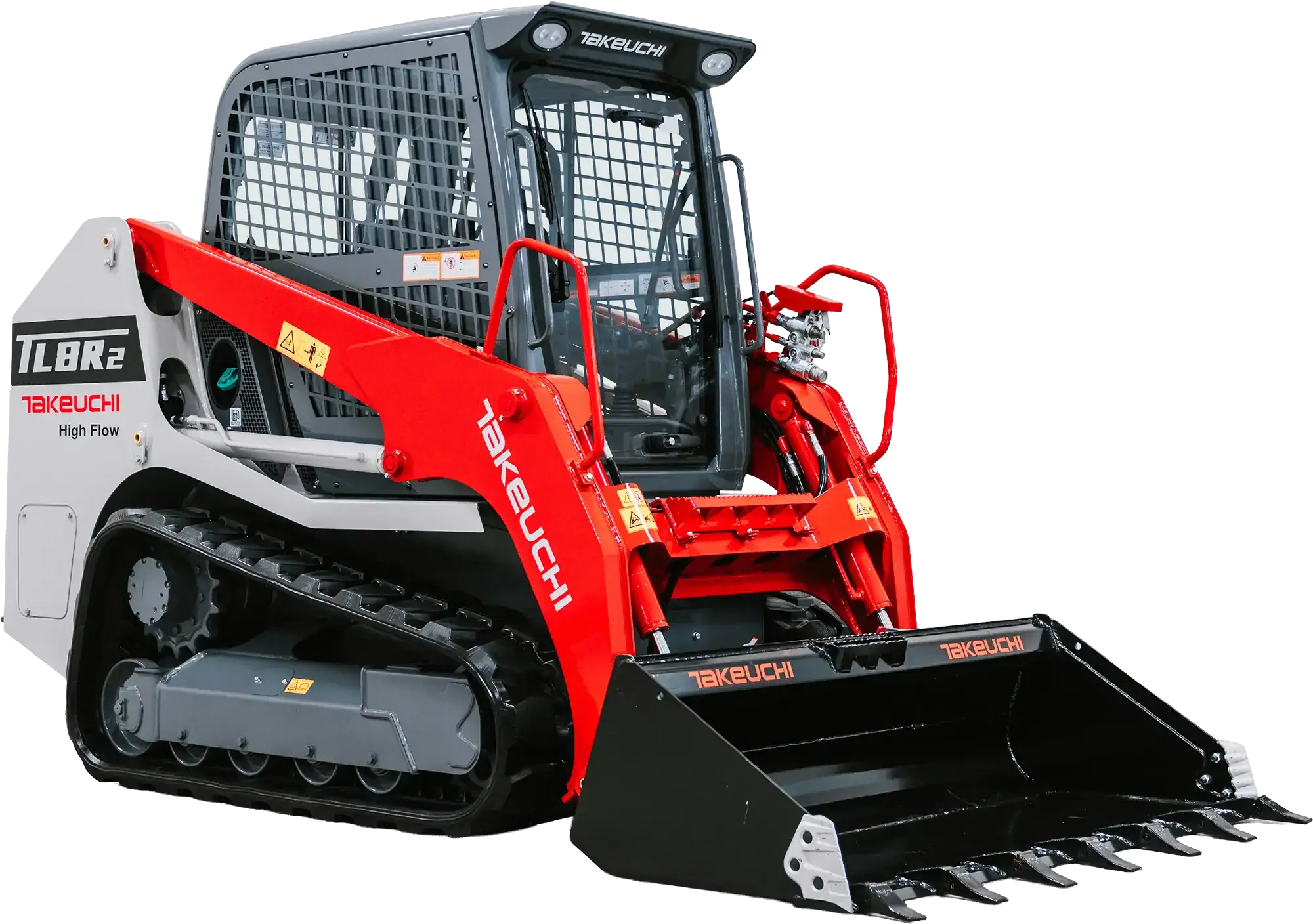
The Takeuchi TL8R2 is especially worth examining when a Canadian buyer needs a radial-lift track loader that can move material and spend meaningful time running a powered attachment. Its most useful equipment distinction is the high-flow package with creep mode. That combination can matter more to a trenching or surface-preparation workflow than a small difference in advertised engine power.
It is still possible to overbuy. If the machine mainly handles a bucket and compatible forks, extra hydraulic equipment may contribute little. Start with the tool and the finished task, then decide whether a standard-flow or high-flow TL8R2 is the appropriate purchase. The following assessment separates those choices and explains what to inspect on a used example.
On This Page
ToggleWhich TL8R2 does this guide describe?
This is the North American TL8R2, also written TL8R-2. It is not a specification guide for the earlier TL8. The detailed reference is Takeuchi’s October 2022 brochure, currently linked from the manufacturer’s model page. Minor headline rounding differs between the brochure and website; the table keeps the brochure basis together.
| Item | Documented value |
|---|---|
| Power | 74.3 hp at 2,600 rpm |
| Operating weight, canopy / cab | 3,995 / 4,165 kg |
| ROC, 35% basis | 960 kg / 2,116 lb |
| Width without bucket | 1,660 mm |
| Transport height / with top guard | 2,230 / 2,290 mm |
| Bucket-pin height / dump height | 3,080 / 2,420 mm |
| Primary / optional high flow | 72.3 / 128 L/min |
The brochure identifies DOC and DPF aftertreatment. It also distinguishes optional protective equipment and cab provisions. Do not assume that a used machine includes every pictured option.
The high-flow decision starts at the attachment
Choose a specific attachment before assigning value to high flow. Obtain its permitted flow and pressure range, return requirements, case-drain requirement where applicable, electrical controls and approved carrier information. A tool described simply as a trencher, cutter or planer may have several versions with different requirements.
The official TL8R2 page identifies creep mode and load-sensing two-speed travel as features of high-flow models. Creep allows travel speed to be selected for attachment work. That is a different benefit from merely increasing the available hydraulic flow.
Consider an attachment whose useful working speed is much slower than ordinary travel. Without a repeatable speed setting, the operator may spend effort continuously managing the travel command while watching the tool. A compatible creep-equipped package is worth demonstrating for that task. The outcome to measure is the quality and consistency of the finished work, not just whether the loader moves slowly.
High flow does not approve every demanding tool. The complete installation still needs appropriate cooling, controls, return plumbing, guarding and operating instructions. An apparently matching flow number cannot establish all of those requirements. Aglist’s standard versus high-flow hydraulics guide explains how to organize the comparison.
When the standard-flow version is enough
A bucket-focused owner should avoid treating the high-flow badge as a general increase in loader capacity. Extra auxiliary flow serves the attachment circuit; it does not turn the machine into a different lifting class. A suitable standard-flow package can be the more coherent purchase when powered-tool work is limited.
List the intended tools in three groups: already required, likely within the next season and merely interesting. Obtain a fit assessment for the first group. Price the second group with realistic expected use. Leave the third group out of the initial business case unless a clear job emerges.
This approach is particularly useful for acreage ownership. A large collection of tools creates storage, service and transport obligations. A smaller set that is properly matched to regular work often delivers more value than a package assembled around hypothetical future capabilities.
A radial loader still needs a loading plan
The TL8R2’s radial lift arrangement is relevant to digging, grading and material movement. It does not mean truck loading should be ignored or that every truck will fit. The bucket follows a changing path, and the receiver must be positioned within the approved work arrangement.
Distinguish maximum pin height from actual dump clearance. Measure the receiving side and the desired deposit position with the proposed bucket. A tool with different geometry can change that relationship. Watch the full approach, raise, discharge and return cycle during a demonstration.
If tall loading dominates the schedule, compare a vertical-lift candidate such as the Kubota SVL75-3 using the same receiver and material. That comparison should identify a real geometric benefit, rather than simply rank radial and vertical machines as good and bad categories.
Capacity: define the complete handling task
The brochure’s rated operating capacity is based on the stated 35% convention. Its larger 50% reference should not be used to create a new everyday operating allowance. Follow the applicable rating and attachment information for the actual configuration.
For farm handling, determine the weight and shape of the normal load. A pallet of bagged product, a wrapped bale and a bucket of loose material can place their centres of gravity differently. An attachment’s own mass and geometry also affect the assessment.
Do not conclude that a pallet is acceptable merely because the material label is below the headline ROC. Include packaging, the pallet, attachment requirements and the intended placement height. Aglist’s capacity guide provides a fuller explanation of those distinctions.
Dimensions that affect a real property
The documented machine width excludes the bucket. Check the tool’s width and the route’s narrow points, turns and obstructions. For a hydraulic attachment, account for its working envelope as well as its travel position. An attachment that enters the site may need more space to operate there.
The separate top-guard height is another reason to inspect the offered configuration. A protective package can change the clearance requirement. Do not select the lowest brochure dimension while assuming equipment from a taller version is fitted.
On a farmyard, map the route between storage, work and disposal locations. Repeated crossings, parked equipment and snow storage can change the usable layout through the year. A machine comparison should use the constrained parts of that route, not only the open demonstration area.
Ground conditions and undercarriage costs
Tracks spread the load over a footprint, but that is not a guarantee of flotation on every wet surface or protection of every lawn. Loaded travel and steering differ from a stationary catalogue condition. Avoid treating a low pressure number as permission to enter ground of uncertain support.
For a buyer working partly on finished surfaces and partly on loose ground, compare the available approved tread options with the surface priorities. The job may call for protecting a route, changing its layout or postponing work. Equipment selection is one part of that plan.
Undercarriage inspection should include more than tread depth. A qualified assessment can identify damaged rubber, uneven wear and concerns involving rollers, idlers or sprockets. Ask for repair estimates on the package as found. New tracks on an otherwise worn undercarriage do not by themselves establish low future cost.
A demonstration for attachment work
Prepare a short task brief that describes the intended material, required finish, attachment model and acceptable working area. Have a competent operator demonstrate the approved combination after compatibility and condition checks. An unrelated tool on a different surface may make an impressive video while answering little about your purchase.
Record productive time, repositioning, adjustments and interruptions separately. For a creep-equipped machine, observe whether the selected travel behaviour supports consistent output over the representative task. Check the transition from tool operation to ordinary movement under the manufacturer’s procedures.
Do not use the trial to discover the machine’s limit by overloading it or forcing the attachment. The trial should confirm a previously specified suitable application. If it reveals a mismatch, change the package or method rather than treating the problem as something the operator must overcome.
Put a price on the option with explicit assumptions
Suppose a complete high-flow package costs CAD 4,000 more in your quotations and saves an assumed 20 minutes on each relevant working day. At an assumed usable time value of CAD 90 per hour, that is CAD 30 per day. The simple recovery point would be about 134 such days, before maintenance, financing or other differences.
Those figures are illustrative, not market prices or measured TL8R2 performance. The important detail is “relevant working day.” Days spent only moving a bucket should not be counted as if the hydraulic option creates the same saving.
Compare renting the specialized package for occasional work. Rental delivery, availability and scheduling matter, but ownership also carries costs while the tool is unused. Use expected jobs or actual records instead of optimistic annual machine hours.
Cab, emissions and Canadian service planning
Match the operator environment to the work calendar. A cab can be valuable when the machine is expected to work through changing weather, but the installed heating, ventilation and visibility equipment need to function properly. Inspect door movement, seals, glazing and the view of the intended attachment.
For a used machine, request maintenance and aftertreatment records. The documented DPF arrangement means a buyer should understand the correct operating and service procedures. Have warning history assessed through proper diagnosis; do not accept a claim that disabled emissions equipment is an upgrade.
Local support should be part of the quote. Establish who can diagnose the machine and attachment combination, how routine parts will be supplied and where repairs will take place. A contractor using a powered tool for booked work has a different downtime exposure from an owner with flexible projects.
Inspect the used machine as a working package
Confirm that the identity plate, offered model and documented hydraulic version agree. Then verify installed controls and accessories. The presence of extra hoses or a high-flow decal is not a complete configuration record.
Have structural condition, loader joints, coupler locking components and hydraulics inspected. Observe an appropriate cold start and warmed-up operation. Any leak, warning or irregular movement needs diagnosis before it is priced as a minor inconvenience.
Inspect included attachments separately and document their identification. A tool may have had a very different duty cycle from the carrier. The machine’s hour reading cannot tell you whether every accessory is ready for work.
Transport and final comparison
Use the weight basis for the actual enclosure and installed equipment, then account for everything carried to the job. Check what is already included to avoid double-counting. Assess the full vehicle and trailer combination rather than relying on a nominal trailer capacity alone.
The John Deere 317G is another catalogue starting point for a comparison. Match the exact generation, tools and task. A lower purchase price is meaningful only after missing provisions, repairs, delivery and support have been considered.
Frequently asked questions
Is TL8R2 simply another spelling of TL8?
No. Use documentation for the full model and serial. The earlier TL8 should not inherit these specifications or option descriptions.
Does every TL8R2 have creep mode?
The cited manufacturer information ties creep mode to high-flow models. Confirm the installed version instead of assuming it from the model badge.
Does high flow increase rated payload?
It serves compatible powered attachments. It does not independently replace the machine’s applicable capacity rating.
Can a guarded cab run any forestry tool?
No. The complete carrier, attachment and protective package must be approved for the intended work. A visible guard is not universal authorization.
What should decide between standard and high flow?
The verified requirements and expected use of specific attachments, supported by a representative demonstration and a complete installed-cost comparison.
Share your experience
Help other Canadian buyers — leave a quick review for the
Takeuchi TL8R2
There are no reviews yet. Be the first one to write one.