Overview & Specs
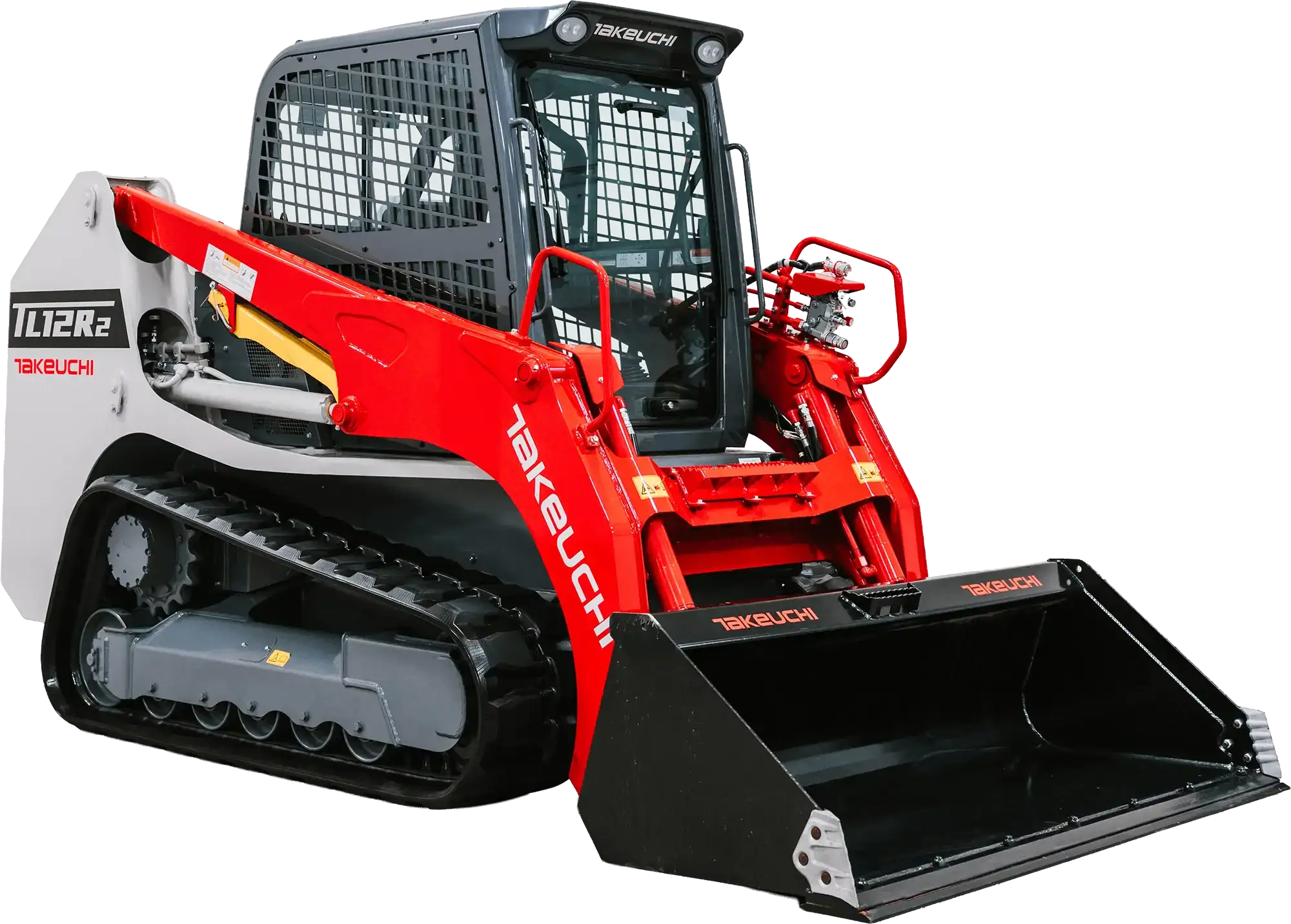
The Takeuchi TL12R2 is a heavy radial-lift compact track loader to consider for substantial ground work and suitable powered attachments. Its buying case is not simply that it has a large engine. The useful question is whether its hydraulic package, working geometry and weight help complete demanding recurring tasks without making transport, surface restoration or ownership unnecessarily expensive.
For a Canadian contractor, that may mean sustained site preparation with a defined attachment. For a farm, it may mean a combination of material movement and property projects. Those uses need different tool packages, so the TL12R2 should be specified from the workload outward rather than purchased as a supposedly universal large loader.
On This Page
ToggleTL12R2 specifications: keep the configuration together
The table follows Takeuchi’s October 2022 North American brochure, linked by the current TL12R2 model page. TL12R2 and TL12R-2 are used for the designation. Do not substitute figures from a TL12V2 or an older TL12.
| Item | Brochure value |
|---|---|
| Power | 111.3 hp at 2,400 rpm |
| Operating weight, canopy / cab | 5,580 / 5,710 kg |
| Published ROC, SAE J818 | 1,349 kg / 2,975 lb |
| Width without bucket | 1,960 mm |
| Bucket-pin / dump height | 3,200 / 2,400 mm |
| Primary / optional high flow | 88 / 153 L/min |
| Ground pressure, canopy / cab | 4.58 / 4.68 psi |
The brochure’s capacity footnote says no more than 35% of tipping load. It specifies DOC, DPF and SCR aftertreatment with a DEF tank. Use its published rating rather than replacing it with your own percentage calculation.
What work justifies the heavier package?
Begin with the tasks that occur often enough to define ownership. Repeated earthmoving, a particular powered attachment or a demanding material-handling sequence may justify examining a substantial carrier. An impressive one-off project is a weaker basis if most later work is modest.
Describe the limiting factor in the current method. Is the attachment unsuitable, the material difficult to work, the receiving arrangement slow or the route inaccessible? Those are different problems. More engine power does not automatically solve all of them.
A hypothetical contractor preparing several sites each season should record how much time is actually spent using the demanding attachment. If most paid hours instead involve waiting, travel and small cleanup tasks, a large ownership package may be underused. Compare a smaller everyday machine plus rental of a specialized package for the intensive stage.
For a farm, distinguish routine chores from land-development projects. A loader selected around a temporary project may require more hauling and service infrastructure than the subsequent workload supports. That does not make the purchase wrong, but its convenience and future use should be explicit in the calculation.
Radial geometry and ground work
The manufacturer’s current page identifies radial lift. That makes the machine relevant to buyers evaluating digging, grading and material movement through lower and intermediate positions. It does not establish a universal advantage over vertical lift, and it does not remove the need to check a loading receiver.
Ask for a demonstration that resembles the work being quoted. For grading, evaluate the specified finished result and the number of passes. For material transfer, include pickup, travel, discharge and cleanup. A strong isolated movement is not the same thing as an efficient complete process.
Truck loading should be assessed with the intended bucket and vehicle. The pin-height and dump-height rows answer different questions. Check the useful discharge position and the space needed around the receiver. Aglist’s lift-path guide explains why geometry needs to be matched to the task.
Power does not define pallet capacity
The TL12R2’s engine output should not be interpreted as a lifting rating. Hydraulic capability, stability, attachment geometry and the manufacturer’s operating limits are separate parts of the assessment. Another machine with similar horsepower can have a different rated load and lift path.
For pallet, bale or irregular-material work, determine the actual load and its centre of gravity. Include the attachment and the required placement. Do not use bucket breakout force as though it were the weight that can be carried on forks.
A seller may emphasize a larger reference percentage or a counterweighted configuration. Verify that the offered machine has the documented equipment and use the applicable published rating. Aglist’s ROC explanation provides a method for separating those numbers without creating a new operating allowance.
Specify hydraulics before buying a powered tool
The flow choices make the exact machine package important. The Takeuchi model page distinguishes standard and optional high-flow systems. A used TL12R2 badge alone does not establish which one is installed or what supporting provisions are present.
Start with the attachment’s accepted flow and pressure ranges, return requirements and electrical controls. Check its approved carrier mass and any guarding or cooling requirements. An attachment marketed for a similar horsepower class can still be the wrong installation.
If the task requires another hydraulic function, identify how that function is supplied and controlled. The brochure describes an optional secondary circuit associated with the high-flow package. Do not assume every high-flow sale machine includes it, or that two published circuit figures can be added to claim simultaneous tool output.
Obtain a complete quotation covering the tool, connections, controls, installation and commissioning. A bare attachment price can hide meaningful additional cost. For a business dependent on the tool, a demonstrated suitable installation should be part of the acceptance criteria.
Guarding is a package requirement, not a label
The manufacturer lists additional protective equipment for certain configurations. Treat that information as a reason to specify the intended application carefully. A polycarbonate door or visible top guard does not prove that the machine is approved for any cutter, mulcher or debris-producing task.
Identify the exact attachment and work environment, then obtain the required carrier and protection configuration from the relevant manufacturers. Confirm what the quotation includes and what it excludes. A used machine’s modifications should be assessed rather than automatically treated as valuable upgrades.
During a demonstration, stay within the approved application and procedures. The purpose is to evaluate a suitable package, not to test whether improvised protection will survive an unsuitable task. A purchase guide cannot replace the specific operating and installation documentation.
Cooling access and the ownership routine
Sustained attachment work makes inspection and service planning important to the business case. Examine how routine checks and cleaning are performed using the correct manual. Access that looks convenient in a brochure must still be usable with the installed equipment and the owner’s service arrangements.
Have the cooling system and hydraulic condition assessed during a used inspection. Look for records, damaged components, leakage or warning history and obtain diagnosis where needed. Do not infer that the model has a recurring overheating problem simply because cooling matters to the proposed application.
Record the conditions of a representative warmed-up demonstration. A brief idle period cannot establish performance during the intended work. Equally, a trial should not be used to push a questionable machine until a fault becomes dangerous or causes damage.
DEF and DPF belong in the operating plan
The documented aftertreatment arrangement adds specific fluid and service responsibilities. Before purchase, make sure the operator understands the applicable instructions and that supplies, storage and servicing can be managed at the work location.
On a used example, request maintenance records and investigate unresolved warnings. Have the system assessed by qualified personnel when its condition is uncertain. Treat undocumented alterations as a matter requiring resolution, not a reason to assume lower running costs.
For Canadian seasonal operation, use serial-specific guidance for fluids, starting and storage. Do not copy a procedure from a smaller loader with a different emissions arrangement. The actual work calendar and service access should influence the package selected.
Low ground pressure does not mean low transport weight
The pressure and operating-weight rows illustrate two different properties. A broad track footprint can produce a relatively low nominal pressure while the loader remains a substantial object to transport. Neither number substitutes for the other.
For site work, evaluate support, surface sensitivity and the intended movements. Tracks do not guarantee that saturated ground, buried structures or finished paving can tolerate the machine. Include the loaded arrangement and turning areas in the plan.
For transport, establish the weight basis of the configured loader and account for every tool and item of cargo. Check what is already included to avoid double-counting. Assess the hauling combination, usable payload, deck space and ratings, along with applicable requirements.
If moves are infrequent, obtain a professional transport quote. If moves are frequent, include travel and loading time in the ownership calculation. A machine that performs well on site can still be an inefficient purchase when moving it consumes too much of the schedule.
Compare complete methods with real inputs
Suppose a hypothetical heavy package saves three working hours on a project but adds CAD 500 in delivery and associated movement costs. At an assumed time value of CAD 120 per hour, the time saving is CAD 360. Under those assumptions the method costs CAD 140 more before other differences.
Those are illustrative values, not Canadian transport rates or measured Takeuchi results. The heavier package could still be justified by the required finish, scheduling or an attachment the smaller machine cannot use. The point is to keep those reasons visible instead of claiming that faster active work always means lower total cost.
Use actual quotations and expected utilization for a real decision. Include repairs, tools, storage, insurance and service logistics as appropriate. Treat resale and future jobs as uncertain inputs rather than guaranteed recovery of the purchase price.
Used TL12R2 inspection priorities
Verify the model, serial, enclosure, hydraulic package, counterweights and modifications. Match those details to the documentation used for capacity and transport. A photograph or decal is not enough to establish the entire configuration.
Have the running gear, structural condition, loader pivots, coupler locks and hydraulic system inspected. The undercarriage should be assessed as a whole, including rubber, rollers, idlers and sprockets. Price identified work before comparing the machine with a ready-to-use offer.
Inspect attachments individually and record what is included. An expensive-looking tool can be poor value if its condition, compatibility or operating history is uncertain. The carrier’s hours do not describe every accessory’s use.
Alternatives and the final shortlist
The Kubota SVL97-3 and Bobcat T770 provide other catalogue starting points. Compare exact configurations against the same job brief; they should not be treated as interchangeable simply because all are track loaders.
Reject packages that fail an essential task, access or hauling requirement. Then compare demonstrated output, condition, service and full delivered cost among the suitable candidates. That order prevents an attractive horsepower figure from concealing an operational mismatch.
Frequently asked questions
Does 111.3 hp make the TL12R2 a high-capacity pallet machine?
Horsepower is not a payload rating. Use the applicable machine-and-fork information for the actual load, centre and placement.
Is high flow standard on every machine?
The cited information lists it as an option. Verify the installed system and supporting provisions on the offered loader.
Can I use TL12V2 lifting figures?
No. The radial and vertical models have different configurations and ratings. Use TL12R2 documentation for this machine.
Does low nominal PSI make wet ground acceptable?
No. Site support and the intended loaded movements require their own assessment. Nominal pressure is a comparison value, not a ground approval.
When does the heavier radial package make sense?
When a recurring, verified task benefits enough from the complete arrangement to justify its transport, tools and ownership obligations.
Share your experience
Help other Canadian buyers — leave a quick review for the
Takeuchi TL12R2
There are no reviews yet. Be the first one to write one.