Overview & Specs
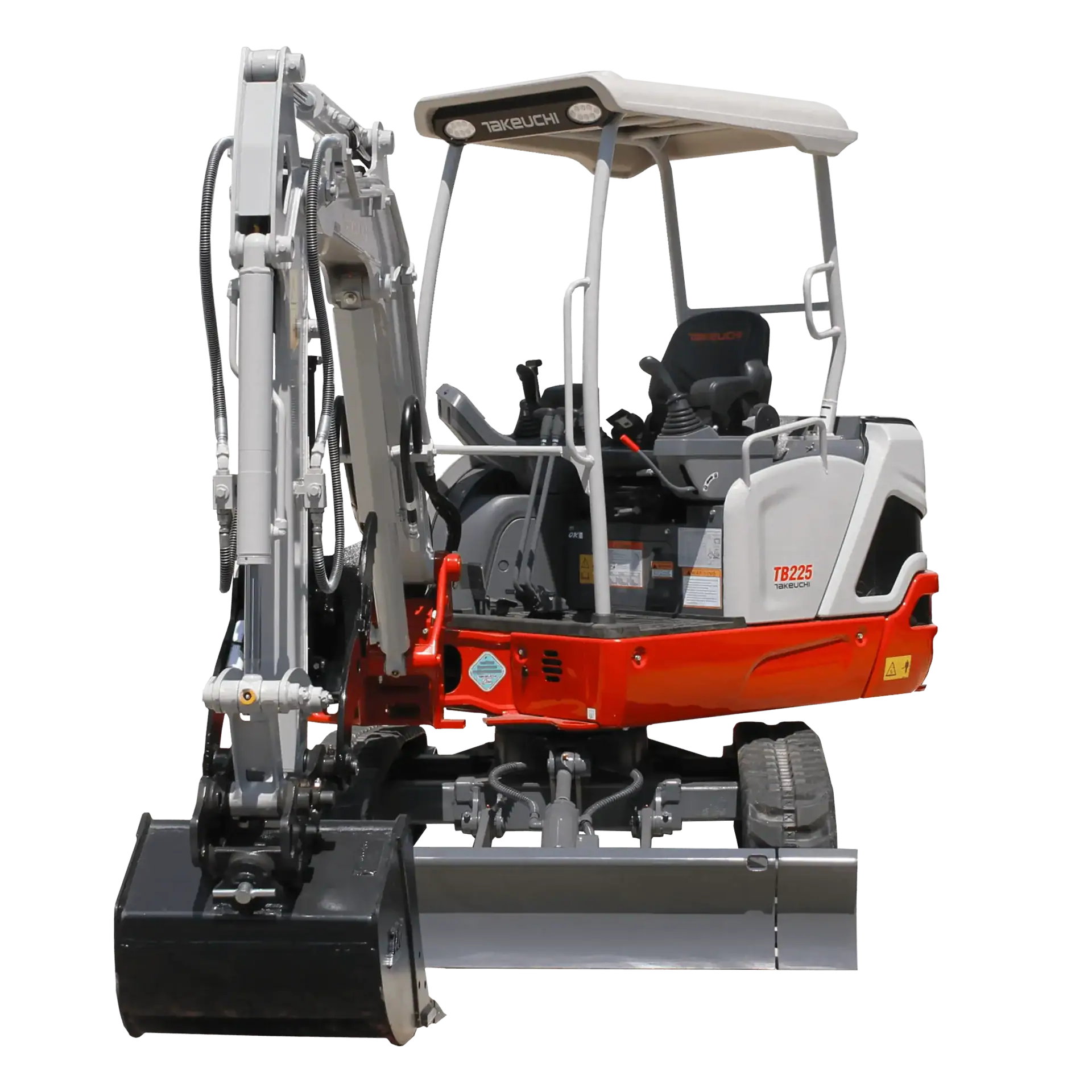
The Takeuchi TB225 is a useful candidate when a contractor needs more working range than the smallest excavator package offers, but a narrow access route still controls the purchase. Its variable-width undercarriage is the central feature: it can use one track width for a suitable passage and another for the working configuration. The decision is therefore about the complete route and job, rather than simply buying the heaviest machine that fits through a gate.
For Canadian acreage maintenance, landscape excavation and repeated property jobs, the TB225 deserves a demonstration that includes setup, digging and discharge. Its electronic attachment controls are also worth assessing if hydraulic tools form part of the work. Neither the adjustable tracks nor a digital setting makes an unsuitable attachment or site arrangement acceptable.
On This Page
ToggleSpecification basis and source dates
This guide uses the North American TB225 page and the brochure linked by Takeuchi. The PDF filename refers to March 2022, while its printed form date is March 2021. Keep that distinction in equipment records; the document is not automatically a model-year declaration for a used machine.
| Item | Brochure reference | Buying implication |
|---|---|---|
| Engine output | 19.6 hp at 2,400 rpm | Not an attachment output or lift rating |
| Operating mass | 2,265 kg | Verify the actual equipped transport package |
| Track width | 1,100 mm retracted; 1,500 mm extended | Check both passage and working position |
| Maximum depth | 2,580 mm | Use the matching range drawing |
| Ground-level reach | 4,250 mm | Different from reach at depth |
| Primary auxiliary flow | 37.7 L/min | Match the actual tool circuit |
The current webpage rounds the imperial operating weight differently from the brochure, while both give the same metric reference. Do not turn a tiny conversion difference into a claimed equipment upgrade. Record the actual enclosure, arm, tracks, coupler and tools before using any weight for a transport decision.
Four hundred millimetres of width change needs a plan
The difference between the cited retracted and extended widths is 400 mm. That can be meaningful along a restricted access route, but the route must accommodate the complete machine and its carried equipment. Check corners, changes in level, overhead restrictions and the blade arrangement as well as the nominal opening.
At the destination, establish the space needed to use the correct working configuration. The brochure’s example lifting table explicitly states that its values use the fully extended undercarriage. Do not apply those values to a retracted machine or use them without the rest of the chart conditions.
This is a broader buying lesson: a machine can pass an access test and still fail the working-layout test. A suitable place to stand, sufficient movement clearance and a practical material destination are all necessary. Write down those requirements before treating the retractable feature as the answer to a difficult job.
For a landscaper serving mixed properties, compare several typical routes rather than one exceptional gate. If only a rare assignment needs the narrowest arrangement, rental may be worth including in the comparison. If restricted access occurs weekly, the feature may affect the useful market for the owned machine.
Do not mistake retractable tracks for compact rear rotation
The brochure’s rear slew radius is 1,240 mm. That measurement comes from the rotation reference, not from the edge of the tracks. The rotating rear remains a separate clearance question from the width used to travel into the work area.
Sketch the intended excavation and dumping movements. Mark the fixed obstacles, supporting equipment and locations where people must be kept clear under the site plan. The front tool, boom and carried material also occupy space; reducing one machine dimension does not reduce every moving envelope.
A TB225 comparison should therefore include candidates with different rear layouts when rotation is the main problem. A narrower entry arrangement may be less important than a more useful working position after arrival. The right answer depends on which constraint actually interrupts the job.
The standard long arm: compare useful positions
The cited package has a 1,245 mm arm. Rather than treating the phrase long arm as a universal performance advantage, use the documented dimensions to test the recurring task. Maximum reach, ground-level reach and maximum digging depth describe different points in the range diagram.
A useful work area includes the cut, bucket filling, extraction and discharge. If the bucket reaches a point but cannot repeat the full movement conveniently, the headline depth has not established productive capability. Coupler and bucket geometry should remain part of that assessment.
The depth and reach guide explains how to read the envelope. Establish suitable machine positions independently, then determine whether the excavator can work from them. Do not change an excavation arrangement merely to make a marginal equipment choice appear adequate.
Electronic flow settings are useful only when the tool is identified
The brochure describes adjustable auxiliary flow and saved attachment presets. For an operator alternating approved hydraulic tools, these features can help make setup repeatable. Their value depends on having the correct requirements and a clear record of which setting belongs to which attachment.
Keep an attachment sheet with the tool identity, accepted flow range, pressure and return requirements, mounting information and approved machine arrangement. A saved number is not evidence of compatibility. It can reproduce an incorrect setup just as consistently as a correct one.
The total hydraulic flow entry is 62.8 L/min, distinct from the 37.7 L/min primary auxiliary reference. Use the circuit supplying the tool rather than selecting a breaker or auger against the combined system figure. Maximum flow and pressure also should not be multiplied into a guaranteed continuous tool output without the applicable performance information.
During a demonstration, have the regular operator identify and select the approved setup and show the intended task. Include the transition back to ordinary digging. This reveals whether controls and tool changes support the working routine, rather than merely proving that an attachment moves.
Build a bucket package around finished work
List the common excavation widths, material types and finishing requirements. Then choose a compatible digging and cleanup package. A collection of included buckets has value only where the mounting, condition and intended use are established.
For example, a property contractor may need a digging tool for the required cut and a separate finishing bucket for the final surface. The finishing tool’s wider coverage does not make it the correct choice for every excavation. Compare complete job time, including unwanted material removal and restoration.
If handling with a thumb is important, specify the bucket, coupler and thumb together. Useful contact and stowed clearance can change with the bucket arrangement. The thumb comparison helps define that purchase without treating a mounting provision as a complete installation.
A whole-job example
Assume a hypothetical small project takes three hours of active excavation and another hour of setup, tool changes and material handling. Reducing active digging time by ten percent saves 18 minutes. Removing a separate 25-minute setup delay would save more, even though it might not change the machine’s digging speed at all.
Those numbers are planning assumptions, not measured TB225 performance. They show why the demonstration should record separate stages. The adjustable undercarriage and attachment controls have potential value when they remove a real restriction or delay; they should not be assigned an invented productivity percentage.
For repeat work, record several completed jobs. Note access preparation, bucket choice, material removal and restoration. That evidence will show whether the next equipment purchase should target reach, access, attachment changes or a supporting machine.
Operator environment and Canadian use
The cited brochure describes a four-post canopy arrangement. Consider weather exposure and the length of normal working sessions. A seasonal owner and a contractor with a longer annual schedule may value shelter differently, even when the excavation requirement is similar.
Inspect the offered seat, controls, display and visibility rather than assuming that every used TB225 retains its original condition. Have the actual operator assess entry, exit and comfortable control use. A brief stationary inspection can miss an awkward working posture that becomes important over repeated days.
Cold-season preparation belongs to the applicable manual for fuel, fluids, starting and warm-up. Ground conditions also change the task. Do not treat the published depth and force figures as a guarantee for frozen material or every Canadian winter assignment.
Transport and ownership cost
Start with the documented machine configuration, then establish the ready-to-move package. Account for installed equipment and separately carried tools without counting the same bucket twice. A reference operating mass does not replace measured loaded weights or the ratings for the actual hauling combination.
Include trailer deck space, loading geometry and securement arrangements in the comparison. A narrow excavator can still have an inconvenient transport package if several attachments must travel with it. The towing vehicle, trailer and applicable requirements need their own assessment.
For an owner keeping the machine at one property, compare delivery with owning and maintaining transport equipment. For a contractor, count the time spent loading and moving between sites. Both can be sensible arrangements; the useful comparison follows your actual move frequency and local quotations.
Keep financing, service, storage and repair allowances separate from speculative resale or hourly revenue. Saved personal time may be valuable without creating cash income. A realistic ownership estimate describes those benefits honestly.
Used TB225 inspection priorities
Confirm the serial identity and installed configuration first. Check the adjustable track and blade equipment, then have a competent inspector evaluate the undercarriage, linkage, structure and hydraulics. Look for evidence of repairs and establish what needs correction before normal use.
Review the attachment controls and saved settings with the equipment documentation. A previous owner’s preset names are not proof that your tools share the same requirements. Resetting or commissioning an installation should follow the applicable documentation and be handled by qualified personnel.
Observe a representative working demonstration after appropriate checks and warm-up. Distinguish unfamiliar controls from mechanical limitations, and investigate symptoms rather than assuming a particular failed component. This guide does not establish a model-specific defect pattern or guaranteed service life.
Price missing components, initial service and delivery alongside the asking price. A less expensive machine can become the more costly working package if it needs a coupler, plumbing and repairs before the first planned job.
Compare the actual constraint
The Bobcat E26 and Kubota U27-4 guides provide other starting points. Verify the offered generations and manufacturer dimensions before comparing them. Nominal size labels do not establish equivalent access or attachment capability.
The strongest TB225 case is a recurring job that benefits from its variable-width arrangement and a documented attachment package. If the working area, depth or tool requirement remains unresolved, keep that item open rather than allowing an attractive price to turn it into an assumed pass.
Frequently asked questions
Can the brochure lift figures be used with retracted tracks?
The cited example table specifies fully extended tracks. Use the applicable chart and every stated condition for the actual task; do not transfer those values to another arrangement.
Does a saved attachment preset approve a tool?
No. Compatibility comes from the tool and carrier requirements. A preset is a way to select documented settings after that match is established.
Is total pump flow the flow available to a hydraulic attachment?
Use the circuit-specific auxiliary rating and the complete hydraulic requirements. The brochure lists those flows separately for a reason.
What should be demonstrated before acceptance?
The required access and working setup, representative digging and discharge, and each important approved tool function. Include the transitions that affect normal job time.
What should stay with the machine records?
Keep serial-specific documents, attachment identities, configuration changes and service history together. They make later tool purchases and transport planning more dependable than an old sales description.
Share your experience
Help other Canadian buyers — leave a quick review for the
Takeuchi TB225
There are no reviews yet. Be the first one to write one.