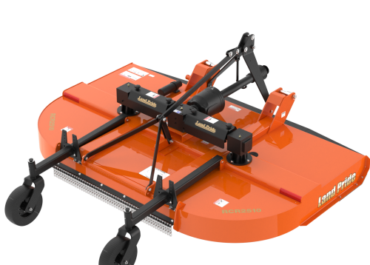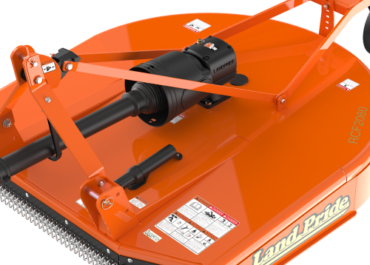
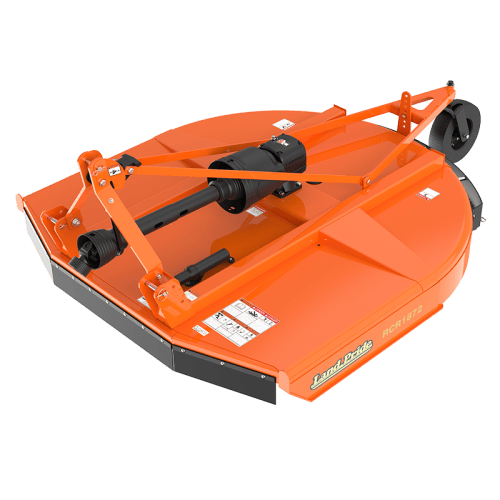
Overview & Specs
The Land Pride RCR1872 is a six-foot rotary cutter for owners whose grass and brush work calls for a two-inch cutting-capacity class, rather than a finish-mower result. Its appeal is the combination of useful coverage and a relatively straightforward three-point attachment. The purchase becomes less straightforward when a buyer treats tractor horsepower as the entire compatibility test: the cutter extends well behind the hitch, and its weight depends on the driveline and guarding package.
For a Canadian acreage, start with the ground that actually needs cutting. Open rough grass, controlled regrowth and maintained field margins make a different case from a landscaped lawn, an unknown abandoned site or a steep ditch. This guide uses Land Pride’s February 1, 2025 RCR1860/RCR1872 operator manual. It separates published specifications from practical planning examples; it does not claim an owner test or a guaranteed production rate.
On This Page
ToggleThe configuration behind the specifications
| Item | RCR1872 specification | Buying implication |
|---|---|---|
| Cutting width | 72 inches | Useful swath differs from the space needed for the complete machine. |
| Overall width and length | 77 inches; 110 inches | Measure gates, storage and turning space. |
| Listed weight | 737 lb in the stated configuration | This includes laminated tailwheel, slip-clutch driveline, front rubber guards and rear metal band. |
| Recommended tractor power | 20–65 hp | The manual’s tractor range is not a promise of full productivity in every crop. |
| Hitch and input | Category 1; 540 rpm PTO | Check the tractor, hitch arrangement and complete driveline fit. |
| Cutting capacity | Up to 2-inch diameter material | This is a vegetation limit, not permission to strike hidden obstacles. |
| Gearbox ratio | 1:1.46 | Do not assume the RCR1860 uses identical drive parts. |
These figures come from the RCR1860/RCR1872 operator manual. Record the serial number and actual options on a used machine before applying them. A seller’s short description of a “six-foot Land Pride mower” does not identify its duty class, protection device or original equipment.
What the two-inch capacity changes
The capacity matters when regrowth is part of the recurring job. It gives a buyer a concrete boundary to compare with the largest stems in the intended work, rather than choosing only by deck width. Walk a representative area and identify the vegetation before pricing a cutter. An average stem size hides the small number of larger pieces that can determine whether the task belongs with a different machine or contractor.
Do not interpret that diameter as an instruction to drive into every patch that appears smaller. Density, visibility, terrain and the ability to keep people away still shape the operation. A crowded stand is a different workload from isolated stems of the same diameter. Nor does the specification describe stump grinding, land clearing through debris or cutting wire. Those are separate hazards and tasks.
For an already maintained pasture margin, a repeatable cutting plan may be more useful than extra theoretical capacity. For an unfamiliar property, an inspection and initial cleanup may matter more than choosing the largest deck the tractor can lift. The cutter should fit the identified work after that assessment, rather than being used to discover what is hidden in it.
Six feet of cutting, more than six feet of machine
The 77-inch overall width deserves its own measurement on a property with narrow entrances. A nominal six-foot opening is not adequate merely because the cut is six feet. Also account for alignment, uneven ground and the tractor itself; a straight measurement between gateposts is only one part of access.
The 110-inch overall length affects where the rear of the cutter goes during a turn. Sketch the route around trees, fence corners and buildings with the complete tractor and attachment in mind. A machine that fits while parked may be awkward to swing into the storage bay. Open areas allow width to earn its keep; repeated tight manoeuvres can erase much of the apparent advantage.
Think about the final strips beside obstacles before buying. If the job includes extensive careful trimming with another tool, compare complete property-maintenance time. Faster coverage through the middle does not necessarily reduce the labour spent along the boundary. This is especially relevant to acreages with many shelterbelt edges, gates and divided paddocks.
Tractor fit is a system decision
The published horsepower range is a starting screen. Next consider rear lift capacity at the relevant position, the tractor’s approved ballast arrangement, tire setup, terrain and control of the raised attachment. An implement’s own weight and its distance behind the tractor both matter. Do not subtract 737 lb from an unrelated lift figure and call the remaining number a safety margin.
Keep engine horsepower and PTO horsepower separate when comparing tractor advertisements. Our guide to tractor PTO horsepower versus engine horsepower explains why those numbers cannot be exchanged. Here, the manufacturer’s range is identified as recommended tractor horsepower; it has not been relabelled as a PTO-power range.
A lower-powered tractor within the stated range may require a different travel pace in heavy growth from a more powerful compatible tractor. The useful question is whether your tractor can complete your actual work acceptably while following both manuals. That assessment includes handling and transport, not only keeping the cutter turning on a favourable demonstration patch.
Hitch movement and driveline fit
The manufacturer’s RCR18 product page describes the floating top-link arrangement and available guarding. The practical buying distinction is between a correctly assembled system that accommodates the intended movement and a collection of parts that merely connects. Missing or substituted hitch hardware on a used cutter warrants attention before work begins.
Quick-hitch convenience does not remove the need to check the driveline throughout the permitted operating range. Changing the distance between tractor and implement can change shaft requirements. A shaft previously shortened for another tractor is not automatically suitable for yours. Use the assembly-specific instructions; an online universal cutting measurement cannot establish correct fit.
The Category 1 quick-hitch compatibility guide covers the broader connection questions. For the RCR1872, record the tractor model, quick hitch if used, cutter serial number and driveline identification together. That record makes later parts and service enquiries much more precise.
Shear bolt or slip clutch: compare the actual package
The manual lists shear-bolt and two-plate slip-clutch driveline alternatives. The choice changes ownership preparation, not the cutter’s vegetation rating. A sacrificial fastener means having the exact specified replacement available. A friction clutch means attending to its prescribed inspection and maintenance, including after inactivity. Neither option makes repeated overloads an acceptable way to work.
On a used machine, ask which driveline is installed now rather than which option appeared on the original invoice. Identification matters because maintenance details can differ between assemblies. The manual itself distinguishes clutch procedures by driveline number; appearance alone is a poor basis for an adjustment.
Compare quotations with guards, driveline and tailwheel listed explicitly. A lower price for an incomplete machine may not remain lower once missing protection and worn components are restored. This is a complete-equipment comparison, not a reason to omit required safety equipment to meet a budget.
RCR1872 versus the narrower RCR1860
Within the same manual, the RCR1860 has a 60-inch cutting width and a listed 599-lb weight in the corresponding stated configuration. The RCR1872 adds 12 inches of cutting width and 138 lb. That comparison helps explain why moving up one width is also a handling decision. It is not just another foot of grass cut on each pass.
Purely geometrically, 72 inches is 20% wider than 60. At identical speed and overlap proportion, ideal travel time over a large rectangle would fall by about 16.7%, because the time ratio is 60 divided by 72. That is a planning relationship, not a manufacturer productivity claim. Turns, obstacles and slower travel in heavier growth can change the result substantially.
The narrower choice can be sensible when access and tractor handling dominate. The wider choice earns consideration when the tractor is fully compatible and open acreage makes effective use of the extra swath. Do not transfer gearbox or blade information between them simply because both names start with RCR18.
Estimating a complete mowing session
Consider a hypothetical 12,000-square-metre maintained area. Assume an effective swath of 1.65 metres after overlap, travel at 4 km/h, and 60% field efficiency to allow for turns and interruptions. Calculated coverage is 1.65 × 4,000 × 0.60 = 3,960 square metres per hour. The area would therefore require roughly three hours of field work under those assumptions.
This is not a recommended speed or a forecast for this cutter. Change the field efficiency to 40% on a more interrupted layout and the calculation becomes 2,640 square metres per hour, or about 4.5 hours. The difference illustrates why a property sketch and representative route tell you more than width alone.
Add attachment, inspection, cleanup and storage time separately. If a contractor is the alternative, compare the same scope: does the quote include boundaries and awkward sections, or just open mowing? A machine purchase and a service quotation can appear far apart simply because one includes tasks the other excludes.
Inspecting a used RCR1872
Start with identification, completeness and records. Look for the model and serial plate, driveline markings, guarding and evidence of the correct assemblies. Ask for maintenance documentation rather than relying on fresh paint or a statement that the unit “ran last year.” Storage time without use does not prove readiness.
With the machine safely stopped, isolated and supported as the manual requires, a competent inspection should address the deck and mounting structure, tailwheel assembly, gearbox condition, driveline, blade carrier and cutting components. Damage, leakage or looseness needs evaluation in context; it is not evidence that every example of this model has the same problem. Do not crawl under an attachment held up only by the tractor hydraulics.
Arrange any operational demonstration in a controlled, appropriate area with the required guards installed. Its purpose is to assess the particular machine and tractor combination, not to prove maximum cutting capacity by deliberately finding an obstacle. Unexplained vibration or repeated protection activation is a reason to stop and investigate.
Questions buyers often miss
Is it a finish mower for the lawn beside the house?
Choose by the required result. A rough-cutting job and a carefully finished lawn are different objectives. Inspect the desired surface, obstacles and clipping expectations before assuming one attachment should handle both. The RCR1872’s capacity specification does not promise a finish-mower appearance.
Will a smaller cutter always be easier to own?
It may simplify access and handling, but repeated passes over a large open area also cost time. Compare complete fit and total sessions per season. For a smaller-duty model, the Land Pride RCR1260 guide offers another selection context; it is a separate model, not an interchangeable specification sheet.
Should I budget only for blades and grease?
Include inspection, prescribed driveline service, wear components, covered storage if available and the time required to attach and maintain the machine. Keep an allowance for identified used-machine repairs separate from ordinary running costs. No current Canadian retail price is assumed here.
What should settle the buying decision?
Use three tests: the cutter’s documented duty fits the vegetation, the complete attachment fits the tractor and route, and ownership makes sense for the frequency of work. A positive answer to all three is more persuasive than a horsepower match by itself.
Share your experience
Help other Canadian buyers — leave a quick review for the
Land Pride RCR1872
There are no reviews yet. Be the first one to write one.