
Overview & Specs
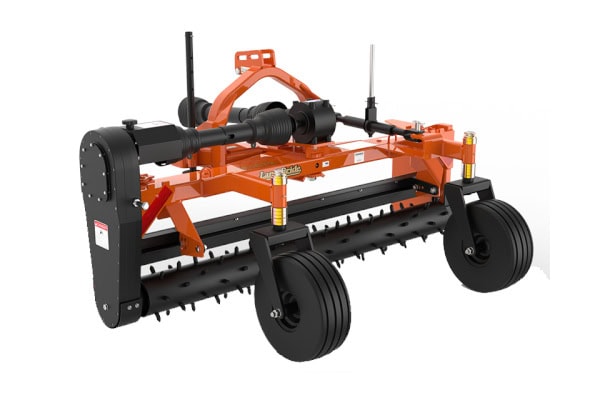
The Land Pride PR1660 is a PTO-powered surface rake for preparing and refining suitable ground, including gathering material into a windrow. Its five-foot working width makes it relevant to smaller landscaping and turf-renovation projects, but the complete attachment is a substantial tractor load. The useful buying question is whether powered surface separation solves your recurring preparation problem better than cultivation or passive finishing alone.
For a Canadian acreage, start with what must be left behind: a suitable seedbed, a refined surface or an area with selected debris gathered for removal. The PR1660 does not make unwanted material disappear. Planning where that material goes is central to judging the attachment’s value.
On This Page
ToggleWhat is documented for the PR1660?
The October 30, 2025 operator manual provides the following model-specific starting points. It covers several widths, so keep the PR1660 column separate from the larger machines.
| Item | PR1660 specification |
|---|---|
| Non-angled working width | 60 inches |
| Weight | 980 lb |
| Tractor range / hitch | 25–60 hp / Category 1 |
| PTO speed | 540 rpm |
| Angle adjustment | 15 degrees left or right; manual or hydraulic configuration |
| Material-control deflector | Urethane |
| Side plates | Removable, with storage provision |
Older literature can differ in driveline details. Use the applicable manual and actual assembly identification for service; do not combine an older promotional driveline category with newer maintenance instructions. The listed weight likewise needs to be reconciled with any equipment added to the offered package.
Surface refinement is different from deep preparation
A powered rake should be selected for its intended surface-working role. It is not a substitute for every preceding operation that a neglected plot may need. Large buried obstructions, major grading requirements or an unsuitable underlying surface should be assessed separately before deciding how to finish the area.
The mechanism can alter the surface and move selected material, but the project’s acceptance criteria still need to be stated. A visually smooth strip may not meet the requirements of the next operation. Look at the remaining material, profile and consistency rather than treating any visibly worked soil as ready for seeding.
For a useful comparison, describe three conditions: the starting ground, the required finished surface and the material that must be removed. If the third item is substantial, include collection and disposal in the work plan. Otherwise, an impressive first pass can leave the owner with the most time-consuming part still unfinished.
Angling creates a material-handling decision
The left and right angle choices let the working process be organised around the desired direction of material movement. Plan the receiving side before starting a comparison. A windrow beside an accessible collection area is different from one trapped against a fence or left across the only exit.
On a rectangular plot, the most convenient direction may be clear. On an irregular area divided by beds, trees or access lanes, the route needs more thought. A demonstration should include those transitions rather than only an uninterrupted straight run.
Angling also changes the straight-across geometry. As a simple illustration, 60 inches multiplied by the cosine of 15 degrees is about 58 inches. That calculation is only a geometric projection, not a claim about net treated width or recommended overlap. Actual pass spacing should be based on the required result and correct operation.
Do not use the non-angled width as a complete access dimension. The tractor, wheels, hitch and other components need their own clearance check, especially when entering a narrow plot or returning to storage.
The deflector changes what remains
The manual explains that the opening at the material-control deflector influences the separation and resulting surface. This is a useful reason to compare settings through the prescribed procedure on representative suitable ground, rather than judging the attachment from one arbitrary demonstration setup.
A finer-looking result is not always the best project outcome. Define what the next step needs and avoid unnecessary processing. Equally, do not accept a coarser result solely because it lets the tractor travel faster if it leaves additional work that matters to the project.
Record the configuration when evaluating a trial. Without that record, a successful result may be difficult to reproduce, and a comparison with another tool may be unfair. The machine model alone does not identify the working setup.
The removable side plates should be included in that configuration record. Confirm they are present on a used offer and that any stored components actually belong to the machine. A missing accessory can change the offered process even if the rake still runs.
Manual or hydraulic angling?
The manual arrangement and hydraulic arrangement should be priced as complete packages. The hydraulic version requires the appropriate duplex outlet and connections. A tractor’s general hydraulic capability does not establish that the necessary rear control is already installed.
Count how often the actual route requires an angle change. If the job is one long series of similar passes, powered adjustment may have limited convenience value. If direction changes frequently across separate areas, the operator routine may be different. Use the work pattern rather than assuming hydraulic adjustment always pays for itself.
For an invented comparison, twelve required setup interruptions at two minutes each total 24 minutes. Reducing each to a hypothetical half-minute would save 18 minutes. That arithmetic is not measured PR1660 performance or permission to adjust anything outside the manufacturer’s procedure. It merely identifies an item worth timing in a representative demonstration.
List any tractor-side installation cost separately. The accessory price alone may understate the complete change. Conversely, an already-equipped tractor may make the option easier to justify without altering the rake’s basic surface-working capability.
A compact working width can still mean a heavy rear load
The 980-lb specification deserves attention when matching a smaller tractor. Evaluate the applicable rear lift rating, carrying geometry, ballast and control of the raised implement. A narrow attachment is not automatically a light attachment.
The 25–60-hp range does not settle those issues. Keep the manufacturer’s tractor-power wording intact and distinguish it from PTO output. The PTO versus engine horsepower guide explains why an advertised tractor number is only one part of matching.
Include the quick hitch from the beginning if it will be used. Changes in connection geometry affect clearance and driveline assessment. The quick-hitch guide provides the broader framework, but the actual rake, shaft and tractor combination must follow the applicable setup instructions.
Soil condition can outweigh adjustment
The PR16 manual cautions that wet, sticky soil is unsuitable for good performance. More power or a different deflector setting cannot be assumed to correct an unsuitable day. Build flexibility into the project schedule, particularly when spring conditions limit access.
A trial on dry, favourable ground also should not become a promise for every condition. Record the starting surface and moisture condition in the demonstration notes. If the intended work differs materially, qualify the comparison instead of extrapolating a single result.
Inspect the site for hazards and complete the appropriate preparation before engaging the machine. A powered rake is not a detector for buried debris. Where the ground’s history is uncertain, that uncertainty belongs in the project assessment before equipment selection.
Compare against passive finishing and powered cultivation
The SP2060 soil pulverizer provides another surface-finishing approach. A powered rake adds a different working mechanism and material-handling capability, but also adds driveline and service considerations. The additional complexity should solve a specific problem.
A rotary tiller addresses a different cultivation process. If the plot needs that work before finishing, compare the complete sequence rather than expecting the rake to reproduce it. Conversely, do not add extensive cultivation to an already suitable surface solely because the equipment is available.
The APS1572 seeder guide shows why preparation and seed application should be assessed as separate project outcomes even when combined on one implement. A PR1660 purchase should fit into the establishment sequence, not become the entire sequence by assumption.
Time the cleanup as well as the rake
Suppose a hypothetical 2,400-square-metre project is worked at an effective width of 1.35 metres and a suitable 4 km/h pace. At an assumed 60% field efficiency, coverage is 3,240 square metres per hour. One comparable working pass takes about 44 minutes.
If gathering and removing the resulting windrow takes another 50 minutes, that stage exceeds the powered-raking time. Improving its collection route by 15 minutes could matter more than a modest increase in working width. These invented inputs illustrate project accounting, not tested production or operating recommendations.
Record all stages: inspection, setup, working passes, collection, transport of removed material, final checks and cleanup. If a contractor’s quote includes those tasks, compare it with the same complete owner-operated scope.
For occasional one-time landscaping, a rental or service may be more practical than buying a powered attachment that later sits unused. For recurring preparation across several sites, availability and repeatable setup can support ownership. The frequency should come from real projects rather than imagined future uses.
Used PR1660 inspection priorities
Identify the model, serial number and installed angling arrangement. Check whether the removable parts, guards and driveline components are complete. Ask what service has been performed and which parts have been replaced.
Under the prescribed shutdown and support procedures, have the roller, working studs, bearings, deflector, side plates, gauge wheels, drive components, frame and hitch assessed. Inspect the hydraulic option separately if present. Wear, damage or leakage needs a repair scope, not a guessed discount.
A powered trial should establish the surface result and proper function on a suitable site. Unexplained vibration, abnormal noise or repeated protective-device activation is a reason to stop and investigate. These checks are general purchase safeguards, not evidence of a recurring PR1660 fault.
Price identified repairs and setup before comparing the offer with a serviceable alternative. Include time to obtain parts. A project that must wait for restoration has a different value from a ready attachment available in the appropriate working window.
Frequently asked questions
Is the PR1660 a deep-tillage machine?
Its documented purpose centres on surface preparation and refinement. Assess major cultivation or reconstruction needs separately.
Does the rake collect debris into a container?
Plan the material destination and subsequent collection explicitly. Windrowing is not the same as removing material from the property.
Does hydraulic angling make the finished surface better automatically?
No. It changes the adjustment routine. Surface condition, configuration and operation still determine the result.
Will a tractor that lifts it empty be suitable?
A lift demonstration alone does not establish complete compatibility, ballast, driveline fit or control across the intended route.
Who should shortlist this model?
An owner with repeated surface-preparation work that benefits from powered refinement and planned material separation, supported by a fully verified tractor and a workable cleanup process.
What should a handover include?
Keep the installed angling configuration, driveline identification and removable-part inventory with the manual. Record the representative surface used for the demonstration and what collection work remained. This gives the next project a useful starting record without turning one successful setup into a universal prescription.
Share your experience
Help other Canadian buyers — leave a quick review for the
Land Pride PR1660
There are no reviews yet. Be the first one to write one.


