
Overview & Specs
HLA Snow Blade 2000 Series Reviews, Specs & Ratings
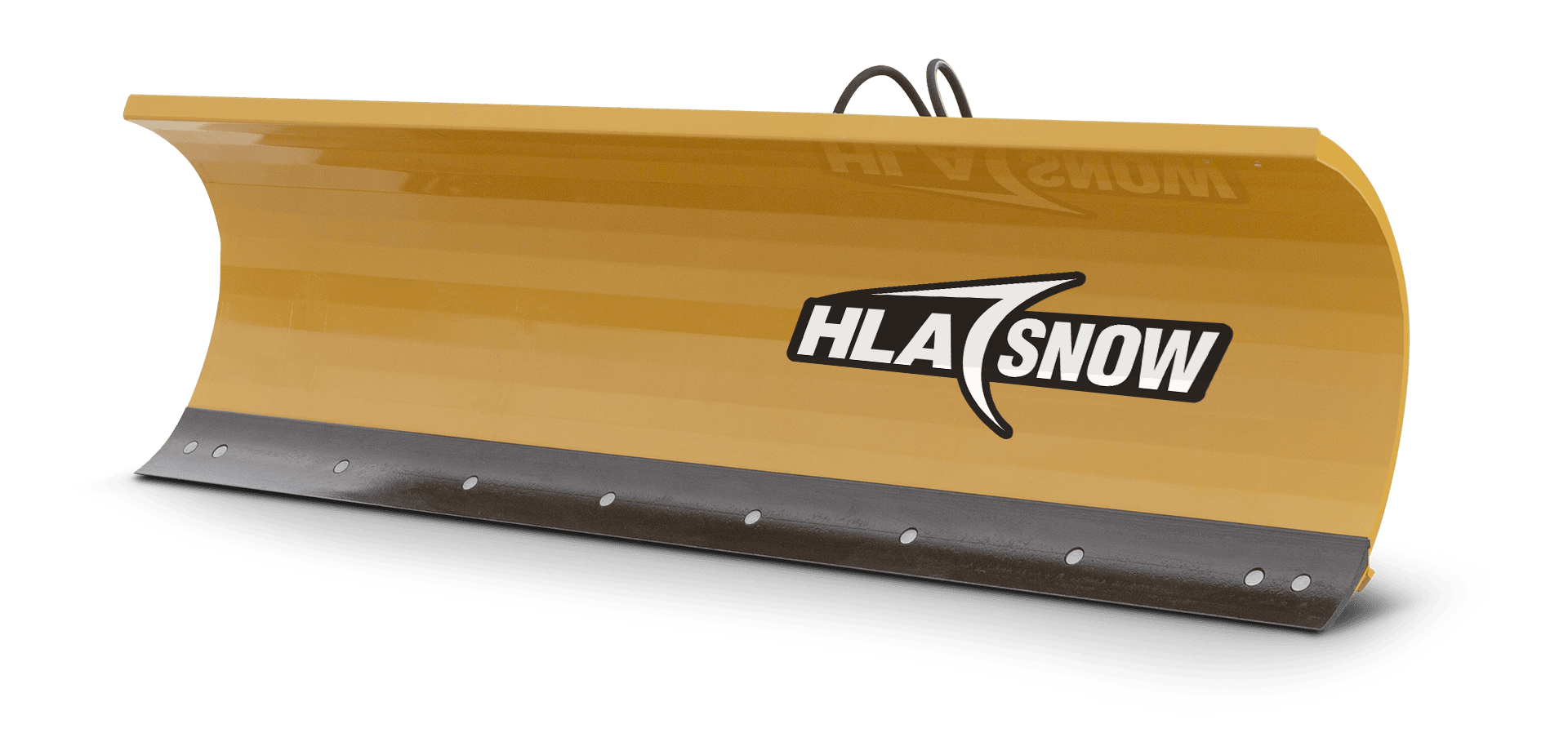
The HLA Snow Blade 2000 Series is HLA Snow’s step-up angle blade between the homeowner-class 1000 Series and the commercial-grade 3000 Series — engineered specifically for compact tractors and skid steers in the 2,500 to 5,000 lb operating weight class. Built in Wallenstein, Ontario by Horst Welding, the 2000 Series delivers a meaningful step up from the 1000 Series by including hydraulic angling as standard equipment (vs optional upgrade on the 1000), adding crossover relief valve protection, and introducing spring-trip cutting edge feature that protects against hidden obstacle damage.
The 2000 Series fills the most-common compact tractor gap in HLA’s lineup. It’s appropriate for mid-range compact tractors (Kubota L2502, L3302, L3902, John Deere 2032R, 2038R, similar 25-45 HP machines) and smaller skid steersthat have outgrown the 1000 Series but don’t yet need the commercial-class 3000 Series construction. For Canadian buyers in this in-between size class, the 2000 Series typically delivers the best capability-per-dollar match.
Key features include the 24-inch tall moldboard with precision-engineered curve construction, 35° hydraulic anglingstandard via dual cylinders, crossover relief valve protection that redirects hydraulic pressure when the blade strikes an obstacle, lateral float for following ground contours, spring-trip feature (cutting edge trips back when struck by hidden obstacles), replaceable reversible steel cutting edge (rubber option available), and adjustable steel skid shoes.
Available in widths from 60″, 72″, 84″, and 96″, with weights ranging 550 to 635 lb depending on configuration. Canadian pricing typically ranges $2,500-$4,000 CAD for standard configurations, with the 8-ft (96″) width being the most-installed for mid-range compact tractors.
On Aglist, this page goes beyond HLA’s brochure to help Canadian buyers understand when the 2000 Series is the right choice over the lighter 1000 Series or heavier 3000 Series, the meaningful jump in features (crossover relief, spring-trip, hydraulic angling standard), and which compact tractors pair best.
Aglist advantage: Use the 2000 Series Reviews & Ratings section below to compare real Canadian owner feedback on mid-range compact tractor performance, the crossover relief valve in real obstacle-strike conditions, and long-term value vs OEM Frontier/Land Pride alternatives.
On This Page
ToggleQuick Specs
- Equipment type: Step-up compact tractor / small skid steer angle snow blade
- Manufacturer: HLA Snow / Horst Welding (Wallenstein, Ontario, Canada)
- Series: 2000 SnowBlade
- Compatible machines: Mid-range compact tractors, smaller skid steers
- Target machine operating weight: 2,500 to 5,000 lb
- Recommended HP range: 25 to 50 HP
- Available widths: 60″, 72″, 84″, 96″
- Moldboard height: 24 inches
- Weight range: 550 to 635 lb depending on width and configuration
- Angling range: 35° in either direction (hydraulic standard)
- Crossover relief valve: Standard (2000 Series-specific feature)
- Spring-trip cutting edge: Standard
- Cutting edge: Replaceable, reversible steel (rubber option available)
- Skid shoes: Adjustable steel
- Lateral float: Standard
- Mounting options: JDQA (John Deere Quick Attach), SSQA (Universal Skid Steer Quick Attach), and other major loader styles
- Country of manufacture: Made in Canada
- Warranty: HLA Snow standard warranty
Reviews & Ratings on Aglist
Factory specifications tell you what the HLA SnowBlade 2000 Series is engineered to do. Real owner reviews tell you whether HLA’s step-up angle blade delivers the right balance of capability and value for the most-common compact tractor class.
What 2000 Series buyers consistently want to know:
- Is the step up from the 1000 to the 2000 worth the price premium for a 30 HP compact tractor?
- How meaningful is the crossover relief valve in real cold-weather obstacle strikes?
- What width works for my specific tractor (L2502, L3902, 2032R, 2038R)?
- Does the spring-trip cutting edge actually trigger when struck, or is it just marketing?
- Real-world cutting edge wear life — reversible steel vs rubber for residential driveways?
- How does the HLA 2000 compare to OEM Frontier and Land Pride angle blades in this size class?
This is where real Canadian owner experience matters most. The 2000 Series sits in HLA’s “sweet spot” position — bridging homeowner pricing with commercial-grade features. Owner reviews on this page help future buyers understand whether the 2000 is the right step up from the 1000, or whether stepping up to the 3000 Series makes more sense for their specific machine.
What Makes the 2000 Series Different
Three engineering decisions define the 2000 Series within HLA’s SnowBlade lineup.
Hydraulic Angling Standard (vs Optional on 1000)
The 2000 Series includes hydraulic angling as standard equipment — a meaningful step up from the 1000 Series where hydraulic is an optional upgrade. The dual hydraulic cylinders allow the operator to change blade angle from the cab — no dismounting required.
For mid-range compact tractor operators, in-cab angle control matters because:
- Cold-weather operation is far more comfortable
- Faster angle changes during clearing sessions
- Better adaptability to varied snow and surface conditions
- Removes the friction of manual angling that often leads operators to “just leave it at one angle” rather than optimize
The hydraulic system on the 2000 Series uses standard auxiliary hydraulic connections on the host tractor — compatible with virtually all compact tractors that have auxiliary hydraulic remotes (most current models).
Crossover Relief Valve Protection
The 2000 Series introduces crossover relief valve protection — not available on the 1000 Series. The crossover relief valve sits between the two angling cylinders and protects the blade and host machine from obstacle impact damage.
How it works:
- Under normal operation, the valve stays closed and the cylinders work normally
- When the blade strikes a fixed obstacle (curb, frozen ice, hidden concrete), hydraulic pressure spikes in the compressed cylinder
- Crossover relief valve opens at the preset threshold
- Hydraulic fluid flows from high-pressure side to low-pressure side
- Blade gives way without damage to cylinders, frame, or host tractor’s loader arms
For compact tractor FEL operations specifically, crossover relief protection matters because compact tractor loaders are more sensitive to impact forces transmitted back through attachments. Without crossover relief, an obstacle strike on an angled blade can:
- Bend the cylinder rods
- Damage the cylinder mounting points
- Crack the blade frame welds
- Stress the host tractor’s loader arms and hydraulics
For typical residential and acreage operations, the crossover relief valve typically pays back the first time it prevents damage from an unexpected obstacle strike.
Spring-Trip Cutting Edge
The 2000 Series introduces spring-trip cutting edge protection — not available on the 1000 Series. The cutting edge can trip backward when struck by a hidden obstacle (manhole cover, frozen debris, expansion joint), then springs back to position.
This is different from but complementary to the crossover relief valve:
- Crossover relief — protects against impacts to the moldboard structure (curbs, larger obstacles)
- Spring-trip cutting edge — protects against impacts to the cutting edge (smaller surface obstacles)
Together, these two protection systems cover the most-common obstacle-strike scenarios for compact tractor angle blade operation. For commercial properties with hidden hazards (drainage grates, manhole covers, decorative concrete edges), the combination is meaningful daily-operation insurance.
Crossover Relief Valve Protection
The crossover relief valve deserves dedicated explanation because it’s the 2000 Series’ most-important commercial feature.
Why It Matters
Standard angle blades without crossover relief use rigid hydraulic cylinders that resist any pressure change. When the angled blade strikes a fixed obstacle:
- Forward momentum continues
- Cylinders cannot give way
- Impact force transmits through the cylinder rods to the cylinder mounts to the frame
- Eventually something fails — cylinder rod bends, mount cracks, or frame welds break
With crossover relief:
- Forward momentum continues
- Hydraulic pressure spikes in the compressed cylinder
- Crossover relief valve opens at preset threshold
- Fluid transfers to the opposite (unloaded) cylinder
- Both cylinders give way smoothly
- Blade swings backward to absorb impact
- No structural damage
The crossover relief valve redirects energy rather than resisting it — the same principle that makes spring-trip cutting edges effective, applied to the entire blade assembly.
Real-World Benefit
For Canadian compact tractor operators with mixed surface conditions:
- Properties with hidden concrete edges (under snow)
- Driveways with embedded drainage covers
- Country roads with deteriorating shoulders
- Acreage with potential debris from previous storms
The crossover relief valve provides meaningful protection for the host tractor’s expensive FEL and hydraulic systems. Cylinder repair or replacement on a damaged blade is far cheaper than repair to a host tractor’s loader arms or hydraulic system.
Spring-Trip Cutting Edge
The spring-trip cutting edge is the 2000 Series’ second protection layer.
How It Works
The cutting edge is mounted to the moldboard via spring-loaded brackets rather than rigid bolt-on connections. When the edge strikes a hidden obstacle:
- Impact force exceeds the spring tension
- Cutting edge trips backward (rotates around the spring axis)
- Spring absorbs and dissipates the impact energy
- When force decreases, spring returns the edge to working position
- Operator continues clearing without stopping
Reversible Edge with Spring-Trip
The standard cutting edge on the 2000 Series is reversible steel — meaning when one wear surface is consumed, flip the edge to use the other surface, doubling the service life. The spring-trip system works equally well with the edge in either orientation.
For long-term ownership, reversible spring-trip edges deliver:
- 2× the service life vs non-reversible edges
- Continuous obstacle protection through full service life
- Lower total cost-per-hour of operation
Rubber Edge Option
For pavement-priority operations (decorative concrete, premium asphalt), a rubber cutting edge option is available. The rubber edge:
- Protects pavement from steel scratching
- Provides gentle scraping
- Shorter wear life than steel (200-400 hours typical residential use)
- Still benefits from the spring-trip mounting
Sizing the 2000 Series
The 2000 Series is available in four widths matched to compact tractor and small skid steer capabilities.
Sizing Recommendations
| Width | Approximate Weight | Recommended Machine Class | Typical HP |
|---|---|---|---|
| 60″ | ~550 lb | Smaller compact tractors with limited counterweight | 25-32 HP |
| 72″ | ~575 lb | Mid compact tractors (most-installed) | 28-38 HP |
| 84″ | ~610 lb | Larger compact tractors, small skid steers | 32-45 HP |
| 96″ (8-ft) | ~635 lb | Larger compact tractors with substantial counterweight, mid skid steers | 38-50 HP |
Specific Tractor & Skid Steer Recommendations
For Canadian buyers with specific machines:
- Kubota L2502 (24.8 HP): 60″ or 72″ 2000 (60″ more conservative)
- Kubota L3302 (~33 HP): 72″ 2000
- Kubota L3902 (37.5 HP): 72″ or 84″ 2000 (most-installed combination)
- Kubota L4802 (49 HP): 84″ or 96″ 2000 (or step up to 3000 Series)
- John Deere 2032R (30.7 HP): 72″ 2000
- John Deere 2038R (36.7 HP): 72″ or 84″ 2000
- Small skid steers under 5,000 lb operating weight: 84″ or 96″ 2000
Counterweight Requirements
For front-loader-mounted blade operation, adequate rear counterweight is mandatory — particularly important on compact tractors. Recommended ballast:
- 60″ 2000 on smaller compacts: 300-450 lb rear ballast minimum
- 72″ 2000 on mid compacts: 400-550 lb rear ballast minimum
- 84″ 2000 on larger compacts: 550-700 lb rear ballast minimum
- 96″ 2000 on largest compacts: 700-900 lb rear ballast minimum
Standard ballast options: 3PH ballast box, liquid-filled rear tires, wheel weights, or rear-mounted implements.
For broader sizing and brand comparison guidance, see our Kubota L02 Series guide and John Deere 1 vs 2 Family guide.
Cutting Edge & Skid Shoe Options
The 2000 Series accepts the same cutting edge configurations as the lighter 1000 Series and heavier 3000 Series.
Cutting Edge Options
Reversible steel cutting edge (standard with spring-trip): Aggressive scraping, long wear life, reversible for double service life. Best for gravel surfaces, packed snow, and ice. Will scratch concrete and asphalt over time.
Rubber cutting edge (option): Gentle scraping, protects pavement surfaces. Best for clean residential concrete and asphalt driveways. Shorter wear life than steel (typically 200-400 hours residential use).
Skid Shoe Adjustment
The adjustable steel skid shoes control cutting edge height above the surface — adjust based on your primary surface:
- For commercial pavement work: skid shoes adjusted to keep cutting edge just barely off the surface (1/8 to 1/4 inch above) — protects pavement while cutting accumulated snow
- For gravel surfaces: skid shoes adjusted meaningfully higher (1/2 to 1 inch above) — prevents cutting edge from digging into gravel
- For packed snow on commercial surfaces: skid shoes adjusted lower for aggressive scraping
JDQA, SSQA & Loader Mount Options
The 2000 Series accepts multiple mounting standards for compact tractor and small skid steer compatibility.
JDQA (John Deere Quick Attach)
For John Deere compact tractors with JDQA-equipped front loaders. Includes the John Deere 1-Series, 2-Series, 3-Series, 4-Series compact tractors with current-generation JDQA loaders.
SSQA (Universal Skid Steer Quick Attach)
For tractors with SSQA-equipped loaders (some Kubota, New Holland, Massey Ferguson) and skid steers. Industry-standard skid steer mounting plate.
Other Loader Mounts
HLA offers mount kits for various non-standard loader configurations:
- Kubota proprietary loader mounts
- Bobcat skid steer plates
- Case skid steer plates
- New Holland skid steer plates
- Custom mount adapters for older or unusual tractor configurations
Verify mounting compatibility with your specific tractor’s loader before purchase. Most dealers can confirm fitment for your exact model.
Best Applications for the 2000 Series
The HLA SnowBlade 2000 Series fits a specific operational profile.
Best fit for the 2000 Series:
- Mid-range compact tractor owners (25-50 HP, 2,500-5,000 lb operating weight)
- Smaller skid steer operators in the 3,000-5,000 lb class
- Acreage owners with significant driveways and varied terrain
- Hobby commercial operators doing light snow contracting
- Buyers stepping up from sub-compact tractors to mid-range compacts
- Operators valuing crossover relief valve and spring-trip protection
- Properties with potential hidden obstacles (drainage covers, expansion joints)
Best fit with rubber cutting edge:
- Decorative concrete or stamped driveways
- Premium asphalt where surface scratching is unacceptable
- Properties with mixed pavement requiring gentle scraping
Less suitable for:
- Sub-compact tractors (under 25 HP, under 2,500 lb operating weight) — step down to HLA SnowBlade 1000 Series
- Mid-frame commercial skid steers (over 5,000 lb operating weight) — step up to HLA SnowBlade 3000 Series
- Heavy commercial operations — 3000+ series for commercial duty cycles and 2-year commercial warranty
- Operations primarily clearing large open areas — consider a snow pusher for better containment
The honest assessment: the 2000 Series is the right answer for most Canadian mid-range compact tractor ownerswith serious driveway and property snow removal needs. It delivers commercial-grade features (hydraulic angling standard, crossover relief valve, spring-trip cutting edge) at a meaningful step down in cost from the 3000 Series — without sacrificing the protection features that matter most for compact tractor FEL operation.
2000 vs 1000 vs 3000
The 2000 Series is HLA’s mid-range SnowBlade. Here’s how it compares to the adjacent models:
| Feature | 1000 Series | 2000 Series | 3000 Series |
|---|---|---|---|
| Target Operating Weight | Up to 3,000 lb | 2,500-5,000 lb | 3,500-13,000 lb |
| Recommended HP | 18-35 HP | 25-50 HP | 30-60+ HP |
| Available Widths | 60″-84″ | 60″-96″ | 6-10 ft |
| Moldboard Height | Standard | 24 inches | 30 inches |
| Approx Weight | 350-500 lb | 550-635 lb | 750-1,200 lb |
| Hydraulic Angling | Optional upgrade | Standard | Standard |
| Crossover Relief Valve | No | Standard | Standard |
| Lateral Float | Available | Standard | Standard |
| Spring-Trip Cutting Edge | No | Standard | Standard |
| Reversible Cutting Edge | Yes | Yes | Yes |
| 2-Year Commercial Warranty | No | No | Standard (heavy-duty series) |
| Approx CAD Price | $1,500-$2,800 | $2,500-$4,000 | $3,500-$6,500 |
Choose the 1000 Series if your machine is under 3,000 lb operating weight (sub-compact tractors and lighter compacts). Entry-level HLA SnowBlade with manual angling option.
Choose the 2000 Series if your machine is 2,500-5,000 lb operating weight (mid-range compact tractors and small skid steers). The most-popular HLA SnowBlade for mid-range compact tractor owners. Adds hydraulic angling standard, crossover relief, and spring-trip cutting edge.
Choose the 3000 Series if your machine is 3,500-13,000 lb (larger compact tractors and small skid steers). Adds commercial-grade heavy-duty construction and 2-year commercial warranty.
The 1000 vs 2000 decision turns on machine size and the value of crossover relief / spring-trip protection. For occasional residential use on sub-compact tractors, the 1000 may be sufficient. For mid-range compact tractor owners with serious property needs, the 2000’s added protection features pay back.
For broader HLA Snow brand information, see the HLA Snow brand page.
Maintenance & Long-Term Ownership
The 2000 Series has a moderate maintenance profile.
Routine maintenance:
- Cutting edge inspection after each storm; replace when thickness reduced by 50%
- Spring-trip mechanism check monthly (verify proper trip and return function)
- Crossover relief valve function check at start of each season
- Skid shoe inspection monthly during season
- Pivot point lubrication monthly during season
- Hydraulic cylinder seal inspection annually
- Mounting hardware inspection at each storm
- Powder-coat inspection annually; touch up bare-metal areas
Typical wear part replacement costs:
- Steel cutting edge (reversible, spring-trip): $150-280 CAD per replacement (typically every 200-500 hours residential use, doubled by reversing)
- Rubber cutting edge: $150-280 CAD per replacement (200-400 hours residential use)
- Spring-trip components: $80-180 CAD per spring assembly (if spring needs replacement)
- Skid shoes: $100-180 CAD per pair (typically last multiple seasons)
- Hydraulic cylinder rebuild kit: $120-250 CAD per cylinder (if needed)
Long-term ownership:
- Welded steel construction typically lasts 15-20+ years with proper care
- Wear parts replaced periodically through service life
- Strong resale value due to HLA brand recognition
- Many Canadian acreage owners run the same HLA 2000 for 15+ years with only periodic wear part replacement
Frequently Asked Questions
Where can I read HLA SnowBlade 2000 reviews and ratings?
On Aglist, the Reviews & Ratings section helps Canadian buyers compare owner feedback, real operating experience, and long-term ownership impressions before choosing the 2000 Series.
Is the HLA SnowBlade 2000 made in Canada?
Yes. HLA Snow manufactures the SnowBlade 2000 Series in Wallenstein, Ontario, as part of Horst Welding’s broader Canadian manufacturing operation.
What’s the difference between the HLA SnowBlade 1000 and 2000?
The 1000 Series targets sub-compact and smaller compact tractors (up to 3,000 lb operating weight) with manual angling standard (hydraulic optional). The 2000 Series targets mid-range compact tractors and small skid steers (2,500-5,000 lb operating weight) with hydraulic angling standard, plus the crossover relief valve and spring-trip cutting edge that aren’t available on the 1000 Series. The 2000 also offers wider width options (up to 96″) and tougher overall construction. The 2000 typically costs $700-1,500 CAD more than equivalent 1000 widths but delivers meaningfully better daily-use features and protection.
What size HLA SnowBlade 2000 do I need for my Kubota L3902?
The Kubota L3902 (37.5 HP) is well-matched to either the 72″ or 84″ width 2000. The 84″ provides more clearing capacity for serious property work; the 72″ is more conservative for very heavy snow conditions or limited counterweight. The 72″ is the most-common installation for the L3902.
What size HLA SnowBlade 2000 do I need for my John Deere 2032R?
The John Deere 2032R (30.7 HP) is well-matched to the 72″ width 2000. Operators in lighter snow regions sometimes choose the 84″ for more clearing capacity, but 72″ is the recommended standard installation with proper counterweight.
Should I get the 96″ (8-ft) version?
The 96″ 2000 is the widest option and works well for larger compact tractors (40+ HP) with substantial rear counterweight (700+ lb). For typical Canadian acreage owners with 30-37 HP compact tractors, the 84″ is more typically appropriate — provides good clearing capacity without overloading the front loader. Note that when angled at 35°, even a 96″ blade has effective clearing width similar to a smaller blade running straight.
Does the 2000 Series include hydraulic angling standard?
Yes. The 2000 Series includes dual hydraulic angling cylinders for 35° in either direction as standard equipment — meaningful step up from the 1000 Series where hydraulic is an optional upgrade.
What’s the crossover relief valve for?
The crossover relief valve protects the blade and host machine from obstacle-impact damage. When the angled blade strikes an immovable object (curb, frozen ice ridge, hidden concrete), the valve opens at preset hydraulic pressure threshold and allows the cylinders to release, letting the blade swing backward to absorb impact. Without crossover relief, the same impact can damage cylinder rods, mounting hardware, and the host tractor’s loader arms. The 2000 Series introduces this feature (not available on the 1000) — it’s one of the most-important reasons to step up from 1000 to 2000.
How does the HLA 2000 compare to JD Frontier or Land Pride OEM blades?
The HLA 2000 typically delivers better long-term value than OEM Frontier (John Deere) and Land Pride (Kubota) angle blades at similar pricing. HLA’s crossover relief valve, spring-trip cutting edge, and reversible cutting edges are protection and value features that OEM alternatives at this price typically don’t match. Many tractor owners who start with OEM angle blades switch to HLA 2000 for the protection features and build quality.
What’s the typical price of an HLA SnowBlade 2000 in Canada?
As of 2026, the HLA SnowBlade 2000 typically ranges:
- 60″ width: $2,400-$2,900 CAD
- 72″ width: $2,700-$3,300 CAD
- 84″ width: $3,000-$3,700 CAD
- 96″ (8-ft) width: $3,400-$4,200 CAD (end-of-season sales can drop this to $1,300-1,500 USD)
Rubber cutting edge typically adds $200-400 CAD over standard steel. Confirm current pricing with your local HLA dealer.
How long does an HLA SnowBlade 2000 last?
The structural blade (moldboard, frame) typically lasts 15-20+ years with proper care. Wear parts (cutting edges, skid shoes, spring-trip components, hydraulic cylinder seals) are replaced periodically. Many Canadian compact tractor owners run the same HLA 2000 for 15+ years with only periodic wear part replacement.
Does the 2000 Series have the 2-Year Commercial Warranty?
No. HLA’s 2-Year Commercial Warranty specifically backs the 3000, 4000, 5000, and 6000 Series (the heavy-duty series). The 2000 Series ships with HLA’s standard warranty covering manufacturing defects under typical residential and light commercial use. For full commercial duty-cycle warranty coverage, step up to the 3000 Series.
Will the 2000 Series fit my 4WD tractor with a non-standard loader?
Most likely, but verify with your dealer. HLA offers mount kit options for major loader brands including JDQA, SSQA, Kubota proprietary loaders, and others. For older or non-standard loader configurations, custom mount adapters may be needed.
Does the 2000 Series work on a skid steer?
Yes — with the SSQA mounting frame, the 2000 Series mounts to skid steers in the 3,000-5,000 lb operating weight class. However, most commercial skid steer operators in this size class step up to the heavier 3000 Series for the heavier-duty construction and 2-year commercial warranty appropriate to commercial duty cycles.
Can the 2000 work in -30°C prairie operation?
Yes. The structural blade is steel construction without temperature-sensitive components. The hydraulic system requires cold-weather-rated fluid (verify your host tractor’s hydraulic fluid grade) and benefits from allowing hydraulics to warm up before full-angle cycles in extreme cold. Most Canadian compact tractor owners in prairie provinces successfully operate hydraulic angle blades year-round with appropriate setup.
Reviews & Ratings on Aglist
Share your experience
Similar Equipment
- HLA SnowBlade 1000 — entry-level angle plow for sub-compact and compact tractors (up to 3,000 lb)
- HLA SnowBlade 3000 — commercial-grade angle plow for larger compact tractors and small skid steers (3,500-13,000 lb)
- HLA Snow — brand catalog with complete product lineup
Note: We try our best to keep specs and information accurate, but some details can be missing or different depending on the source. Before you buy, service, or repair equipment, please double-check key specs with the manufacturer, the owner’s manual, or your dealer.
About reviews: Reviews on Aglist are written by real users. We moderate them for spam and abuse, but opinions and claims are still personal—so use them as guidance, not as a guarantee.
Share your experience
Help other Canadian buyers — leave a quick review for the
HLA Snow Blade 2000
There are no reviews yet. Be the first one to write one.


