
Overview & Specs
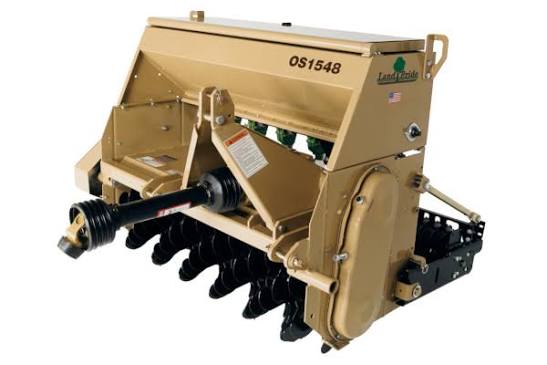
The Land Pride OS1548 combines a PTO-powered soil-working rotor with a ground-driven seed-metering system. That separation is the key to understanding this overseeder: tractor PTO speed runs one part of the process, while travel over the ground drives seed delivery. It is a candidate for recurring turf-renovation work where the complete preparation and placement method fits the establishment plan.
It should not be bought simply as a four-foot box that spreads grass seed. Drive configuration changes the machine’s width and weight, and the optional slit-seeding equipment changes how seed is directed. For a Canadian acreage owner or grounds operator, those choices can affect tractor suitability, access and the result more than the model number suggests.
On This Page
ToggleThe configuration makes a substantial difference
This guide uses the June 21, 2024 manual for serial number 166724 and later. Its OS1548 table distinguishes gauge-wheel and rear-roller seed-drive arrangements. Identify the actual machine before transferring these figures to a used offer.
| Item | OS1548 specification |
|---|---|
| Seeding width / seedbox length | 51 inches / 48 inches |
| Overall width, gauge-wheel drive | 77¾ inches |
| Overall width, rear-roller drive | 60½ inches |
| Empty weight, two-inch spacing | 1,290 lb wheel drive; 1,250 lb roller drive |
| Empty weight, three-inch spacing | 1,220 lb roller drive |
| Seedbox / metering cups | Four bushels / seven cups |
| Tractor requirements | 25–60 hp, Category 1, 540 rpm PTO |
The different overall widths are especially important on an established property. A buyer who plans around the 48-inch box length can substantially underestimate the space required. The weights are empty configuration figures, not a complete loaded tractor assessment.
Two drives, two separate checks
The powered rotor prepares the immediate surface through its knives. Seed metering takes its drive from ground travel through the fitted wheel or roller arrangement. These systems operate together in the job, but adjusting one does not automatically establish the performance of the other.
For a demonstration, first establish that the preparation action produces an appropriate surface. Then verify delivery with the intended seed and the prescribed calibration procedure. A visibly disturbed strip and moving metering components are not proof that the correct amount of seed has been applied.
Record seed quantity, measured area and machine configuration. This lets the operator distinguish an application problem from an area-estimation problem. Without those records, the end of a seed bag can become an unreliable substitute for calibration.
Likewise, do not try to use tractor speed as a universal correction for an incorrect seed setting. The ground-driven mechanism is intended to relate delivery to distance. Follow the actual setup and calibration instructions for the fitted drive, rather than borrowing a routine from a PTO spinner spreader.
Overseeding is not automatically slit seeding
The manual identifies a separate slit-seeder attachment that directs seed into the cuts made by the knives. Confirm whether that equipment is installed and whether its spacing matches the machine. The presence of a rotor does not prove that every offered OS1548 has the same delivery arrangement.
This matters when the project specifies a particular placement method. If a quotation describes only “overseeding,” ask what equipment and operation that includes. Compare the actual supplied process with the seed and site plan rather than treating a broad term as a guarantee.
Seed placement and subsequent establishment are also different outcomes. A machine can distribute the intended quantity without guaranteeing germination or a finished stand. Species selection, site conditions, timing and aftercare still need a suitable local plan. The equipment should support that plan instead of replacing it.
Choose the amount of disturbance deliberately
The manufacturer’s OS15 description distinguishes straight and curved knives and offers optional seed and surface-working equipment. The practical question is how much disturbance the existing surface can accept while meeting the renovation objective.
A thin lawn that needs a defined renovation treatment presents a different project from ground that needs major reshaping or deep preparation. Do not select the most aggressive-looking configuration simply because it appears more substantial. Define the required surface and preserve the parts of the site that should remain intact.
Use an appropriate trial area to judge the result before committing seed across the whole property. Inspect what remains after the pass, including debris, disturbed material and uniformity. If the surface is not ready for the intended treatment, identify the missing preparation rather than automatically adding more seed.
For substantial surface finishing, the SP2060 pulverizer guide describes a separate mechanism. It is a process comparison, not a recommendation to add every available operation to a seeding project.
Four bushels does not identify the seed payload
Hopper volume is not a fixed mass. Different materials and mixtures can occupy the same volume with different weights. Use the actual seed information and permitted configuration when assessing the loaded machine.
Include optional boxes, accessories and hitch equipment in that assessment. An empty lift demonstration is insufficient evidence that the tractor can carry the intended working load in the required position. The tractor’s relevant lift and ballast guidance must be applied to the complete combination.
Filling logistics deserve a route of their own. Determine where bags will be stored, how material will be transferred safely and where the machine can be serviced without obstructing the job. A larger fill may reduce interruptions, but only if the handling arrangement remains appropriate.
Do not buy or apply extra seed merely to use the available hopper volume. Quantity should follow measured area and the suitable application plan. Unused space in the box is not evidence that the machine is being operated uneconomically.
Access can decide between the two seed drives
The gauge-wheel version’s 77¾-inch width is significantly greater than the rear-roller version’s 60½ inches. This can be decisive at gates or between established features. Measure the actual equipped machine, including everything supplied with it.
Access is not the only difference to assess. The drive arrangement and depth-control configuration must suit the operating instructions and site. Avoid choosing a version purely because it fits a doorway while leaving its working setup unresolved.
Map the complete route through the treated area, including headlands, refill access and the turn back into storage. A narrow treatment strip can still require a wider turning area. If much of the property consists of isolated small patches, setup and repositioning may dominate the session.
Calibration needs the actual material
A seed chart is a starting reference. Seed lot, mixture, machine configuration and condition belong in the measured check. Keep the measured result alongside the setting so it can be understood later.
For a hypothetical project, assume a locally selected target of 60 kg per hectare across 0.35 hectares. Planned seed use is 21 kg. If 24.5 kg is consumed over that measured area, the apparent rate is 70 kg per hectare, about 16.7% above the target. These are arithmetic examples, not recommended grass-seeding rates.
The discrepancy does not identify its own cause. Reconcile the measured area, overlap, quantities and calibration before changing settings. A narrow irregular plot may include repeated coverage that is easy to overlook when comparing total seed use with a rough area estimate.
When a second pass is part of the establishment plan, account for its application explicitly. Do not deliver a full intended quantity twice by accident. The plan should state what each traversal accomplishes and how the total prescribed amount is distributed.
What a meaningful used-machine inspection includes
Confirm serial number, drive version, knife spacing and all fitted options. Ask for the applicable documentation and evidence of previous calibration or service. A clean hopper is welcome, but it does not establish the condition of the metering and preparation systems.
Inspect the seed path, cups, drive components, knives, rotor, bearings, roller or gauge wheels, frame, hitch and guards through the prescribed secured procedure. Assess optional equipment separately. Missing pieces in a slit-seeding arrangement can matter even if the main machine appears complete.
Have corrosion, deformation, incorrect replacements or abnormal movement evaluated before operation. These checks do not imply that the OS1548 has a specific recurring defect. They help distinguish a ready machine from one needing a defined return-to-service project.
A suitable demonstration should include both the preparation result and a permitted delivery check with appropriate material. Watching a shaft turn proves much less than measuring the output and understanding which configuration produced it.
Compare the complete establishment process
The APS1572 guide describes another ground-driven seed application arrangement with a different surface-working system. It should not be treated as the same machine in a wider size. Compare placement, preparation and tractor requirements before comparing coverage.
Separate preparation plus a spreader may make sense when suitable equipment is already owned. Contracted renovation can be attractive for a large one-time project. An integrated overseeder earns consideration when the same appropriate process recurs often enough to justify its setup, storage and maintenance.
Include aftercare in the overall project, even when it is outside the machine’s role. A favourable equipment price does not compensate for an establishment plan that cannot be supported after application. Conversely, a more complete service quote should not be compared directly with an attachment price as though both include the same work.
Estimate time from effective coverage
As invented planning inputs, take a 1.2-metre effective width, a suitable 4 km/h pace and 60% field efficiency. Coverage becomes 1.2 × 4,000 × 0.60 = 2,880 square metres per hour. A 3,500-square-metre plot would take about 73 minutes for one comparable working pass.
This is not a measured OS1548 output or operating recommendation. Add calibration, filling, turns not represented by the allowance, cleanup and any separate preparation. If the actual project needs two passes, do not present the one-pass figure as completion time.
Canadian seasonal timing should follow the site and establishment plan. The manual advises against wet or muddy operation and requires proper cleanout after work. Equipment availability does not make unsuitable conditions appropriate, and the seed hopper should not become long-term storage.
Questions to settle before purchase
Is the machine only 48 inches wide?
No. That is the box length. The documented seeding width is 51 inches, and overall width varies substantially with the drive arrangement.
Does the PTO drive the seed cups?
The cited machine uses ground-driven metering; PTO power runs the preparation rotor. Verify both functions separately.
Does every unit direct seed into the slits?
No. Confirm the relevant optional attachment and its configuration rather than assuming it from the overseeder name.
Can the tractor match be based on horsepower alone?
No. Loaded weight, hitch geometry, driveline fit, ballast and route remain essential checks.
Who should shortlist the OS1548?
An operator with repeated suitable renovation work, a verified tractor and a practical calibration routine. Its value comes from delivering the required complete process, not simply combining several mechanisms on one frame.
What should be written on the delivery record?
Record drive type, knife spacing, optional seedbox and slit attachment, actual serial number and the calibration procedure demonstrated. Keep those details with the seed-lot measurements. A later operator should be able to establish what was supplied without trying to infer the configuration from a sales photograph.
Share your experience
Help other Canadian buyers — leave a quick review for the
Land Pride OS1548
There are no reviews yet. Be the first one to write one.


