
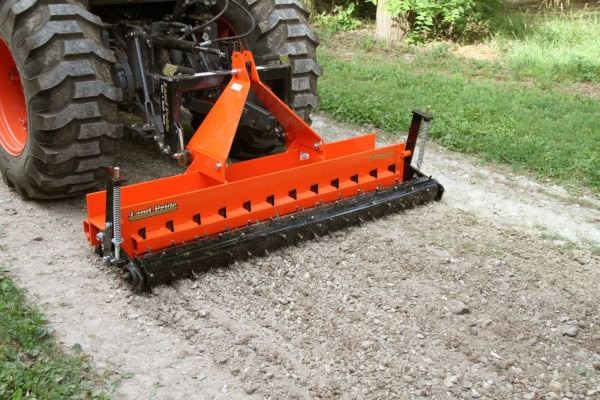
Overview & Specs
The Land Pride SP2060 is a soil pulverizer for finishing suitable prepared ground through a combination of shanks and a trailing spiked roller. It belongs in a landscaping or seedbed-preparation discussion when the surface needs further breakup and refinement. It should not be confused with a powered rotary tiller, a stone screen or a machine for hauling large quantities of soil.
The most useful buying question is where it fits in the project sequence. What condition will the ground be in before the SP2060 arrives, and what result is required afterward? If neither is defined, a demonstration that merely leaves a different-looking surface can be mistaken for proof that the tool solves the whole project.
On This Page
ToggleSP2060 specifications that affect selection
The August 30, 2022 specification sheet lists a 60-inch working width, 65¼-inch overall width and 491-lb weight with a single roller. It specifies a 35-engine-hp maximum, a Category 1 hitch, 21 shanks and 86 roller spikes. The second-roller option shown for the SP30 series is not listed for the SP2060.
Keep the engine-horsepower wording intact. A tractor whose PTO rating happens to be below 35 hp is not thereby within a maximum stated in engine horsepower. The engine versus PTO guide explains why those labels must not be exchanged.
The base weight also does not describe every possible equipped or ballasted arrangement. Follow the applicable implement and tractor instructions for the actual configuration. A physically compatible hitch is only one part of the match.
Understand the two-stage surface action
The shank section and trailing roller perform related but different work. The purchase should be evaluated as a sequence: material disturbed at the front must reach an acceptable condition after the rear element passes. Looking only at the roller misses half the system.
Observe what remains on the surface and beneath it after a representative trial. Are the unwanted clods adequately reduced for the next operation? Are larger objects still present? Has material been moved into a pattern that requires another tool? Those questions make the result measurable without pretending the pulverizer supplies a laboratory-standard product.
Do not infer a screened particle size from the number of shanks or spikes. The machine works the surface; it does not promise to separate all material above a specified diameter. Where a project requires screened soil or removal of a particular contaminant, establish a different process.
Similarly, do not assume that a smoother appearance establishes the correct final grade. Surface texture and elevation are separate acceptance criteria. A project can have a pleasing texture while still requiring correction of its profile.
When preparation is not yet complete
A rough site may need debris removal, bulk movement or another operation before a finishing implement makes sense. Decide which stage is actually limiting progress. Repeated finishing passes cannot be assumed to replace missing preparatory work.
For an acreage landscaping project, divide the area into zones. A previously worked section may be ready for refinement, while another section still contains obstructions or substantial elevation differences. Treating both as one uniform job can lead to buying the wrong tool.
Write down what will be supplied by other equipment or a contractor. This makes the SP2060’s role clearer and prevents comparing its purchase price with the cost of a service that includes several additional stages.
If the required job is substantial movement of material between nearby locations, consider the BB1572 box scraper as a different mechanism. If the need is selective gathering of loose debris, compare the LR1672 landscape rake. Neither comparison should imply identical results.
Soil condition can matter more than another pass
The December 27, 2023 manual says to discontinue pulverizing when buildup on the roller indicates the ground needs to dry. This is an important limit on the expectation that additional passes or more power will solve every unsatisfactory finish.
Assess the surface before committing the whole area. A short suitable trial lets the operator judge whether the machine is working as intended and whether the result advances the project. If conditions are inappropriate, postponement may be more useful than increasing the intensity of work.
For Canadian seasonal planning, allow flexibility around the actual ground rather than a fixed weekend on the calendar. Equipment ownership gives access to the tool; it does not guarantee that the site is ready when the owner has free time.
Record starting conditions when comparing demonstrations. A machine tested on a dry prepared strip should not be declared better than another working a different wet or rough section. The comparison must hold the task reasonably consistent.
Working width, access width and tyre coverage
The documented working width is narrower than the overall machine. Gates and storage therefore need to accommodate more than the five-foot treated strip. Include room for alignment and the full combination’s movement through turns.
Measure the tractor as equipped and compare the desired pass pattern. Tyre spacing, overlap and the actual job layout determine whether the nominal width provides an efficient routine. Do not infer tractor-track coverage from the model number alone.
A wider alternative can reduce the theoretical number of passes, but only if the tractor match and site layout remain suitable. Tight areas, short runs and repeated repositioning can reduce the value of added width.
For an illustrative rectangular project, imagine a 12-metre-wide area and 1.4 metres of effective pass spacing. Dividing 12 by 1.4 gives about 8.6, so at least nine traversals are needed to span the width under that simplified plan. End treatment and real overlap can add work. This is a planning example, not a prescribed SP2060 spacing.
Estimate finished area, not just travel distance
One traversal does not always mean the area is ready for the next operation. Define the target texture and remaining work, then count the passes actually required to achieve it. Otherwise a fast travel demonstration can overstate useful productivity.
As invented inputs, use 1.4 metres of effective width, a suitable 3 km/h travel pace and 65% field efficiency. Straight-line coverage is 4,200 square metres per hour; the assumed practical rate is 2,730. A 1,000-square-metre area takes about 22 minutes for one pass or 44 minutes for two comparable passes.
Add attachment setup, travel to the area, inspection and cleanup separately. The numbers above are not measured machine performance or speed recommendations. They show why a complete session can be substantially longer than the easiest pass.
If another method produces the required result in fewer stages, compare that whole process. A tool that appears slower in one isolated operation may still finish the project earlier by reducing follow-up work. Conversely, a quick pulverizing pass has limited value if it leaves a separate unresolved grading task.
Do not transfer SP30 options to SP20
The shared family sheet covers several models. It is easy to read an option from a neighbouring column and assume it belongs to every machine on the page. The second roller is a clear example: the SP2060 column shows it as unavailable.
For any proposed addition, obtain the exact approved option and model applicability. A seller’s statement that “these can have two rollers” is incomplete if it refers to a different series. An improvised attachment is not equivalent to a documented factory arrangement.
This also matters when inspecting used equipment. Identify what is original, what is optional and what has been altered. Do not assign extra value to an added component until its suitability and effect on the complete machine have been established.
Use the quotation to remove ambiguity. List the model, supplied roller arrangement, connection equipment and any necessary tractor preparation. The practical package is what should be compared with alternatives.
Assess the tractor beyond the horsepower screen
Check carrying requirements, clearance and the prescribed hitch setup. Include any quick hitch in the geometry. The implement needs to be controlled and carried correctly as well as pulled through suitable material.
The Category 1 quick-hitch guide explains the distinction between pin category and complete fitment. Verify the exact components rather than assuming that a common category makes every raised position acceptable.
For a tractor used for several jobs, plan where the pulverizer will be parked between sessions. A stable accessible storage position can simplify switching tools. If the only location blocks another essential implement, include that inconvenience in the purchase decision.
A one-time landscaping project may not justify permanent ownership even when the tractor match is excellent. Compare rental availability and a complete service quotation, including delivery and the actual condition of the finished surface.
Inspect wear across the full working system
On a used SP2060, inspect the shanks as a set, the roller, bearings, frame, hitch and retention hardware. Look for missing or inconsistent components, distortion and evidence of repairs. These are inspection priorities rather than claims of recurring model failures.
The manual describes reversible shanks. That feature does not make wear irrelevant: establish the remaining usable condition and the cost of restoring the full row. Pricing only one visibly damaged piece can understate the work needed.
Inspect the roller’s working surfaces and movement under the correct secured procedure. A roller that looks complete in a photograph may still need parts or adjustment. Obtain a competent assessment of doubtful structural or bearing condition.
Compare the ready-to-work cost after identified repairs. Include transport, required connection equipment and the time needed before the first project. A cheap implement that cannot be made ready within the working window may offer less value than a serviceable alternative.
A demonstration needs an end point
Choose an inspected representative area and state what acceptable preparation looks like for the next stage. Have the machine operated correctly. Record the initial condition, configuration, passes and remaining tasks.
Evaluate the surface after work rather than the quantity of material moving during the pass. If the result is inadequate, determine whether the reason is unsuitable conditions, incomplete prior preparation, setup, wear or the wrong mechanism. Those causes lead to different purchasing decisions.
Keep the demonstration notes with the quotation. They make it easier to compare another machine or a contractor’s proposal on the same result instead of relying on an impression of how aggressively the equipment worked.
Frequently asked questions
Is the SP2060 a rotary tiller?
No. Its shank and trailing-roller arrangement is a different mechanism from powered rotary tillage. Select the process required by the site.
Does it screen stones to a defined size?
No such guarantee follows from the specification. It is a surface-working implement, not a calibrated screening system.
Can I fit the second roller listed on the family sheet?
The cited SP2060 column does not list that option. Do not transfer an SP30 feature to this model.
Should more passes solve roller buildup?
The manual calls for stopping until the ground is dry enough. Repetition is not a substitute for suitable conditions.
What is the strongest buying case?
Recurring finishing work on appropriately prepared ground, a verified tractor match and a clear standard for the surface left behind. Without those, compare other preparation methods before purchasing.
Share your experience
Help other Canadian buyers — leave a quick review for the
Land Pride SP2060
There are no reviews yet. Be the first one to write one.