Overview & Specs
The John Deere 3032E is the middle-power choice in the 3E compact-tractor family, and its strongest buying argument is a rear-implement requirement that needs more PTO output than the smallest model provides. It is less convincing as an upgrade purchased solely in the hope of lifting heavier pallets. Engine output, hydraulic supply and approved loader capacity are separate questions.
For Canadian property owners, this makes the 3032E a useful model to assess around a named mower, tiller or other rear tool. The decision should be whether that complete combination does the work, with appropriate access and handling capability, at a sensible total cost. The specifications below refer to John Deere Canada’s published information checked on September 30, 2026.
On This Page
ToggleThe figures that matter for a 3032E purchase
| Item | Published information |
|---|---|
| Gross engine output | 22.9 kW; horsepower labels differ on the page |
| PTO output | 18.6 kW / 25 hp |
| Engine | Approximately 1.64 L, three-cylinder naturally aspirated Yanmar diesel |
| Transmission | Two-range hydrostatic |
| Implement hydraulic flow | 20.2 L/min / 5.3 US gpm |
| Rear hitch | Category 1 |
| Hitch lift at 24 inches behind link arms | 615.1 kg / 1,356 lb |
Source: John Deere Canada’s 3032E page. Its engine feature text gives 30.7 hp, while the specification table labels 31.2 hp; both show 22.9 kW. This guide preserves that discrepancy rather than silently treating the labels as identical. For an implement purchase, use its required rating type and the documented tractor configuration.
What should justify choosing the middle model?
A middle model can be a sensible fit, but its position in the range is not evidence of value. Start with one sentence: “I need this tractor to operate this implement under these conditions.” Then add the other essential tasks. That forces the comparison to address useful capability rather than a modest-looking price step between neighbouring models.
If your chosen rear tool fits the 3032E’s documented power and hitch envelope, the next question is whether the larger alternative changes the work enough to justify its cost. If the tool does not fit, choosing the middle model because it feels like a compromise is not a solution. If the smaller alternative already meets the whole task list, compare what else the price difference could buy: the right attachment, required ballast or better storage and maintenance arrangements.
Aglist’s tractor buying guide gives the broader process. Here, the important discipline is to keep the 3032E attached to a real equipment plan. A tractor without the tools, connections and setup needed for the work is an incomplete quotation.
Plan mowing around the job, not just cutting width
For rear mowing, list the vegetation, terrain, desired finish, obstacles and the time available between cuts. A large open area and a smaller area full of trees can demand very different work patterns. The implement’s power range is only one part of selecting a useful width and configuration.
Consider a hypothetical comparison between a 1.5-metre and a 1.8-metre working width. The wider tool covers 20% more width on a straight pass, but that does not prove 20% less mowing time. Turning, overlap, obstructions and a possible change in travel speed affect the result. Both tools must first be approved matches for the tractor and task. The calculation is a planning illustration, not a recommendation for a particular mower.
Record the route with a few representative areas: an open strip, a turn around an obstacle and the narrowest passage. During an appropriate demonstration, observe the finish as well as the speed. A faster pass that leaves unacceptable material behind is not better productivity. Equally, a wider implement that makes the route awkward may give back much of its theoretical advantage.
If the property is primarily maintained lawn, investigate a mower-focused package such as the 2025R or the more powerful 2038R. Verify the exact deck and tractor compatibility. Family numbering is not a substitute for comparing how the mowing arrangement works around your property.
Tilling and other PTO work need controlled feed rate
A shaft-driven implement needs its specified PTO speed. Ground travel controls how quickly material enters the tool or how much work is attempted over a given distance. These are related operating decisions, but they are not the same speed. The tractor and implement manuals establish the appropriate settings and procedures.
The hydrostatic arrangement is worth evaluating where ground conditions change within a pass. It allows travel speed to be adjusted within the chosen range. That can be useful when moving from easier to more demanding work, but it does not increase the implement’s permitted capacity or correct a mismatch in tractor requirements.
For a tiller purchase, establish the tool’s weight, hitch geometry, required power, driveline compatibility and the soil conditions it is intended to handle. For an auger or another intermittent tool, assess the approved mounting and operating arrangement rather than borrowing a recommendation from a mower of similar width. Each implement creates a different load on the tractor.
Why more engine power does not answer a loader question
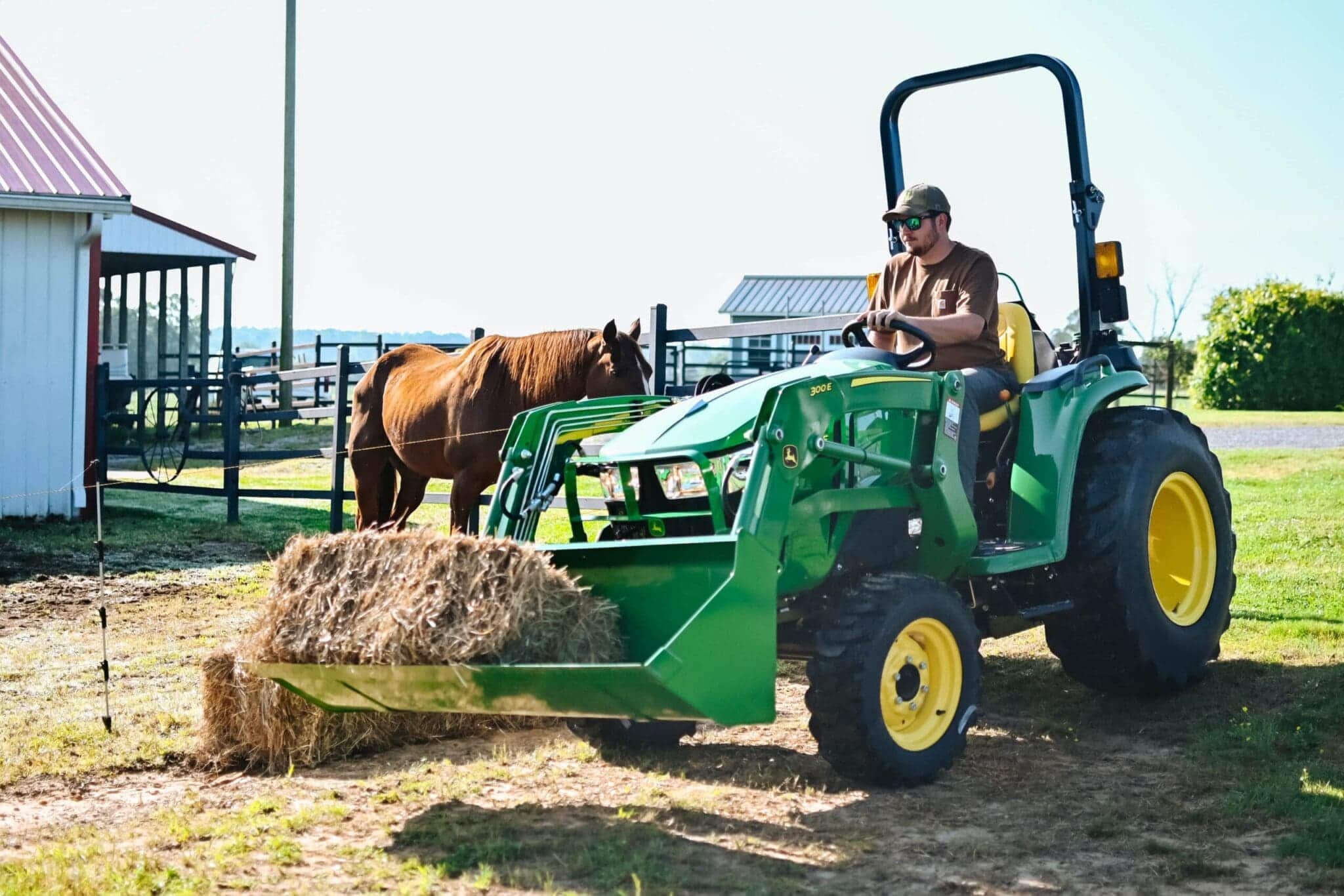
The 300E loader specification identifies the 3025E, 3032E and 3038E as compatible tractors. Loader performance must be evaluated from the actual combination and measurement conditions; a change in tractor engine rating does not authorise a larger load on unspecified forks.
Make a separate handling worksheet. Include the complete goods weight, container or pallet, attachment identity, load centre and intended placement height. Obtain the applicable capacity information and ballast requirements. Keep front-loader figures separate from the rear hitch rating in the table above.
For bucket work, identify the material and normal operating route. Consider where the loader must turn, the receiver height and the view of the working edge. A demonstration that merely raises an empty bucket does not show whether the combination can complete your actual loading cycle. Use the intended receiver or a suitable representation of it during an authorised assessment.
If routine handling is the limiting task, compare a different loader-and-tractor package instead of assuming the next engine option solves it. A buyer who regularly moves dense palletised goods may need a different class of machine even when the property itself is small.
Understand the hydraulic quotation
A tractor can list both steering and implement hydraulic flow. Adding the two and calling the sum available attachment flow can mislead a buyer. Establish the supply available at the required connection, along with the permitted pressure, valve arrangement and return requirements of the proposed tool.
A grapple, for example, adds a control and connection requirement beyond fitting a bucket carrier. The quotation should identify the attachment interface and the hydraulic equipment that operates the grapple. Mechanical attachment compatibility and hydraulic compatibility should be checked independently.
Do the same for rear tools that need remote hydraulics. Count the functions and identify how they are controlled. Do not infer that an advertised implement-flow figure means the tractor already has every remote or connection your equipment requires. Written configuration details prevent an apparently complete package from arriving with an important function missing.
Used 3032E tractors: the serial range matters
Deere’s 3E service reference distinguishes earlier and later 3032E serial ranges and includes a DPF entry for the specified later range. This is a concrete reason not to treat every used 3032E as the same engine and service specification.
Obtain the serial identity before ordering parts or interpreting service history. Use the matching operator’s manual for fluids, maintenance and exhaust-system instructions. This guide does not assign a universal regeneration interval, predict repair costs or claim that one serial range has a proven reliability advantage.
Inspect a used package as several assets: tractor, loader and implements. A qualified inspection should cover the relevant drivetrain and hydraulic operation, loader mounting and pivots, front axle, hitch, tyres and repair evidence. Any included tool should have its own identification and condition assessment. A low hour reading cannot establish whether the complete package was maintained appropriately.
Canadian seasonal work and practical access
For winter clearing, choose the snow-handling method before the implement. A blade, loader bucket and PTO blower put different demands on power, attachment arrangement and the operator. Identify where snow will be stored or discharged and how the available space changes through the season.
Aglist’s snowblower fitment guide is useful when comparing mounting and drive requirements. A blower must meet the actual tractor configuration, not merely share a brand name. Include visibility, lighting, clothing and the expected duration of open-station work in the decision.
Measure access with the actual implements. A rear mower can create a wider or longer working envelope than the bare tractor, while a loader changes turning and storage needs. Include the narrowest gate, the turn after it and the shed opening. Review the complete transport arrangement with loader, ballast and carried equipment rather than treating a shipping-weight entry as the trailer load.
Compare the 3032E on an equal equipment basis
One useful way to resist buying by model position is to write an acceptance condition for the main tool. For example: the selected cutter must be within all documented tractor requirements, produce the required finish on the representative route and fit the available storage area. This is stronger than deciding that the middle tractor should be “enough.” It also leaves room for an honest outcome: a different implement may meet the job better without requiring more tractor, while a mandatory tool can justify moving beyond this model.
The Kubota L3302 and New Holland Workmaster 35C are relevant compact-tractor candidates to investigate against the same work list. Compare the chosen transmission, PTO requirement, loader and rear-implement arrangement using current primary specifications for each configuration.
Ask for itemised prices for the tractor, loader, implements, ballast and any needed hydraulic equipment. Separate finance charges and delivery. A package that appears cheaper may omit the tool that makes the tractor useful, while another may include equipment you will rarely use.
For ownership planning, list scheduled service, implement wear parts, storage, transport and a realistic allowance for downtime. Use local quotations and your intended hours rather than a guessed national ownership cost. After the first season, compare actual hours by task with the assumptions that led to the purchase.
3032E buyer questions
Is its engine 30.7 or 31.2 horsepower?
The current Canadian page uses both labels while showing the same gross kilowatt figure. Confirm the exact rated specification for the machine; this guide does not hide the inconsistency.
Does the middle model automatically offer the best value?
No. Value depends on the tools and tasks it enables, the complete quotation and the alternatives that meet those same requirements.
Will it lift more because it has more engine power?
That conclusion does not follow from engine output alone. Use the approved loader or hitch information for the actual configuration and attachment.
Can I buy a mower from its width alone?
No. Check required power, hitch, weight, driveline and intended duty, then evaluate the route and finish you need.
What should I establish first on a used example?
Its serial identity and installed equipment. Those details anchor the specification, service information, attachment compatibility and inspection.
Share your experience
Help other Canadian buyers — leave a quick review for the
John Deere 3032E
There are no reviews yet. Be the first one to write one.