Overview & Specs
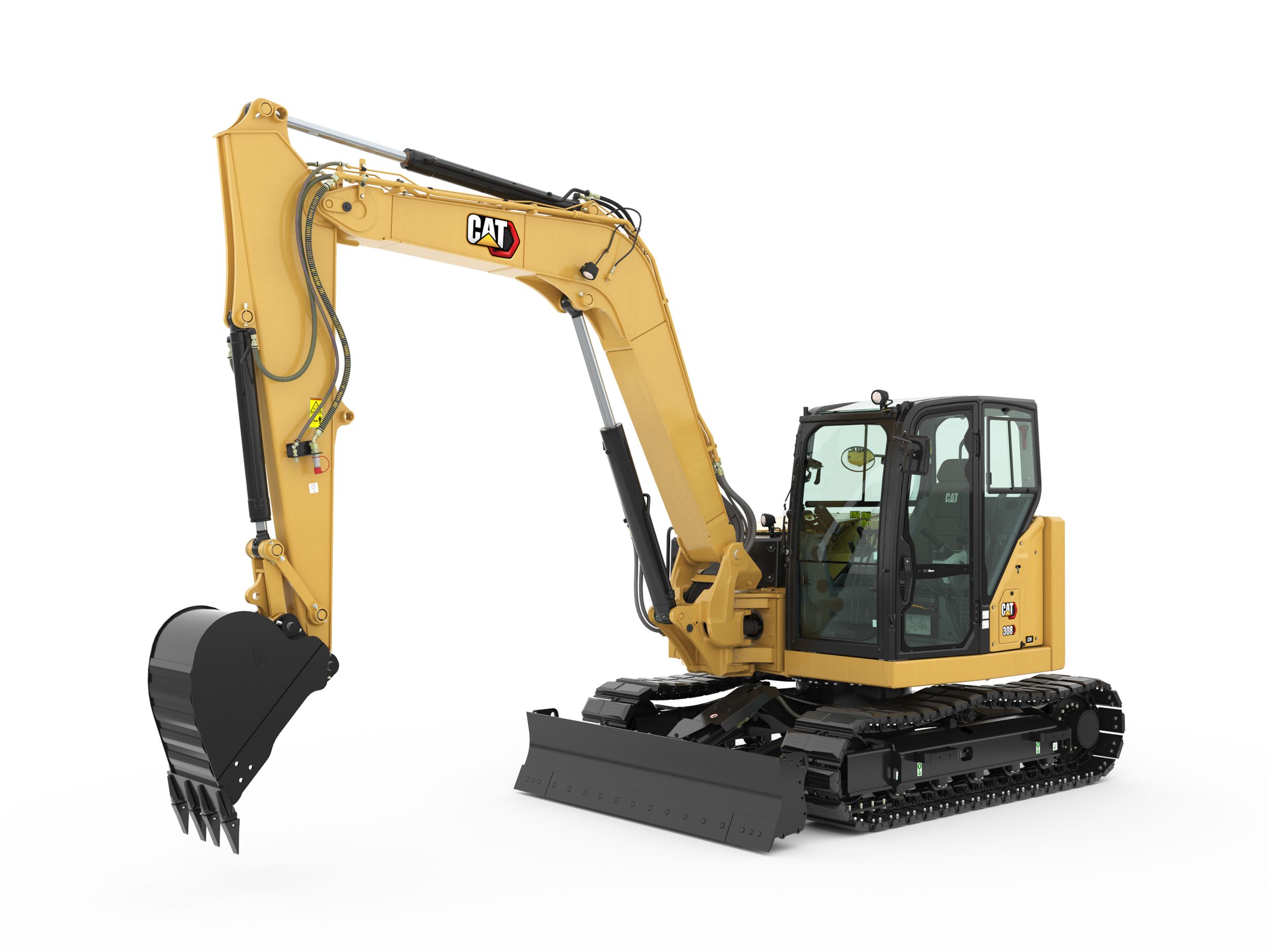
The Cat 308 CR can be a candidate for Canadian contractors and property operations that need a substantial working envelope while still considering rear clearance and attachment versatility. The first buying task is to identify which 308 CR is being offered. Caterpillar documents different versions and boom arrangements, so a familiar badge is not enough to select the correct specifications.
This guide covers the updated North American C2.8 Turbo swing-boom model on Caterpillar’s product page 128360. It does not combine that machine with the separately listed fixed-boom or variable-angle-boom versions, or assume that older used examples have the same configuration. That distinction matters to working range, equipment and transport planning.
On This Page
ToggleCat 308 CR specifications for the documented version
Source: Cat 308 CR C2.8 product specifications.
| Item | Published value |
|---|---|
| Engine; net power | C2.8 Turbo; 51.2 kW / 69 hp |
| Cab operating weight range | 8,505–9,420 kg |
| Track width | 2,300 mm |
| Depth, standard / long stick | 4,108 / 4,643 mm |
| Ground reach, standard / long | 6,949 / 7,460 mm |
| Stick force, standard / long | 42.3 / 35.7 kN |
| Maximum primary auxiliary flow at pump | 131 L/min |
| Rear radius, without / with counterweight | 1,450 / 1,585 mm |
The weight configurations exclude the bucket and differ in tracks, stick and counterweight. Peak hydraulic flow and pressure are not simultaneous operating values. Use configuration-specific information for the offered package.
Identify the version before comparing prices
A used advertisement may provide a model name, hours and a photograph without enough information to select the correct technical data. Ask for the serial number, engine identification, boom arrangement and equipment list. Match those to appropriate documentation before building a comparison table.
The fixed-boom and variable-angle-boom versions should be treated as distinct equipment choices. Their presence in the same product family does not make their working ranges or transport dimensions interchangeable. A buyer should not take the most attractive number from each version and describe the result as one machine.
Apply the same discipline to dealer quotations. Identify the stick, tracks, counterweight, blade, coupler and hydraulic provisions in writing. An apparently large price difference may partly reflect a different package; it may also reflect condition or generation. Establish those differences before negotiating around a single headline figure.
What work supports this ownership decision?
Begin with a realistic schedule of recurring jobs. A contractor might need a machine for sustained excavation and suitable attachment work. A farm property might have several planned projects but relatively little use after they are completed. Those cases can call for different ownership arrangements.
List the tasks that the machine must perform without compromise and those that can be assigned to other equipment. Include access, material handling, receiving vehicles and finishing work. The excavator’s value comes from the completed method, not simply from being the largest candidate on the list.
If most regular work can be handled by a smaller package, compare that ownership option with hiring suitable equipment for exceptional jobs. If the larger workload is frequent, the 308 CR may deserve a detailed trial. Use actual job and cost information rather than assuming that capacity automatically pays for itself.
Access and compact rear clearance
The track-width figure is an initial route measurement. The installed blade, tools and accessories still need to fit, as do turns and overhead restrictions. A route with nominally enough width may be impractical if alignment or ground conditions leave no usable clearance.
At the operating position, use the matching rear-radius information and assess the complete moving envelope. Compact rear geometry can be relevant where space matters, but it does not remove the need to plan around structures, people and other equipment.
Consider how the layout changes during the job. A stockpile grows, receiving vehicles move and the excavation progresses. A location that works for the first cut may become awkward later. Include that sequence in the comparison rather than assessing only a static parking position.
Standard and long stick: more than a depth comparison
The long stick expands the envelope while the published force figure changes. Select it for a demonstrated reach requirement, then assess the complete task. It is not automatically the more productive configuration for digging that remains comfortably within the standard range.
Read horizontal distance and depth together on the appropriate working-range diagram. Maximum ground reach is not the reach available at maximum depth. The bucket also needs room to cut, fill, curl and clear the surrounding excavation.
A demonstration should include the intended bucket and coupler. Their geometry and mass form part of the equipment package. Where the requirement approaches a limit, obtain the relevant configuration information rather than treating a generic illustration as proof.
Aglist’s guide to depth and reach explains how to organize the measurements. The suitable machine positions must come from the site plan; the brochure cannot establish where ground or structures will support the proposed operation.
Specialist attachments need a complete specification
For powered equipment, begin with the attachment’s accepted operating range and carrier requirements. Flow, pressure, return restrictions, controls, mass and any guarding provisions all need to be considered. The at-pump maximum in a catalogue is not a guarantee of performance at the tool.
Ask for the intended combination to be demonstrated where attachment work is central to the purchase. Record the tool model, installed circuit and conditions. A general video showing another machine using a similar attachment is not evidence that the offered package is ready for the same work.
If several hydraulic functions are planned, identify how each is controlled. A tilt function, thumb or another accessory may require provisions beyond the primary attachment circuit. Installation and commissioning costs should be included before comparing quotations.
Do not buy a specialist tool solely because its advertised carrier-weight class appears to match. That label is one filter. Exact compatibility and approved use still determine whether the package is suitable.
Bucket, coupler and thumb as one arrangement
A coupler can make tool changes convenient, but it becomes part of the working equipment. Include its mass and geometry in the relevant assessment. The bucket and any thumb must be matched to the resulting arrangement, not evaluated as unrelated accessories.
For material handling, identify the objects and required placement rather than asking for the strongest-looking thumb. Grip does not create additional lifting capacity. Use the applicable manufacturer load and attachment information for the operation.
For excavation, choose bucket dimensions around the material and finished shape. Excessive width can create more spoil and restoration work; an unsuitable bucket can reduce useful output even on a capable carrier. Demonstrate the tool that will actually do the job.
Transport the configured machine, not the model name
The operating-weight range already spans different equipment combinations and excludes the bucket. Establish the actual configuration and the basis of its weight record. Then account for other fitted and separately carried equipment without adding the same item twice.
Measure loaded dimensions in the approved transport arrangement. A boom-height figure labelled for transport without tools is not automatically the overall height of a loaded machine with an attachment. Deck space and securing provisions also need to suit the package.
Assess the entire hauling combination against its ratings, usable payload and applicable requirements. Do not infer suitability from a pickup category or the word “mini.” For this ownership decision, professional transport may be a meaningful alternative to purchasing a complete hauling setup.
Frequency matters. A machine moved occasionally between long projects creates different logistics from one transferred several times a week. Include loading, travel, unloading and return trips in the business calculation.
A useful cost-per-job comparison
Compare complete methods using actual quotations. As a hypothetical example, assume one arrangement requires two additional transport movements at CAD 350 each but saves five working hours valued at CAD 100 per hour. The extra movements total CAD 700 and the assumed time value is CAD 500, leaving CAD 200 of additional cost under those assumptions.
These are illustrative numbers, not Canadian market rates or measured 308 CR performance. They show why a faster on-site method can still cost more overall. Change the movement frequency, time value or job requirements and the result may change.
Also account for work quality and scheduling. A method that reliably achieves the required result may justify a higher cost, while an unsuitable machine can create rework. Keep those reasons explicit instead of presenting a simplified arithmetic result as a universal purchase rule.
Operator environment and Canadian scheduling
Test the actual cab’s visibility, entry, controls and installed climate functions. For work extending into wet or cold periods, these details can affect whether the planned schedule is practical. A general feature list does not establish the condition of a used machine’s equipment.
Consider the routine tasks the operator will repeat and the visibility they require. Demonstrate them with the intended working equipment, following the appropriate operating procedures. Comfort and control preferences are best assessed directly rather than inferred from a photograph.
Use the serial-specific manual for seasonal preparation, fluids, starting and maintenance. The local service arrangement should include parts, inspection and repair logistics. If downtime would interrupt booked work, plan how that interruption will be handled before buying.
Used 308 CR: inspect identity and modifications carefully
Start by resolving the version. Then record every meaningful configuration item and any modification. An undocumented attachment installation or altered equipment arrangement requires more investigation than a seller’s assurance that it has always worked.
Have a competent inspector assess the undercarriage, structural condition, joints and hydraulic system. Observe a proper cold start and warmed-up representative operation. Obtain diagnosis for warnings or irregular behaviour rather than attributing them to normal model characteristics.
Inspect the tool package separately. Wear, locking condition and mounting compatibility affect its value. If an attachment is central to the planned work, an untested inclusion should not be priced as a verified ready-to-use asset.
Review service records and repair documentation, then obtain estimates for identified work. Hour readings help describe use but do not establish maintenance quality. Put the agreed equipment and repairs in writing before delivery.
Compare alternatives with the same job brief
The Bobcat E88 and Kubota KX080-5 are relevant catalogue starting points for another configuration assessment. Verify exact versions and equipment before comparing numbers.
Use the same access route, excavation shape, material, tools and receiving arrangement for each demonstration as far as practical. Record active work, waiting and repositioning separately. A comparison that changes both the machine and the task cannot isolate the value of either package.
First eliminate essential mismatches. Then weigh condition, support, transport and price among suitable offers. This keeps the purchase centred on the work rather than on a badge or one maximum specification.
Frequently asked questions
Does this guide cover every Cat 308 CR?
No. It covers the specified C2.8 swing-boom version. Older, fixed-boom and variable-angle-boom machines need their own documentation.
Does CR mean no rear overhang?
No. Use the actual rear radius and configuration in the site plan. Compact geometry still requires working clearance.
Can I choose the long stick from depth alone?
Compare the full work shape, force information and complete cycle. Additional reach is valuable when it solves a recurring task requirement.
Is the operating-weight figure the transport load?
Not by itself. Establish the configured machine and everything carried, including the attachments excluded from the published basis.
What should justify this size of machine?
A repeatable job advantage that remains worthwhile after access, tools, transport, service and supporting equipment are included. The complete method is the purchase, not just the excavator.
Share your experience
Help other Canadian buyers — leave a quick review for the
Cat 308 CR
There are no reviews yet. Be the first one to write one.