Overview & Specs
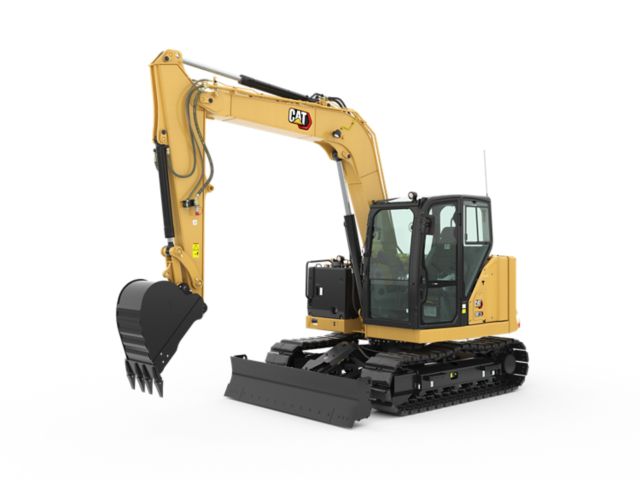
The Cat 307.5 is a machine to assess when an open work area allows room for the excavator and the job needs a useful digging and loading envelope. Its buying case is different from that of a compact-radius machine selected primarily to reduce rear clearance. For a Canadian contractor or property operator, the important question is whether its geometry supports the work well enough to justify the complete equipment and transport package.
This guide covers Caterpillar’s North American Tier 4 Final/Stage V, C2.4 Turbo version. It keeps standard- and long-stick information separate and treats the actual offered configuration as the basis for purchase. The model designation alone does not identify transport mass, installed tools or every available feature.
On This Page
ToggleCat 307.5 specifications that affect the site plan
Source: official Cat 307.5 specifications.
| Item | Published value |
|---|---|
| Engine; net power | C2.4 Turbo; 40.9 kW / 54.8 hp |
| Cab operating weight range | 7,505–8,120 kg |
| Track / upper-house / blade width | 2,200 / 2,250 / 2,280 mm |
| Rear radius, without / with counterweight | 1,800 / 1,930 mm |
| Depth, standard / long stick | 4,100 / 4,642 mm |
| Ground reach, standard / long | 6,151 / 6,670 mm |
| Dump clearance, standard / long | 5,300 / 5,717 mm |
| Maximum primary auxiliary flow at pump | 131 L/min |
Published weight configurations exclude the bucket. The auxiliary figure is explicitly measured at the pump; it is not guaranteed tool-port performance. Peak flow and pressure are not simultaneously available.
The three widths tell an important story
Track width is not necessarily the widest part of an excavator. The separate base, upper-house and blade figures in the table show why a route assessment should consider the whole machine. Measuring only the tracks could produce the wrong answer for a restricted entrance.
Inspect the offered equipment rather than relying on a generic dimension. Tracks, blade, attachments and accessories may differ from the reference arrangement. Include overhead restrictions and turns as well as the narrowest opening.
At the operating area, leave the entry question behind and assess the moving envelope. The rear requires its own space, and the front equipment needs a path for digging and discharge. A site can have a broad entrance but an awkward operating position beside a building, stockpile or receiving vehicle.
This makes the 307.5 a particularly useful example of why machine selection should begin with a layout. Open-site work may accommodate its geometry comfortably. Repeated work between existing structures may create a stronger reason to compare other designs.
Who should consider this size of excavator?
A contractor with repeated excavation and loading work may value a machine that can stay productive through a full project sequence. A property owner may instead need equipment for a substantial but temporary development task. Those ownership cases are different even when the immediate excavation looks similar.
For recurring work, identify the machine positions, material conditions and receiving arrangements that appear regularly. Establish which part of the current method limits progress. A larger envelope is useful when it solves that limitation; it contributes less when the bottleneck is a truck schedule or another supporting operation.
For a one-time project, compare a suitable rental or contractor package with ownership beyond the project’s end. Include storage, servicing and transport. Convenience may still support buying, but it should be recognized as a separate benefit rather than disguised as an automatic cost saving.
Rear radius and counterweight selection
Use the dimensional and load information that matches the installed counterweight. Do not evaluate the smallest rear envelope while assuming the capabilities of another configuration. The equipment list and the charts should refer to the same machine.
Rear clearance is not only about avoiding a fixed wall. It also affects how receiving vehicles, materials and other equipment can be arranged around the excavator. A workable layout needs room for the entire sequence, including changes as the excavation and stockpiles develop.
Ask a demonstration operator to explain the machine’s swept area in an appropriate open setting. The goal is to understand the actual geometry and visibility, not to test how closely the counterweight can approach an obstruction. A reduced-clearance alternative should be compared where space is a recurring constraint.
Loading height: assess where the material lands
The dump-clearance figures make loading a worthwhile part of the buying demonstration. However, clearing a receiving edge is only the first requirement. The bucket must discharge in a useful position, and the receiving vehicle must fit the approved site arrangement.
Measure the actual truck or container and note relative standing elevations. Include the intended bucket and coupler. Check the complete path over the edge and into the receiving area instead of comparing only two maximum height numbers.
For repeated loading, record how often the vehicle or machine must move. An arrangement that works acceptably for a few loads may be inefficient over a full day. Where loading is occasional, a simpler workable method may be sufficient.
Keep loose-material loading separate from lifting. A maximum discharge height is not a suspended-load rating. If lifting is part of the job, use the applicable manufacturer load chart, approved provisions and procedures for the exact configuration.
Standard or long stick?
The long stick expands the working envelope, but the decision should be based on the actual excavation and loading geometry. The largest available depth is not automatically the best configuration for repeated work well inside the standard range.
Mark the required points on the correct working-range drawing. Horizontal distance and depth must be considered together. The maximum outward point and maximum downward point do not define a rectangular zone of equal capability.
Then evaluate the full movement: cut, fill, extract, discharge and return. A point that the teeth can touch may not provide useful room for filling and removing material. The intended bucket and coupler belong in this assessment.
Caterpillar’s dimension notes also distinguish transport and working arrangements. Do not use a low boom-transport figure as the overall height of a machine with tools fitted. Establish the actual loaded dimensions and follow the approved configuration procedures rather than improvising changes for transport.
Hydraulic attachments and the at-pump distinction
A maximum at-pump flow figure is useful for understanding the specification, but the attachment receives oil through the installed circuit. Obtain the relevant operating information for that circuit and compare it with the tool’s accepted flow, pressure, return and control requirements.
Do not promise attachment output by multiplying separate maximum flow and pressure values. A complete compatible installation should be demonstrated where powered-tool work is important to the purchase. Record the tool, settings and conditions so the result is meaningful.
Also identify any additional functions that need hydraulic control. A thumb or other accessory may change the required arrangement. A machine advertised with auxiliary hydraulics may still need equipment or commissioning for the particular combination.
Bucket selection for repeat loading and excavation
Choose the bucket from material, required cut and carrier compatibility. A large bucket that cannot be used effectively is not a productivity improvement. A smaller tool may suit precise work while a different compatible tool serves bulk or finishing tasks.
Account for the coupler and other fitted equipment. Their mass and geometry belong in the relevant assessment. A used attachment’s nominal excavator class does not establish mounting or load suitability.
For loading, consider material retention and the required discharge position. For excavation, consider the finished shape and the restoration that follows. A purchase comparison should value a bucket package that supports both the immediate task and the next stage of the project.
Plan the material-removal system alongside the excavator
Suppose a hypothetical arrangement fills a receiving vehicle in eight minutes, but the vehicle takes twelve minutes to return after leaving. With no other receiving capacity, the excavator may spend a large part of that cycle waiting. These are illustrative values, not performance claims for the 307.5.
The example shows why buying more digging capability may not increase completed output. A different hauling arrangement, stockpile plan or job sequence could contribute more. Compare those options before assuming the excavator is the only relevant investment.
Record actual delays during a representative trial. Separate waiting for transport from active work, operator repositioning and tool changes. The result should explain the entire job rather than advertise one fast movement.
Canadian operating environment and service access
Assess the actual cab equipment and condition against the work calendar. Clear glazing, functioning visibility aids and suitable installed climate equipment matter when the machine is expected to work through changing conditions. Test the functions on the offered machine.
Use the correct manual for seasonal preparation, fluids, starting and maintenance. Do not assume that another excavator with a similar engine rating has identical service requirements. Keep records of the machine and attachments together.
Consider where service will happen and how the machine will reach it. For remote work, parts logistics and downtime planning can affect the purchase as much as a small difference in asking price. A support arrangement should be concrete enough to include in the ownership budget.
Transport is a separate project
The class name and operating-weight range do not describe the full carried load. Establish the exact machine configuration and identify what its weight information includes. Add fitted and separately carried tools where necessary, without counting the same equipment twice.
Measure the actual loaded dimensions, including the working equipment in the approved transport arrangement. Assess usable trailer payload, deck space, ratings, tow vehicle and load distribution, together with applicable requirements.
For infrequent moves, obtain a professional transport quotation. For regular transfers, include loading, travel and unloading time as well as the hauling equipment. A machine that performs well at one site may be a poor business fit if moving it repeatedly consumes too much of the schedule.
Inspecting a used 307.5
Verify the serial number, generation, stick, counterweight, track arrangement, coupler and installed hydraulics. Ask for the exact equipment list and compare it with the machine being demonstrated. Photographs from a different configuration should not decide the purchase.
Have the undercarriage, linkage, structure and hydraulic system assessed by a competent inspector. Observe a proper cold start and warmed-up representative operation. Investigate warnings, irregular motion or leakage through diagnosis rather than assuming they are normal for the model.
Price identified repairs and inspect attachments separately. A substantial-looking tool package can add little value if mounting compatibility is uncertain or repairs are extensive. Document included items and agreed work before delivery.
Alternatives and the decision order
The Bobcat E88 and Kubota KX080-5 provide other catalogue entries to research. Compare specific configurations and the actual task, not a general assumption that nearby size classes behave alike.
First establish access and suitable working positions. Next verify the digging, loading and attachment requirements. Then compare condition, transport, service and price among the packages that pass. This prevents a compelling price from concealing an unsuitable operating layout.
Frequently asked questions
Can track width alone confirm access?
No. The documented upper house and blade are separate dimensions, and the offered equipment may differ. Measure the entire machine and route.
Is the 307.5 a compact-radius model?
Do not plan it as if it had the clearance envelope of a CR machine. Use its documented rear radius and actual counterweight configuration.
Does maximum dump clearance prove a truck will work?
No. Check the full bucket path and useful discharge position with the actual vehicle, attachment and relative elevations.
Is at-pump auxiliary flow the same as tool performance?
No. Match the installed circuit and attachment requirements, then demonstrate the complete system where that work matters.
When is this model a sensible choice?
When its geometry fits the site and improves the recurring excavation and loading sequence, with transport and support arrangements that make the complete package practical.
Share your experience
Help other Canadian buyers — leave a quick review for the
Cat 307.5
There are no reviews yet. Be the first one to write one.