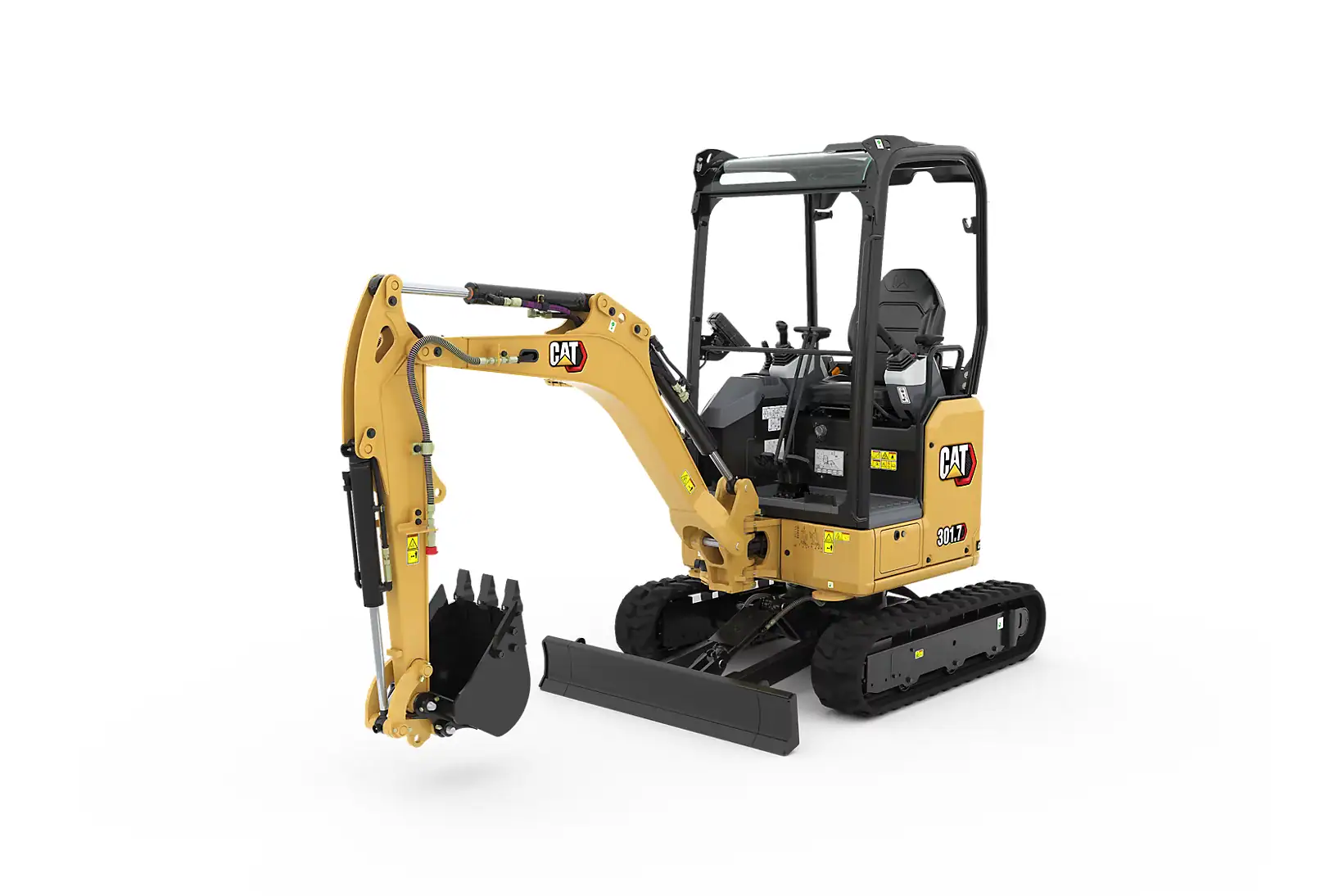
Overview & Specs
The Cat 301.7 CR is a candidate for buyers whose excavator has to work around an existing property rather than on an empty construction site. The challenge might be a fenced yard, a narrow route between buildings or a landscape project where access and material storage compete for the same space. In these situations, choosing by maximum digging depth alone misses the constraint that determines whether the job is practical.
A useful assessment starts with a site plan: how the machine enters, where it works, where the rear rotates and how excavated material leaves. This guide explains how to evaluate that plan with the documented North American 301.7 CR configuration, including the standard versus long stick decision. It does not assume that an older used machine has every feature shown on today’s product page.
On This Page
ToggleKey Cat 301.7 CR specifications
Caterpillar’s 301.7 CR product specifications provide the following comparison points.
| Specification | Value |
|---|---|
| Engine and net output | C1.1; 15.7 kW / 21 hp |
| Canopy operating weight range | 1,790–1,915 kg, configuration dependent |
| Expandable track width | 990 mm retracted; 1,300 mm expanded |
| Tail-swing radius | 650 mm |
| Dig depth, standard / long stick | 2,350 / 2,540 mm |
| Ground reach, standard / long stick | 3,900 / 4,060 mm |
| Stick digging force, standard / long | 9.5 / 8.3 kN |
| Primary auxiliary flow | 33 L/min |
The documented machine has an expandable undercarriage as standard and an open canopy. The weight range reflects different equipment; obtain the offered machine’s exact configuration before transport planning.
Start with three spaces, not one gate measurement
1. The route into the property
Walk the entire route with a measuring tape and a sketch. Include the narrowest opening, changes of direction, overhead obstructions and the ground supporting the route. A gate can be wide enough while the turn beyond it is not. Temporary access through a removable fence section may be practical on one property and impossible on another.
Also identify what has to travel through the opening with the machine. The bucket, blade configuration and any carried equipment belong in the assessment. Do not assume a track-width measurement describes every protruding part. Access planning should leave real clearance rather than rely on two nominal dimensions being identical.
2. The operating position
The place where the excavator digs needs its own assessment. The required operating setup can occupy more space than the travel setup. Use the manual’s instructions for track position and stability; squeezing into an area is not evidence that all digging or lifting operations are appropriate there.
Rear clearance, front attachment movement and visibility must be considered together. Compact-radius branding helps identify a design priority, but it is not permission to rotate against a wall. Installed accessories and the actual upper-structure configuration can matter, and people must remain outside the operating area.
3. The material-handling space
Determine where each bucket of material will go. On a confined property, this can be the limiting factor even when the machine fits comfortably. A stockpile, a carrier, a truck and an access corridor all need space. Moving the same soil twice because the initial stockpile blocks the next stage can erase the benefit of a compact machine.
This three-part plan gives the 301.7 CR a fair evaluation. It might solve the entry problem while another piece of equipment handles spoil. Alternatively, a slightly different project sequence may allow a larger excavator to work from outside the restricted area. Compare complete methods, not just machine footprints.
Compact rear geometry does not answer every clearance question
The rear-radius figure and the track widths are distinct dimensions. Their relationship changes when the undercarriage is in a different position. Avoid converting that relationship into a blanket claim of “zero clearance needed,” especially on a used machine with equipment that differs from the reference configuration.
For a landscaper working around finished surfaces, clearance is also a commercial issue. Damage to a fence, wall or mature planting can outweigh a modest saving in machine hire. A useful quotation therefore includes the access method and protection work needed, not simply an hourly excavator charge.
Ask for a demonstration of the actual machine’s swept area in an open location. Review how the operator monitors the rear while concentrating on a precise bucket movement. If sightlines are poor for the intended task, shrinking the rear radius does not solve the whole problem. A sound operating plan still has to address visibility and separation.
Choose the stick for the shape of the work
The long stick changes more than the deepest point on a diagram. It changes the relationship between the machine position and the working area. That can be useful where the position is constrained, but the corresponding force rating and the relevant load chart must remain part of the decision.
For example, imagine two hypothetical landscaping jobs. The first requires several shallow excavations in loose, accessible material. The second involves reaching into a planned work area from a restricted but suitable machine position. The first may gain little from extra reach; the second may gain considerably. Neither comparison can be settled by the model’s engine output.
When reviewing a working-range diagram, locate the required depth and horizontal distance together. Maximum ground reach is not the available reach at maximum depth. Also check whether the bucket can curl, clear the work and discharge where the material needs to go. A point the teeth can touch is not necessarily a useful working zone.
Where deep work is only occasional, compare a different rental machine for those jobs. The longer stick should solve a recurring geometry problem, rather than serve as an inexpensive substitute for a machine with a substantially different operating envelope.
Bucket selection for finished properties
Precision and restoration cost often matter more than a large bucket on a developed property. Match the cutting width to the planned work and the material. An unnecessarily wide excavation creates more material to move and more area to restore, even if the initial digging appears fast.
A separate finishing tool can be useful, but assess its mass and mounting rather than assuming that every bucket offered for a similar-size excavator will fit. The coupler, linkage and attachment geometry form a system. Confirm the complete arrangement before paying a premium for a used machine advertised with “several buckets.”
Think about storage positions too. A bucket left in the access corridor can become a repeated handling problem. Plan which tool is used first, where unused tools sit and how attachment changes fit into the approved work procedure. On a small property, a tidy equipment sequence can improve the job more than one extra attachment.
Hydraulic attachments require a separate buying decision
The flow rating in the specification table is only one part of matching a powered tool. Obtain the tool’s acceptable flow range, pressure requirements, return restrictions and carrier requirements. A tool with suitable flow can still be unsuitable because of its mass, plumbing or operating controls.
If a thumb and another hydraulic attachment are both planned, write down how each will be controlled and connected. Do not assume the presence of hoses means the machine has every circuit needed. Establish the installed equipment and demonstrate the functions you intend to use.
For an occasional user, hiring a specialist attachment together with a compatible carrier may be more sensible than permanently equipping the excavator for a rare task. For a contractor who uses that tool every week, a demonstrated and documented installation can be worth more than a lower base-machine price.
A practical confined-yard comparison
Suppose a hypothetical customer needs three separate landscape areas excavated, with all material removed through one narrow route. Compare candidates using the same route and the same spoil-removal arrangement. Count setup changes, machine moves, attachment changes and waiting time, rather than timing only how quickly one bucket fills.
One machine might dig faster but require more access preparation. Another might fit easily but spend much of the day waiting for material transport. These are project costs, not necessarily weaknesses in either excavator. The best choice is the combination that completes the work efficiently within the site’s constraints.
Useful alternatives to research include the Bobcat E20 and Kubota KX018-4. Compare their actual configurations against your site sketch. Avoid transferring current specifications to older advertisements or assuming similar model classes have the same rear clearance.
Owning a canopy excavator in Canada
The timing of the work affects the value of the package. Planned summer landscaping and urgent shoulder-season work place different demands on the operator environment. If the business depends on working through wet or cold conditions, evaluate whether a canopy machine fits that schedule before concentrating on purchase price.
Site access also changes with the season. A route that looks suitable in dry weather may need reassessment after prolonged rain or thaw. Treat ground conditions as part of project planning; a compact machine’s size is not a guarantee that the ground can support the proposed operation.
For maintenance, build the schedule from the correct manual and record completed work. Note the service arrangements available locally, how filters and wear items will be obtained, and what happens if the machine needs transport for repair. These practical arrangements matter to both a remote acreage owner and a contractor with booked jobs.
Buying used: inspect the components that support the access argument
If expanding tracks are central to your purchase, their condition deserves particular attention. Have the mechanism, associated hoses and undercarriage structure examined and its operation demonstrated according to the manual. A machine sold on variable-width convenience should actually provide that function properly.
Inspect the rear body and surrounding structure for evidence of contact and repairs, but avoid treating cosmetic damage as a diagnosis. A competent inspection should distinguish appearance from structural condition. Check the front linkage and attachment locking system with the same care.
Ask for a cold start, service records, warning-history information where available and a warmed-up operating demonstration. A video of a machine idling does not establish how it performs under representative work. Record any deficiencies and obtain repair estimates before negotiating around an apparently attractive asking price.
Finally, verify the equipment list. A photographed tool, spare track or transport item may not be included in the sale. Write the agreed package into the purchase documents, with identification sufficient to distinguish it from other equipment on the seller’s property.
Transport and the total ownership package
Use the actual ready-to-transport load rather than the model’s class label. Reconcile the machine’s documented weight with its installed equipment, then include separately carried tools and other cargo. Establish which components are already counted so the calculation remains meaningful.
Assess the complete towing combination against its individual ratings and applicable requirements. A nominal trailer rating is not available payload, and a pickup description is not a towing assessment. If your work involves infrequent moves, obtain delivery and transport quotes before buying a dedicated trailer.
Build the ownership comparison around a year of expected work: acquisition, servicing, storage, transport, attachments and outside help for unsuitable jobs. Use actual quotes where possible. This exposes a common mistake in compact-equipment shopping: spending the entire budget on the machine and leaving no provision for the equipment that makes it useful.
Frequently asked questions
Does CR mean it can work directly against a building?
No. Assess the full moving envelope and the actual setup. Rear geometry is one part of clearance planning; the front equipment, accessories, operator visibility and site conditions still matter.
Is the long stick always better for landscaping?
It is useful when the job needs its reach. For other work, compare force, tool choice and the complete cycle before paying for a configuration that does not solve a recurring problem.
Can I select a trailer from the operating-weight table?
Use the table to identify the need for a configuration check. Establish the actual load and compare the whole transport combination; do not treat one catalogue number as the final answer.
What should decide between the 301.7 CR and another small excavator?
Use a measured site plan and a representative demonstration. The winning machine should enter, work, discharge material and leave without a sequence of expensive compromises. Local support and the condition of the complete package then help distinguish otherwise suitable choices.
What if there is no room to stockpile material in the yard?
Resolve material removal before selecting the machine. Compare an appropriate carrier or loading arrangement and its access needs. Excavator fit alone does not make the project practical when every bucket blocks the next movement.
Share your experience
Help other Canadian buyers — leave a quick review for the
Cat 301.7 CR
There are no reviews yet. Be the first one to write one.