Overview & Specs
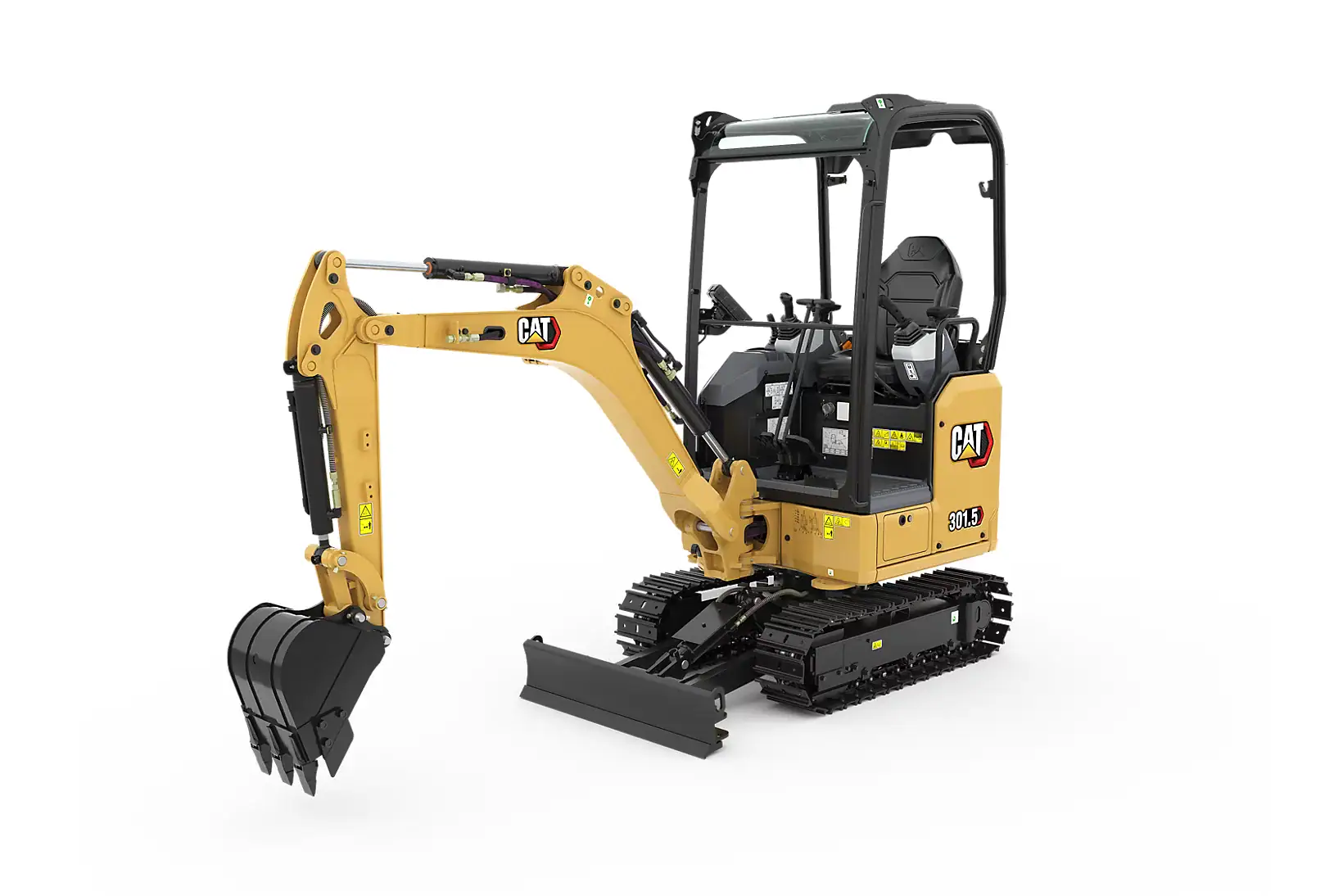
The Cat 301.5 deserves consideration when access, manageable equipment logistics and occasional excavation matter more than moving a large volume of material every day. For a Canadian acreage owner or landscape business, its buying question is straightforward: can a small canopy excavator complete the regular jobs without turning each one into a long sequence of repositioning and spoil handling?
Answer that through the entire property project. Getting through the gate is only the beginning. The machine needs room to work, somewhere to place excavated material, a suitable bucket and a transport arrangement that accounts for everything travelling with it. This guide uses Caterpillar’s North American specifications for the current documented configuration; older machines with similar names require their own serial-specific information.
On This Page
ToggleCat 301.5 specifications that shape the purchase
The following selection comes from the official Cat 301.5 specifications. Standard- and long-stick values are separate configurations.
| Item | Published value |
|---|---|
| Engine; net power | Cat C1.1; 15.7 kW / 21 hp |
| Canopy operating weight, minimum–maximum | 1,580–1,775 kg, configuration dependent |
| Dig depth, standard / long stick | 2,340 / 2,540 mm |
| Ground-level reach, standard / long | 3,730 / 3,890 mm |
| Tail-swing radius | 820 mm |
| Expandable track width, retracted / expanded | 990 / 1,300 mm |
| Primary auxiliary flow | 33 L/min |
| Stick force, standard / long | 8.2 / 7.2 kN |
The expandable undercarriage is optional. The minimum-weight specification uses a fixed undercarriage; the maximum uses an expandable one and different tracks. Treat those as configurations, not a weighing certificate for a particular sale machine.
Who should put the 301.5 on the shortlist?
A useful candidate owner has several small excavation tasks scattered through the year: reshaping an accessible landscape area, removing selected planting beds, preparing a small project area or maintaining property features where the work has already been properly planned. In this situation, availability can matter as much as peak output. Owning a machine lets you coordinate excavation with material delivery and the rest of your project schedule.
A contractor should apply a different test. Count how many jobs actually benefit from this footprint, and how often the machine would be waiting for another piece of equipment to carry soil away. A compact excavator can be an effective specialist in a fleet even when it would be a frustrating only machine. Access-sensitive work and high-volume open excavation are different business cases.
Be cautious about buying around one difficult stump or one deep installation. Those tasks can dictate a much larger machine than the routine work needs. Compare a smaller machine for recurring work plus hired help for exceptional jobs against owning extra capacity all year. The answer depends on actual work frequency, storage and transport costs, not the largest photograph in a sales advertisement.
Fixed versus expandable tracks: establish what you are buying
The width figures in the table are useful only when the offered machine has the matching undercarriage. A used advertisement that says “301.5, narrow access” is not enough. Include the undercarriage configuration in the written equipment description and inspect it directly. Do the same for the blade and any removable or folding width-related components.
Measure the route at several heights. A gate opening measured between posts can become narrower at a latch, and a turn immediately beyond it may be more restrictive than the opening itself. Low branches, roof overhangs and stored materials can matter as much as track width. Plan an unobstructed route; a nominally matching measurement leaves no allowance for alignment or irregular ground.
Once inside, assess the operating area separately. Retracted access width is not a promise that every operation is suitable in that configuration. Follow the machine’s operating instructions for undercarriage position. Buying because the machine fits an entrance, while ignoring the space needed for its working setup, is an expensive way to discover a site constraint.
The rear needs room even when the tracks fit
The 301.5’s rear-clearance requirement deserves its own line on a site sketch. Track width describes the base; tail swing describes the rotating upper structure. These dimensions answer different questions. A narrow passage is therefore not automatically a place where the excavator can rotate and work.
For a property buyer, this matters around sheds, fences and established landscaping. Map the working position, the rear sweep and the front attachment path together. Include the bucket, hoses and anything installed on the machine. Do not treat a manufacturer’s rear-radius figure as a complete collision envelope or a safe separation distance.
A sensible demonstration can reveal this without using a real obstruction as a test target. Ask the operator to explain the required working clearance on an open demonstration area, using the actual configuration. If most prospective work is confined on several sides, compare a compact-radius alternative before committing to a conventional-tail machine.
Standard or long stick for property excavation?
The longer stick expands the reach envelope, but it does not make the machine a larger excavator in every respect. The table shows both the added depth and the different stick-force rating. The choice should follow the geometry and material of your recurring jobs.
A standard stick is worth evaluating when most digging takes place comfortably inside its range and the work involves filling a bucket repeatedly. A long stick deserves attention when the relevant task is reaching a particular area from an approved machine position. Neither option removes the need to check the full working-range drawing, attachment configuration and lifting information.
Consider a hypothetical garden project with several shallow, separated work areas. Extra maximum depth may contribute little; access and the time spent moving spoil may dominate. A different project with a difficult-to-reach corner could make additional reach valuable even though the excavation itself is not deep. Those are distinct reasons for selecting an arm, and neither requires claiming that one configuration is universally better.
Maximum depth also describes a limit, not a rectangular hole the machine can excavate from one position. The bucket must cut, curl, clear the excavation and discharge. A machine that can touch the deepest point may still need frequent repositioning to finish the required shape.
Choose buckets around the material and finished result
Start a bucket package with the jobs you can name. A digging bucket and a finishing bucket solve different problems; a large collection of inexpensive buckets is not automatically a useful package. Record each tool’s width, mass, mounting arrangement and intended material, then check compatibility with the actual machine and coupler.
A wider bucket may look efficient when priced beside a narrow one. However, taking more material per pass only helps if the excavator can fill and handle it appropriately. For awkward ground or precise work, control of the cut and the amount of material disturbed can be more useful than nominal bucket volume.
A coupler also becomes part of the working equipment. Its mass and geometry belong in the package assessment. Used buckets that appear to have the right pins may still have unsuitable spacing, width or linkage compatibility. Have fit and locking verified before treating an included attachment as an asset in your purchase comparison.
Auxiliary hydraulics: check the tool, not only the hose ends
The listed primary auxiliary flow is a starting point for attachment selection. It is not an assurance that any small excavator tool will perform properly. Hydraulic tools also have pressure limits, return requirements, control requirements and carrier-mass restrictions.
For a proposed auger or other powered attachment, obtain its operating requirements and compare them with the machine’s configured circuit. Ask for a demonstration of the intended combination when attachment work is central to the purchase. Connecting compatible-looking couplings is not the same as establishing a suitable hydraulic installation.
Include attachment changes in the ownership plan. Where will tools be stored, how will they be transported, and can they be changed using the approved procedure without disrupting the rest of the job? For occasional property work, a smaller, clearly matched package can be more useful than paying for tools that spend most of their time in storage.
Transport planning starts with the complete load
The model designation is not the transport weight. Begin with the actual machine configuration and establish what its documented weight includes. Then account for the bucket, coupler, additional tools, tie-down equipment and other items carried. Avoid adding items twice when they are already included in the relevant figure.
Compare the complete loaded combination against the ratings of the trailer, axles, tyres, hitch and tow vehicle, as applicable. A trailer’s advertised gross rating is not the same as its available payload after its own weight. The machine also has to fit the usable deck and loading arrangement; capacity alone does not answer that question.
If transport happens rarely, compare delivery or a suitable hired transporter with ownership of a dedicated hauling setup. For a small acreage machine, the supporting equipment can change the financial decision substantially. Obtain real local quotes rather than assuming a particular pickup category will be sufficient.
Canadian seasons and a canopy machine
Think about when the work can realistically happen. A canopy machine may suit planned fair-weather projects, while frequent cold or wet work places a different value on operator shelter. Protective clothing cannot make every schedule equally comfortable or productive. Compare the operating environment as part of the machine choice rather than as an afterthought.
For seasonal storage, use the machine’s manual to establish fluid, battery, fuel and inspection requirements. Keep maintenance records with the serial number so that the next season begins with known work rather than guesses. Protect attachments and keep their identification legible; an unidentifiable hydraulic tool creates another compatibility problem later.
Do not buy a small excavator on the assumption that frozen ground will make difficult digging predictable. Seasonal soil and access conditions can change the project, and a task that works well in one month may need a different plan in another.
Inspecting a used Cat 301.5
- Identity and configuration: match the serial plate, documentation, undercarriage and stick to the seller’s description.
- Wear and previous repairs: have pins, bushings, attachment linkage, tracks, rollers and structural repairs assessed by a competent inspector.
- Operation: observe a proper cold start and a demonstration after warm-up. Note warning messages and irregular behaviour without diagnosing them from a sales video.
- Included equipment: verify coupler locking, tool fit and hydraulic compatibility; do not price an untested attachment as ready to work.
- Ownership costs: obtain written estimates for identified repairs and routine service items before comparing the purchase with a better-equipped alternative.
These are inspection priorities, not a claim that the model has particular recurring faults. A low hour reading cannot establish maintenance quality by itself. Equally, visible wear needs context: documented repairs and an independent assessment are more useful than a blanket rule that every marked machine is a poor buy.
Alternatives and a useful demonstration
For another perspective on the small-excavator purchase, review the Bobcat E19 guide and the Kubota KX018-4 guide. Use them to build a comparison list, then compare current serial-specific specifications and actual packages. A class label does not make machines identical in clearance, equipment or weight.
Give each candidate the same buying test: the measured access route, the intended bucket, a representative task and the material-removal plan. Record whether the operator can see the work clearly and whether setup or repositioning consumes disproportionate time. A short representative demonstration is more informative than ranking machines from one peak specification.
Frequently asked questions
Is every Cat 301.5 fitted with expanding tracks?
No. Establish the actual undercarriage before using the variable-width figures. A photograph or model name alone should not decide an access-critical purchase.
Should I automatically choose the long stick?
Choose it for a demonstrated reach requirement. Compare the complete digging cycle and the matching force and load information, rather than treating the deepest published figure as a free upgrade.
Can the 301.5 replace a loader on an acreage?
Plan the two functions separately. Excavating from a working position and repeatedly carrying material between locations are different jobs. If spoil must travel a significant distance, include a suitable material-handling method in the project.
Is it a good first excavator?
It can be a candidate when the work, access and support arrangement fit. The stronger first purchase is the machine whose actual configuration solves your regular jobs and whose operating and maintenance requirements you can support, not simply the smallest machine available.
What should an occasional owner budget for besides the excavator?
Include a usable bucket package, delivery or transport, storage, routine service and any supporting equipment needed to move material. Separate these from optional tools for jobs that may never arise; otherwise a low machine price can conceal an incomplete ownership setup.
Share your experience
Help other Canadian buyers — leave a quick review for the
Cat 301.5
There are no reviews yet. Be the first one to write one.