Overview & Specs
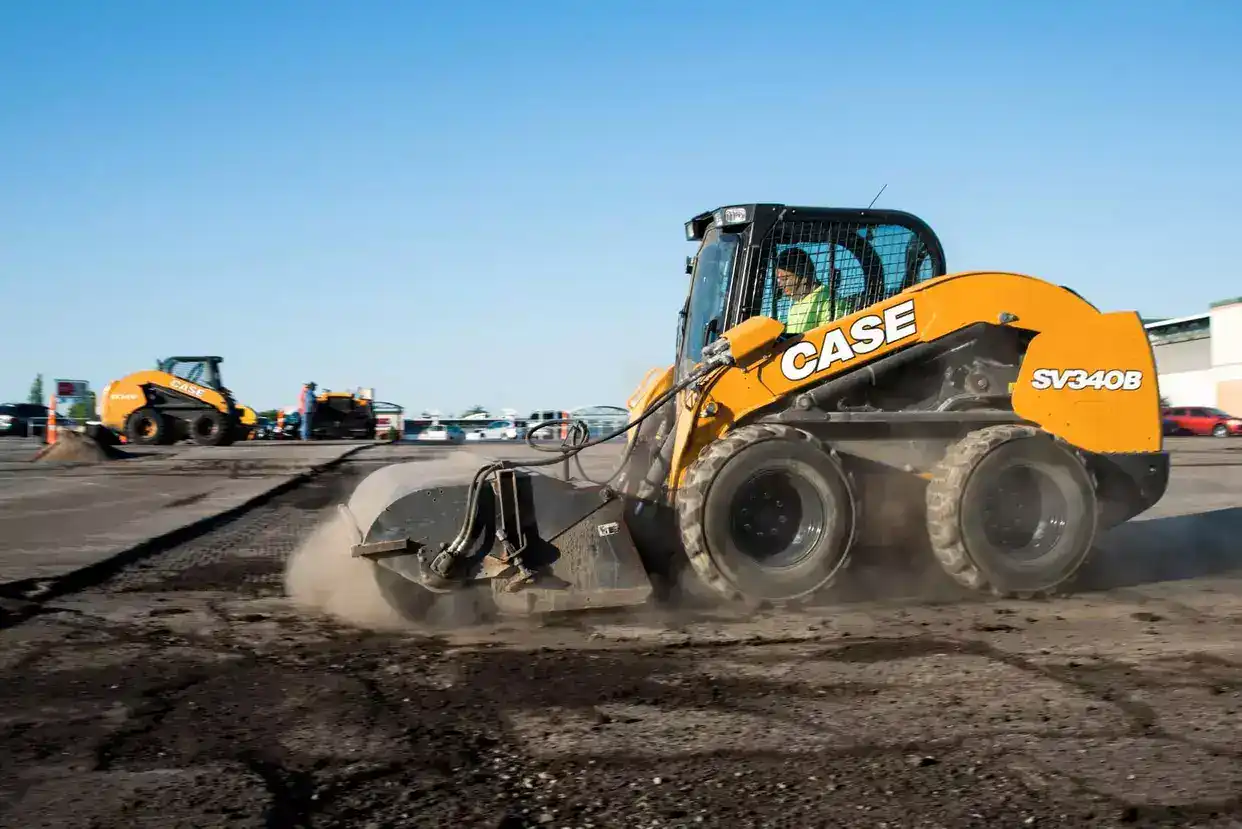
The CASE SV340B belongs on the shortlist when the job requires a substantial wheeled loader and the buyer can explain what the extra capability will accomplish. Heavy material handling, frequent placement at height and demanding powered attachments are different reasons to consider it. Each requires its own verification rather than a general assumption that the largest machine will cover everything.
One particularly useful distinction is between high-flow and enhanced high-flow hydraulics. The enhanced package has a lower published flow figure but a higher pressure rating. Selecting only by gallons per minute can therefore lead a buyer to misunderstand the options. This guide examines that choice alongside loading geometry, transport, Canadian seasonal work and used-machine inspection.
On This Page
ToggleSV340B specifications in context
| Item | North American specification |
|---|---|
| Lift geometry | Vertical |
| Engine power | 90 gross hp / 84 net hp |
| ROC at 50% of tipping load | 3,400 lb / 1,545 kg |
| Reference operating weight | 9,100 lb / 4,136 kg |
| Width over reference tires | 73.8 in / 1.88 m |
| ROPS height | 80.4 in / 2.04 m |
| Bucket hinge-pin height | 131.6 in / 3.34 m |
| Wheelbase | 52 in / 1.32 m |
CASE’s May 2026 sheet defines the weight with an open cab, 165 lb operator, full fuel, a 78-inch heavy-duty bucket and 14 × 17.5 tires. It lists a 3.4-litre engine and SCR aftertreatment using DEF. Those details should follow the machine’s serial-specific documentation when evaluating a used or differently equipped example.
Three hydraulic arrangements, three separate checks
| Arrangement | Published flow | Published pressure |
|---|---|---|
| Standard auxiliary | 24.2 gpm / 91.5 L/min | 3,450 psi / 238 bar |
| Optional high flow | 38.7 gpm / 146.5 L/min | 3,450 psi / 238 bar |
| Optional enhanced high flow | 35.0 gpm / 132.5 L/min | 4,000 psi / 276 bar |
These are the package figures in the linked manufacturer sheet. They are not three outputs to add together. The selected attachment must accept the relevant flow and pressure, along with the machine’s return arrangement, case drain where required, electrical controls and carrier requirements.
For a hydraulic motor, flow and pressure play different roles. A useful screening calculation for hydraulic power is flow in US gpm multiplied by pressure in psi, divided by 1,714. Applying that arithmetic gives approximately 77.9 hp for 38.7 gpm at 3,450 psi, and 81.7 hp for 35 gpm at 4,000 psi. This is theoretical hydraulic power at the stated pair of values, before losses.
Those calculations are not measured attachment output or a promise that maximum published flow and pressure are sustained together during every task. Engine loading, losses, temperature and simultaneous functions affect real operation. Their purpose is to explain why the smaller flow number does not automatically mean a weaker package.
The standard and high-flow guide explains the underlying matching process. For the SV340B, request the exact package on the build sheet and quote, then compare it with the tool manufacturer’s requirements. A “high flow” sticker does not identify every relevant part of the system.
Build the attachment decision around the work
A tool used occasionally for cleanup creates a different ownership case from one expected to earn revenue for long working periods. Write down the material, expected pass or cutting depth, required finish, travel pattern and daily operating duration. These details are more useful to the supplier than asking whether the loader can run a generic “large attachment.”
Include guarding and visibility in the equipment package. A compatible hydraulic circuit does not establish that the cab, shields and machine configuration meet the attachment’s requirements. Confirm the complete approved arrangement before assuming that a standard used machine can be converted cheaply.
During a qualified demonstration, evaluate control precision and behaviour through the intended duty pattern. Observe how the operator coordinates travel and the tool. A machine that runs an attachment briefly while stationary has not necessarily demonstrated the task that will justify the purchase.
If the demanding tool is only a possibility, cost a separate rental or contracted-work plan. Buying extra capability can be sensible, but an unselected future attachment should not automatically dictate the most expensive configuration today. Conversely, an established contract depending on the tool justifies resolving every compatibility question before purchase.
Heavy pallets and bales require more than a high ROC
The SV340B’s published capacity is a useful comparison point, but payload geometry remains decisive. Establish the actual load mass and centre, the attachment’s weight and rating, placement height and the surface supporting the machine. Bales with different moisture and density should not be treated as interchangeable simply because their dimensions look similar.
Fork capacity printed on the attachment does not independently establish the loader’s capacity with those forks. The system is constrained by the applicable machine-and-attachment limits. Do not use tipping load as the operating target or infer high-placement suitability from the ability to raise a load slightly off the ground.
For background, read ROC and tipping load explained. Then write the essential handling job into the purchase requirement. If that job remains outside the approved arrangement, a forklift, telehandler or another handling plan may be more appropriate than seeking a marginally larger skid-steer headline number.
Vertical geometry and receiver clearance
Measure the receiver and the approach, not just the loader’s lift height. The sidewall, wheel position or a barrier may keep the machine farther away than expected. The bucket must clear and discharge through its movement, while the operator retains an appropriate view and operating position.
A larger bucket can add material volume but change reach, discharge clearance and load position. If the purchase is justified by faster truck loading, verify it with the actual bucket type. A high hinge-pin figure is not a guarantee that every bucket will empty cleanly into the target body.
The lift-path comparison helps identify the useful measurements. For a second large wheeled candidate, the Bobcat S770 offers another model to investigate. Verify current machine-specific facts independently; an older comparison page should not determine a new purchase’s rating basis or attachment approval.
The footprint must work every day
Size can improve one task while complicating several others. Check doors, maintenance space, attachment storage and the room beside a trailer. Include the bucket or grapple and the rear swing in the assessment. Tire width alone is not the operating envelope.
Consider a yard where heavy loading happens in the open but daily cleanup requires narrow passages. The SV340B may suit the first task and be inconvenient for the second. Compare a single-machine compromise with a smaller support machine or a revised workflow. The correct choice depends on how often each task occurs and what the compromise costs in time.
Transport is another continuous consequence of size. Obtain the actual loaded weight and assess the complete vehicle and trailer arrangement with all carried tools. A reference operating weight is not a transport certificate, and the model name does not account for counterweights, cab equipment or alternative tire assemblies.
SCR and DEF: include the routine in the ownership plan
The documented SV340B arrangement uses SCR and DEF. Do not transfer a no-additional-fluid claim from another CASE model. Verify the engine and emissions configuration on the specific machine and retain its operating and storage instructions.
For a farm with several machines, make fluid identification and storage unambiguous. The operator should know which fill point belongs to which fluid and how contamination is prevented. An occasional user needs the same clear procedure as a full-time operator, especially where several people share the loader.
During used inspection, have diagnostic messages and emissions-system concerns evaluated properly. A missing warning at the moment of a short demonstration is not a full condition assessment. Records and a competent inspection provide a better basis for budgeting than a seller’s statement that the system “never gives trouble.”
Cold-weather preparation should follow the applicable manual and fluid requirements. Do not improvise additives or modifications to solve a starting or emissions concern. Diagnose the actual issue and preserve the approved machine configuration.
Snow work and spring ground are different tests
A powerful loader does not eliminate the need to match traction and attachment size. For pushing snow, evaluate the route, tire configuration and space to store material. For blowing, add the hydraulic and control match. A broad attachment can reduce the number of straight passes while making the turnaround or final placement slower.
Check cab heat, clearing of glazing, lighting and visibility with the tool fitted. Long winter shifts can expose shortcomings that a brief summer demonstration does not reveal. Make those functions part of the inspection rather than relying on a cab photograph.
Spring access deserves its own assessment. If the loaded route repeatedly becomes too soft, compare site preparation or a tracked machine. The wheels versus tracks article addresses that decision. More machine weight and horsepower do not independently establish that the ground can support the intended operation.
Buying used: concentrate on expensive uncertainty
Resolve the installed hydraulic package first if a demanding attachment is the reason for purchase. Next, review service records, structural condition, coupler and pivot wear, cylinder rods, tires and the drive system. Ask a qualified inspector to distinguish repairable wear from concerns requiring deeper diagnosis.
Observe the machine after warm-up and during an approved representative task. Record fault messages, unexpected behaviour and any evidence of repairs. These are inspection priorities, not claims that the model has a documented pattern of failures. This guide does not use unverified owner anecdotes as reliability statistics.
Price uncertainty explicitly. A missing option with a firm installation quote can be included in a comparison. An unexplained hydraulic problem should not be assigned a casual repair allowance. Until the diagnosis is clear, its effect on the purchase remains unknown.
Frequently asked questions
Why does enhanced high flow have fewer gpm?
The package combines its stated flow with a higher pressure rating. Attachment suitability depends on both, along with the rest of the circuit and tool requirements. Comparing flow alone misses that distinction.
Does the theoretical hydraulic calculation show real tool power?
No. It is a screening calculation before losses and does not establish continuous performance at simultaneous maximum ratings. Use the approved tool match and an appropriate demonstration for the actual job.
Is this the right loader for every heavy pallet?
No. Load centre, fork arrangement, height and operating conditions can make a particular pallet unsuitable even when a headline number appears sufficient. Check the complete approved handling arrangement.
Should I buy it for occasional high-demand work?
Compare annual ownership with a rental or contracted alternative, including mobilisation and availability. Frequent essential work supports a different decision from an uncertain future project.
What should be written into the quote?
The exact hydraulic package, cab and guarding requirements, controls, tires, coupler and compatible attachment. These details determine whether the delivered machine matches the job; the model designation alone does not.
Sources and limits
Checked October 7, 2026: CASE Canada SV340B and CCE202605SV340B specification sheet. Specifications are tied to the documented build. Calculations are explanatory, and no measured field performance, price or owner rating is claimed.
Share your experience
Help other Canadian buyers — leave a quick review for the
CASE SV340B
There are no reviews yet. Be the first one to write one.