Overview & Specs
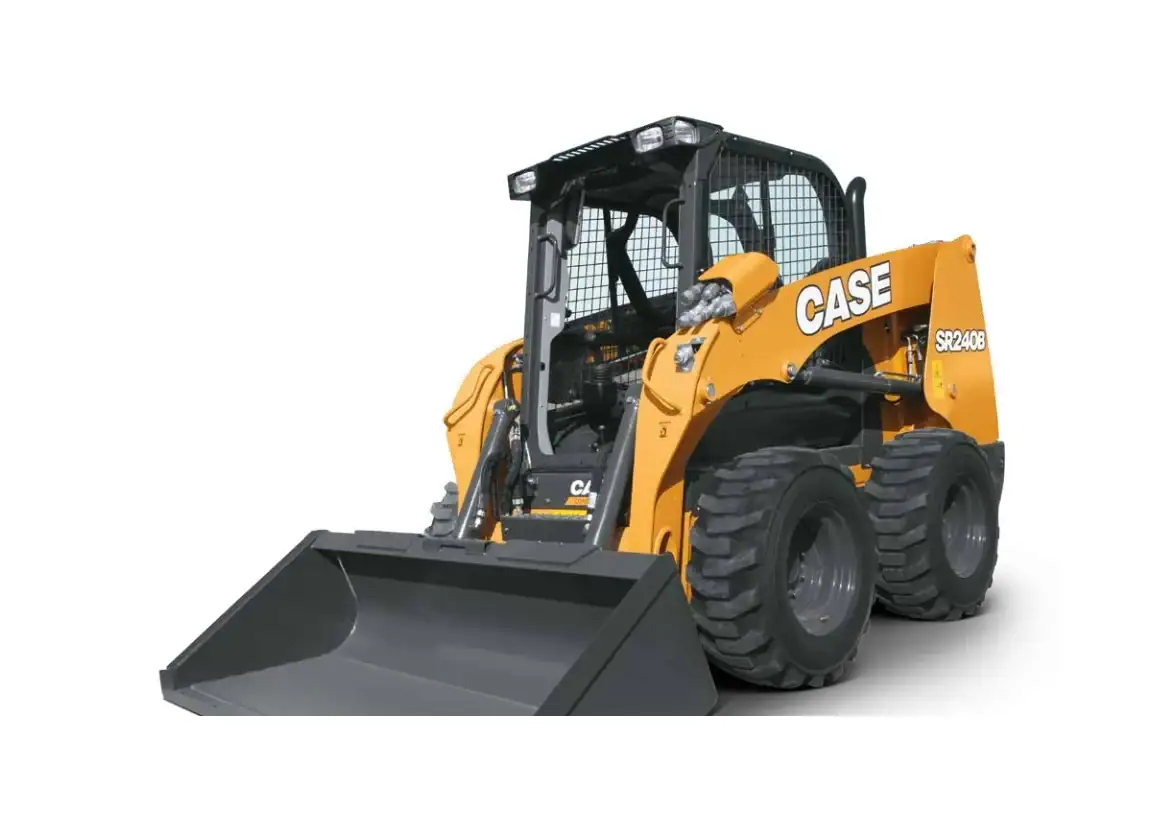
The CASE SR240B is a radial-lift skid steer for buyers who need to examine a larger working package without assuming that the next useful improvement must be more engine horsepower. It shares the familiar 74 gross hp headline with some smaller CASE machines, yet its longer wheelbase, capacity and optional hydraulic package create a different purchase proposition.
For farmyard maintenance, landscape preparation and repeated material movement, that makes the SR240B a machine to judge by the complete cycle. Can it carry the approved load, turn where the work happens, operate the chosen tool and empty into the intended receiver? A larger chassis earns its place when those answers improve the operation enough to justify its space and transport requirements.
On This Page
TogglePublished specifications and their boundaries
| Specification | North American reference |
|---|---|
| Lift path | Radial |
| Engine output | 74 gross hp; 68 net hp |
| ROC at 50% of tipping load | 2,400 lb / 1,088 kg |
| Operating weight | 7,400 lb / 3,350 kg in the specified build |
| Wheelbase | 52 in / 1.32 m |
| Length with foundry/excavating bucket | 142.2 in / 3.61 m |
| Width over specified tires | 69.6 in / 1.77 m |
| Standard auxiliary flow | 24.2 gpm / 91.5 L/min |
| Optional high flow | 37.6 gpm / 142.5 L/min |
The linked CASE sheet bases operating weight on an open cab, 165 lb operator, full fuel, a 72-inch Dirt & Foundry bucket and 12 × 16.5 tires. Its engine specification lists 3.4 litres and DOC aftertreatment. The Canadian product page and linked document were checked in October 2026; production year and installed equipment still matter when buying a particular machine.
The step up is about the chassis and job
Compare the SR240B with a compact candidate by walking through the worksite. Extra length can affect a turn beside a building, the room between a stockpile and a trailer, or the approach to a storage bay. Width alone may suggest both machines fit while overlooking the manoeuvre required once they are inside.
At the same time, a buyer should not assume that the smallest loader which physically fits will be the most productive. If its approved payload or tool capability forces many additional cycles, the compact machine can become an expensive compromise. The correct comparison is time and cost per completed task, including the parts of the task that remain manual.
Use a representative work period rather than the busiest exceptional day. List ordinary material volumes, routes and attachment changes. Then record which limits are currently causing delay. A purchase intended to solve insufficient bucket capacity should not be justified mainly with an unrelated horsepower comparison.
Bucket choice can decide whether the larger machine helps
A buyer moving up from a smaller loader may be tempted to retain every attachment. Sometimes that works; sometimes a bucket which was appropriate before leaves the new machine poorly matched to its intended material. Check coupler engagement, width, weight, geometry and manufacturer compatibility before considering the economics.
For loose low-density material, bucket volume may constrain output before payload does. For dense aggregate, the reverse can be true. A wider or deeper bucket can also change visibility of the cutting edge and the space needed to dump. Treat each of these as a separate question instead of calling a bucket simply “large” or “small.”
Here is an illustrative productivity calculation, not an SR240B performance claim. If an approved working arrangement moves 0.35 cubic metres per complete cycle and another moves 0.45, shifting 9 cubic metres requires at least 26 versus 20 cycles after rounding up. If both cycles take two minutes, the difference is about 12 minutes. But if the larger arrangement needs an extra 40 seconds of manoeuvring per cycle, the apparent saving disappears. Measure the actual site constraint before predicting output.
Radial lift: assess the working height you use
The SR240B’s geometry makes low- and middle-height work a natural part of the evaluation, but a lift-path label is not a complete explanation of digging ability. Bucket selection, grip, positioning and ground conditions remain central. It is more useful to test a specific grading or loading cycle than to rank all radial machines above all vertical machines.
For loading over a sidewall, check the bucket’s path and discharge clearance through the whole movement. A published hinge-pin height describes the pivot, not the bottom edge of a tipped bucket. A receiver that appears low enough on paper may still prevent material from being placed where you want it.
Where high placement dominates the work, compare a vertical-lift option and the actual receiver geometry. Where most time is spent shaping a yard or moving material between ground-level locations, focus on visibility, tool control and cycle efficiency. The radial and vertical lift comparison provides the framework without turning design type into a universal verdict.
High flow needs a business case and a compatible tool
The SR240B’s optional hydraulic output may be important to a buyer planning continuous powered attachments. It should be evaluated against a named attachment’s required range, pressure and return arrangement. Having a larger available flow number does not make every tool more productive, and supplying excessive flow to an incompatible tool is not an upgrade.
Separate three purchase cases. First, ordinary bucket work may provide no direct reason to buy high flow. Second, an existing attachment may specifically require a compatible high-flow machine. Third, a future attachment may be plausible but not yet selected. The first case calls for restraint; the second calls for documentation; the third calls for a realistic quote for both the machine and the intended tool.
For a demonstration, include travel control, implement control and the expected duty pattern. A short unloaded run does not establish sustained performance under working demand. Check applicable cooling and guarding requirements, electrical controls and any case-drain connection. The hydraulic matching guide covers those requirements in more detail.
Loading capacity is not a shortcut around fork ratings
The SR240B’s ROC is useful for positioning the machine in a shortlist. It cannot independently confirm a pallet-handling job. Write down the actual load dimensions, mass and centre, then identify the required placement height and ground conditions. Packaging and the attachment are part of the arrangement even when they are absent from the product’s advertised weight.
Do not use tipping load as a working allowance or treat a successful low lift as proof of full-height suitability. The ROC guide explains these distinctions. For the purchase itself, obtain the approved machine-and-fork information for the proposed work.
A farm that mainly moves bulk material but occasionally receives a heavy pallet should cost a separate unloading plan. That may be better than changing the everyday machine around a rare task. If heavy deliveries occur weekly, however, handling capacity may deserve priority over a marginal saving in chassis size.
Firm yards, spring access and snow clearing
A wheeled loader should be evaluated on the surfaces where it will actually earn its hours. On a developed yard, the relevant questions may be tire wear, turning space and attachment changeover. On an access lane that deteriorates in spring, support and rutting may decide whether work can proceed at all.
Compare site improvement with machine changes. A short prepared route to a manure storage area may address a specific bottleneck. If the operation regularly requires travel across soft ground in many locations, a track loader may deserve a separate assessment. See the wheeled versus tracked loader guide for that broader decision.
For snow work, choose around the route and disposal point. A large pusher can be inefficient where every pass ends in a tight turn or a poorly located pile. A blower can avoid some relocation but adds hydraulic and control requirements. Neither attachment should be selected only by the loader’s horsepower or overall width.
Cab condition affects the practical shift. Demonstrate heating, clearing of glazing, wipers and lights on the machine being purchased. Confirm prescribed cold-weather preparation in its manual. An option list from a current brochure cannot prove how an older machine was ordered or how well its equipment works today.
Transport and ownership: compare complete packages
Begin transport planning with actual configuration, then obtain a measured weight for the loaded arrangement. Include separately carried attachments and equipment. A loader’s reference operating weight and a trailer’s headline rating do not by themselves establish a suitable transport combination.
For ownership comparisons, separate recurring maintenance, wear items and financing from one-time conversion costs. If one machine needs tires, coupler work and a missing attachment before it can start, put those costs into the first-year plan. If another includes options you will never use, do not assign them full purchase-price value merely because they were expensive when new.
A sensible cost worksheet also records downtime consequences. A farm support machine that can wait until tomorrow creates a different service requirement from a loader responsible for an essential daily process. Ask about the practical repair pathway and parts identification before the machine becomes the only way to perform that process.
A used-machine inspection with a clear purpose
Identify the build and service history first. Verify the hydraulic package, controls and fitted attachments. This avoids spending the rest of the inspection evaluating a machine that cannot support your central task without uncertain modifications.
Have a qualified inspector assess the loader pivots, coupler, structure, cylinder rods, hoses, tires and drive behaviour. Warm operation matters as well as cold starting. Record any fault indications, uneven control response or suspected repairs, and obtain an explanation supported by inspection rather than reassurance.
Inspect service access and signs of neglected cleaning around cooling areas. This is a condition check, not a claim that the SR240B has a particular recurring defect. No verified failure-rate data is used here, and normal inspection priorities should not be misrepresented as model-specific faults.
SR240B buying questions
Why choose this over a smaller 74 hp machine?
Potential reasons include capacity, chassis fit and the required hydraulic package. The same engine-power headline does not imply the same loader. Compare the complete job and configuration rather than paying for size without a purpose.
Is high flow necessary for snow work?
It depends on the attachment. A pushing tool and a powered blower have different requirements. Select the tool first, then verify the circuit and controls required by that exact model.
Should a truck-loading buyer choose vertical lift instead?
Include it in the comparison when loading at height is frequent. The receiver, bucket and required payload determine suitability. A radial machine that completes the approved cycle cleanly need not be rejected simply for its lift-path label.
Will a wider bucket always reduce clearing time?
No. It can add manoeuvring, traction demands or clearance problems. Time a complete representative route, including discharge and return, before assuming width produces a proportional gain.
What is the strongest reason to pass on a used example?
A mismatch with the essential job is more decisive than a cosmetic issue. Unresolved structural, hydraulic or drive concerns also need diagnosis before pricing can be meaningful. A bargain which cannot perform the required task is not an economical purchase.
Manufacturer sources
Checked October 7, 2026: CASE Canada SR240B and the linked SR240B specification sheet. Illustrative cycle calculations are original planning examples. Confirm the serial-specific equipment and operating limits before purchase.
Share your experience
Help other Canadian buyers — leave a quick review for the
CASE SR240B
There are no reviews yet. Be the first one to write one.