

Updated: May 2026 | Aglist Editorial Team
Choosing the right John Deere compact tractor is one of the most-debated equipment decisions Canadian acreage owners face. The reasoning is simple: it’s a $20,000–$50,000+ purchase, you’ll likely own the tractor for 10-20 years, and the difference between picking the right model and the wrong one shows up every time you hook up a loader or mower for the next two decades. The John Deere 1 Family and 2 Family lineups give buyers five genuinely distinct choices — the 1023E, 1025R, 2025R, 2032R, and 2038R — covering everything from budget sub-compact through serious mid-tier compact tractors.
This guide compares all five current John Deere 1 and 2 Family models side-by-side, with the specifications that matter, the real-world strengths of each, configuration decisions (DPF emissions, loader options, cab availability), and clear recommendations for Canadian buyers across acreage sizes, climate regions, and use patterns. Where competitor guides repeat John Deere’s marketing about “the world’s most popular compact tractors,” we focus on the practical differences that determine whether a specific model genuinely fits your operation — and how each compares to the Kubota equivalents you’ll likely cross-shop.
If you’re a first-time tractor buyer comparing sub-compact to compact options, an acreage owner debating green vs orange, or a current 1 Family owner evaluating whether to step up to the 2 Family, this guide is written for you.
Quick Answer: Which John Deere Compact Tractor Should You Buy?
If you only need a 30-second answer, here it is:
- John Deere 1023E — 22.4 HP entry-level 1 Family. Best for budget buyers with small properties (under 3 acres) and light use patterns. No DPF/DEF emissions.
- John Deere 1025R — 23.9 HP flagship 1 Family. Best for typical 1-5 acre properties wanting the AutoConnect mower system, Quik-Park loader, and Twin Touch pedals. The right choice for most John Deere sub-compact buyers. No DPF/DEF.
- John Deere 2025R — 23.9 HP entry 2 Family with DPF. Best for acreage owners (3-15 acres) needing the 120R loader’s higher 840 lb lift, MSL loader option, or Mauser factory cab.
- John Deere 2032R — 30.7 HP common-rail 2 Family. Capability sweet spot of the 2 Family lineup. Best for 10-30 acre operations needing the 220R loader (1,120 lb lift) and 62″ mower deck.
- John Deere 2038R — 36.7 HP turbocharged flagship 2 Family. Best for 25-50 acre operations doing sustained heavy work requiring the turbocharged engine’s torque headroom.
The full comparison below explains why — including the critical “1025R vs 2025R” decision (no DPF vs DPF) that most buyers get wrong.
Side-by-Side Specs: All Five Models
| Spec | 1023E | 1025R | 2025R | 2032R | 2038R |
|---|---|---|---|---|---|
| Family | 1 Family | 1 Family | 2 Family | 2 Family | 2 Family |
| Engine | Yanmar 3-cyl | Yanmar 3-cyl | Yanmar 3-cyl IDI | Yanmar 3-cyl CRS | Yanmar 3-cyl CRS Turbo |
| Displacement | 77.5 cu. in. | 77.5 cu. in. | 77.5 cu. in. | 100.2 cu. in. | 95.8 cu. in. (turbo) |
| Gross Horsepower | 22.4 HP | 23.9 HP | 23.9 HP | 30.7 HP | 36.7 HP |
| PTO Horsepower | 16.9 HP | 18.3 HP | 18.6 HP | ~24-25 HP | ~30 HP |
| Rated Engine RPM | 3,200 | 3,200 | 3,200 | 2,500 | 2,500 |
| Fuel System | Mechanical IDI | Mechanical IDI | IDI w/ DPF | Common-Rail w/ DPF | Common-Rail Turbo w/ DPF |
| DPF Required? | No | No | Yes | Yes | Yes |
| DEF Required? | No | No | No | No | No |
| Transmission | HST + Twin Touch | HST + Twin Touch | HST + Twin Touch | HST + Twin Touch | HST + Twin Touch |
| Drive | 4WD standard | 4WD standard | 4WD standard | 4WD standard | 4WD standard |
| Cruise Control | Optional | Optional | Optional | Standard | Standard |
| Front Loader | 120E | 120R Quik-Park | 120R Quik-Park (+ MSL option) | 220R Quik-Park | 220R Quik-Park |
| Loader Lift (at pin, full height) | ~530 lb | 758 lb | 840 lb | 1,120 lb | 1,120 lb |
| AutoConnect Mower | Yes (54″/60″) | Yes (54″/60″) | Yes (54″/60″) | Yes (54″/60″/62″) | Yes (54″/60″/62″) |
| CommandCut Mower System | No | No | No | Yes | Yes |
| Backhoe Option | 260B (~6 ft) | 260B (~6 ft) | 260B (~6 ft, 8’8″ reach) | 270B (~7 ft) | 270B (~7 ft) |
| iMatch Quick-Hitch | Yes | Yes | Yes | Yes | Yes |
| Cab Option | 1R (dealer) | R1 (dealer) | Mauser (factory) | Heated cab (factory) | Heated cab (factory) |
| Operating Weight | 1,444 lb | 1,444 lb | ~1,870 lb | 2,436-2,879 lb | 2,500-2,950 lb |
| Travel Speed (forward) | 0–7.2 mph | 0–8.6 mph | Higher | Higher | Higher |
| Approx CAD price (with loader) | $20,000–$24,000 | $24,000–$29,000 | $30,000–$36,000 | $36,000–$42,000 | $40,000–$46,000 |
Note on specs: Numbers reflect current John Deere Canada published spec sheets as of May 2026. Configurations, pricing, and exact specifications vary between Canadian dealers — always confirm details directly with your local John Deere Canada dealer before ordering.
How the Five Models Are Actually Different
Specs in a table tell you what each tractor is engineered to do. What follows is what each one actually feels like on a real Canadian property.
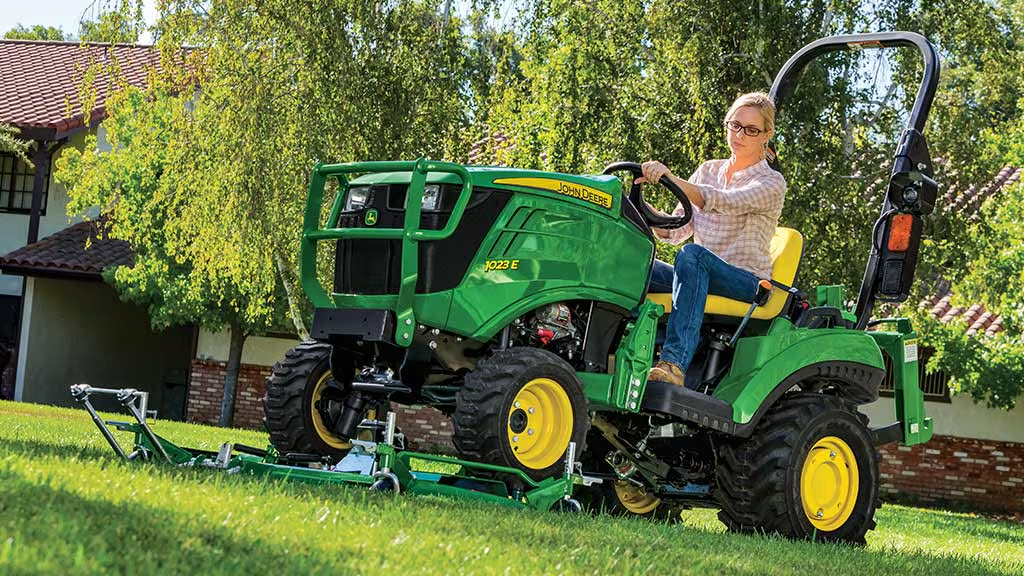
John Deere 1023E — The Budget Entry
The 1023E is the entry point into the John Deere 1 Family — and the most-affordable John Deere compact tractor option. With 22.4 gross HP and the smaller 120E loader (approximately 530 lb lift capacity), the 1023E shares the same chassis platform, AutoConnect mower compatibility, and iMatch Quick-Hitch as the more-capable 1025R — but with reduced loader specification, spring suspension seat (vs deluxe with armrests), and slightly lower travel speed.
The 1023E typically costs $4,000-5,000 CAD less than the 1025R for a comparably-equipped configuration. For Canadian buyers with truly small properties (1-3 acres), tight budgets, and light use patterns, the 1023E delivers John Deere brand and dealer support at the lowest 1 Family price point.
Where the 1023E shines:
- Small residential properties (1-3 acres) with light use
- First-time tractor buyers wanting John Deere brand at the lowest 1 Family price
- Budget-conscious buyers comfortable with the smaller 120E loader’s ~530 lb capacity
- Properties where light material handling is sufficient
- Buyers who don’t expect significant growth in their tractor use
Where it falls short:
- 30% less loader capacity than the 1025R’s 120R loader — meaningful difference for material handling
- Reduced operator amenities (spring seat vs deluxe with armrests)
- Lower travel speed (7.2 vs 8.6 mph)
- Most buyers who try to save with the 1023E end up wishing they’d bought the 1025R within 2-3 years
- Limited growth headroom — operators outgrow it quickly with serious property use
Best buyer for the 1023E: Buyers who’ve identified that their work genuinely fits within 530 lb loader capacity, their property is genuinely small, and the $4,000-5,000 CAD savings vs the 1025R matter to their budget. For everyone else, the 1025R typically represents better long-term value.
John Deere 1025R — The Flagship 1 Family
The 1025R is the flagship of John Deere’s 1 Family lineup and one of the bestselling sub-compact tractors in the Canadian market. With 23.9 gross HP from the Yanmar 3-cylinder engine, the 120R Quik-Park loader (758 lb lift capacity), full AutoConnect mid-mount mower compatibility, and the signature John Deere Twin Touch pedal system, the 1025R represents the premium 1 Family experience.
The 1025R’s signature advantages include the Quik-Park tool-less loader removal (about one minute, no tools), AutoConnect mower system that attaches in under 60 seconds, Twin Touch pedals (side-by-side forward/reverse), and the iMatch Quick-Hitch for fast 3-point implement changes. For operators who prioritize ease of attachment changes and intuitive controls, the 1025R often wins the cross-shop against competing sub-compacts.
Critical advantage: like the 1023E, the 1025R is deliberately rated under 25 HP to avoid EPA Tier 4 Final emissions requirements. That means no DPF and no DEF — a significant long-term ownership advantage that the 1025R shares with the Kubota BX2680.
Where the 1025R shines:
- Residential acreages (1-5 acres) with comprehensive maintenance needs
- First-time tractor buyers specifically wanting John Deere build quality
- Properties requiring 60-inch AutoConnect mowing capability
- Operators valuing the Twin Touch pedal system for daily use
- Buyers who want no-DPF simplicity
- Year-round operators in cold climates (with R1 cab option)
Where it falls short:
- Loader capacity (758 lb) less than the 2025R’s 840 lb on the same physical loader
- Properties over 5 acres often outgrow the 1 Family chassis
- R1 cab not compatible with the 260B backhoe (cab-equipped 1025R cannot accept the backhoe)
Best buyer for the 1025R: Acreage owners with 1-5 acre properties who specifically want the no-DPF advantage, AutoConnect mower convenience, and John Deere ecosystem. The right answer for most John Deere sub-compact buyers.
John Deere 2025R — The Entry 2 Family
The 2025R is John Deere’s entry point into the 2 Family compact tractor lineup — a step up from the sub-compact 1 Family. At 23.9 gross HP, the 2025R has the same horsepower rating as the 1025R but crosses the EPA Tier 4 Final emissions threshold and requires DPF (diesel particulate filter).
The trade-off: the 2025R delivers meaningfully better real-world capability through stronger hydraulics. The same 120R loader that lifts 758 lb on the 1025R lifts 840 lb on the 2025R — an 11% increase. The 2025R also offers the mechanical self-leveling (MSL) loader option, factory-installed Mauser cab (more substantial than the 1 Family’s R1 cab), and the 260B backhoe with 8’8″ reach.
The honest framing: many Canadian buyers cross-shopping the 1025R and 2025R explicitly choose the 1025R becauseof the no-DPF advantage — even though they could afford the 2025R. The 2025R is the right answer specifically when (1) you need more loader capacity than the 1025R delivers, AND (2) you accept the DPF complexity trade-off.
Where the 2025R shines:
- Acreage owners (3-15 acres) stepping up from the 1 Family
- Buyers requiring 840 lb loader lift for regular material handling
- Operations wanting the Mauser cab for serious year-round prairie operation
- Operators valuing the mechanical self-leveling loader option
- Buyers comfortable with DPF management
Where it falls short:
- Same HP as the 1025R — the step-up isn’t in raw power
- DPF adds complexity over the no-DPF 1025R
- Cab incompatible with the 260B backhoe (same limitation as 1025R)
- For buyers wanting “more tractor” without specific 2025R features, the 2032R typically represents better value per dollar
Best buyer for the 2025R: Buyers who specifically need the 840 lb loader capacity or factory Mauser cab and accept DPF for the additional capability. Many John Deere shoppers either stay with the 1025R (for simplicity) or step past the 2025R to the 2032R (for meaningfully more capability).
John Deere 2032R — The 2 Family Capability Sweet Spot
The 2032R is the most-popular 2 Family model among Canadian buyers — and the capability sweet spot of the entire 1+2 Family lineup. With 30.7 gross HP from the common-rail Yanmar engine (a meaningful technical upgrade from the IDI engines in smaller models), the 220R Quik-Park loader delivering 1,120 lb lift capacity, the CommandCut mower deck lift system, standard electronic cruise control, and the factory heated cab option, the 2032R is a genuinely different tractor than the 2025R below it.
For approximately $5,000-7,000 CAD more than the 2025R, the 2032R delivers:
- 28% more horsepower (30.7 vs 23.9 HP)
- 33% more loader capacity (1,120 vs 840 lb)
- 62-inch mower deck option (vs 60″ max on 2025R)
- CommandCut mower deck lift system (more precise height control)
- Standard cruise control (vs optional)
- 270B backhoe with 7-foot dig depth (vs 260B at 6 ft on 2025R)
- Common-rail engine technology (vs IDI on 2025R)
For approximately $3,000-5,000 CAD less than the 2038R, the 2032R keeps most of the same features while saving meaningful cost.
Where the 2032R shines:
- Acreage operations (10-30 acres) with regular varied work
- Buyers requiring 1,120 lb loader capacity for serious material handling
- Small farms transitioning from sub-compact to compact tractor capability
- Operations valuing the 62-inch mower deck
- Year-round operators in cold climates (with heated cab)
- Operations with regular backhoe needs at 7-foot dig depth
Where it falls short:
- DPF complexity vs the no-DPF 1025R
- The Kubota L3902 delivers more raw capability for comparable money (more HP, more PTO, more loader lift)
- For pure capability seekers without specific John Deere preference, cross-shop carefully with Kubota L02
Best buyer for the 2032R: Most Canadian buyers stepping up from the 1 Family or 2025R. The 2032R hits the capability-per-dollar position that the 1025R holds in the sub-compact category — it’s the rational default choice for serious acreage operations under the 2038R.
John Deere 2038R — The Turbocharged Flagship
The 2038R is the largest 2 Family model and features a turbocharged common-rail Yanmar engine delivering 36.7 gross horsepower. It uses the same 220R loader, same CommandCut mower system, same 270B backhoe option, same factory heated cab, and same operator amenities as the 2032R — but with meaningfully more engine capability through the turbocharged design.
For approximately $3,000-5,000 CAD more than the 2032R, the 2038R adds:
- 20% more horsepower (36.7 vs 30.7)
- Turbocharged engine for stronger torque under load
- Better sustained performance for heavy implement work
- More comfort during multi-hour operations under load
Where the 2038R shines:
- Larger acreage operations (25-50 acres) with sustained heavy use
- Operations regularly using 6-foot+ rear implements at full rated performance
- Buyers specifically valuing the turbocharged engine’s torque characteristics
- Long-term operators (10+ years) where capability headroom pays off
- Properties where the 2032R is borderline-sufficient and growth headroom matters
Where it falls short:
- Same loader and most accessories as the 2032R — capability gain is engine-only
- For buyers not specifically benefiting from the additional horsepower, the 2032R represents better value
- Approaches utility-tractor pricing without quite delivering 3 or 4 Family capability
Best buyer for the 2038R: Operations specifically needing the turbocharged engine’s additional capability. The 2038R is the right answer for buyers who’ve identified that the 2032R is at its limits in their typical work — not for buyers who just want “the biggest 2 Family.”
Decision Matrix: Match Your Property to the Right John Deere
| Property / Application | Best John Deere Choice | Why |
|---|---|---|
| Hobby property (under 1 acre) | Consider John Deere ZTrak instead | A zero-turn mower is more productive |
| 1-3 acres, light use, tight budget | 1023E | Most affordable, sufficient capability |
| 1-3 acres, want growth headroom | 1025R | Better long-term value for modest premium |
| 3-5 acres, mixed use | 1025R | The right answer for most sub-compact buyers |
| 5-10 acres, need more loader | 2025R | 840 lb loader vs 758 lb on 1025R |
| 5-10 acres, want factory cab | 2025R | Mauser cab more substantial than 1R |
| 10-20 acres, serious mixed use | 2032R | Capability sweet spot of 2 Family |
| 20-30 acres, mowing-heavy | 2032R | 62″ CommandCut deck, larger engine |
| 25-50 acres, heavy daily use | 2038R | Turbocharged engine for sustained work |
| Acreage with regular dig needs | 2032R + 270B | 7-foot dig depth, larger backhoe |
| Cold-climate (Saskatchewan/Alberta) | 2032R or 2038R with heated cab | Factory cab essential for prairie use |
| Buyer prioritizing no-DPF simplicity | 1025R | Only no-DPF option above 1023E |
| Want max mowing convenience | Any with AutoConnect | All five offer the system |
| Cross-shopping Kubota | See dedicated comparisons | Each model has Kubota equivalent |
The Critical DPF Decision: 1 Family vs 2 Family
If you remember one technical concept from this guide, make it this: the emissions structure changes completely between the 1 Family and 2 Family.
- 1023E — mechanical injection. No DPF. No DEF. Simplest fuel system in the John Deere compact lineup.
- 1025R — mechanical injection. No DPF. No DEF. Same emissions simplicity as the 1023E.
- 2025R — indirect injection (IDI). DPF required. Crosses the EPA Tier 4 Final threshold.
- 2032R — common-rail injection (CRS). DPF required. More refined emissions management.
- 2038R — turbocharged common-rail. DPF required. Same emissions architecture as 2032R.
No 1 or 2 Family John Deere tractor uses DEF. DEF is required only at higher HP classes — typically above 50 HP.
What DPF Means for Owners
A diesel particulate filter is a passive component that periodically goes through “regeneration” — a higher-temperature cycle that burns accumulated soot. On modern John Deere common-rail engines, regeneration is largely automatic during sustained operation.
Practical implications of choosing 1 Family (no DPF) vs 2 Family (DPF):
| Factor | 1 Family (1023E, 1025R) | 2 Family (2025R, 2032R, 2038R) |
|---|---|---|
| Long-term complexity | Lowest | Moderate |
| Regeneration cycles | None | Periodic during operation |
| Cold-weather concerns | Engine cold-start only | DPF regen requires sustained load |
| Expensive failure modes | Few | DPF replacement at 5,000-6,000 hours |
| 10-year ownership cost | Lower | Higher (~$3,000-5,000 CAD more) |
| Diagnostic codes | Simpler | More complex |
For Canadian buyers, the practical decision logic is:
- Want zero emissions aftertreatment complexity → 1025R (or 1023E for budget)
- Need more capability and accept DPF → 2032R (skip the 2025R for most buyers)
- Need turbocharged engine and accept DPF → 2038R
The 1025R vs 2025R decision is the most-common cross-shop because both rate at 23.9 HP — but they have fundamentally different emissions characteristics. Many buyers specifically choose the 1025R because of the no-DPF advantage, even though they could afford the 2025R.
The Loader Decision: 120E vs 120R vs 220R
The three loader options on the 1 and 2 Family lineups represent three meaningfully different capability tiers.
120E Loader (1023E only)
- Lift capacity at pivot pin: Approximately 530 lb
- Use case: Light residential material handling, garden work, light snow scooping
- Limitations: Insufficient for serious material handling, pallet work, or larger projects
120R Quik-Park Loader (1025R: 758 lb / 2025R: 840 lb)
- Lift capacity at pivot pin (1025R): 758 lb
- Lift capacity at pivot pin (2025R): 840 lb
- Tool-less removal: Approximately one minute, no tools
- Use case: Most residential acreage work — gravel, mulch, snow, light pallets, smaller round bales
- Limitations: Approaching capacity limits with heavier pallets, larger round bales
220R Quik-Park Loader (2032R, 2038R)
- Lift capacity at pivot pin: 1,120 lb
- Tool-less removal: Approximately one minute, no tools
- Use case: Serious acreage work — full pallets, 4×5 round bales, heavy gravel, construction materials
- Limitations: Approaches limits with very heavy round bales (5×6 or larger)
The capability tier transitions are:
- 530 lb → 758 lb (1023E to 1025R): 43% increase — most-meaningful step-up in the entire lineup
- 758 lb → 840 lb (1025R to 2025R): 11% increase — meaningful but modest
- 840 lb → 1,120 lb (2025R to 2032R): 33% increase — substantial capability gain
- 1,120 lb → 1,120 lb (2032R to 2038R): Same loader — the step-up is in engine, not lifting capability
For operators specifically looking for loader capability gains, the major break points are 1023E to 1025R (within the 1 Family) and 2025R to 2032R (within the 2 Family). Steps between adjacent models within either family are smaller.
The Cab Decision: 1R vs Mauser vs Heated Cab
John Deere offers three meaningfully different cab options across the 1 and 2 Family lineups:
1R Cab (1023E, 1025R)
- Installation: Dealer-installed (not factory)
- Features: Full enclosure, heat, optional A/C, removable doors
- Backhoe compatibility: Not compatible with 260B (cab must be removed for backhoe use)
- Cost adder: $7,500-12,000 CAD over open-station
Mauser Cab (2025R)
- Installation: Factory-installed
- Features: Sealed enclosure, factory heating system, optional A/C, sound insulation
- More substantial than 1R cab — designed and matched to chassis
- Backhoe compatibility: Not compatible with 260B
- Cost adder: $9,000-13,000 CAD over open-station
Heated Cab (2032R, 2038R)
- Installation: Factory-installed
- Features: Full sealed enclosure, factory heating, heated mirrors available, retractable sunshade, bright LED roof work lights, optional A/C
- Backhoe compatibility: Not compatible with 270B
- Cost adder: $10,000-14,000 CAD over open-station
For Canadian buyers in cold provinces (Saskatchewan, Alberta, Manitoba, northern Ontario, Quebec), the cab is essentially required for serious year-round operation. The capability progression across the three cab tiers reflects increasing sophistication — the heated cab on the 2032R/2038R is the most-substantial John Deere compact tractor cab option.
Critical limitation across all three: none of the John Deere 1 or 2 Family cabs are compatible with the corresponding backhoes. If you need both cab AND backhoe capability simultaneously, the cab must be removed for backhoe use. For dedicated TLB capability, the Kubota BX23S delivers more integrated factory TLB performance.
John Deere vs Kubota: Cross-Brand Comparisons
Most Canadian compact tractor buyers cross-shop John Deere and Kubota. Here’s the practical model-by-model comparison framework:
| John Deere Model | Closest Kubota Equivalent | Cross-Shop Notes |
|---|---|---|
| 1023E | Kubota BX2380 | BX2380 has higher loader capacity (699 vs 530 lb); 1023E has AutoConnect |
| 1025R | Kubota BX2680 | Direct competitors. 1025R has AutoConnect; BX2680 has more PTO HP and fuel capacity |
| 2025R | Kubota L2502 | L2502 wins on no-DPF and 1,446 lb loader (vs 840 on 2025R); 2025R wins on AutoConnect |
| 2032R | Kubota L3902 | L3902 has more HP/PTO/loader; 2032R has CommandCut mower and heated cab |
| 2038R | Kubota L4802 | L4802 has larger LA766 loader (1,675 lb); both add complexity in their own way |
For full Kubota lineup comparisons, see our Kubota L02 Series buyer’s guide and Kubota BX Series buyer’s guide.
The Honest Cross-Brand Verdict
Where John Deere typically wins:
- AutoConnect mower system (faster mower attachment than any Kubota equivalent)
- CommandCut mower deck lift system (2032R/2038R)
- Twin Touch pedal system (some operators prefer; preference is individual)
- Factory cab options (Mauser, heated cab) more substantial than Kubota dealer cabs
- iMatch Quick-Hitch implement system
Where Kubota typically wins:
- Loader capacity at most equivalent price points — significant practical advantage
- More horsepower and PTO HP at most equivalent price points
- Higher 3-point lift capacity
- Mower compatibility on L Series models is rear-only (vs JD mid-mount) — actually a JD advantage on mowing
- No-DPF L2502 specifically delivers emissions simplicity beyond JD options
The honest framing: for mowing-focused operations, John Deere’s AutoConnect/CommandCut systems are meaningful advantages. For loader-focused operations, Kubota’s higher capacity ratings are meaningful advantages. Most cross-brand decisions ultimately come down to dealer relationships, test drive preferences, and which capability set matters more to the specific buyer.
Cost of Ownership: 10-Year View
For typical Canadian acreage use (150-300 hours per year), the five John Deere models have meaningfully different total cost of ownership.
Approximate 10-Year TCO (CAD, typical configurations)
| Cost Factor | 1023E | 1025R | 2025R | 2032R | 2038R |
|---|---|---|---|---|---|
| Initial purchase (with loader) | $22,000 | $26,500 | $33,000 | $39,000 | $43,000 |
| Fuel (10 years @ 200 hr/yr) | $6,000 | $7,500 | $9,000 | $11,000 | $12,500 |
| Routine maintenance (10 years) | $3,000 | $3,500 | $5,000 | $6,500 | $7,500 |
| DPF replacement (years 5-7) | $0 | $0 | $3,500 | $4,000 | $4,500 |
| Total 10-year cost | ~$31,000 | ~$37,500 | ~$50,500 | ~$60,500 | ~$67,500 |
| Estimated resale value (year 10) | $9,500 | $12,000 | $14,000 | $16,500 | $18,500 |
| Net 10-year ownership cost | ~$21,500 | ~$25,500 | ~$36,500 | ~$44,000 | ~$49,000 |
These figures are estimates based on current pricing and typical maintenance patterns. Actual costs vary substantially based on use intensity, operator practices, and Canadian regional fuel costs.
Takeaways from the math:
- The 1025R’s no-DPF advantage compounds meaningfully over 10 years vs the 2025R
- The 2032R’s capability premium over the 2025R is well-spent for buyers who use the additional capacity
- The 2038R’s $5,000 additional cost over the 2032R is justified only if turbocharged capability is genuinely used
- Strong resale values across the lineup mean ownership costs are roughly 60-70% of total spending
- The 1025R hits the lowest net ownership cost per capability unit in the lineup
Operating in Canadian Winter: What Matters
The 1 and 2 Family lineups have varying cold-weather characteristics:
Cold-start reliability with proper preparation:
- 1023E / 1025R: Reliable to approximately –25°C. Mechanical injection simplifies cold operation.
- 2025R: Reliable to 0°F (–18°C) without block heater per John Deere specs; lower with block heater.
- 2032R: Reliable to approximately –25°C. Common-rail with electronic management.
- 2038R: Similar to 2032R; turbocharger adds slight complexity in extreme cold.
Cab recommendation by climate region:
- Ontario, BC, Maritimes, southern Quebec: All five models work well year-round with proper preparation; cab optional
- Saskatchewan, Alberta, Manitoba (prairie): Cab essentially required. 2032R or 2038R with factory heated cab are the strongest year-round prairie performers
- Northern Canada: Compact tractor class generally underspec’d for extreme cold; consider larger utility tractors
Recommended cold-weather setup across all models:
- 5W-40 full synthetic engine oil (October-April)
- Winter-blend diesel with anti-gel additive
- Block heater plugged in 3-4 hours before start at –15°C and below
- Battery load-tested in fall, replaced if 3+ years old
- Factory or dealer cab for serious year-round operation in cold provinces
For complete prairie winter operation guidance applicable to all John Deere compact tractors, see our prairie winter equipment operation guide.
Common Buyer Questions (FAQ)
Why is the John Deere 1025R such a popular sub-compact tractor?
A combination of factors: the AutoConnect mower system that attaches in under 60 seconds, the Quik-Park tool-less loader removal, the Twin Touch pedal system that reduces operator fatigue, the iMatch Quick-Hitch for fast implement changes, and the no-DPF emissions simplicity. The 1025R has held a leadership position in the Canadian sub-compact tractor market for multiple generations.
Which John Deere compact tractors require DPF?
The 2025R, 2032R, and 2038R all require DPF (diesel particulate filter). The 1023E and 1025R do NOT require DPF — they’re deliberately rated under 25 HP to avoid the EPA Tier 4 Final emissions threshold.
Do any John Deere compact tractors require DEF?
No 1 or 2 Family John Deere compact tractor requires DEF (diesel exhaust fluid). DEF is required only at higher HP classes — typically above 50 HP in the 3 or 4 Family compact utility tractors.
Should I save money with the 1023E or step up to the 1025R?
For most buyers, the 1025R is worth the $4,000-5,000 CAD premium. The 30% larger loader capacity (758 vs 530 lb), deluxe operator amenities, and growth headroom typically pay back through better long-term satisfaction. The 1023E makes sense specifically for buyers with very small properties (under 3 acres) and tight budgets who’ve confirmed their work fits within 530 lb loader capacity.
Should I buy the 1025R or step up to the 2025R?
This decision turns mostly on DPF tolerance. The 1025R has no DPF; the 2025R requires DPF but delivers 11% more loader capacity (840 vs 758 lb) and offers the Mauser factory cab and MSL loader options. Many buyers specifically choose the 1025R because of the no-DPF advantage. Cross-shop carefully — for buyers who value emissions simplicity, the 1025R is typically the better long-term choice.
Should I buy the 2025R or step up to the 2032R?
For most buyers stepping into the 2 Family, the 2032R represents better value than the 2025R. The 2032R delivers 28% more horsepower, 33% more loader capacity (1,120 vs 840 lb), the larger 62-inch mower deck option, CommandCut mower system, standard cruise control, common-rail engine, and 270B backhoe with deeper dig capability. The 2025R is the right answer specifically for buyers who’ve identified that they need the Mauser cab or MSL loader and don’t need the 2032R’s capability gains.
What’s the difference between the 2032R and 2038R?
Same loader, same mower system, same operator amenities, same heated cab option, same 270B backhoe compatibility. The difference is engine: 2038R has a turbocharged engine with 36.7 HP (vs 30.7 naturally aspirated on 2032R). The 2038R typically costs $3,000-5,000 CAD more than the 2032R. Choose the 2038R specifically if you need the turbocharged engine’s torque headroom for sustained heavy work.
Are John Deere compact tractors better than Kubota?
Neither brand is objectively better. John Deere typically wins on mower system convenience (AutoConnect, CommandCut), cab options, and Twin Touch pedal preference. Kubota typically wins on loader capacity, raw horsepower per dollar, and 3-point lift capacity. Most cross-brand decisions come down to dealer relationships, test drive preferences, and which capability set matters more. For detailed Kubota comparisons, see our Kubota L02 Series guide and Kubota BX Series guide.
Can I add a cab AND a backhoe to my John Deere compact tractor?
Not simultaneously across the 1 and 2 Family lineup. All John Deere 1 and 2 Family cabs (1R, Mauser, heated cab) are incompatible with the corresponding backhoes (260B, 270B). Cab-equipped tractors cannot accept the backhoe without cab removal. For dedicated TLB (tractor-loader-backhoe) capability with both cab and backhoe, the Kubota BX23S is a more integrated factory TLB platform.
What’s the warranty on a new John Deere compact tractor?
John Deere Canada typically offers (verify with your dealer at time of purchase):
- 2 years / 2,000 hours full warranty
- 6 years / 2,000 hours powertrain warranty
Warranty coverage is generally consistent across the 1 and 2 Family lineup.
Which John Deere compact tractor is best for snow removal?
For residential snow removal on 1-5 acre properties, the 1025R is well-equipped with front-mount snow blowers (via Quik-Tatch). For larger properties or commercial-style snow contracting, the 2032R or 2038R deliver materially more capability with larger blowers, pushers, and the heated cab option for operator comfort.
Should I order a cab on my John Deere for prairie use?
For serious year-round prairie operation in Saskatchewan, Alberta, or Manitoba — yes. The cab is essentially required. Open-station tractors are uncomfortable below approximately –15°C and become genuinely unsafe below –25°C for extended use. The Mauser cab on the 2025R or the factory heated cab on the 2032R/2038R is the appropriate choice for prairie buyers.
Will any John Deere compact tractor fit in my garage?
All five models with ROPS folded fit through standard 7-foot residential garage doors. The 1023E and 1025R (76.5 inches) are the smallest. The 2 Family models are slightly larger but still fit standard garage doors. Width and length within standard single-car garage stalls work for all five.
Which John Deere has the best resale value?
The 1025R holds resale value particularly well due to its bestseller status in the sub-compact category. The 2032R holds resale value well as the most-popular 2 Family model. The 1023E has the lowest resale percentage but also the lowest initial cost. All five maintain stronger resale than most competing compact tractors in their class.
How to Choose: A Final Framework
Forget brochures for a moment. Here’s the framework most experienced Canadian John Deere buyers actually use:
- Start with property size and primary use case. Under 3 acres of light work → 1023E. 1-5 acres of mixed work → 1025R. 3-15 acres needing more loader → 2025R. 10-30 acres serious mixed use → 2032R. 25-50 acres sustained heavy work → 2038R.
- Decide your DPF tolerance. Do you specifically want no DPF (1023E or 1025R)? Or do you accept DPF for more capability (2025R, 2032R, 2038R)? This is often the deciding factor between the 1025R and 2025R.
- Match loader to expected work. Confirm the loader capacity (530, 758, 840, or 1,120 lb) matches your typical material handling. Most “wrong tractor” stories come from undersized loaders.
- Plan for the cab if you’re in cold provinces. Add $7,500-14,000 CAD to your budget. Essentially required for serious year-round prairie use.
- Consider 10-year ownership cost, not just purchase price. The 1025R’s no-DPF advantage compounds substantially over a decade.
- Cross-shop the Kubota equivalent. For every John Deere model in this guide, there’s a Kubota equivalent worth considering. See our Kubota L02 Series guide and Kubota BX Series guide for direct comparisons.
If you’re still on the fence, here’s the honest tiebreaker: the 1025R is the right answer for most Canadian sub-compact buyers. The 2032R is the right answer for most buyers stepping into compact tractor capability. The other three models serve specific niches — the 1023E for budget, the 2025R for buyers specifically needing 840 lb loader with cab, and the 2038R for buyers specifically needing turbocharged capability.
See Each Model in Detail
Browse the full specs, photos, and dealer information for each John Deere 1 and 2 Family model on Aglist:
- John Deere 1023E — 22.4 HP entry-level 1 Family with 120E loader.
- John Deere 1025R — 23.9 HP flagship 1 Family with 120R Quik-Park loader, no DPF.
- John Deere 2025R — 23.9 HP entry 2 Family with 120R loader (840 lb lift) and Mauser cab.
- John Deere 2032R — 30.7 HP common-rail 2 Family with 220R loader and CommandCut mower.
- John Deere 2038R — 36.7 HP turbocharged flagship 2 Family.
Cross-Shop the Kubota Lineup
Most Canadian buyers cross-shop John Deere and Kubota. See our complete Kubota guides for direct comparisons:
- Kubota L02 Series Compared — Compare L2502, L3302, L3902, and L4802 compact tractors.
- Kubota BX Series Compared — Compare BX1880, BX2380, BX2680, and BX23S sub-compact tractors.
Related Resources
- Prairie Winter Equipment Operation Guide — cold-weather operation tips for compact tractors and skid steers.
- Buying Used Farm Equipment at Auction in Canada — practical guide for buying tractors at Canadian agricultural auctions.
All specifications in this article are sourced from current John Deere Canada published spec sheets as of May 2026. Specifications, configurations, and pricing are subject to change without notice. Always confirm exact specs and current pricing with your local John Deere Canada dealer before purchase.
Aglist is an independent equipment marketplace based in Canada. We are not affiliated with John Deere Canada, Kubota Canada, or any equipment dealer mentioned. Specifications cited from manufacturer documentation are reproduced under fair-use editorial standards.
Reviews and ratings on Aglist come from real owners and operators across Canada. We moderate for spam and abuse but do not edit content for opinion. Use reviews as guidance, not as guarantees.
