
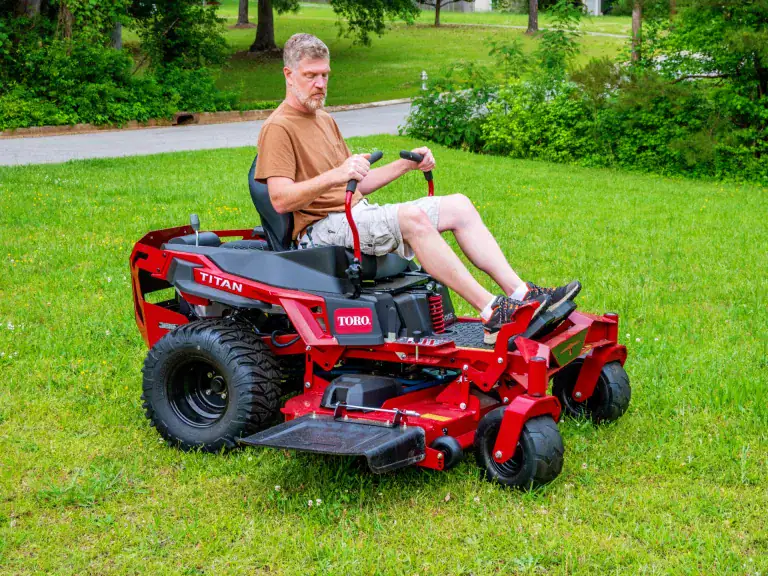

Toro builds one of the most complete residential zero-turn lineups available in Canada — but it’s also one of the most confusing to navigate. TimeCutter, TimeCutter MyRIDE, TimeCutter MAX MyRIDE, Titan, Titan MAX, Titan MyRIDE: six sub-series whose names tell you almost nothing about what actually separates them. Two Toro mowers with the same 60-inch deck can differ by $3,000 CAD, two horsepower, an entire frame class, and a suspension system.
This guide compares every Toro zero-turn model on Aglist side by side — current production and discontinued machines alike — and explains the real differences in plain terms: frame construction, engine choice (and Toro’s quietly inconsistent Kohler/Kawasaki split), deck sizes, the MyRIDE Suspension System, and which machine fits which Canadian property. Whether you’re mowing a half-acre suburban lot in Manitoba or a 6-acre hobby farm outside Saskatoon, by the end of this guide you’ll know exactly which Toro to look at — and which to skip.
The Toro Zero Turn Lineup at a Glance
Here is every Toro zero-turn model currently covered on Aglist, from the compact entry machine to the residential flagship. Click any model for full specifications, owner-focused analysis, and reviews.
| Model | Engine | Deck | Suspension | Weight | Status | Approx. CAD Price |
|---|---|---|---|---|---|---|
| TimeCutter MyRIDE 42 | 22 HP Kohler 725cc | 42″ | MyRIDE | 589 lb | Current | $5,200–$6,200 |
| TimeCutter 50 | 24 HP Kohler 725cc | 50″ | None | — | Discontinued | $3,000–$4,800 used |
| TimeCutter MyRIDE 50 | 23 HP Kawasaki 726cc | 50″ | MyRIDE | 662 lb | Discontinued | $4,000–$6,500 used |
| TimeCutter MAX MyRIDE 54 | 23 HP Kawasaki 726cc | 54″ | MyRIDE | — | Current | $6,200–$7,200 |
| TimeCutter MAX MyRIDE 60 | 24 HP Kohler 725cc | 60″ | MyRIDE | 702 lb | Current | $6,500–$7,500 |
| Titan 54 | 26 HP Kohler 747cc | 54″ | None | 751 lb | Current | $7,500–$8,500 |
| Titan 60 | 24 HP Kawasaki 726cc | 60″ | None | 845 lb | Current | $7,800–$8,800 |
| Titan MAX 60 | 26 HP Kohler 747cc | 60″ | None (seat kit opt.) | 876 lb | Current | $9,500–$10,500 |
| Titan MyRIDE 60 | 26 HP Kohler 747cc | 60″ | MyRIDE | 819 lb | Discontinued | $6,000–$9,500 used |
Prices reflect typical Canadian dealer and used-market ranges; they vary by region, dealer, model year, and condition. Discontinued models remain widely available used, with parts and service support continuing through Toro’s Canadian dealer network.
TimeCutter vs Titan: The Real Difference
Strip away the marketing names, and Toro’s residential zero-turn range splits into two genuinely different machine classes.
The TimeCutter Range: Residential Value
The TimeCutter is Toro’s mainstream homeowner line. Every TimeCutter on Aglist carries an IronForged fabricated 10-gauge steel deck — a genuine durability advantage over the stamped decks common on entry-level zero-turns from other brands — on a standard tubular steel frame. Top speed is around 7 mph, fuel tanks run 3 to 5 gallons, and the focus is value: a durable deck, a comfortable seat, and (on MyRIDE models) real suspension, at the most accessible prices in Toro’s range.
The TimeCutter family itself has tiers. The base TimeCutter skips suspension and keeps the price down. The MyRIDE models add Toro’s floating-platform suspension. The current MAX MyRIDE models combine the suspension with heavier deck construction, cast-aluminum spindle housings with maintenance-free bearings, and the HG-ZT2800 transaxles shared with the Titan line — meaningfully more machine than the original TimeCutters they replaced.
The Titan Range: Commercial-Style Build
The Titan is a different animal. Every Titan rides on a commercial-style I-beam front end with a fully-welded grade-50 hardened steel bumper, cast-aluminum spindle housings, dual hydrostatic HG-ZT2800 transaxles, and massive 22–23-inch aggressive-tread rear drive tires. Top speed rises to 8.5–9 mph. These are the build details that normally appear on commercial mowers — brought into the residential range for acreage owners who mow a lot of grass and want the machine to last a decade of it.
The practical rule: if you mow under 3 acres of reasonably smooth ground, a TimeCutter does the job and saves you $1,500–$3,000. If you mow 3 acres or more, deal with rough rural terrain, or simply want the machine to outlast the property, the Titan’s frame, spindles, and tires earn their premium.
Toro’s Engine Split: Kohler vs Kawasaki
Here’s the detail that catches almost every Toro shopper off guard: engine brand does not follow series logic. Toro mixes Kohler and Kawasaki engines across the lineup in a pattern you have to check model by model.
The current lineup on Aglist breaks down like this. Kohler-powered: TimeCutter MyRIDE 42 (22 HP, 725cc), TimeCutter MAX MyRIDE 60 (24 HP KT735, 725cc), Titan 54 (26 HP KT745, 747cc), and Titan MAX 60 (26 HP, 747cc). Kawasaki-powered: TimeCutter MAX MyRIDE 54 (23 HP, 726cc), Titan 60 (24 HP FR730, 726cc), and the discontinued TimeCutter MyRIDE 50 (23 HP, 726cc).
The counterintuitive result: the smaller-deck Titan 54 actually carries the bigger engine (26 HP Kohler 747cc) than the wider Titan 60 (24 HP Kawasaki 726cc). If you have a strong brand preference — and many zero-turn owners do, with Kawasaki’s FR series holding a particularly loyal following for durability — you may end up choosing your deck size by engine rather than the other way around.
In practice, both engine families are proven air-cooled V-twins with straightforward maintenance and good parts availability across Canada. Power-to-deck matching matters more than badge: 22–24 HP is well-matched to 42–54-inch decks in typical residential grass, while the 26 HP 747cc Kohler gives the 60-inch Titans the reserve to push through the thick, fast-growing grass of a wet prairie June without bogging.
Deck Size: 42 vs 50 vs 54 vs 60 Inches
Deck width is the single biggest driver of mowing time, and the single most common sizing mistake is buying wider than the property can use.
42-Inch: Compact Properties and Tight Access
The TimeCutter MyRIDE 42 is the pick for properties up to about 2 acres, especially where gates, garden beds, trees, or shed storage limit machine size. It’s the easiest Toro zero-turn to maneuver and store, and the only one in this compact class with full MyRIDE suspension.
50-Inch: The Versatile Middle (Now Used-Market Territory)
Both 50-inch models — the base TimeCutter 50 and the TimeCutter MyRIDE 50 — are discontinued, which makes the 50-inch width primarily a used-market play in Canada. That’s not a weakness: a clean used MyRIDE 50 at $4,000–$6,500 is one of the better value entries into a suspension-equipped Toro, and our model pages cover exactly what to inspect before handing over the money.
54-Inch: Coverage Without the Bulk
The 54-inch width is the sweet spot for 1.5–5 acre properties with obstacles. The TimeCutter MAX MyRIDE 54 serves the comfort-focused homeowner; the Titan 54 serves the acreage owner who wants the I-beam build and the strong 26 HP Kohler. A 54-inch deck threads gates and tree lines that frustrate a 60, while still covering ground roughly 30% faster per pass than a 42.
60-Inch: Acreage Speed
Sixty inches is the width that makes 3–7 acre properties manageable — roughly 3.5–4 acres per hour on open ground at practical mowing speeds. Four of the nine models in the lineup carry it: the TimeCutter MAX MyRIDE 60, Titan 60, Titan MAX 60, and the used-market Titan MyRIDE 60. Run your own numbers for any deck size and property with the Mowing Time Calculator.
MyRIDE Suspension: What It Actually Does
The MyRIDE Suspension System is Toro’s signature comfort feature and the most decision-shaping option in the lineup. Instead of suspending just the seat, MyRIDE suspends the entire operator platform — seat and footrest area together — on adjustable rear shocks, fully isolated from the mower frame. Bumps, ruts, and frame vibration are absorbed before they reach the rider.
The real-world effect isn’t just comfort; it’s speed. On rough ground, a rigid-frame mower forces you to slow down because the operator can’t tolerate the pounding. A MyRIDE machine lets you hold mowing speed across terrain that would rattle your teeth on a standard frame — which means the suspension effectively buys back mowing time on rough properties.
Who should prioritize MyRIDE: anyone mowing rough, rutted, or uneven ground for sessions over an hour, and anyone with back issues. Who can skip it: owners of smooth, established lawns, where the standard high-back seat on a rigid-frame model is perfectly comfortable and the savings are real.
One important nuance for Titan shoppers: the current flagship Titan MAX 60 does not offer MyRIDE — it uses a rigid frame with an optional suspension seat kit. The only suspension-equipped Titan ever built is the discontinued Titan MyRIDE 60, which is exactly why that used model still draws serious interest: it’s the only way to combine the Titan’s heavy build with full platform suspension.
Current vs Discontinued: Reading the Used Market
Three of the nine models in this guide are out of production, and for many Canadian buyers they’re the smartest money in the lineup.
The Titan MyRIDE 60 is the standout. At $6,000–$9,500 used, it delivers the same 26 HP Kohler 747cc engine and 60-inch IronForged deck as the current $9,500–$10,500 Titan MAX 60 — plus the MyRIDE suspension the MAX never got. A well-kept example undercuts the new flagship while offering a feature it can’t match. The trade-offs are a 5-gallon tank (versus the MAX’s 7), optional rather than standard ROPS, and whatever hours and wear the previous owner left behind.
The TimeCutter MyRIDE 50 at $4,000–$6,500 is the value route into a suspension-equipped, Kawasaki-powered Toro for mid-size properties. And the base TimeCutter 50 at $3,000–$4,800 is the lowest-cost entry into an IronForged-deck zero-turn — sensible for smooth, flat lawns where suspension adds little.
On any used Toro zero-turn, the inspection checklist is consistent: total hours and service records first, then the deck shell for cracks and rust-through (especially along the spindle reinforcements), spindle bearings for play, hydrostatic transaxles for smooth, leak-free drive in both directions, and on MyRIDE machines, the suspension’s action over rough ground. Each model page above carries a model-specific used-buying section.
Which Toro Fits Your Property: Canadian Scenarios
Suburban lot or small acreage up to 2 acres, tight gates, shed storage — TimeCutter MyRIDE 42. Compact, suspended, easiest to live with.
Smooth 2–4 acre lawn, budget-first — a used TimeCutter 50, or the TimeCutter MAX MyRIDE 54 if ride comfort matters and the budget stretches to new.
2–4 acres with rough or uneven ground — TimeCutter MAX MyRIDE 60. The widest suspended deck below the Titan line, and arguably the best value-per-acre machine Toro currently builds.
3–5 acre acreage or hobby farm, demanding use, gates or tree lines — Titan 54. Full Titan build, the strong 26 HP Kohler, in the more maneuverable width.
3–6 acres of open ground, Kawasaki preference — Titan 60. The wide-deck Titan at a meaningful gap below flagship money.
5–7 acres, want the most capable residential Toro made today — Titan MAX 60. Biggest engine, 7-gallon tank, 9 mph, standard ROPS, 4-year warranty.
Rough acreage, long sessions, comfort is non-negotiable — a used Titan MyRIDE 60. The only Titan with full suspension, at used-market money.
For properties on slopes, prioritize a ROPS-equipped configuration regardless of model — standard on the Titan MAX, optional on the others — and mow up and down rather than across.
How Toro Compares to John Deere
The most common cross-brand question Canadian zero-turn shoppers ask is Toro versus John Deere. The short version: Toro’s residential range leans on deck construction (IronForged fabricated decks appear lower in the lineup than Deere’s fabricated decks do) and the MyRIDE suspension, which has no direct equivalent in Deere’s residential ZTrak line. Deere counters with its dealer network density in rural Canada and a deeper commercial range above the residential tier. Pricing overlaps heavily through the middle of both lineups.
For the full model-by-model breakdown of Deere’s residential and commercial ZTrak range, see our John Deere Zero Turn Mowers Canada buyer’s guide, and browse the complete Toro lineup with specs and owner reviews on the Toro brand hub.
Frequently Asked Questions
What is the difference between the Toro TimeCutter and Titan?
The Titan is the heavier, commercial-style line: I-beam front end, grade-50 welded bumper, cast-aluminum spindles, 22-inch-plus drive tires, 26 HP engines on most models, and 8.5–9 mph top speeds. The TimeCutter is the mainstream residential line: same IronForged deck philosophy on a lighter standard frame, 22–24 HP engines, around 7 mph, at $1,500–$3,000 less. Property size and terrain roughness decide which one earns its price.
Is the Toro Titan MAX worth it over the Titan 60?
The Titan MAX 60 adds the 26 HP Kohler (versus the Titan 60’s 24 HP Kawasaki), a 7-gallon tank, 9 mph top speed, standard ROPS and armrests, and a 4-year warranty — for roughly $1,700–$2,700 more. If you mow 5+ acres or want ROPS as standard, the MAX justifies itself. For 3–5 acres, the Titan 60 delivers the same deck and frame class for less, and the Kawasaki engine is a draw in its own right.
Which Toro zero turns have the MyRIDE suspension?
In the current lineup: the TimeCutter MyRIDE 42, TimeCutter MAX MyRIDE 54, and TimeCutter MAX MyRIDE 60. On the used market: the TimeCutter MyRIDE 50 and the Titan MyRIDE 60 — the latter being the only Titan ever offered with full platform suspension. The current Titan 54, Titan 60, and Titan MAX 60 are rigid-frame machines.
Are Toro zero turn mowers good for Canadian conditions?
Yes, with the usual qualifications. The air-cooled Kohler and Kawasaki V-twins handle Canadian summer mowing seasons well, the fabricated IronForged decks resist the rock strikes and rough use common on rural prairie properties, and Toro’s dealer and big-box presence across Canada keeps parts accessible. As with any gas zero-turn, proper off-season storage — fuel stabilizer or a dry tank, battery on a maintainer — matters through a prairie winter.
Should I buy a discontinued Toro model used?
Often, yes. The Titan MyRIDE 60 and TimeCutter MyRIDE 50 are discontinued for lineup reasons, not reliability problems, and parts support continues through Toro’s dealer network. A used MyRIDE-equipped machine is frequently the cheapest way into Toro suspension. Check hours, deck condition, spindle play, and transaxle health before committing — each model page on Aglist details what to inspect.
How long does it take to mow with each deck size?
As a rough open-ground guide at practical speeds: a 42-inch deck covers about 1.5–2 acres per hour, a 50–54-inch deck about 2.5–3, and a 60-inch deck about 3.5–4. Obstacles, slopes, and trimming cut those figures by a quarter to a third. The Mowing Time Calculator gives an estimate tailored to your property size, deck width, and layout.
Note: We try our best to keep specs and information accurate, but some details can be missing or different depending on the source, model year, or configuration — Toro in particular mixes Kohler and Kawasaki engines across the lineup. Before you service or repair equipment, or commit to a specific model, please double-check key specifications with Toro’s documentation, the owner’s manual, or your Canadian dealer. Prices shown are approximate ranges and vary by region, dealer, and condition.
About reviews: Reviews on Aglist are written by real users. We moderate them for spam and abuse, but opinions and claims are still personal — so use them as guidance, not as a guarantee.
