

Introduction
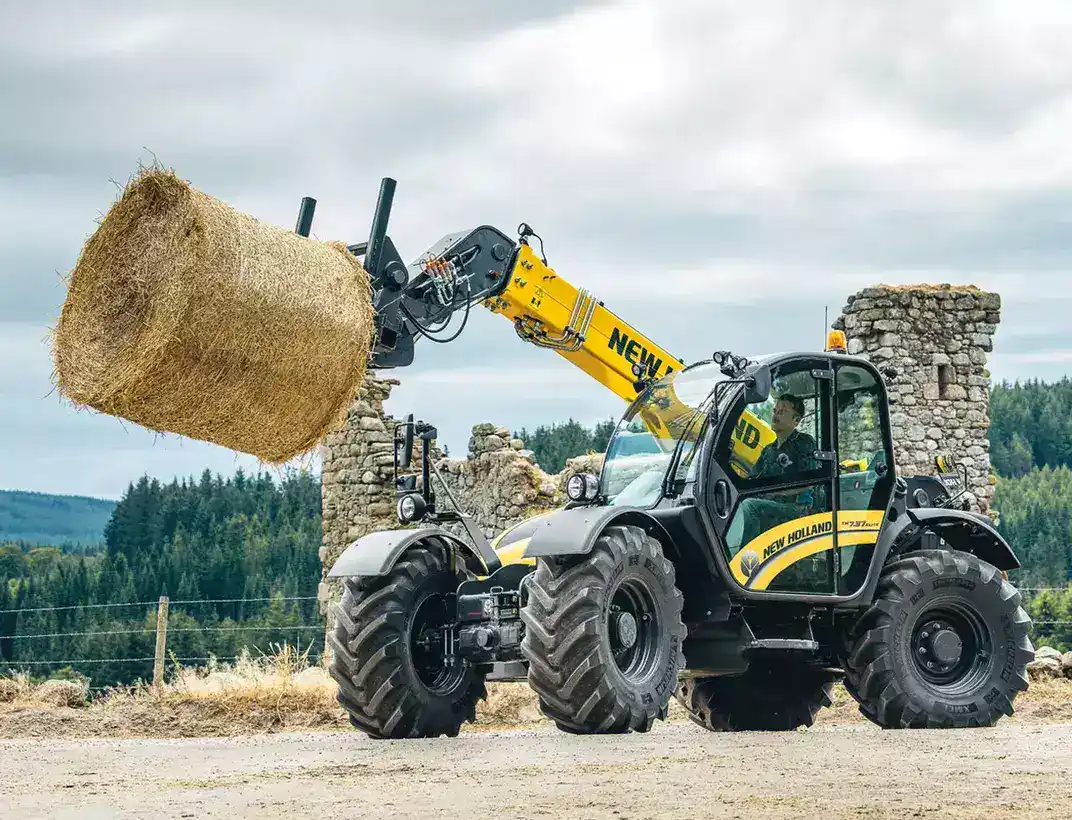
New Holland’s TH Series covers the telehandler needs of most farms in five models, from the compact TH6.26 to the high-reach TH9.35 Elite. For a prairie mixed or livestock operation, a telehandler is one of the most useful machines in the yard: it stacks bales, loads feed and mixer wagons, handles material, and reaches where a tractor and loader cannot, with better visibility to the load and more stability at height. Choosing the right TH Series model comes down to a few clear decisions rather than a spec chase, and this guide works through them in order.
The range breaks into three groups: the compact TH6.26 for tight spaces, the mid-range TH7.42 for heavy handling, and the high-reach TH9.35 for stacking high, with the two larger models each offered in Plus and Elite versions. We will work through how much reach and capacity you need, whether the Plus or Elite version fits how hard you work the machine, and how the TH Series compares to a loader tractor, then finish with a full comparison table.
Because the difference between models is about the work they suit rather than one being better than another, the goal here is to point you to the right machine for your operation.
The three groups in the TH Series
Before the individual decisions, it helps to see how the five models divide, because that frames the whole choice.
The compact group is a single model, the TH6.26. It is built with a narrow frame and a cab height around 75 inches to work inside older barns, low sheds, and tight livestock yards, while still lifting to 19.7 feet and handling 5,732 lb. It uses a hydrostatic transmission for smooth low-speed control and a 74-horsepower engine, and it fills the role a full-size telehandler cannot when access is the priority.
The large-frame group covers the other four models, built on New Holland’s large-frame platform with the 360-degree Vision Cab, a 7-inch InfoView display, an LED load moment indicator, and a 6F/3R powershift transmission. Within it, the TH7.42 is the mid-range machine, lifting to 22.9 feet with a 9,300 lb capacity, and the TH9.35 is the high-reach machine, reaching near 30 feet while carrying somewhat less. Each of these two comes in a Plus version at 133 horsepower and an Elite version at around 145 horsepower with auto-shift in the higher gears. So the large-frame choice is really two decisions: reach, and Plus or Elite.
Question 1: How much reach and capacity do you need?
This is the broadest cut, and it maps to the work your farm does most.
If access into tight, low buildings is the priority, the TH6.26 is the machine. Its compact, narrow frame gets into barns and pens that stop a larger telehandler, and its 19.7-foot lift and 5,732 lb capacity handle daily livestock and material work in confined spaces. For a mixed or dairy operation with older infrastructure, the access is often the whole reason to choose it.
If heavy bale and material handling in open yards is your main work, the mid-range TH7.42 Plus or TH7.42 Elite is the productive middle of the range. A 22.9-foot lift stacks bales several high and loads mixer wagons, and the 9,300 lb capacity handles heavy bales and pallets, which covers the core work of most farms.
If stacking bales high or loading tall equipment is central, the high-reach TH9.35 Plus or TH9.35 Elite reaches near 30 feet, trading some maximum capacity for the height to get bales to the top of a tall stack. For grain, hay, and large livestock operations that stack high, that reach is what makes the work possible.
As a rough guide, match the machine to your buildings and your stacking: tight access points to the TH6.26, general heavy handling to the TH7.42, and high stacking to the TH9.35.
Question 2: Plus or Elite?
On the two large-frame models, this is the second decision, and it is about how hard and how long you work the machine.
The Plus versions, the TH7.42 Plus and TH9.35 Plus, deliver 133 maximum horsepower through the 6F/3R powershift transmission. They handle the full lift and capacity of their model, and for most operations they are enough machine, at a lower price than the Elite. If your use is moderate, or you want the reach and capacity without paying for the top power, the Plus is the sensible choice.
The Elite versions, the TH7.42 Elite and TH9.35 Elite, step up to around 145 maximum horsepower and add auto-shift in transmission speeds four, five, and six, so the machine changes gears automatically at higher working and transport speeds. That extra power gives quicker cycle times and more margin under heavy load, and the auto-shift reduces operator workload on long days. For high-intensity use, custom work, or an operation that runs the telehandler most of the day, the Elite earns its premium.
The honest way to decide: the Plus and Elite of a given model reach the same height and carry the same load, so you are choosing power and automation, not capability. Moderate use points to the Plus, heavy all-day use to the Elite.
Question 3: TH Series or a loader tractor?
Many farms weigh a telehandler against a tractor with a front loader, and the two suit different priorities.
A telehandler lifts higher, reaches farther forward, gives better forward visibility to the load, offers faster cycle times, and stays more stable at height, which makes it the better tool for stacking bales, loading mixer wagons, and material handling. A loader tractor is more versatile for PTO work and field tasks, and it does double duty as a tractor. For an operation whose daily work is heavy material handling, the telehandler’s reach and stability are worth having as a dedicated machine, and many farms run both, using the tractor for field and PTO work and the telehandler for the yard. The compact TH6.26 in particular makes the telehandler role available to operations whose buildings would not take a larger machine.
Full New Holland TH Series comparison chart
The five TH Series models in one view. Reach, capacity, and power are shown so you can line the models up by what your work needs.
| Model | Group | Max lift height | Max capacity | Power | Transmission |
|---|---|---|---|---|---|
| TH6.26 | Compact | 19.7 ft | 5,732 lb | 74 hp | Hydrostatic |
| TH7.42 Plus | Mid-range | 22.9 ft | 9,300 lb | 133 hp | 6F/3R powershift |
| TH7.42 Elite | Mid-range | 22.9 ft | 9,300 lb | ~145 hp | 6F/3R, auto-shift |
| TH9.35 Plus | High-reach | ~29.8 ft | ~7,716 lb | 133 hp | 6F/3R powershift |
| TH9.35 Elite | High-reach | ~29.8 ft | ~7,716 lb | ~145 hp | 6F/3R, auto-shift |
Figures are drawn from New Holland and North American dealer sources and vary by configuration. Confirm exact specs and current pricing with your dealer.
Which TH Series model fits your operation
For access into tight, low buildings and daily livestock work, the compact TH6.26 fits where larger machines cannot, bringing telehandler reach and lift to operations with older barns and pens.
For heavy bale and material handling in open yards, the mid-range TH7.42 is the productive middle of the range. Choose the TH7.42 Plus for moderate use at a lower price, or the TH7.42 Elite for heavy all-day use with more power and auto-shift.
For stacking bales high and loading tall equipment, the high-reach TH9.35 reaches near 30 feet. Choose the TH9.35 Plusfor moderate high-reach work, or the TH9.35 Elite for intensive high stacking with more power.
The deciding path is straightforward: size the reach and capacity to your buildings and stacking, choose Plus or Elite on how hard you work the machine, and weigh the telehandler against a loader tractor by how much dedicated material handling you do. For a broader look across brands, see the telehandlers category and the JCB Loadall range, and explore the full New Holland lineup on the New Holland brand page.
Frequently asked questions
How many models are in the New Holland TH Series?
Five: the compact TH6.26, the mid-range TH7.42 in Plus and Elite versions, and the high-reach TH9.35 in Plus and Elite versions. The TH6.26 is a compact machine for tight spaces, while the TH7.42 and TH9.35 are large-frame machines for heavy handling and high reach respectively.
What is the difference between the TH Series Plus and Elite?
On the large-frame models, the Plus delivers 133 maximum horsepower, and the Elite delivers around 145 with auto-shift in transmission speeds four, five, and six. Both versions of a given model reach the same height and carry the same load, so the choice is about power and automation rather than capability. The Elite suits heavy all-day use, and the Plus suits more moderate use at lower cost.
Which New Holland telehandler is best for livestock farms?
It depends on your buildings and work. For tight, low barns and pens, the compact TH6.26 fits where larger machines cannot. For heavy bale and feed handling in open yards, the mid-range TH7.42 is the productive choice. For stacking bales very high, the high-reach TH9.35 reaches near 30 feet. Many livestock operations choose based on their infrastructure and stacking needs.
How high does the New Holland TH Series lift?
It ranges from 19.7 feet on the compact TH6.26, to 22.9 feet on the mid-range TH7.42, to near 30 feet on the high-reach TH9.35. The higher-reaching models carry somewhat less at maximum, trading capacity for height.
Is a New Holland telehandler better than a tractor with a loader?
For dedicated material handling, a telehandler lifts higher, reaches farther, gives better visibility to the load, and is more stable at height, which suits bale stacking and loading. A loader tractor is more versatile for PTO and field work. Many farms run both, using each for what it does best. The compact TH6.26 makes the telehandler role available even to operations with tight buildings.
Which TH Series model has the most capacity?
The mid-range TH7.42, in both Plus and Elite versions, has the highest maximum capacity at 9,300 lb. The high-reach TH9.35 carries somewhat less, around 7,716 lb, because reaching higher shifts the balance toward height over maximum weight.
Keep comparing
- Telehandlers: browse and compare telehandlers across brands.
- JCB telehandler buyer’s guide: a competing telehandler range for comparison.
- New Holland brand page: the full New Holland equipment lineup on Aglist.
Note: We try our best to keep specs and information accurate, but some details can be missing or different depending on the source. Before you buy, service, or repair equipment, please double-check key specs with the manufacturer, the owner’s manual, or your dealer.
About reviews: Reviews on Aglist are written by real users. We moderate them for spam and abuse, but opinions and claims are still personal, so use them as guidance, not as a guarantee.
