Overview & Specs
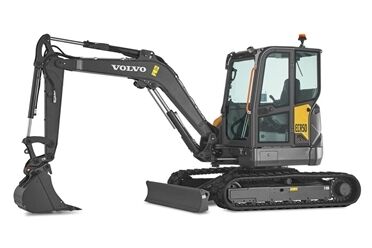
The Volvo ECR50 deserves a closer look when a smaller excavator can reach the job but struggles to carry the attachment package or complete the working cycle efficiently. Its appeal is a compact rear outline around a roughly five-tonne machine, rather than the promise that a larger excavator will fit wherever a smaller one did. Access width, attachment hydraulics, loaded reach and transport still need separate decisions.
This guide covers the North American ECR50 described on Volvo’s Canadian product page and in its current linked brochure, whose technical tables identify the machine as ECR50F. That generation label matters when comparing used listings or ordering an attachment. Specifications for an older ECR48, ECR50 variant or another regional version should not be substituted merely because the machines look similar.
On This Page
ToggleWhere the ECR50 makes sense
A Canadian property contractor may need one machine for drainage excavation, landscape preparation and occasional hydraulic attachment work. A farm may value the ability to excavate around existing infrastructure without moving to a much larger machine. In either case, the ECR50 should be evaluated as a complete working package: undercarriage, cab, arm, counterweight, coupler, tool and delivery arrangement.
The purchase becomes harder to justify if nearly every assignment involves a narrow passage, a light trailer package or only shallow digging with a small bucket. Compact tail geometry solves one kind of space problem. It does not cancel the physical size and mass of the rest of the machine. A productive choice begins with the jobs that earn the most hours, not the largest bucket that can be photographed on it.
Key specifications and their practical limits
| Item | Published reference | What to check |
|---|---|---|
| Engine | Volvo D2.4H; 41.8 gross hp on the Canadian page | Engine output is not hydraulic tool output |
| Reference operating mass | 5,050 kg / 11,133 lb | Weigh the actual equipped machine for transport |
| Width with 400 mm rubber tracks | 2,000 mm | Check blade, coupler and carried tool as well |
| Arm choices | 1,400 or 1,800 mm | Compare reach against force and configured mass |
| X1 attachment circuit | Maximum 75 L/min; 22 MPa listed maximum pressure | Confirm required flow, pressure and return arrangement for the tool |
These references come from the Canadian ECR50 product page and the linked North American ECR50 brochure. The brochure rounds gross output to 42 hp and lists 31.2 kW; that rounding should not be interpreted as a different engine package. Use the relevant serial-number documentation to establish what an individual machine actually has.
Zero tail swing has a configuration boundary
Volvo describes the ECR50 as a zero-tail-swing machine. The standard rear outline is especially useful when an operator must repeatedly turn beside a fixed obstruction. However, the brochure’s dimension table deserves attention before applying that description to every equipped machine.
It lists a 951 mm tail radius for the short-arm reference arrangement and 1,032 mm for the long-arm/counterweight arrangement. Half of the listed 2,000 mm track width is 1,000 mm. On that simplified dimensional comparison, the standard rear radius stays inside the half-width, while the larger reference radius exceeds it by 32 mm. This is a calculation from the published geometry, not a safe-clearance recommendation.
The distinction is small on paper but important in a buying conversation. A quotation that adds rear ballast can change the envelope that attracted you to the machine. Ask for a configuration drawing and inspect the actual rear outline. Do not approve a site plan using the base model’s marketing label while ordering a different counterweight arrangement.
Even with the standard rear inside the tracks, the boom, bucket, load and operator’s visibility require working space. A narrow rear can reduce exposure to one obstruction; it cannot make a full turn safe beside people, utilities or vulnerable structures. Boom offset and upperstructure rotation are also different movements, with different swept areas.
Access planning starts with two metres, then gets more specific
The published track width is a useful first filter for gates and lanes, but a measured two-metre opening is not automatically suitable for a two-metre machine. Site tolerances, ground alignment, projecting hinges, slopes and the carried tool all affect the passage. Measure the narrowest usable opening along the actual route and preserve appropriate working margins established for the site.
There may also be enough entrance width but nowhere to turn, place spoil or position a truck. Sketch the route through the job rather than measuring only the gate. A machine that enters comfortably and then repeatedly reverses out to clear material can be less productive than a different excavation and material-handling arrangement.
For buyers comparing a smaller platform, the Bobcat E35 guide offers another compact-excavator reference. Compare exact equipped dimensions and intended work, not just nominal class names. A smaller machine can be the stronger business choice when it opens access to jobs the larger package cannot serve.
Short versus long arm: reach is only half the decision
The longer arm changes where the bucket can work relative to the tracks. That may help with a wider excavation, a spoil placement problem or reaching a work point without another machine move. It does not simply add an equal amount to every dimension, and the extra reach is not free capacity.
In the brochure’s C digging-depth row, the two arm arrangements are listed at 3,374 and 3,768 mm. The separate C* maximum-depth row has different figures and a different illustrated condition. Keep those labels when making a comparison; selecting the largest number from one machine and an ordinary reference dimension from another creates a misleading result.
The stated ground-level reach rises from 5,748 to 6,137 mm. Meanwhile, the published arm digging force decreases from 5,834 to 4,896 lbf. Those are reference specifications, not a prediction of output in Canadian clay, gravel or frozen material. They illustrate why longer reach and digging leverage should be assessed together.
A useful demonstration includes the actual trench profile, spoil location and return motion. Can the short arm complete the task from a reasonable position? Does the long arm remove a costly repositioning step, or does it mostly encourage work farther from the machine? The guide to excavator digging depth and reach explains why maximum geometry alone is a weak production estimate.
Attachment flow: use the circuit rating, not the pump headline
The brochure lists 120 L/min for the hydraulic system, but the X1 breaker/shear circuit is listed at a maximum of 75 L/min. A tool selected as though it receives the entire system flow may be poorly matched. The X3 slope/rotator circuit is separately listed at a maximum of 40 L/min; its function and configuration must be checked independently.
Begin with the attachment manufacturer’s permitted flow range, required pressure, return restrictions and control requirements. Then match them to the exact machine installation. A maximum pressure and maximum flow appearing in a specification table do not establish that both are continuously available together at the tool under every operating condition.
Physical fit matters just as much. Check the coupler interface, pin dimensions where applicable, hose routing, weight and working clearance throughout the intended motion. A hydraulic attachment may connect successfully yet have an unsuitable control arrangement or interfere with the boom at part of its travel.
For a Canadian owner considering several tools, write a separate requirements line for each. A breaker, rotating tool and hydraulic thumb should not be treated as interchangeable hydraulic loads. The mechanical versus hydraulic thumb guide is useful for separating a gripping task from a digging task before committing to an installation.
Budget for the complete attachment workflow
A higher-capacity carrier earns its place when the whole workflow improves. Include unloading, setup, tool changes, material sorting and cleanup in the estimate. Counting only active digging minutes can hide the time spent waiting for another machine or preparing a hydraulic attachment.
Consider an illustrative contractor who expects an equipped machine to avoid 20 minutes of setup on 60 jobs per year. That is 1,200 minutes, or 20 hours annually. At an assumed internal time value of C$80 per hour, the theoretical benefit is C$1,600 per year before financing, transport, maintenance or additional attachment costs. These are planning assumptions, not market prices or a claim about ECR50 productivity.
The example is useful because it exposes the question that needs evidence: will the complete package actually save those minutes? Record a few comparable jobs before purchasing. If the bottleneck is truck availability, adding machine capability may change almost nothing. If repeated tool changes are the bottleneck, the correct coupler and controls may matter more than a small difference in engine output.
Transport: operating mass is a reference, not a loaded ticket
The brochure gives a transport mass of 4,975 kg alongside the 5,050 kg operating reference. Neither number certifies the weight of a machine carrying your coupler, thumb, extra counterweight and tools. Establish what is included in the reference, list every addition and use measured loaded weights for the final plan.
Do not judge the transport package by trailer deck length alone. The complete combination needs suitable ratings and a loading and securement arrangement appropriate to the equipment and applicable requirements. Keep this assessment separate from whether the excavator has enough capability for the job itself.
For a farm that moves equipment infrequently, contracted delivery can be worth comparing with ownership of a dedicated transport package. For a contractor moving daily, route access and load preparation may materially affect the economics. Use your actual frequency and costs rather than assuming one arrangement is always cheaper.
Used ECR50 inspection: verify the package, then observe it working
Start with the identification plate, generation, service records and attachment list. A listing labelled ECR50 may use an abbreviated name; reconcile it with the ECR50F technical reference before relying on specifications. Establish the fitted arm, counterweight and auxiliary circuits rather than inferring them from a sales photograph.
Inspect the undercarriage, visible leaks, hose protection, pin joints and attachment interface. Have a competent evaluator observe travel, slew, digging and the intended hydraulic tool under appropriate conditions. The aim is to distinguish wear, setup limitations and unfamiliar controls; a single symptom is not proof of a particular component failure.
Check whether the offered coupler and attachments have the documentation needed to confirm compatibility. Missing fitment information can turn an apparently complete package into a separate engineering and purchasing task. Price that uncertainty explicitly instead of treating every accessory as useful value.
No reliable model-specific failure frequency or service-life estimate is established by the sources used here. This guide therefore does not label ordinary inspection points as known ECR50 defects. Individual condition, maintenance history and installation quality require their own assessment.
Questions to settle before buying
Does zero tail swing mean no rear projection on every ECR50?
No. The brochure shows different rear radii for different reference arrangements. The standard radius fits within the listed half-width; the larger counterweight arrangement needs its own envelope check. Neither arrangement removes the need for clearance around the front equipment and the working load.
Can an attachment use the full 120 L/min system figure?
Do not specify a tool on that assumption. The brochure separately lists the X1 circuit at a maximum of 75 L/min. Match the tool to the actual circuit, pressure and return requirements, and verify the installed controls.
Is the long arm always the better choice?
No. It increases useful reach in some layouts while changing force and configured weight. Compare a complete working cycle at your required reach, with the attachment fitted, instead of choosing solely from the largest depth number.
What should a final quotation identify?
Specify the generation, arm, counterweight, tracks, cab or canopy, coupler, attachment circuits and included tools. Add the configuration’s dimensional and weight references and the documents needed for attachment matching. That produces a package you can compare, transport and put to work with fewer unresolved assumptions.
Which records are useful after the purchase?
Keep the serial identity, fitted equipment list, attachment compatibility documents and service history together. Record changes such as a replacement coupler or added counterweight so future transport and site planning use the machine you actually own. An old sales brochure cannot track those changes for you.
Share your experience
Help other Canadian buyers — leave a quick review for the
Volvo ECR50
There are no reviews yet. Be the first one to write one.