Overview & Specs
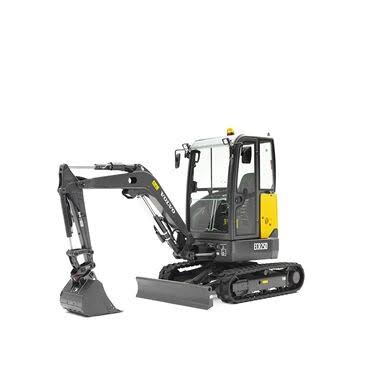
The Volvo ECR25D is worth considering when an excavator needs to move between small property jobs and work where rear clearance is restricted. Its buying case is the combination of a compact working arrangement and a manageable equipment package, rather than a promise that every pickup and trailer can carry it. For a Canadian acreage owner or landscape contractor, the route into the work area and the frequency of moves should be defined before choosing the arm and attachment options.
This guide concerns the diesel ECR25D offered on Volvo’s Canadian website. It is not the ECR25 Electric. Similar names do not make their weights, power systems or ownership requirements interchangeable. On a used machine, identify the serial configuration, tracks, arm, counterweight and operator enclosure before applying a specification sheet.
On This Page
ToggleStart with the whole machine envelope
The Canadian ECR25D page lists 20.9 gross hp and an operating-weight range of 5,490–5,737 lb, with a separate lighter canopy range. Those are configuration figures, not a ready-made trailer recommendation. The linked brochure gives the dimensional detail needed to understand what is actually narrow and what still projects.
| Dimension or configuration | Brochure value | What to check |
|---|---|---|
| Width with 250 mm rubber tracks | 1,500 mm | The blade is a separate width |
| Width with 300 mm rubber tracks | 1,550 mm | Use the actual fitted track arrangement |
| Blade width | 1,550 mm | Can govern passage through an opening |
| Arm lengths | 1,050 or 1,350 mm | Identify the installed option |
| Tail radius | 750 mm standard; 825 mm with the illustrated additional-counterweight arrangement | Do not assume the smallest outline on every machine |
These dimensions come from Volvo’s Canadian-linked Tier 4f brochure. The distinction between track width and blade width is particularly useful: selecting narrower tracks does not necessarily make the complete machine equally narrow.
Access is a route, not one gate measurement
Measure the narrowest opening, then follow the machine’s proposed path to the working position. A turn immediately inside a gate, a low branch or a projecting building corner can become the real constraint. The attachment carried during travel also belongs in the assessment.
For a landscaped property, identify surfaces that need protection and areas where turning will be awkward. Do not treat a compact excavator as a guarantee against disturbance. Ground condition, machine movements and the protection plan affect the result. A short route across a finished yard may require more preparation than a longer route on suitable access ground.
Once the machine reaches the work area, the upper structure and front equipment need their own room. A short rear radius helps with one part of the moving outline. It does not eliminate the bucket’s path, boom offset, hoses, blade or the space required to place excavated material. A useful site sketch includes both travel and work.
Short arm or long arm?
In the brochure’s working-range table, the row labelled digging depth is 2,461 mm with the short arm and 2,761 mm with the long arm. Ground-level reach is 4,313 and 4,602 mm respectively. The drawing also contains a separately labelled maximum-depth row; those labels should not be collapsed into one generic depth claim.
The longer arrangement can help when the required working points cannot be reached conveniently from appropriate machine positions. It should not be chosen solely because the largest number looks more capable. Compare the complete digging cycle and the applicable force and lifting information for that configuration.
For repeated shallow work in a reasonably open area, additional reach may do little to change completion time. Bucket selection, spoil handling and the number of repositioning moves may matter more. For a specific reach constraint, however, the geometry can be decisive. Mark the required points on the correct drawing instead of combining maximum depth and maximum reach into an imaginary rectangular work area.
Aglist’s dig depth and reach guide explains that reading process. Suitable machine positions come from the site assessment; reach calculations do not justify moving closer to an excavation edge or obstruction.
Choose buckets around the finished job
A small excavator benefits from an attachment set chosen for recurring work. Identify the required excavation width, material and finish before deciding how many buckets to include. A wide cleanup tool and a digging bucket can be useful for different stages without being interchangeable in dense material.
Consider a hypothetical 20-metre excavation with a planned 0.30-metre width and 0.60-metre depth. Its simple rectangular volume is 3.6 cubic metres. Increasing the assumed width to 0.45 metres gives 5.4 cubic metres, an additional 1.8 cubic metres before allowing for the actual excavation design or material behaviour. This is a geometry illustration, not a trench-design instruction.
The calculation shows why an unnecessarily wide cut can add handling and restoration work. It does not mean the narrowest available bucket is always correct: the project and safe excavation arrangement govern the required shape. Compare equipment against that shape rather than letting an included bucket determine the project.
For used packages, identify each tool and its mounting system. Worn teeth, damaged pin areas or missing coupler components can reduce the value of a bundle. Count only attachments that are compatible, serviceable and relevant to the intended tasks.
Hydraulic tools need circuit information
The brochure lists accessory flow up to 50 L/min. Its system-flow and digging-force figures differ from some figures on the current product page, so those disputed headline values are not used here as a definitive comparison. Obtain the applicable serial-specific documentation where the difference affects a purchase.
For a breaker, auger or other hydraulic tool, start with its accepted flow, pressure, return and control requirements. The main pump figure is not automatically the flow available at the attachment. Nor does matching one maximum number establish a suitable installation.
Record the actual outlets, controls and any secondary circuit in the quotation. An advertised option is not proof that it is fitted to a particular used machine. A demonstration should show the intended approved tool operating through the required cycle, not merely a hose connection or unloaded movement.
If a thumb is important, assess it with the bucket and coupler that will actually be used. The mechanical-versus-hydraulic thumb guide helps separate mounting, movement and control questions. Gripping an object does not establish the machine’s permitted lifting capacity.
Lifting and loading are different from digging
For lifting, use the correct load chart and approved equipment for the exact configuration. Radius, height, orientation, blade condition and attachment assumptions matter. A breakout-force number describes a digging action; it is not a payload rating.
For loading material, examine the bucket path into the receiving vehicle or container. Clearing the near side does not necessarily allow useful distribution across the receiving area. A compact excavator can spend considerable time waiting or repositioning if the support arrangement is poorly matched.
Describe the material destination before the demonstration. If spoil will be moved by another machine, assess the handoff and waiting time. A faster digging cycle has little value while the excavator waits for somewhere to discharge.
Transport: weigh the complete package
The ECR25D is marketed around mobility, but a general transport claim does not approve a specific Canadian towing combination. Establish the mass of the actual machine, with its fitted equipment, and the separately carried attachments. Verify which items the starting weight already includes to avoid either omission or double counting.
A hypothetical machine-and-equipment load of 2,800 kg placed on a 900 kg trailer creates a 3,700 kg combined trailer-and-load mass. Those assumed figures do not describe this machine or approve a vehicle. They illustrate why trailer payload and the loaded trailer’s total mass are different quantities.
The towing vehicle, trailer, hitch, tyres, axles, loading arrangement and applicable requirements all need to suit the package. Deck length and attachment storage can be limiting even when the weight calculation appears acceptable. Do not select transport equipment from an informal truck size category.
Move frequency changes the economics. An owner keeping the excavator at one acreage may compare delivery with maintaining a transport setup. A contractor moving daily should include loading, securement and travel time in the machine comparison. These are different ownership patterns despite using the same excavator.
Canadian seasons and operator accommodation
Choose cab or canopy around the actual working season and session length. A cab’s value can include shelter and a more practical working routine, but inspect the installed heating, ventilation and visibility equipment on the offered machine. Do not assume every cab listing includes identical climate equipment.
Cold-weather preparation should follow the applicable manual for fluids, fuel, starting and warm-up. Frozen material is also a change in the job, not just a change in air temperature. Identify whether the work calls for another tool or method rather than using ordinary digging specifications as a guarantee in all conditions.
Plan cleaning and storage after muddy or snowy work so the next job begins with accessible service points and an inspectable undercarriage. For remote properties, ask how parts and field service will be obtained and include the practical consequences of downtime in the ownership plan.
Inspecting a used ECR25D
Begin with identity and configuration. Photograph the serial plate, arm, counterweight and track arrangement, then match the documents. A specification copied from another ECR25D can be wrong for the offered combination even when the model name is correct.
Have undercarriage wear, linkage play, structure, hydraulics and repairs evaluated by a competent inspector. Observe an appropriate cold start and warmed-up working demonstration. These are condition checks, not claims that the model has a known defect pattern.
Price identified repairs and missing equipment before comparing offers. Service history and complete compatible attachments can be more informative than a low hour reading alone. A machine ready for its first planned job is a different purchase from one needing a coupler, hydraulic setup and several repairs.
Alternatives and useful final questions
For comparison questions, review the Bobcat E32 and Bobcat E35 pages. Verify their exact generations and manufacturer data independently. Compare the full route, attachment and transport package rather than treating a nominal size class as a promise of equivalent capability.
Is the ECR25D the electric model?
No. This guide concerns the diesel ECR25D; ECR25 Electric is a separate machine.
Do narrow tracks guarantee the machine fits?
No. The blade and other fitted equipment can govern the complete width.
Does the long arm only change reach?
It changes the relevant configuration, so force, lifting, counterweight and transport information must also be checked.
Can a pump specification approve a hydraulic attachment?
No. Use the actual accessory circuit and the tool’s complete requirements.
What is the strongest reason to choose this model?
A verified fit for frequent small-site jobs, with a practical transport arrangement and an attachment package that completes the whole task.
Share your experience
Help other Canadian buyers — leave a quick review for the
Volvo ECR25D
There are no reviews yet. Be the first one to write one.