Overview & Specs
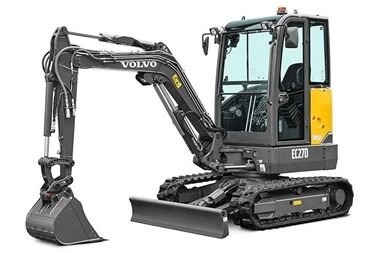
The Volvo EC27D deserves a place on a compact-excavator shortlist when the job provides room for a conventional rear layout and the buyer wants to assess digging, loading and attachment work as a complete cycle. It shares a 20.9-hp gross engine rating with the ECR25D, but equal horsepower does not mean equal working geometry or digging performance. The EC27D’s usefulness must be judged from its own configuration.
For Canadian farms, acreages and small landscape operations, the important question is whether the machine can reach the intended working position, excavate the required shape and discharge material without avoidable repositioning. A conventional tail is not automatically a disadvantage on an open site, and a compact track width does not guarantee adequate room to rotate beside a building.
On This Page
ToggleEC27D specification basis
The Canadian Volvo EC27D page and its linked Tier 4f brochure provide the source configuration. The listed operating weight of 2,730 kg includes the heated cab, short arm, 300 mm rubber tracks and direct-fit bucket in the brochure’s defined arrangement. Options change the package.
| Item | Published figure | Comparison use |
|---|---|---|
| Gross engine power | 20.9 hp | Keep separate from hydraulic and digging ratings |
| Width with 300 mm tracks | 1,550 mm | Initial access check |
| Tail radius | 1,080 mm before optional extra overhang | Assess the rotating rear outline |
| Arm length | 1,200 or 1,500 mm | Match working-range and force data |
| Accessory flow maximum | 50 L/min | One part of hydraulic-tool matching |
| System flow maximum | 65 L/min | Not interchangeable with accessory flow |
Record the actual enclosure, arm, counterweight, tracks and attachments on the quote. A model name is not enough to identify transport mass or the applicable lifting information.
Why a conventional tail can still make sense
The rear of the EC27D needs clearance as the upper structure rotates. On an open property job, that space may be readily available and should be considered alongside the machine’s other characteristics. Paying for a different rear arrangement is most persuasive when it solves a recurring site restriction.
A useful initial calculation compares the listed 1,080 mm rear radius with half of the 1,550 mm track width. The difference is 305 mm, illustrating rear projection beyond the track side in the corresponding geometry. It is not a prescribed clearance allowance, and optional equipment or the actual configuration must be included.
Do not reduce the assessment to that one subtraction. The bucket and boom sweep in front, the blade projects from the undercarriage, and nearby objects may be higher or lower than the rear body. The site plan must account for the complete machine and the working movements.
For occasional restricted work, compare whether a different suitable machine can be hired for those jobs. For a contractor routinely working beside walls and fences, rear geometry may instead be a primary purchase criterion. The choice follows the work mix rather than a universal ranking of tail designs.
Read the two arm configurations as different packages
The brochure lists digging depth of 2,486 mm with the 1,200 mm arm and 2,859 mm with the 1,500 mm arm. Ground-level reach increases from 4,295 to 4,665 mm. Short- and long-arm tearout figures are 4,060 and 3,469 lbf. Keep the matching rows together instead of pairing long-arm reach with short-arm force.
Those changes do not prove that either arm completes every job faster. The long arm may reach a useful working point from an appropriate position, while the short arrangement may suit work occurring comfortably inside its envelope. Evaluate the intended bucket and material through a complete cycle.
The dimensions table includes both digging depth and a separately labelled maximum digging depth. Consult the drawing and retain the stated conditions rather than quoting the largest number without context. Aglist’s digging-depth guide explains why the entire working shape matters.
For a planned excavation, identify the required points relative to the machine’s standing level. A reach figure measured at ground level does not describe horizontal reach at every depth. Likewise, reaching the bottom once is not evidence that the bucket can repeatedly fill, clear the excavation and discharge where required.
Open-site work: follow the spoil
The EC27D should be demonstrated around the way material will actually leave the excavation. If spoil can be placed nearby in an appropriate area, the cycle differs from loading a vehicle that must repeatedly depart. A machine comparison that ignores this support arrangement can reward the wrong feature.
Consider a hypothetical 250-cycle task. Saving four seconds per equivalent cycle produces 1,000 seconds, or about 16.7 minutes, of active-cycle saving. If the receiving vehicle creates 40 minutes of waiting, improving the support arrangement could have a larger effect. These assumptions are an illustration, not measured EC27D productivity.
Keep cycle counts comparable. A faster cycle moving less useful material is not necessarily an improvement. Record bucket type, material, operator and finishing requirements so the demonstration reflects the intended result. Loose material in a sales yard may not resemble the property job.
Also include restoration. Excavation width, stockpile location and machine travel can affect the work remaining after the digging ends. The meaningful completion time runs through the required finished result, not simply the final bucket removed.
Choose the bucket set deliberately
Start with the recurring tasks and select a compatible digging bucket for the material and required cut. Add a cleanup or grading tool only when its purpose is clear. A bundle containing several buckets is not automatically more valuable than a smaller set in sound condition that suits the work.
Inspect the mounting interface, pins, cutting edges, teeth and repair history. If a coupler is part of the package, establish which tools it accepts and how its presence affects the complete arrangement. A physical pin match does not establish carrier approval or suitable operating characteristics.
For a hydraulic thumb, specify the bucket and coupler together. Different bucket geometries can change the useful contact and stowed clearance. The excavator thumb comparison helps determine whether occasional preset handling or frequent adjustable positioning is the real requirement.
Hydraulics: the attachment needs more than a flow number
The distinction between system and accessory flow is important on this machine. Use the circuit that supplies the tool, then compare its pressure, return and control provisions with the tool’s requirements. Do not calculate guaranteed tool power from unrelated peak values.
Inventory what is installed on a used EC27D. A secondary circuit listed as an option in a brochure is not evidence that the sale machine has it. Couplers, plumbing, controls and commissioning can materially affect the cost of putting a hydraulic tool to work.
Where a tool is central to the business case, arrange a representative demonstration of the approved complete installation. Assess control and sustained task completion rather than merely whether the attachment moves. A hydraulic system can be connected yet still be unsuitable for the intended duty.
Lifting requires the applicable chart
Neither engine horsepower nor bucket breakout force describes permitted lifting capacity. Use the manufacturer’s chart for the exact arm, counterweight and machine arrangement, including radius, height, orientation and blade conditions. Account for attachments according to that chart’s assumptions.
If material placement is a regular task, put it explicitly in the buying brief. Identify the load and the position it must reach. A successful digging demonstration does not establish that the same machine can perform a proposed lift.
Similarly, truck loading is a geometry question as well as a digging task. Measure the receiving height and useful discharge position, including differences in standing elevation. A bucket that clears the near edge may still be awkward for distributing material across the body.
Transport planning for a complete EC27D package
The operating-weight entry is a useful starting point only when its included equipment is understood. The transport arrangement must account for the actual machine, fuel condition, fitted options and separately carried tools. Avoid adding a bucket twice or forgetting a tool that travels elsewhere on the deck.
Check available trailer payload and the loaded combination, alongside the tow vehicle, hitch, axles, tyres and applicable requirements. A nominal excavator class does not approve a particular truck. Deck space, loading geometry and securement arrangements also need to suit the equipment.
For an owner who rarely moves the machine, compare delivery and collection costs with maintaining a hauling setup. For a small contractor, record loading and travel time across a normal week. The same excavator can create very different ownership costs depending on how often it changes sites.
Canadian working seasons and service support
Assess the enclosure and visibility equipment against the actual schedule. A cab can be valuable for shoulder-season work, but the installed heating, ventilation and glazing condition should be checked. Do not assume all used cab machines have the same options or performance.
Use the appropriate manual for cold starting, fluids, fuel and warm-up. The intended material also changes seasonally: a machine selected for ordinary summer excavation should not be assumed to deliver the same result in frozen conditions without reassessing the task and tool.
Before purchase, identify how service will be delivered to the working location. Ask about routine parts, transport to a workshop and field support where relevant. For a remote acreage, one unplanned move for repairs may matter more than a small difference in an advertised purchase price.
Used inspection: configuration first, condition second
Confirm the model and serial identity, then record the arm, tracks, counterweight and hydraulic provisions. Compare those with the documents supplied. A specification sheet for another configuration can make an otherwise honest listing misleading.
Have the undercarriage, linkage, structure and hydraulic system evaluated by a competent inspector. Observe normal controls and a warmed-up working demonstration, and investigate leaks, unusual noise or repair evidence. These are inspection priorities, not allegations of common EC27D faults.
Price the complete route to useful ownership: repairs, initial servicing, delivery, required attachments and missing mounting or hydraulic components. Service records and a verified working package can matter more than the hour meter alone.
Cross-shopping and final questions
Aglist’s Bobcat E32 and Bobcat E35 guides provide alternative starting points. Verify the offered generation and manufacturer configuration for each. Compare the same excavation, access route and material-removal plan before treating nominal size labels as equivalent.
Does equal horsepower make the EC27D equivalent to an ECR25D?
No. The machines have different geometry, weight and other specifications that affect the complete task.
Is conventional tail swing unsuitable for property work?
No. It can be appropriate where the working layout provides the required clearance. Assess the actual site.
Should I choose the long arm automatically?
Choose it when its geometry solves a recurring requirement, after checking the matching force, lifting and attachment information.
Can accessory flow alone determine breaker fit?
No. Pressure, return, controls, mounting and carrier approval remain part of the installation.
What makes a useful demonstration?
A complete, representative cycle from excavation through discharge, with the intended tool and a realistic support-equipment arrangement.
Share your experience
Help other Canadian buyers — leave a quick review for the
Volvo EC27D
There are no reviews yet. Be the first one to write one.