Overview & Specs
The Massey Ferguson 2M.60 deserves a close look when a compact tractor must supply substantial rear-PTO power while still offering a choice between hydrostatic and power-shuttle travel. The important purchase is the version, not simply the badge. The mechanical and HST configurations differ in the manufacturer’s power and geometry tables, so a buyer should not combine one version’s favourable figures with another version’s controls.
For a Canadian owner moving between mowing, lane work, material handling and snow clearing, that creates a practical decision: which tasks determine the tractor, and which transmission makes the complete workload easier to manage? This guide uses the current 2M documentation and separates confirmed specifications from entries that need clarification for the actual build.
On This Page
ToggleTwo configurations to compare explicitly
| Item | Mechanical | HST |
|---|---|---|
| Rated engine output | 60.3 hp | 60.3 hp |
| PTO output | 47.0 hp | 44.6 hp |
| Transmission | 12×12 power shuttle | Three-range Servo-HST |
| Implement flow | 48.0 L/min | 47.8 L/min |
Source: Massey Ferguson’s 2M technical sheet, linked by the Canadian product page, checked October 11, 2026. This covers the current 2M.60 rather than assuming that a previous 2860M has identical equipment.
Let the hardest recurring implement set the first requirement
Start with the implement that consumes the most time or creates the strongest compatibility constraint. Record its exact model, mounting type, power requirement, shaft speed, mass and intended duty. A wide mower, a tiller and a snowblower should not be approved from one generic “sixty-horsepower tractor” description.
For illustration, imagine a tool with a documented minimum of 46 PTO hp. The mechanical figure clears that first screen while the HST figure does not. That is only a numerical comparison. It does not establish that the tool’s hitch arrangement, driveline, weight or working conditions suit either version.
If the real implement fits both, keep the power difference in perspective. It does not directly measure fuel economy, acres per hour or durability. The operator’s ability to maintain an appropriate feed rate, manoeuvre around obstacles and finish the task can matter just as much to the practical choice.
The PTO horsepower guide is useful when an implement advertisement uses an unclear rating. Resolve that definition before negotiating around a tractor’s engine number.
A whole-day transmission comparison
Describe a typical day in blocks: prepare and attach the tool, travel to the work, complete long passes, manoeuvre in confined areas, return, park the implement and perform loader chores. Mark where ground speed changes repeatedly and where a consistent pace dominates.
For the shuttle version, evaluate the usable working gears and the direction-change procedure under the exact operating instructions. For HST, evaluate travel control within the appropriate range while the implement operates as specified. Neither demonstration should depend on pushing a machine beyond approved conditions to discover a limit.
Include the regular operator in the comparison. Reach to the controls, footwear clearance, rearward visibility and seat adjustment are individual matters. A configuration that suits an experienced operator doing long passes may feel different to someone sharing the machine between several short jobs.
Record observations immediately. “The controls felt good” is less useful than “the operator could reposition comfortably while maintaining a clear view of the rear tool.” That level of detail helps compare a second tractor later, when the first demonstration is no longer fresh.
Aglist’s transmission comparison expands the general distinctions. For the 2M.60, tie them to the actual version-specific implement requirements rather than selecting a transmission in isolation.
Geometry changes can matter alongside power
The technical sheet separates mechanical and HST length and ground-clearance entries for this model. That is a reason to measure the exact configuration being offered, particularly when working around low obstacles, ramps or a constrained storage area. Do not borrow the more convenient dimension from the other version.
The overview and technical sheet also differ on some overall-height and base-weight entries. This guide therefore does not provide a single guaranteed clearance or transport mass. The actual tyres, station and installed equipment must be included in those decisions.
A useful site measurement begins with the whole combination. Mark the widest point, the highest protrusion and the rear implement’s sweep during a turn. Check the narrowest usable gate opening and the approach to the shed, including objects that force an angled entry. Straight-line tractor width alone cannot establish that the route works.
If one version requires a change to storage or hauling, include that cost in its purchase case. A small quoted tractor-price difference can become less important than a practical incompatibility discovered after delivery.
Rear linkage: compare like measurement positions
The technical sheet gives the mechanical version a different rear-lift entry from the HST version. Preserve the transmission and measurement position when comparing documents. A lift-point figure should not silently replace a figure measured behind the linkage.
Then assess the implement itself. Where does its weight act? How far does it project behind the tractor? Does an adapter or quick hitch change that position? What ballast and driveline requirements apply? These questions remain relevant even when the implement mass looks comfortably below a brochure number.
For a tool that will be changed frequently, assess parking and connection as part of the purchase. A convenient hitch is valuable when it suits the actual implements and the space available. It becomes less useful if one essential tool needs a different arrangement or the driveline no longer fits the approved setup.
Use the quick-hitch guide for the connection checks, while retaining the 2M.60’s own applicable hitch documentation. General category descriptions do not approve every combination.
More engine output does not create more hydraulic functions
The small difference between the two implement-flow entries should not distract from the installed control package. A rear attachment may need several separately controlled movements; a grapple requires a clamp function in addition to a compatible carrier. List those requirements individually on the quotation.
Identify the attachment’s pressure, supply and return requirements from its documentation. A physically matching coupler does not prove that a connection is appropriate. Do not add steering flow to implement flow to produce a larger advertised attachment-supply figure.
For a buyer moving up from the 2M.50, this is especially important: additional engine output should not be credited with solving a missing valve, unsuitable hydraulic attachment or insufficiently documented installation. Compare what the complete package can actually operate.
Material handling: assess the FL2814 separately
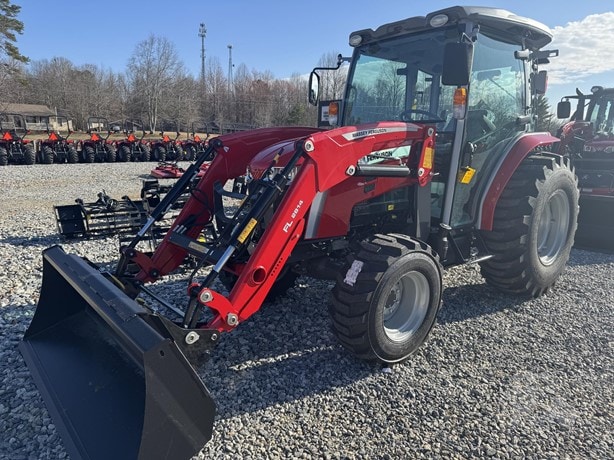
The reviewed sheet lists the FL2814 loader across the 2M models. Treat its rated geometry as a separate system assessment. The 2M.60’s engine power is not permission to handle a heavier pallet than the approved loader-and-fork arrangement allows.
Begin with the load description and receiving location. Include product and packaging mass, fork frame, load centre, required height and reach. A task that involves setting material over a high side may be more demanding than a ground-level move of the same mass.
For bulk material, bucket volume needs to be related to the actual material and permitted setup. A useful planning example is 0.25 m³ at an assumed 1,400 kg/m³: that represents 350 kg of material before considering the attachment. Those invented values are not a recommended bucket size, material density or approved load for this tractor. They simply illustrate why volume alone does not answer the weight question.
Review the complete requirements in the loader capacity guide. A demonstration should validate a documented suitable task, not find a limit by lifting until the tractor or hydraulics object.
Where the 2M.60 belongs in a Canadian work plan
Longer mowing or vegetation-maintenance sessions
Choose the implement for the vegetation and intended finish before choosing width. Then compare the required power with the correct tractor version. For properties with awkward edges, count the time spent turning and repositioning as well as the time cutting. More shaft power may help a suitable tool process material, but it cannot remove every access constraint.
Snow clearing that cannot be postponed
Make operator environment and visibility part of the initial requirement. A cab’s heating and glass-clearing equipment should be assessed with the tool in view, including rearward viewing if the chosen system works behind the tractor. The snowblower fitment guide helps define the mounting and drive package.
Plan the route when snow storage has reduced working space. Consider how the tractor leaves its shed, where it can turn and where discharged snow may go. The suitable machine is the one that fits that winter sequence, rather than only the open summer yard.
Occasional digging alongside general tractor work
The CB85 backhoe footnote includes the 2M.60. Verify the full installation and configuration restrictions before valuing that capability. If digging is infrequent, compare the cost and changeover burden with hiring the work or renting appropriate equipment. Avoid assuming that owning a tractor backhoe will replace every excavation task.
A useful comparison with the 2M.50 and 2M.65
The 2M.50 deserves consideration when it already meets the actual implement requirements. The 2M.65 has a different configuration proposition, including HST-only specification, so it should not be treated as simply the same mechanical tractor with more power. Compare the versions as purchasable packages.
An outside-brand shortlist can include tractors selected for the same tools and station needs. The John Deere 3039R guide illustrates configuration questions to carry into such a comparison, not a claim that it is an identical-capacity substitute. Use current manufacturer data for each actual candidate.
Put all mandatory equipment into each quote before comparing payment or total price. Include valves, tools, ballast, installation, delivery and any necessary storage or transport change. A better-equipped offer should be evaluated for the tasks its extra items solve.
Inspection and ownership records
For a used machine, verify model identity, transmission and installed equipment first. Review service records against the correct manuals and have a qualified inspection cover operation, hydraulic functions, loader mounting, linkage, tyres and repairs. Include cab equipment where fitted and inspect attachments independently.
Resolve active warnings and unclear maintenance history before deciding the package is ready for work. These are prudent inspection steps, not claims about known recurring 2M.60 failures. Do not apply an online service or regeneration procedure from another tractor without establishing that it is the correct instruction for this one.
Retain the final configuration list, inspection findings and any clarified manufacturer specifications. Future tools should be checked against that record. A new implement with a different mounting arrangement or load centre deserves a fresh assessment even when its marketing description resembles the old one.
Frequently asked questions
Which version has the higher published PTO output?
The mechanical version. That is one input to the purchase, not proof that it completes every job faster.
Are mechanical and HST dimensions interchangeable?
No. The technical sheet separates some dimensions, so use the actual configuration for access and storage.
Does more horsepower increase the loader’s approved payload?
Not by itself. The tractor-loader-attachment documentation and task geometry remain decisive.
Can I select a trailer from base weight?
No. Establish the complete equipped transport load and check the entire hauling arrangement.
What justifies choosing the 2M.60?
A verified requirement for its configuration and power, combined with a demonstration showing that the chosen transmission suits the recurring work.
Share your experience
Help other Canadian buyers — leave a quick review for the
Massey Ferguson 2M.60
There are no reviews yet. Be the first one to write one.