Overview & Specs
The Massey Ferguson 1M.35 is worth considering when you want a compact tractor with a choice of transmission and operator station, but your implements do not require the higher output of the 1M.40. Its purchase case starts with a complete working package: the mower or snowblower it must power, the material it must handle, and the space in which it will operate. Buying the smaller engine option can be sensible when those requirements already fit. It is less convincing when an essential implement is just beyond its documented power range.
This guide covers the current North American 1M.35 shown on Massey Ferguson’s Canadian website, not an older 1835M advertised under a similar description. It explains how to assess the tractor for Canadian acreage work without treating a brochure lift figure as a pallet rating or assuming that every cab and hydraulic option is included.
On This Page
ToggleThe figures that shape the purchase
| Item | 1M.35 specification |
|---|---|
| Rated engine power | 36.2 hp at 2,600 rpm |
| PTO power | 27.5 hp mechanical; 25.7 hp HST |
| Engine | 1.83 L, three-cylinder turbocharged Iseki diesel |
| Transmission choices | 12×12 power shuttle; three-range Servo-HST |
| Implement hydraulic flow | 47.8 L/min |
| Rear hitch | Category 1 |
Source: the manufacturer’s 1M specification sheet, checked October 11, 2026. The Canadian M Series page identifies the current generation and cab choices. Installed equipment still needs to be listed on the quotation.
Begin with the tool that cannot be compromised
A property owner may use the loader more often than any other attachment but still need to size the tractor around a demanding rear tool. Write down that tool’s exact model and configuration, minimum and maximum tractor requirements, mounting arrangement and intended duty. A tractor that conveniently moves compost all summer is not a successful purchase if it cannot run the snowblower chosen for the driveway.
Use the appropriate PTO figure from the table. As a hypothetical example, a tool specifying a minimum of 27 PTO hp passes the initial numerical screen for the mechanical version but not for the HST version. That example does not approve a particular implement or recommend buying with almost no operating margin. It shows why the transmission belongs in the compatibility discussion before an order is signed.
If both versions satisfy all the tools, the decision can shift to travel control and operator preference. If neither does, investigate another tractor or a genuinely suitable implement. Travelling slowly is not a substitute for meeting a manufacturer’s minimum requirement. Aglist’s PTO horsepower explanation develops the distinction between engine output, shaft power and shaft speed.
Choose a transmission around the day’s sequence
For a loader job interrupted by short moves, tight approaches and frequent changes of direction, evaluate how comfortably the operator controls travel while also watching the attachment. An HST demonstration should include that sequence, not only a drive along an open lane. The selected range, the approach to the pile and fine positioning all matter more than a quick impression of acceleration.
A power shuttle deserves a different demonstration: choosing a suitable working gear, reversing within the operating instructions, and maintaining the required pace through a longer pass. A shuttle is not the same as an infinitely variable travel system. Nor does its name establish the procedure for every gear or range change. Learn the actual control sequence before comparing it with HST.
Make the comparison with the same type of job and similar conditions. Someone who spends most hours mowing an open area may rank the controls differently from someone maintaining several small pens and storage areas. The transmission buying guide helps identify those priorities without declaring one transmission universally better.
The loader number needs its measurement point
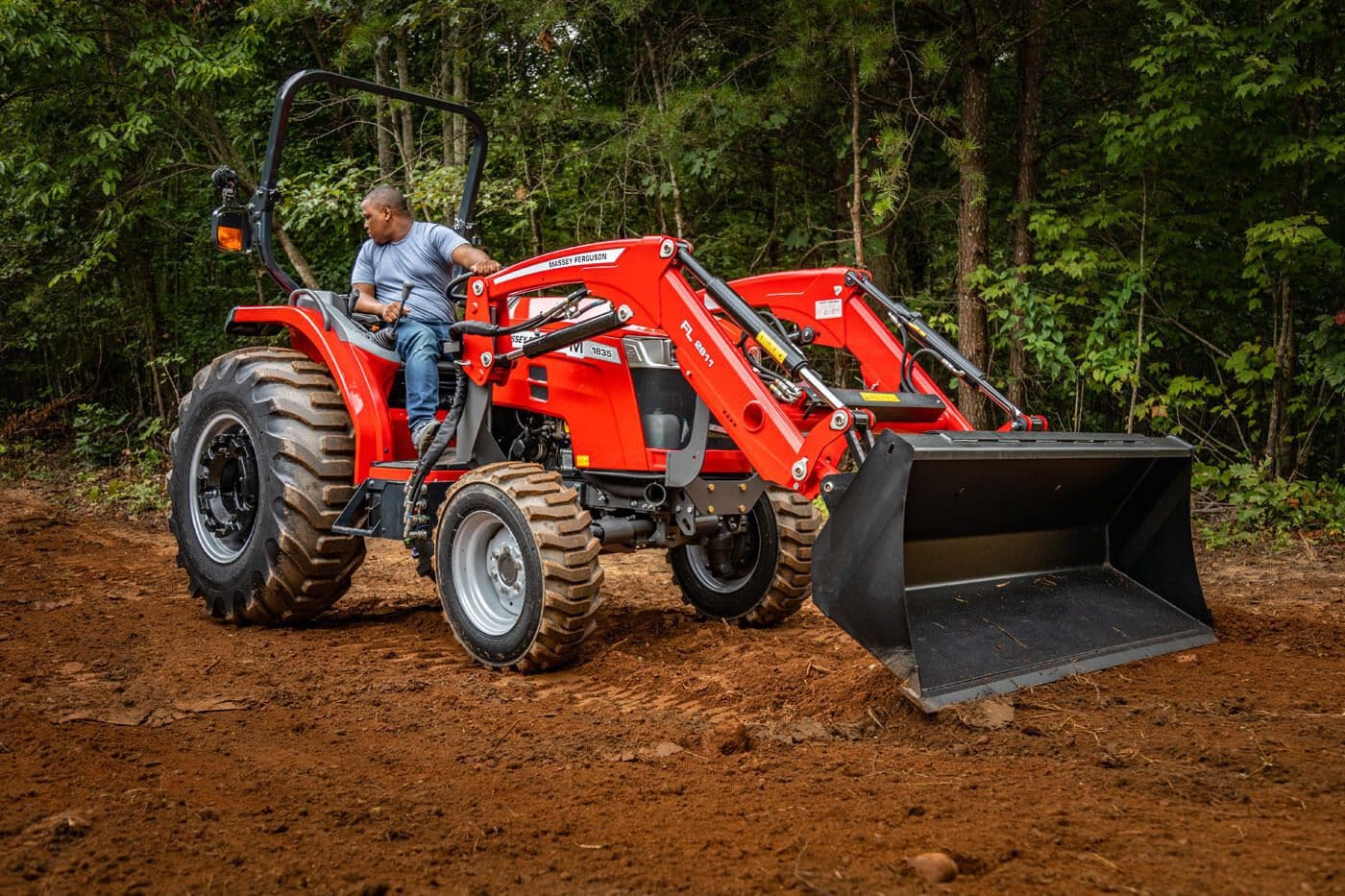
The FL2611 table in the 1M sheet distinguishes 1,870 lb at the pivot from 1,380 lb measured 19.5 inches forward, both at maximum height. The Canadian overview places the larger value under a forward-measurement heading. That discrepancy is a reason to use the detailed sheet for initial comparison and obtain the exact tractor-loader attachment documentation before approving a load.
For pallet work, describe the goods, packaging, pallet and fork assembly. Include the location of the load’s centre and the height at which it must be placed. A bag of feed close to the carriage and a bulky pallet projecting further forward do not present the same geometry. Subtracting fork mass from a pivot figure does not resolve the whole problem.
For bucket work, the receiver may be the deciding constraint. Measure the trailer side and where the material must land. A bucket can reach a useful height without having sufficient discharge clearance at the required location. Plan a demonstration with the actual receiver or reliable dimensions, using a permitted load and the prescribed tractor setup.
The loader capacity guide explains these measurements in more detail. Treat the 1M.35 as one complete handling system, including ballast and attachments, rather than an engine attached to a headline lifting number.
Build a rear-implement package, not a pile of compatible labels
Category 1 is useful connection information, but it does not settle implement mass, rearward projection, driveline travel or required front ballast. Start with the implement’s actual geometry. A long tool can create a very different clearance problem from a compact tool with similar weight.
Walk the storage-to-work route with the full combination in mind. Consider gate turns, a garden entrance and the room available to attach or park the tool. A quick hitch may simplify part of the changeover while moving the implement rearward. That changed arrangement must also suit the PTO driveline where one is fitted. The quick-hitch compatibility guide covers the checks that the category label cannot answer.
List hydraulic functions individually. A loader lift-and-curl circuit does not establish that a grapple clamp or hydraulic top link can be controlled. Pump flow, valve availability and attachment plumbing are different requirements. The implement-flow entry in the table should not be increased by adding the steering circuit’s flow.
Three useful Canadian work plans
Acreage mowing and garden work
Choose mowing equipment for the vegetation and desired finish, then evaluate the full route. Around trees or landscaped areas, a wider implement can save straight-line passes yet cost time in awkward corners. Record those interruptions during a representative demonstration. For garden work, the turning space beyond the plot and the condition of the soil belong in the assessment alongside PTO power.
The 1M.35 makes the strongest case here when the tools already fit its requirements and the chosen controls help the operator complete them comfortably. Paying for more engine power is not automatically useful if the limiting factor is access, tool width or repeated attachment changes.
Winter driveway clearing
Decide where snow will go before selecting a blade, bucket or blower. A narrow driveway with limited storage presents a different problem from a yard with room to pile snow. For a blower, confirm the exact mounting and drive system, chute controls and operator sightlines. Do not assume that rear PTO availability proves compatibility with an unspecified front system.
Compare the proposed station while wearing winter clothing. Assess pedal access, entry, rearward viewing and the installed heating and glass-clearing equipment. The purchase should address the recurring clearing routine, including later-season banks, rather than only an empty autumn driveway. Use the snowblower fitment guide when assembling the quote.
Material and property chores
For mulch, manure, soil and occasional deliveries, list the heaviest actual task separately from the most frequent light task. The loader package may be convenient for routine bucket work while a particular delivery still needs another unloading method. Arranging supplier unloading can be a rational part of an acreage equipment plan; it is not a reason to approve an unsupported tractor lift.
Storage and transport: measure the complete machine
The sheet lists a minimum tractor width of 1,715 mm. That is an initial screening dimension, not the width of every tyre setting or attachment. Measure the proposed machine with its bucket, mirrors and other protrusions, then allow appropriate working clearance for the route.
Cab and upright ROPS versions can have different height envelopes. Do not assume that the cab must be taller or that a folding structure makes every low opening suitable for normal operation. Identify the approved operating arrangement and measure the actual storage access, including lights and door hardware.
Published base weights differ between the overview and detailed sheet. This guide therefore does not use a single mass to approve a trailer. Include fuel, operator where applicable to the assessment, loader, tools, ballast and carried equipment in the real working or transport configuration. Verify the hauling arrangement against its own ratings and requirements.
Comparing the 1M.35 with alternatives
The immediate family comparison is the 1M.40. Its extra output is worth evaluating when it changes a documented implement match or a recurring power-limited task. Do not assume the upgrade increases every other capability.
The John Deere 3039R offers another configuration-led comparison. The useful question is which complete tractor, station and attachment package satisfies the task list. Brand preference can help choose between suitable offers, but it cannot resolve a missing hydraulic function or an incompatible tool.
Ownership and a used-machine inspection
For a used or demonstration tractor, verify that the identification actually says 1M.35. Record the transmission, station, loader and included implements separately. Obtain the applicable manuals and service history, then have a competent inspection evaluate the drivetrain, hydraulics, mounts, linkage, tyres and repairs. These are buying priorities, not claims that this model has recurring defects.
The documented engine includes exhaust aftertreatment. Establish the correct operating and maintenance instructions for that exact machine, review warning history and resolve active faults before purchase. Avoid borrowing regeneration procedures or service intervals from older Massey tractors because their names look similar.
Budget for required equipment as well as the tractor. Separate the loader, attachments, valves, ballast, delivery and identified service work. A low monthly payment can hide a package missing the implement that makes the purchase useful. Keep the completed configuration list with the invoice so future attachment purchases start from the machine actually owned.
1M.35 questions buyers ask
Is the 1M.35 the same model as an 1835M?
This guide covers the current 1M designation. Use the identification and applicable documentation for an older machine; a similar engine rating does not establish identical equipment or parts.
Does HST mean less work gets done?
Its published PTO rating differs, but completion time also depends on the job and controls. Compare a suitable complete package in representative work rather than converting the rating difference into a productivity percentage.
Can it handle every Category 1 tool?
No. Category, weight, geometry, power, driveline and required setup must all match.
Will buying the larger engine fix a pallet problem?
Only a verified change in the complete loader arrangement could answer that. Horsepower alone is not a pallet-capacity upgrade.
What would make this the right purchase?
A confirmed fit for the essential tools, a comfortable operating sequence and a complete price that leaves no necessary equipment to discover after delivery.
Share your experience
Help other Canadian buyers — leave a quick review for the
Massey Ferguson 1M.35
There are no reviews yet. Be the first one to write one.