
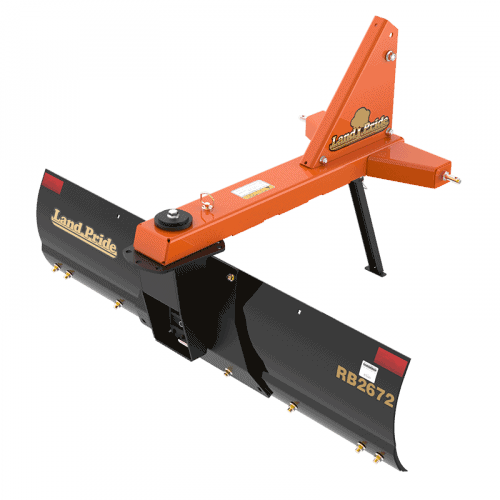
Overview & Specs
The Land Pride RB2672 is a six-foot rear blade for buyers who need the RB26 package rather than simply a wider cutting edge. Compared with the same-width RB1672 in the manufacturer’s shared specification, it brings a taller moldboard, greater approximate mass and a different tractor range. Those differences matter only when they suit the host tractor and the material-moving task.
For a Canadian acreage, begin with the job that is difficult today. Is the problem positioning material beside the tractor, repeatedly changing angle, containing a small quantity, or maintaining a consistent surface? The answer determines whether this blade, a different rear implement or another work method is worth considering.
On This Page
ToggleRB2672 and RB1672: what actually changes?
The September 28, 2018 RB16/RB26 specification provides a direct same-width comparison. It lists the RB2672 at approximately 369 lb with a 25–60-hp range, compared with 297 lb and 20–40 hp for the RB1672. The RB26 moldboard is 17½ inches tall and 5/16 inch thick, compared with 14 inches and ¼ inch for RB16.
Both are nominally 72-inch blades in that document. The change is therefore not extra straight-line width. It is a different implement package and matching range. Accessories can change the delivered mass and arrangement, so these base figures should remain tied to the cited configuration.
Do not translate the additional 72 lb into a guaranteed percentage improvement in grading. Weight, blade geometry, tractor traction, setup and material condition interact. The practical question is whether the complete RB2672 combination produces the required result under representative conditions.
The RB1672 guide covers the lighter same-width alternative. If that package already suits the tractor and recurring task, moving to RB26 needs a specific reason beyond a preference for a heavier model.
Describe the material movement before choosing adjustments
Sketch where material starts, where it should finish and where the tractor can travel. A rear blade is especially worth examining when the desired action involves directing material rather than simply carrying it inside a box. That sketch also exposes whether an offset position is useful or whether the route makes it awkward.
Separate shallow maintenance from a project that needs a designed grade or correction of an underlying problem. Repeatedly moving surface material cannot be assumed to repair drainage, a failing base or a recurring source of erosion. Establish the actual repair requirement before choosing an implement around the visible symptom.
For example, a maintained access lane with displaced loose material presents a different assignment from creating a new approach through unknown ground. The former may be an equipment-selection question; the latter may require site investigation and a broader project plan first.
Agree on an acceptance criterion that can be observed: material in the intended location, an appropriate finished profile or a clear route. A visually large windrow is not necessarily success if it is left where the next operation cannot use it.
Angle, offset and tilt solve different problems
The cited table identifies blade angling, a 12-inch offset in either direction and tilt positions up to 15 degrees either way. Those are available configuration limits, not recommended settings for every driveway. Follow the applicable manual and assess the actual arrangement.
Angle changes the blade’s plan-view orientation. Offset changes its lateral location relative to the tractor. Tilt changes the relative height of the ends. A buyer who needs one function frequently may have little need to change the others during a session.
Keep those distinctions on the quotation. The RB26 product page describes an optional hydraulic angling kit. That does not mean that tilt and offset are also hydraulically controlled or that the tractor already has the required control arrangement.
Count the adjustments in a representative job before valuing the option. A long straight session at one angle creates a different convenience case from a divided yard where the desired direction changes repeatedly. The useful accessory is the one that addresses the actual interruption.
Working coverage changes when the blade is angled
A six-foot nominal blade does not present six feet across the travel direction at every angle. In a simplified plan-view calculation, projected width equals blade length multiplied by the cosine of the angle. This is geometry, not a claim about the exact finished strip.
At 30 degrees, 72 inches projects to about 62.4 inches. At 45 degrees, it projects to about 50.9 inches. Actual working coverage also depends on overlap, offset and material behaviour, so use these figures to identify a question rather than to prescribe a pass pattern.
Suppose the tractor has an illustrative 60-inch outside tyre width. The straight blade is wider, while the simplified 45-degree projection is narrower. The owner must evaluate the intended angled routine rather than assume that the nominal width guarantees coverage of both tracks.
Offset can change where the working strip lies, but it does not restore the lost projected width. Likewise, a larger blade may solve one coverage problem while introducing a carrying or access problem. Compare the complete machine in its actual working position.
Side plates change retention, not the tool’s entire identity
The manufacturer’s RB26 page lists optional side plates as well as skid shoes. These accessories should be evaluated separately because they answer different questions: retaining material and controlling the relationship of the cutting edge to the surface are not the same function.
A side plate does not automatically turn a rear blade into a fully equivalent box scraper. Compare the actual shape, intended action and handling sequence with the required job. If the main objective is contained transfer from one nearby location to another, investigate a box scraper directly.
The BB1572 guide develops that alternative. For recurring dressing of a sound gravel surface, the GS1572 guide provides another mechanism to consider. Similar improvements in appearance can result from materially different working methods.
List accessories by exact part or kit on the offer. A photograph with plates, shoes or a cylinder is not proof that the advertised base price includes them. Include installation, necessary controls and any change to storage dimensions.
Respect the complete tractor match
The listed horsepower range includes an upper limit. More tractor power is not automatically an advantage, and a Category 1 connection alone does not establish suitability. Preserve the manufacturer’s power terminology rather than substituting a different rating to make the tractor appear to fit.
Within the stated range, check lifting geometry, ballast guidance, clearances and the intended use. Include fitted accessories and any quick hitch. The base implement mass is a useful input, not a complete description of how the combination behaves.
Check the rearward envelope in turns and transport. The tractor may clear a post while the blade’s far end approaches it. A property with narrow gates or closely spaced buildings can make an otherwise suitable six-foot blade inconvenient.
Aglist’s quick-hitch guide explains the broader fitment process. Use the exact blade, hitch and tractor identities. Do not borrow a serial-specific compatibility claim from another series or an apparently similar used implement.
Summer shaping and winter clearing deserve separate trials
If the buying case includes snow work, evaluate the winter route independently from the summer grading job. Decide where snow can be placed as the season progresses and whether the operator can carry out the prescribed routine comfortably with adequate visibility.
A route that is open early in the season may become constrained later. Include that development in the equipment plan rather than assuming the first clearing demonstrates the whole winter. Surface obstacles and permitted operating conditions also need assessment.
For summer work, judge the achieved material placement and profile. A satisfactory snow-clearing impression does not establish grading suitability, just as a good gravel demonstration does not answer winter access and visibility questions.
Keep expectations specific to the site. There is no universal rear-blade setting that can be recommended for every Canadian driveway. The January 16, 2024 operator manual should guide the applicable setup and operation.
Value adjustment convenience with observed work
Use your own workload to compare manual and powered angle adjustment. As an invented illustration, suppose ten adjustment interruptions per session each take two minutes under the correct stopped procedure. That represents twenty minutes in the session before considering any alternative arrangement.
If a properly installed system reduces that total by an assumed fifteen minutes and the job occurs sixteen times a year, the assumed annual difference is four hours. Those numbers are not measured RB2672 performance. They show the scale of the question that a demonstration or work log can answer.
Convenience may still justify an option when the time saving is modest. State the benefit honestly and compare the full cost of the kit, controls and upkeep. Avoid inventing an hourly payback to support a preference for easier adjustment.
Also include changeover and storage. An implement that requires moving several other tools before every use can lose more time than the hydraulic option saves. A practical parking location is part of the equipment system.
Used inspection: assess the adjustment structure
Confirm model identity, the fitted options and the manual that applies. Inspect the moldboard, edge, frame, hitch, pivots and locking hardware. Distortion or missing retention components can affect the very adjustability that makes the blade attractive.
Check adjustments using the prescribed secured procedure. Identify binding, excessive movement or evidence of alterations and obtain a competent assessment where necessary. These are general inspection priorities, not claims of recurring RB2672 defects.
If hydraulic angling is fitted, identify the kit and inspect the cylinder, hoses and connections as a complete installation. A cylinder added by a previous owner is not automatically equivalent to the documented option.
Price the ready-to-work package. Include identified wear parts, missing accessory hardware, required tractor equipment and delivery. A used offer should not be compared with a new complete package as though every visible attachment in the seller’s photograph is supplied and serviceable.
At handover, retain a list of the supplied adjustment parts and accessory hardware. It prevents a later repair or conversion from being planned around equipment that was shown in a brochure but never included with this particular blade.
Final buying questions
Is RB2672 wider than RB1672?
Both have a nominal 72-inch blade in the cited shared table. The comparison concerns the heavier RB26 package and different tractor range, not extra nominal width.
Does extra weight guarantee better grading?
No. The material, tractor, setup and required result must be assessed together. Weight alone is not a performance test.
Does hydraulic angle include hydraulic tilt?
No. Identify each supplied function separately. A powered angling option does not establish powered control of every adjustment.
Can side plates replace a dedicated box scraper?
They can change retention, but the complete mechanism and work sequence still differ. Compare the actual task rather than assigning equivalence from one accessory.
Who benefits most from the RB2672?
An owner with a correctly matched tractor and recurring work that uses the RB26 configuration and adjustments. A heavier purchase is justified by a demonstrated task, not merely by the next number in the range.
Share your experience
Help other Canadian buyers — leave a quick review for the
Land Pride RB2672
There are no reviews yet. Be the first one to write one.
