Overview & Specs
The KIOTI CK4020 is the higher-output choice in the base CK2620/CK3520/CK4020 compact-tractor group. Its strongest buying case is an identified need for more PTO power while retaining the working footprint of that family. It is a less convincing upgrade when the unresolved requirement is a heavier rear implement, a larger loader payload or additional room for the operator.
For a Canadian acreage or small farm, this distinction matters because the most expensive task is not always the task that needs the most horsepower. A mower may need more shaft output, while a delivery pallet may need a different handling arrangement altogether. Define both jobs before deciding that the highest engine number in the group is the right answer.
On This Page
ToggleCK4020 specifications and model boundaries
This guide covers the North American base manual CK4020. The CK4020H hydrostatic version and CK4020SE family should be identified separately in a quotation. Do not combine the base tractor’s price with another version’s controls or station equipment.
| Item | Published figure | Decision it supports |
|---|---|---|
| Engine output | 39.6 hp | Engine comparison within the family |
| Manual PTO output | 34.8 hp | Driven-implement power screening |
| CK4020H PTO output | 33.3 hp | Version-specific HST matching |
| Rear PTO speed | 540 rpm | Drive-speed compatibility |
| Rear hitch rating | 1,631 lb at 24 inches aft of hitch | Carrying assessment with geometry retained |
| Wheelbase | 65.75 inches in the brochure | Basic footprint comparison |
| Minimum-tread width | Approximately 54.5 inches | Starting point for actual access measurements |
The Canadian CK4020 page and February 2025 CK20 brochure are the manufacturer references. The base manual transmission is listed as 9F/3R in the brochure but 12F/12R on the webpage. Resolve that conflict with the documentation for the tractor being sold; neither a family photograph nor the SE gear specification settles it.
What the extra output buys
Relative to the manual CK3520’s published 30.9 PTO hp, the manual CK4020’s 34.8 figure is 3.9 hp higher, about 12.6 percent. That is a comparison of ratings, not a measured increase in field productivity. It can matter when a suitable implement’s requirements or the recurring workload justify the additional output.
It should not be interpreted as permission to increase every attachment width by the same percentage. Implement design, vegetation or soil conditions, carrying requirements and appropriate travel speed affect the combination. A wider tool may also need more turning space or create a different transport problem.
Begin with the exact implement requirement. If a hypothetical tool requires at least 35 PTO hp, neither the manual nor HST figure passes that initial screen. Rounding the engine label to “40 hp” does not change the answer. Select another approved combination instead of treating a small shortfall as automatically acceptable.
The PTO horsepower explanation provides a matching framework. This is especially useful for used equipment, where a seller may remember the engine rating of the previous tractor but not its actual PTO output or configuration.
A power upgrade is not necessarily a chassis upgrade
The cited brochure gives the same wheelbase and rear hitch rating for the three base CK models discussed here. That makes it important to distinguish a power requirement from a carrying requirement. The CK4020 should not be assumed to solve a rear-tool problem simply because its hood carries the largest number.
Imagine an owner who already has sufficient power for a mower but wants to carry a longer, heavier implement. The next information needed is the implement’s mass distribution, mounting and required tractor configuration. Another few horsepower does not answer those questions. A different tool, hitch arrangement or tractor class may be needed.
The same reasoning applies at the front. Loader capacity depends on the specific loader and attachment arrangement, load position, height and required setup. If pallet handling is the reason for shopping, organise the purchase around the pallet task. The loader capacity guide explains how to preserve those conditions.
Vegetation management: make the finish part of the specification
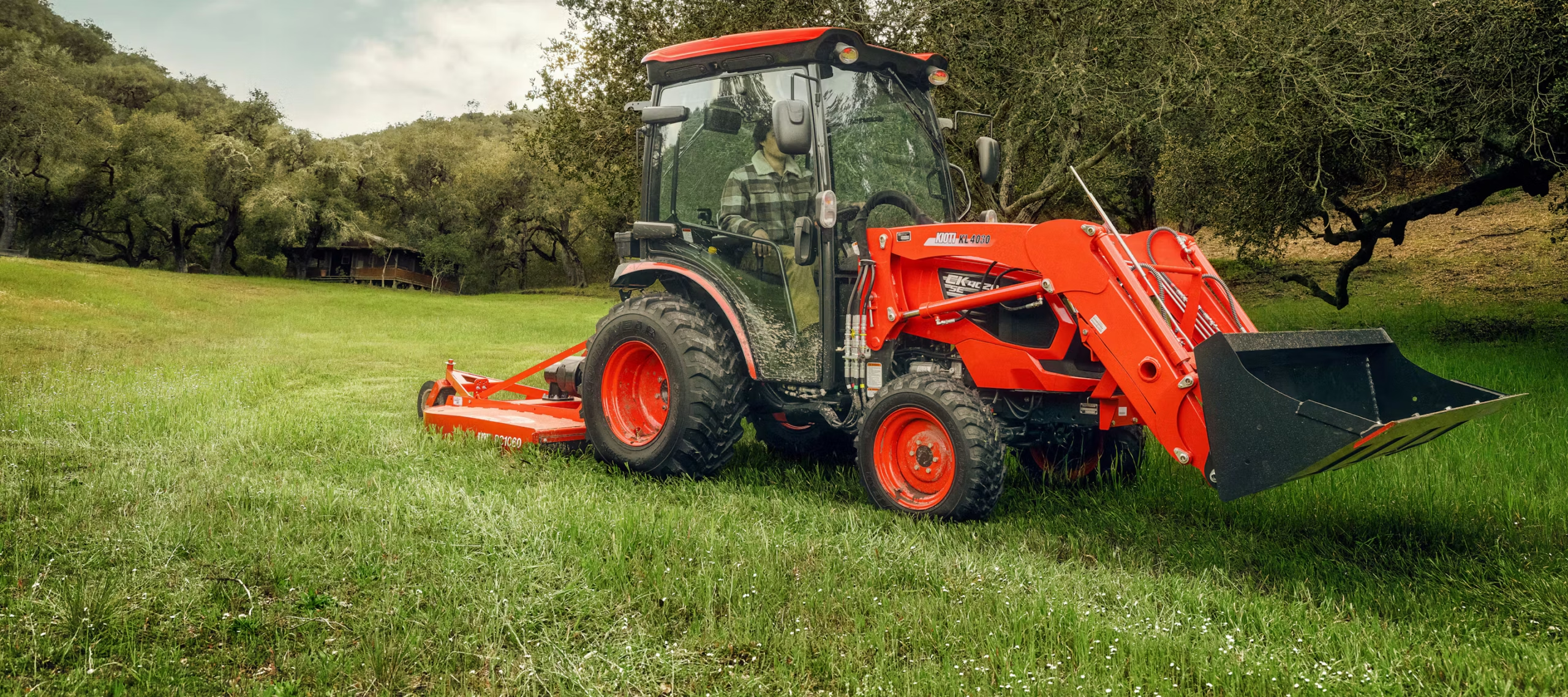
For mowing or rough vegetation work, define what the implement will encounter and the result expected. Maintained grass around buildings and rough growth along a boundary are different duties. Selecting an implement designed for the material comes before selecting the tractor to power it.
Once the tool type is appropriate, consider the maintained area, available time and obstacles. A large open section can reward a wider approved tool. A route broken by trees, buildings and narrow entrances may reward manoeuvrability and convenient changeover instead. The total number of acres does not describe this difference.
A useful demonstration includes representative material and the expected finish. Record the appropriate working pace and interruptions separately. If the operator slows mainly to avoid obstacles, additional power may have little effect on completion time. If processing the material is the constraint within an approved setup, the higher output may be more valuable.
Avoid treating one easy pass as evidence of all-season capability. Growth, moisture and maintenance condition change the task. The decision should be based on the recurring demanding work that the implement is intended to handle, without deliberately overloading equipment as a test.
Tilling and other rear-tool work
A tiller requires more than a compatible PTO speed. Confirm the manufacturer’s tractor power range, mounting, driveline and carrying requirements, then consider the soil preparation task. Established garden maintenance differs from initial work on unfamiliar ground.
The CK4020’s additional output may widen the set of tools that pass an initial power screen, but tool suitability still determines the useful result. A heavy or long implement can impose a carrying problem even when shaft power is adequate. A quick hitch or other adapter also changes the complete geometry.
For non-powered rear tools, identify what the tractor must actually provide. Traction, weight distribution, appropriate setup and operator control can matter more than the engine rating once sufficient power is available. More output is not a substitute for choosing the right tool for the ground condition.
Choose the transmission around repetitions
Transmission choice should reflect the actions repeated throughout the job. A long steady pass, frequent loader reversals and precise positioning beside a building create different demands. The CK4020H’s lower listed PTO output is one factor, not a complete verdict on the HST option.
Make a small task log: minutes spent travelling steadily, number of direction changes, time looking rearward, and frequency of fine positioning. It need not be elaborate. Its purpose is to prevent the most memorable occasional job from dominating a purchase that will spend most of its hours doing something else.
Test each candidate using the correct operating procedure. Verify the manual tractor’s actual gear arrangement before evaluating it, and assess the HST version’s range and pedal controls with the intended operator. Aglist’s transmission comparison provides a broader discussion of these tradeoffs.
Access, storage and the complete machine
A shared basic footprint can make the CK4020 attractive when a larger chassis would complicate the property layout. However, the listed tractor dimensions do not include every loader, bucket, rear implement or tyre arrangement. Measure the exact package and the space it needs to turn.
Map the route from storage to each working area. Include gates, roof overhangs, low branches, tight turns and the place where tools will be parked. A rear implement projecting beyond the tractor can change the turning envelope substantially. The straight-line gate measurement is only one part of the route.
If transporting the machine, establish actual equipped mass and dimensions rather than selecting a trailer from bare tractor weight. Include attachments and ballast that will travel with it, and verify the entire transport arrangement. Do not turn an approximate brochure weight into a payload allowance.
Canadian winter work and practical preparation
For snow clearing, higher shaft output is useful only within a complete compatible attachment package. A blower needs the correct mounting, drive and controls. A blade needs an appropriate working arrangement and a place for accumulated snow. Site layout can remain the controlling constraint even when engine power is ample.
Consider the operator’s direction of travel and visibility. A rear-mounted system can involve repeated rearward observation, while a front system has its own mounting and access implications. Have the actual routine demonstrated before buying accessories based on a catalogue photo.
Cold-weather preparation belongs in the ownership plan. Use the correct manual for fluids, fuel, starting and any approved heating equipment. Identify the installed engine and emissions controls and follow their instructions. No universal winter starting temperature, warm-up duration or fluid grade is assumed here.
Arrange summer-tool storage so winter equipment can be fitted without moving everything outside in poor conditions. A stable, accessible parking location and complete mounting hardware can make seasonal changeover far more predictable.
Does the power premium pay for itself?
Use a real equipped price difference and observed time savings when possible. For an illustration only, suppose one package costs CAD 2,400 more and is expected to save 12 minutes on each of 30 annual jobs. The assumed saving is six hours per year. At an assumed value of CAD 40 per hour, that is CAD 240 annually and a simple ten-year price-difference recovery.
Those are invented inputs, not market prices or tested CK4020 savings. The calculation excludes financing, fuel, maintenance and resale. Its value is in exposing the assumptions. If the time saving is smaller, the argument weakens; if the extra output enables an essential approved tool that otherwise cannot be used, simple minutes may not capture the benefit.
Also distinguish operator time from elapsed time. A quicker pass does not save its full duration if preparation and cleanup remain unchanged. Conversely, avoiding an additional equipment rental may have value beyond the minutes spent operating. Put those benefits into separate rows so they are not counted twice.
Buying used and comparing alternatives
Confirm whether the machine is CK4020, CK4020H or an SE variant. Match the manuals and supplied equipment to that identity. Examine service records and inspect control operation, guards, mounting points, hoses and attachment connections. An independent assessment is useful where repairs or unusual behaviour need explanation.
Do not infer condition from low hours alone. Storage, maintenance, previous equipment and the quality of repairs matter. Equally, this guide does not claim a recurring CK4020 fault or a guaranteed operating life without supporting evidence. Price the issues found on the particular machine.
For alternatives, compare a lower-output CK package when all mandatory tasks already fit, or a different tractor class when carrying and handling remain unresolved. Aglist’s Kubota L2502 and John Deere 3025E pages can start a lower-output compact comparison. Use their manufacturers’ exact current configurations before making a specification judgement.
Frequently asked questions
Does “40 hp” mean 40 PTO hp?
No. The engine and PTO ratings are different, and the transmission version changes the published PTO figure.
Is the CK4020 automatically the best loader tractor in this group?
Not from engine output alone. Compare the actual loader, attachment and required load arrangement.
Will extra power make a heavy rear tool compatible?
No. Carrying, geometry, clearance and configuration remain separate requirements.
Can I use the webpage’s gear count without further checking?
The dated brochure and webpage conflict. Resolve the specification for the actual machine before using it to plan work or compare quotations.
Who has the clearest reason to choose the CK4020?
A buyer with a verified recurring PTO workload that benefits from the higher output, while the complete tractor and attachment package already meets access, carrying and handling requirements.
Share your experience
Help other Canadian buyers — leave a quick review for the
KIOTI CK4020
There are no reviews yet. Be the first one to write one.