Overview & Specs
John Deere 850 Specs, Reviews & Used Price Canada (2026)
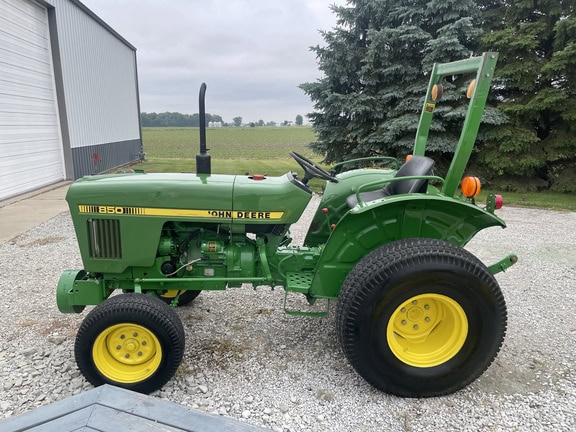
The John Deere 850 is where John Deere’s compact tractor story begins. Launched in 1978 alongside the larger 950, it was one of the first two compact utility tractors Deere ever sold — built in Japan by Yanmar as Deere’s answer to the small diesel tractors then winning North American acreages. It runs a 25 HP Yanmar 3T80-J three-cylinder diesel through an 8F/2R gear transmission, was offered in 2WD and 4WD (MFWD), and was independently tested at the Nebraska Tractor Test Laboratory at 22.27 PTO horsepower. Production ran from 1978 to 1989, and nearly five decades later these tractors are still doing daily chores across Canada.
Status disclosure up front: the 850 is long discontinued — its successor was the 870 (1989–1998) — and everything on this page is written for the used buyer. Like every tractor of its era, the 850 predates emissions equipment entirely: no DPF, no DEF, no electronics. That simplicity, plus a Yanmar diesel with a near-legendary durability record, is why clean 850s still change hands quickly.
Aglist quick take: The 850 is the archetypal “grandfather’s compact” — mechanically honest, cheap to keep, and genuinely capable within its 22 PTO HP. The honest framing: this is a 45-plus-year-old machine with dry shoe brakes, an unsynchronized gearbox, and a known dislike of cold mornings without a block heater. The single most important thing a used buyer needs to know is the 1984 split: earlier 850s have a transmission-driven PTO, while 1984-and-later units (serial 16001 up) gained a continuous-live PTO via a two-stage clutch — a real difference in daily usability that most listings never mention.
On This Page
ToggleQuick Verdict — Who the 850 Is For
Buy it if: you want an inexpensive, dead-simple 25 HP diesel for mowing, box blading, small-field chores, and light loader duty, you can service your own machine, and CAD $6,000–$14,000 is your budget instead of $25,000+ for a modern sub-compact. A 1984-or-later unit with live PTO — ideally MFWD with a loader — is the configuration worth hunting for.
Skip it if: you need loader-heavy productivity (a hydrostatic compact earns its price there), a cab for winter hours, or plug-and-play parts convenience — sheet metal and some trim pieces take patience to source on a tractor this old. If your work justifies a modern machine, the John Deere 2025R is today’s closest equivalent in spirit and size.
Full John Deere 850 Specifications
Compiled from John Deere technical literature and Nebraska Tractor Test 1280 (conducted June 12–21, 1978), cross-checked against reference databases. Configurations changed across the 1978–1989 run — verify the setup on any specific unit.
| Category | Spec | Value |
|---|---|---|
| Equipment type | Compact utility tractor | Built by Yanmar (Japan) for John Deere |
| Production | Model years | 1978–1989 |
| Historical note | Position | One of John Deere’s first two compact utility tractors (with the 950) |
| Engine | Model | Yanmar 3T80-J, 3-cyl liquid-cooled diesel |
| Displacement | 78 cu in (1.3 L); 80 mm bore × 85 mm stroke | |
| Rated power | 25 HP (18.6 kW) @ 2,600 rpm | |
| Compression | 21.2:1 | |
| Tested power | PTO (Nebraska Test 1280) | 22.27 HP |
| Drawbar (Nebraska Test 1280) | 18.9 HP | |
| Emissions | Aftertreatment | None — pre-emissions era (no DPF, no DEF) |
| Transmission | Type | 8F/2R gear, unsynchronized |
| Clutch | Dry disc, 8.3 in. | |
| Top speed | 11.7 mph (18.8 km/h) | |
| Drive | Options | 2WD standard; MFWD (4WD) optional |
| Steering | Type | Manual; power steering optional |
| Brakes | Type | Differential mechanical expanding shoe |
| Hydraulics | Type | Open centre, 2,030 psi; approx. 5 gal system (varies by year) |
| 3-point hitch | Category | 1 |
| Rear PTO | Speed | 540 rpm @ 2,258 engine rpm |
| Through MY 1983 | Transmission-driven | |
| MY 1984+ (s/n 16001 up) | Continuous-live via two-stage clutch | |
| Fuel | Tank | 8.5 gal (32.3 L) |
| Cooling | Capacity | 6 qt (5.7 L) |
| Electrical | System | 12 V, negative ground |
| Weight | Approx. | 2,350–2,400 lb |
| Dimensions | Wheelbase / length / width | 64 in. / 117.7 in. / 53.3 in. |
| Tires | Standard | 5.00-15 front, 11.2-24 rear; 9.5-24 ag and turf options |
| Attachments | Offered | Front-end loader, 72-in. mid-mount mower deck, blades |
| Operator station | Type | Open station, 2-post ROPS |
| Original price | Late production | Approx. USD $10,157 |
| Successor | Model | John Deere 870 (1989–1998) |
The 1984 PTO split is the spec that matters. Through model year 1983 the 850’s PTO is transmission-driven — the implement stops when you clutch. From 1984 (tractor serial number 16001), a two-stage clutch delivers continuous-live PTO: half-pedal stops ground travel, full pedal stops everything. For mowing and snowblowing this is a genuine usability difference, and later units deserve their price premium. The serial number plate sits at the rear of the tractor, below the PTO shaft.
Owner Reviews & Ratings on Aglist
A 1978 spec sheet is a starting point; forty-five Canadian winters are the real test. As owners share their experience on Aglist, the rating system tracks:
- Reliability — the 3T80-J’s longevity, cold-start behaviour, electrical condition at this age
- Transmission and clutch — gear engagement, and two-stage clutch wear on live-PTO units
- Loader performance — real-world handling with period JD or Buhler/Allied loaders
- Parts and service — what’s still easy to source, what takes hunting
- Value for money — cost per year of ownership on a 45-year-old machine
If you own or have run an 850 in Canada, please leave a star rating and a short note below — long-term feedback on a machine this age is exactly what a used buyer cannot get from any spec database.
John Deere 850 vs the Alternatives
The 850’s real cross-shop is its own family: the bigger 950 from the same launch, and the later 790 that closed out the Yanmar-gear-tractor line.
| Spec | John Deere 850 | John Deere 950 | John Deere 790 |
|---|---|---|---|
| Years | 1978–1989 | 1978–1989 | 2000–2007 |
| Gross HP | 25 | 31 | 30 |
| PTO HP | 22.27 (Nebraska tested) | ~27 (Nebraska tested) | 26 (claimed) |
| Transmission | 8F/2R gear | 8F/2R gear | 8F/2R gear |
| Live PTO | From MY 1984 (s/n 16001) | From MY 1984 | Standard on MFWD |
| Emissions | None | None | None |
| Typical Canadian price | CAD $6,000–$14,000 | Modest premium over 850 | CAD $10,000–$20,000 |
Where the 850 wins: entry price and simplicity. It is usually the cheapest way into a real diesel compact with a Category 1 hitch and 540 PTO, and its parts commonality with the wider Yanmar family keeps wear items affordable. For mowing, gardens, and light chores on a few acres, 22 PTO HP is honestly enough.
Where the math flips: the 950 carries the same chassis philosophy with roughly five more PTO horsepower — the better pick if a 5-ft rotary cutter or tiller is your main implement. The John Deere 790 offers the same gear-drive simplicity two decades newer, typically with lower hours and easier parts. And if the work justifies new equipment, the modern John Deere 2025R is the closest current equivalent — hydrostatic, warrantied, and roughly triple the outlay of a good 850.
Real-World Performance
Engine
The Yanmar 3T80-J is the reason so many 850s survive: an understressed, mechanically injected three-cylinder that runs on clean fuel and regular oil changes essentially indefinitely. Nebraska’s 1978 test put 22.27 HP at the PTO shaft and 18.9 at the drawbar — and at roughly 2,400 lb the 850 puts an unusually high share of its power to the ground, which is why it out-pulls garden tractors with bigger engine numbers on paper.
Transmission & Drive
Eight forward and two reverse gears through an unsynchronized box: stop, clutch, shift. The 8.3-in. dry disc clutch is a wear item — on live-PTO units especially, a soft or grabby two-stage clutch is the most common ownership complaint, and a clutch job is the repair to budget for on a high-hour unit. MFWD versions add front traction that transforms loader and snow work; 2WD units with manual steering are fine for mowing and hitch work but heavy going with a loaded bucket.
Loader & Hitch Work
Period John Deere loaders (the 80 appears on many units) fit the 850, and on the Prairies you’ll just as often find Buhler or Allied aftermarket loaders — Manitoba-built and common on Western Canadian tractors of this era. The loader model materially affects value and parts availability, so identify it before pricing a unit. The Category 1 hitch handles box blades, 4-ft rotary cutters, tillers, and rear blades comfortably within the 22 PTO HP envelope, and a 72-in. mid-mount mower deck was offered for turf duty.
Canadian Winters
Cold starting is the 850’s honest weak point — this era of Yanmar wants a block heater below freezing, full stop. Canadian listings say it plainly (“starts well in the cold — plugged in”). With winter-blend diesel, a healthy battery, and the plug-in habit, an 850 with a rear blower or blade remains a perfectly serviceable driveway machine. It is an open-station tractor: for extended winter hours, dress for it — our prairie winter equipment operation guide covers cold-weather setup that applies directly.
Common Problems & Reliability Notes
Transparency note: these are patterns reported across the ownership base of a 45-year-old machine, not confirmed defects. Condition varies enormously unit to unit.
Cold-start reluctance. The most-reported complaint. A working block heater, sound glow circuit, healthy battery, and winter fuel solve most of it; a unit that won’t fire when plugged in needs diagnosis, not hope.
Two-stage clutch wear (1984+ live-PTO units). The feature that makes later 850s desirable is also their main wear point. On a test drive, check for clean engagement at both pedal stages; a clutch replacement is a known, priceable job — use it in negotiation.
Unsynchronized shifting wear. Gears forced on the move eventually chip. Every gear should engage cleanly from a stop; grinding or popping out of gear is a red flag.
Mechanical shoe brakes. Serviceable but age-sensitive — check adjustment and side-to-side evenness, and expect to go through them on any neglected unit.
Age-related electrics and sheet metal. Wiring, switches, and gauges are at the age where gremlins appear, and body panels or trim can take patience to source. Mechanical parts, by contrast, remain well supported through Deere and the Yanmar aftermarket.
The core endures. There is no pattern of engine or driveline failure on maintained 850s. The machines that die are the ones left outside with water in the fuel — not the ones worked hard and serviced.
Used Price Range in Canada (2026)
The 850 trades in a wide band because condition varies from parts-tractor to restored. Indicative Canadian ranges:
- Project or high-hour 2WD units: roughly CAD $4,000–$7,000
- Solid running 2WD, straight and serviced: roughly CAD $7,000–$10,000 — the middle of the market
- MFWD and/or loader-equipped, live PTO (1984+): roughly CAD $10,000–$15,000
- Exceptional low-hour or rebuilt units: above that — rebuilt-engine 4WD examples command real money
North American dealer data shows most listings clustering in the mid-single-digit thousands (USD), with averages around $7,800 — Canadian pricing runs proportionally, with MFWD, a loader, and the post-1984 live PTO being the three features that move value most. Units surface on AgDealer, MarketBook, Kijiji, and farm auctions; Prairie supply is steady.
Best Use Cases in Canadian Conditions
Small-acreage chores (SK / AB / MB). Mowing, box blading, gravel maintenance, garden work — the 850’s home ground for four decades. Hobby and heritage farms. A second tractor that costs little to own and nothing to depreciate. Mowing. The 72-in. mid-mount deck or a 4-ft rear rotary cutter within its 22 PTO HP. Snow duty. Rear blower or blade on driveways and yards — with the block-heater habit. Not ideal for: loader-cycle-intensive work, sustained 5–6 ft implement duty (step to the 950 or 790), or anyone who needs modern parts convenience and a cab.
Maintenance & Service
- Daily: engine oil, coolant, air cleaner element, tire pressure, grease points
- Per the operator’s manual: engine oil and filter, fuel filter, hydraulic/transmission fluid on schedule; keep fuel scrupulously clean and water-free on a mechanical-injection diesel
- Gear drive: clutch free-play and shoe-brake adjustment are routine owner jobs
- Age items: wiring condition, gauge function, ROPS hardware, tire age-cracking
- Winter: block heater (non-negotiable), winter-blend diesel, battery load-tested each fall
Engine and driveline parts remain well supported through John Deere dealers and the broad Yanmar aftermarket; overhaul kits for the 3T80-J are still readily produced.
Where to Find a Used John Deere 850 in Canada
850s appear steadily on AgDealer, MarketBook, and Kijiji, and regularly at farm auctions across the Prairies. Inspection priorities for any unit: decode the year from the serial plate (rear of tractor, below the PTO shaft) to confirm whether it’s a live-PTO 1984+ machine; test both stages of the clutch pedal on live-PTO units; shift every gear from a stop; verify cold-start behaviour honestly (ask them not to pre-warm it, or check for a working block heater); identify the loader make and model; check brake adjustment and steering play; and look for fuel-system neglect — water separators and filter condition tell you how the tractor lived. A serviced, live-PTO MFWD unit is worth stretching for over a cheaper early 2WD.
John Deere 850 FAQ
How much horsepower does the John Deere 850 have? 25 gross HP from a Yanmar 3T80-J three-cylinder diesel, with 22.27 PTO HP and 18.9 drawbar HP as independently measured in Nebraska Tractor Test 1280 (1978).
What years was the John Deere 850 made? 1978 to 1989, built in Japan by Yanmar for John Deere. It launched alongside the 950 as one of Deere’s first two compact utility tractors.
Does the John Deere 850 have a live PTO? Depends on the year. Through model year 1983 the PTO is transmission-driven. From 1984 (tractor serial number 16001 and up), a two-stage clutch provides continuous-live PTO — the more desirable configuration for mowing and snowblowing.
What transmission does the 850 use? An 8-forward, 2-reverse unsynchronized gear transmission with an 8.3-in. dry disc clutch. You stop to shift.
What loader fits a John Deere 850? Period John Deere loaders such as the 80 appear on many units, and Canadian-market 850s very commonly wear Buhler or Allied aftermarket loaders. The loader model affects mounting, hydraulics, and value — identify it before agreeing on price.
Does the 850 have a DPF or need DEF? No — it predates emissions equipment entirely. No particulate filter, no regeneration cycles, no DEF, no engine electronics.
How much does a used John Deere 850 cost in Canada? Roughly CAD $4,000–$7,000 for project or high-hour units, CAD $7,000–$10,000 for solid running 2WD tractors, and CAD $10,000–$15,000 for MFWD or loader-equipped live-PTO machines, as of 2026. Condition moves price more than hours.
John Deere 850 vs 950 — which should I choose? Same era, same layout, same launch: the 950 simply carries about five more PTO horsepower. Choose the 850 for mowing and light chores at the lowest entry price; choose the 950 if a 5-ft rotary cutter or tiller is your main implement. Condition and the 1984+ live PTO matter more than the badge.
Related Models on Aglist
- John Deere 790 — the last of the Yanmar gear-drive compacts (2000–2007), newer used alternative
- John Deere 2025R — the modern 2 Family equivalent, new alternative
- John Deere 1025R — modern sub-compact alternative, also DPF-free
- Kubota B2601 — cross-brand 24 HP alternative
- All tractors on Aglist — full tractor coverage
Disclaimer
Specifications compiled from John Deere technical literature and Nebraska Tractor Test 1280 (June 1978), cross-checked against reference sources; configurations varied over the 1978–1989 production run, including the 1984 change to a continuous-live PTO at serial number 16001. The John Deere 850 is a discontinued model — availability is limited to the used market, and pricing reflects indicative Canadian ranges that vary by region, condition, hours, and configuration. Reviews on Aglist are written by real users and moderated for spam — opinions are personal. Always confirm specifications and condition against the operator’s manual, a serial-number decode, and a physical inspection before committing to any specific machine.
John Deere 850 Reviews & Ratings
Share your experience
Help other Canadian buyers — leave a quick review for the
John Deere 850
There are no reviews yet. Be the first one to write one.