Overview & Specs
John Deere 750 Specs, Reviews & Used Price Canada (2026)
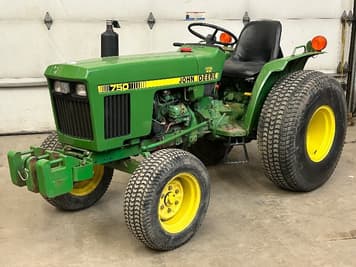
The John Deere 750 is a Yanmar-built compact utility tractor sold from 1981 to 1989 — 20 horsepower from a 1.3 L three-cylinder diesel, an 8F/2R gear transmission, a Category 1 hitch, and 2WD or 4WD (MFWD) in a package weighing well under a tonne. One naming note before anything else: this page covers the compact tractor. John Deere also used “750” for its famous no-till grain drill and “750” appears on Deere crawler dozers — different machines entirely. The tractor on this page is the small green diesel that has been mowing Canadian acreages since the Trudeau Sr. era.
Status disclosure up front: the 750 is long discontinued — its successor was the 770 (1989–1998) — and everything here is written for the used buyer. Like all of Deere’s Yanmar-era compacts, it predates emissions equipment completely: no DPF, no DEF, no electronics. It was independently tested at the Nebraska Tractor Test Laboratory at 18.54 PTO horsepower, and an honest disclosure that matters for cross-shopping: its engine is the same 1.3 L Yanmar three-cylinder architecture as the bigger John Deere 850’s — identical bore and stroke — simply rated lower, at 20 HP @ 2,400 rpm versus the 850’s 25 HP @ 2,600 rpm.
Aglist quick take: The 750 is the sweet spot of the small Yanmar Deeres — enough tractor for a 60-in. mower, a 4-ft tiller, or the JD 67 loader, small enough to sneak through a garden gate. The honest framing: 18.5 PTO HP is genuinely modest, the rear PTO is transmission-driven on this model (plan on an overrunning clutch coupler for rotary cutters), and 2WD units have manual steering. Buy it as a nimble chore-and-mowing tractor, not a loader workhorse — and if your implements are 5-ft class, the 850 is the same tractor with more lungs.
On This Page
ToggleQuick Verdict — Who the 750 Is For
Buy it if: you want a small, simple, cold-war-durable diesel for mowing, tilling, box blading, and garden work on 2–15 acres, at roughly CAD $6,000–$12,000 instead of $22,000+ for a modern sub-compact. A 4WD unit with the JD 67 loader — or a mid-mount deck plus the 59-in. front snowblower — is the configuration Canadian acreages actually use.
Skip it if: your main job is loader work (the 750 is light and 2WD steering is manual — a hydrostatic sub-compact or the 850/790 serve better), you run 5-ft PTO implements regularly (that’s 850 territory), or you need live PTO — on the 750 the rear PTO is transmission-driven, full stop. Today’s closest equivalent in spirit is the John Deere 1025R.
Full John Deere 750 Specifications
Compiled from John Deere technical literature and Nebraska Tractor Test 1504 (conducted October 31 – November 10, 1983), cross-checked against reference databases. Verify configuration on any specific used unit.
| Category | Spec | Value |
|---|---|---|
| Equipment type | Compact utility tractor | Built by Yanmar (Japan) for John Deere |
| Production | Model years | 1981–1989 |
| Engine | Model | Yanmar 3T80, 3-cyl liquid-cooled diesel |
| Displacement | 78.2 cu in (1.3 L); 80 mm bore × 85 mm stroke | |
| Rated power | 20 HP (14.9 kW) @ 2,400 rpm | |
| Compression | 22.5:1 | |
| Family note | Same 1.3 L architecture as the John Deere 850’s engine, in a lower-rated tune | |
| Tested power | PTO (Nebraska Test 1504) | 18.54 HP |
| Drawbar (Nebraska Test 1504) | 15.30 HP | |
| Emissions | Aftertreatment | None — pre-emissions era (no DPF, no DEF) |
| Transmission | Type | 8F/2R gear (two-range), unsynchronized, dry disc clutch |
| Drive | Options | 2WD standard; MFWD (4WD) optional |
| Steering | Type | Manual; power steering optional |
| Brakes | Type | Differential mechanical dry, internal expanding shoe |
| Hydraulics | Type | Open centre, 2,030 psi; approx. 3.75 gal system |
| 3-point hitch | Category | 1 |
| Rear PTO | Type / speed | Transmission-driven, 540 rpm |
| Mid PTO | Availability | On mid-mount-mower-equipped units |
| Front PTO | Availability | Optional (front snowblower drive) |
| Fuel | Tank | 6.2 gal (23.5 L) |
| Cooling | Capacity | 4.7 qt (4.4 L) |
| Weight | Shipping | Approx. 1,700 lb (2WD); approx. 1,900 lb (4WD); more as equipped |
| Dimensions | Wheelbase / length / width | 61.1 in. / 112 in. / ~45 in. |
| Tires | Standard | 4.00-15 front (2WD; 4WD fronts larger), 9.5-24 rear; turf options |
| Front loader | Factory match | John Deere 67 (quick-tach) |
| Mower | Mid-mount | John Deere 160, 60-in. 3-blade deck |
| Snow equipment | Offered | 59-in. front snowblower (front PTO), blades |
| Operator station | Type | Open station, 2-post ROPS |
| Original price | Range | USD $7,070 (1983) to $10,000 (1989) |
| Successor | Model | John Deere 770 (1989–1998) |
The engine-family disclosure, plainly: Deere’s 750 and 850 use the same basic Yanmar 1.3 L three-cylinder — the 750 rated at 20 HP @ 2,400 rpm, the 850 at 25 HP @ 2,600 rpm. If you’re deciding between them, you’re mostly choosing a power rating and hitch capacity, not a different machine. That’s worth knowing before paying an 850 premium for 750-class work — or buying a 750 for jobs that need the 850’s tune.
Owner Reviews & Ratings on Aglist
Nebraska measured what a new 750 did in 1983. Canadian owners know what a forty-year-old one does now. As owners share their experience on Aglist, the rating system tracks:
- Reliability — the 3T80’s longevity, cold-start behaviour, fuel-system condition
- Transmission and clutch — gear engagement and clutch slip on high-hour units
- Implement performance — real-world mowing with the 160 deck, tiller and cutter duty at 18.5 PTO HP
- Parts and service — what’s easy to source, what takes hunting on a 1980s compact
- Value for money — cost per year of ownership
If you own or have run a 750 in Canada, please leave a star rating and a short note below — this is the information no spec database can offer a used buyer.
John Deere 750 vs the Alternatives
The 750 sits between its little brother from the same 1981 launch and the 850 it shares an engine family with.
| Spec | John Deere 750 | John Deere 650 | John Deere 850 |
|---|---|---|---|
| Years | 1981–1989 | 1981–1989 | 1978–1989 |
| Gross HP | 20 | 14.5 | 25 |
| PTO HP | 18.54 (Nebraska tested) | ~12.5 | 22.27 (Nebraska tested) |
| Transmission | 8F/2R gear | 8F/2R gear | 8F/2R gear |
| Rear PTO | Transmission-driven | Transmission-driven | Live two-stage from MY 1984 |
| Weight (2WD) | ~1,700 lb | Lighter | ~2,350 lb |
| Typical Canadian price | CAD $5,000–$12,000 | Similar, slightly less | CAD $6,000–$14,000 |
Where the 750 wins: the size-to-capability ratio. It runs a real 60-in. mid-mount deck, a Category 1 hitch, and a proper loader while staying light and narrow enough for gardens, orchard rows, and small barns — jobs where the 850 starts feeling wide and the 650 starts feeling short of breath.
Where the math flips: the John Deere 850 carries five more PTO horsepower on the same engine architecture and, from 1984, a continuous-live PTO the 750 never offered — worth real money if mowing and snowblowing are your life. And the later John Deere 790 delivers the same gear-drive philosophy two decades newer. If the work justifies new equipment, the modern John Deere 1025R is today’s hydrostatic equivalent at roughly triple a good 750’s price.
Real-World Performance
Engine
The derated tune is the secret to the 3T80’s longevity in the 750: an understressed 1.3 L spinning to only 2,400 rpm simply doesn’t wear out with clean fuel and oil changes. Owners routinely run 4-ft tillers and cutters at part throttle. The mechanical injection system is durable but exacting — it wants water-free fuel and correct timing, and a unit that’s had amateur fuel-system work needs a careful look.
Transmission & PTO — the part to understand
Eight forward, two reverse, stop to shift — standard Yanmar-Deere practice. What’s specific to the 750 (and 650) is the rear PTO: it is transmission-driven across the entire production run. Clutch in, and the PTO stops with the wheels — and here’s the catch every new owner learns once: a heavy spinning implement like a rotary cutter will then drive the tractor forward through the PTO. The fix is a $60–$100 overrunning clutch coupler on the PTO shaft — consider it mandatory equipment for rotary cutter work on this tractor. Mid-mount-mower units add a mid PTO, and an optional front PTO drove the snowblower.
Loader & Hitch Work
The John Deere 67 quick-tach loader is the factory match, typically wearing a 55-in. bucket — sized honestly for mulch, gravel, and snow rather than round bales. On a light 1,700-lb 2WD tractor with manual steering, a full bucket is real exercise; the MFWD version with optional power steering is the loader configuration worth seeking. The Category 1 hitch handles box blades, 4-ft cutters and tillers, rear blades, and small implements comfortably within 18.5 PTO HP.
Canadian Winters
The classic Canadian 750 setup is the 59-in. front-PTO snowblower with turf tires and chains — a genuinely capable driveway machine to this day. Cold starts are this generation’s known weakness: a block heater is effectively mandatory (Canadian listings even flag its absence as a warning), along with winter-blend diesel and a strong battery. It’s an open-station tractor, so dress for the work — our prairie winter equipment operation guide applies directly.
Common Problems & Reliability Notes
Transparency note: these are patterns reported across a 40-year-old ownership base, not confirmed defects. Condition varies enormously unit to unit.
Cold-start reluctance. The most-reported issue. Block heater, healthy glow circuit, strong battery, winter fuel — a 750 that won’t fire when plugged in needs diagnosis, not optimism.
Clutch slip on worn units. Reported as “transmission slippage” in owner feedback — usually the dry clutch reaching the end of its life. Test under load on a hill; a clutch job is a known, priceable repair to negotiate around.
Hydraulic seepage. Minor leaks at the pump, steering circuit (power-steering units), and rockshaft are the typical age items. Weeping is normal at this age; dripping is a negotiation point.
Fuel-system sensitivity. Mechanical injection rewards clean fuel and punishes water and amateur timing work. Check filter condition and ask about injection-pump history.
Manual-steering fatigue and light front end. Not defects — physics. Loader work on a 2WD unit is heavy going; front weights or a ballast box help hitch-work steering.
The core endures. No pattern of engine or driveline failure exists on maintained 750s. Parts for engine and driveline remain well supported through Deere and the Yanmar aftermarket; sheet metal takes more patience.
Used Price Range in Canada (2026)
The 750 trades a step below the 850, with configuration driving value. Indicative Canadian ranges:
- Project or rough 2WD units: roughly CAD $4,000–$6,500
- Solid running 2WD, serviced: roughly CAD $6,500–$9,500 — the heart of the market
- MFWD, loader- or blower-equipped, lower hours: roughly CAD $9,500–$14,000
- Low-hour survivors (sub-1,000 hours) with the 67 loader command the top of the range
US dealer data shows most listings between $5,400 and $8,900 with averages around $7,200 — Canadian pricing runs proportionally, with 4WD, power steering, and a loader or front blower being the value-movers. Supply is steady on AgDealer, MarketBook, Kijiji, and at farm auctions; Quebec and Ontario dealers list them regularly alongside Prairie units.
Best Use Cases in Canadian Conditions
Small-acreage mowing and grounds (SK / AB / MB / ON). The 160 mid-mount deck on 2–10 acres of turf is the 750’s signature job. Gardens, orchards, and tight yards. Narrow, light, and short — where bigger compacts don’t fit. Snow duty. The 59-in. front blower or a rear blade on driveways, with the block-heater habit. Light loader chores. Mulch, gravel, snow with the 67 loader — MFWD strongly preferred. Hobby farms. A cheap-to-own second tractor. Not ideal for: loader-intensive work, 5-ft-plus PTO implements (step to the 850), rotary cutter work without an overrunning clutch, or anyone needing a cab.
Maintenance & Service
- Daily: engine oil, coolant, air cleaner, tire pressure, grease points
- Every 50 hours: engine oil and filter, grease all fittings, check the air element
- Every 200–400 hours: fuel filter, transmission/hydraulic fluid and filter, belts and hoses
- Fuel discipline: clean, water-free diesel is non-negotiable on mechanical injection
- Winter: block heater, winter-blend fuel, battery load-tested each fall
- PTO safety: fit an overrunning clutch coupler before running any rotary cutter
Engine and driveline parts remain readily available through John Deere dealers and the broad Yanmar aftermarket.
Where to Find a Used John Deere 750 in Canada
750s surface steadily on AgDealer, MarketBook, and Kijiji, and at farm auctions across the country. Inspection priorities: confirm 2WD vs MFWD and whether power steering is fitted; identify the loader (the JD 67 quick-tach carries value) or mower/blower equipment; test the clutch under load and shift every gear from a stop; verify honest cold-start behaviour and check for a block heater; look for water in the fuel system and injection-pump tampering; and check rear-tire condition — 9.5-24s are an easy cost to forget. A serviced MFWD unit with the 67 loader or the front blower is worth stretching for.
John Deere 750 FAQ
How much horsepower does the John Deere 750 have? 20 gross HP from a Yanmar 3T80 three-cylinder diesel, with 18.54 PTO HP and 15.30 drawbar HP as independently measured in Nebraska Tractor Test 1504 (1983).
Is this the same John Deere 750 as the no-till drill? No — Deere reused the number. The 750 grain drill and 750-series dozers are entirely different machines. This page covers the 1981–1989 Yanmar-built compact utility tractor.
Does the John Deere 750 have a live PTO? No. The rear PTO is transmission-driven across the entire production run — it stops when you clutch. For rotary cutter work, fit an overrunning clutch coupler on the PTO shaft so a spinning implement can’t push the tractor.
Is the 750’s engine the same as the 850’s? Same 1.3 L Yanmar three-cylinder architecture with identical bore and stroke — the 750 is rated at 20 HP @ 2,400 rpm, the 850 at 25 HP @ 2,600 rpm. You’re choosing a tune and hitch class, not a different machine.
What loader fits a John Deere 750? The John Deere 67 quick-tach loader is the factory match, typically with a 55-in. bucket. Aftermarket loaders appear on some units — identify what’s fitted before pricing.
Can the 750 blow snow? Yes — a 59-in. front-mount snowblower ran off the optional front PTO, and rear blowers and blades work off the Category 1 hitch. It remains a popular Canadian driveway setup.
How much does a used John Deere 750 cost in Canada? Roughly CAD $4,000–$6,500 for rough units, CAD $6,500–$9,500 for solid running 2WD tractors, and CAD $9,500–$14,000 for MFWD machines with a loader or blower, as of 2026.
John Deere 750 vs 850 — which should I choose? The 750 for mowing, gardens, and tight spaces at the lowest cost; the 850 for 5-ft implements, loader work, and (on 1984+ units) live PTO. Same engine family — pick the rating that matches your implements.
Related Models on Aglist
- John Deere 850 — same engine family, more power, live PTO from 1984
- John Deere 790 — the last Yanmar gear-drive compact (2000–2007), newer used alternative
- John Deere 1025R — the modern sub-compact equivalent, new alternative
- Kubota B2601 — cross-brand modern alternative
- All tractors on Aglist — full tractor coverage
Disclaimer
Specifications compiled from John Deere technical literature and Nebraska Tractor Test 1504 (October–November 1983), cross-checked against reference sources; configurations varied over the 1981–1989 production run. The John Deere 750 is a discontinued model — availability is limited to the used market, and pricing reflects indicative Canadian ranges that vary by region, condition, hours, and configuration. Reviews on Aglist are written by real users and moderated for spam — opinions are personal. Always confirm specifications and condition against the operator’s manual, a serial-number decode, and a physical inspection before committing to any specific machine.
John Deere 750 Reviews & Ratings
Share your experience
Help other Canadian buyers — leave a quick review for the
John Deere 750
There are no reviews yet. Be the first one to write one.