Overview & Specs
The Cat 306 CR deserves a close look when the work involves more than occasional digging: repeated excavation, handling suitable material with matched attachments, and moving between several tasks on a property or contract. For a Canadian buyer, its value depends on whether the complete configuration improves that workflow without creating an impractical transport or service requirement.
There is an important specification issue to resolve before purchase. Caterpillar’s North American model page and its 2026 European family chart show different weight ranges. This guide keeps the model-page configuration separate and does not present its range as a universal weight for every 306 CR. The machine’s serial number and actual installed equipment remain essential.
On This Page
ToggleCat 306 CR specifications: read the configuration notes
The following figures are from the North American 306 CR product page.
| Item | Model-page value |
|---|---|
| Engine; net power at 2,200 rpm | C2.4 Turbo; 41.7 kW / 55.9 hp |
| Track width | 1,980 mm |
| Cab operating weight range | 6,470–7,150 kg |
| Depth, standard / long stick | 3,710 / 4,110 mm |
| Ground reach, standard / long | 6,130 / 6,535 mm |
| Stick force, standard / long | 29.5 / 26.5 kN |
| Primary auxiliary flow | 90 L/min |
| Rear radius, without / with counterweight | 1,350 / 1,475 mm |
That weight table excludes the bucket and describes fixed-blade configurations. The page lists straight blade, angle blade and Extra Tool Carrier choices. These are equipment decisions, not features to assume on every sale machine.
Why the market and configuration matter
The 2026 European Cat mini excavator family chart lists a different weight range for its market and popular configurations. Those figures should not replace the North American model-page data. Obtain documentation for the particular machine and weigh the actual transport package where needed.
This is a practical buying issue rather than a reason to abandon the model. It means a seller’s short advertisement should not become the basis of trailer selection or an attachment calculation. Record the exact machine, configuration and source used for each decision.
When comparing two offers, keep their equipment lists beside their weight information. A difference may reflect tracks, arm, counterweight, blade or other provisions. Until those are identified, a lighter quoted number does not necessarily represent an equivalent package.
Describe the work that justifies a 306 CR
A useful buyer brief begins with recurring tasks and their constraints. For a farm property, that could involve approved excavation projects, handling selected material and maintaining developed areas. For a contractor, it may be a series of jobs where a smaller machine’s envelope or tool package causes repeated delays.
Identify the actual limitation. If it is reach from a suitable position, compare working-range drawings. If it is a powered attachment, compare the configured hydraulic system. If it is waiting for soil removal, evaluate the supporting equipment. These are different problems and should not all be answered by buying more machine.
A larger recurring workload can justify investing in a more complete package, but occasional exceptional jobs may still be better hired out. Divide the expected schedule into suitable work, work requiring support and work requiring another solution. That exposes the real role the excavator will have.
Keep access width separate from working clearance
The base width does not describe all the space needed to operate. Measure the actual blade and equipment, then review the route’s turns, overhead restrictions and supporting ground. Entry into the site and operation within it are separate pass-or-fail questions.
At the proposed work position, include rear rotation, boom and attachment movement, material placement and other machinery. Counterweight configuration matters to the applicable dimensional information. A compact-radius design does not make the rear irrelevant.
For a rural owner, the critical restriction may be a route between buildings rather than an entrance gate. For a contractor, it may be a receiving truck occupying the space needed for a useful swing. Sketch the entire arrangement so that successful entry is not mistaken for a workable job.
Standard versus long stick for repeated work
The longer stick changes the available envelope. It can be useful where the work must be reached from a constrained but suitable position. Where the regular task lies well within the standard envelope, compare the matching force figures and a representative digging cycle before paying for reach that contributes little.
Use the intended bucket in the comparison. Its mass, shape and any coupler affect the complete equipment arrangement. The bucket must cut, fill, curl, clear and discharge; simply touching the deepest required point does not establish a productive task.
Depth and horizontal reach must be read together on the correct drawing. They are not independent maximums that can be combined into a rectangular work area. Aglist’s depth and reach guide provides a method for organizing that assessment.
Do not solve an inadequate envelope by improvising a machine position near an excavation or structure. Suitable positions come from the site plan; equipment selection determines what can work from those positions.
Blade and Extra Tool Carrier choices
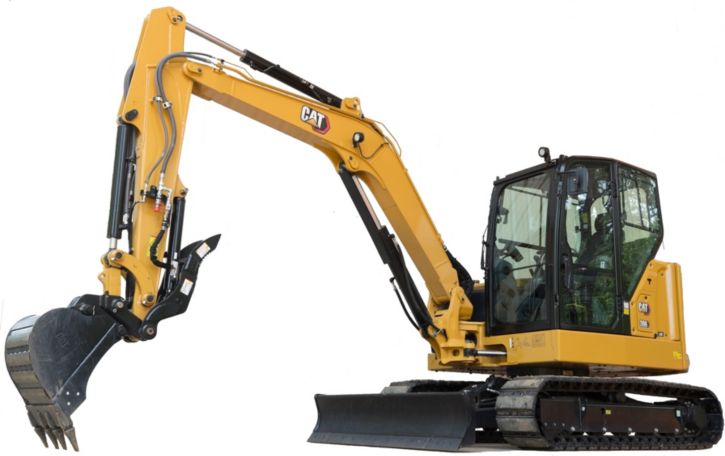
Ask which front-underframe arrangement is actually offered and what work it is intended to support. The standard-looking blade in a photograph does not tell you whether an advertised package has an angle function or a different carrier arrangement.
If considering an Extra Tool Carrier configuration, obtain its specific attachment compatibility, operating information and weight documentation. Do not assume it accepts every tool from another machine simply because the name suggests versatility. A useful option must have a defined role in your actual work.
Compare complete methods. If the goal is reducing the number of supporting machines, demonstrate all relevant stages rather than only showing that a tool can be attached. Include the time and space needed for changes, material handling and finishing.
For a buyer whose jobs are mostly bucket excavation, additional equipment may offer little return. For another buyer, a demonstrated task-specific arrangement could be central. The distinction comes from the work plan, not a universal ranking of options.
Hydraulic tools and multiple functions
Start with the tool’s documented operating requirements, including accepted flow, pressure, return restrictions and controls. Match those to the circuit installed on the actual 306 CR. The published flow is a screening value, not an approval of any attachment with a similar carrier-class label.
Where the operator needs another hydraulic function as well, establish how each is supplied and controlled. A thumb, tilt function or another accessory can alter the circuit requirement. Visible hoses alone cannot confirm that the intended combination is complete.
For frequent powered-tool use, request a representative demonstration with the intended installation. Observe the task as a whole, including the movements required while the tool operates. Keep the conditions recorded so the comparison is not reduced to an unsupported claim of smoother or faster hydraulics.
Installation and commissioning belong in the purchase cost. A lower-priced tool may need additional machine provisions, while a more complete package may already include them. Compare delivered, usable combinations.
Material handling: grip, reach and lifting are different limits
A bucket-and-thumb arrangement can help control suitable irregular objects, but gripping ability does not establish lifting capacity. Use the applicable machine and attachment information for the operation. Do not substitute bucket breakout force or maximum reach for a load chart.
Identify the intended material in the buying brief. Shape, mass and required placement all matter. A tool suitable for one category of objects may be poorly matched to another, and an attachment that can physically close around an object does not prove the entire operation is appropriate.
Include tool mass and geometry as required by the relevant documentation. Review the arrangement again when equipment changes. A previous assessment for a lighter bucket should not silently become the basis for a heavier attachment package.
Build a realistic equipment-utilization record
A contractor comparing ownership choices can divide scheduled time into excavation, attachment work, finishing, travel and waiting. Use actual job records if available. This shows which part of the package creates value and which part remains idle.
For example, a hypothetical week with 12 hours of excavation and 8 hours of material handling has a different equipment priority from one with 20 hours of uninterrupted digging. Neither pattern establishes a particular machine’s suitability by itself, but each gives the demonstration a clear purpose.
Count supporting labour and equipment too. If a machine change saves digging time but introduces a second transport trip, the net result may be smaller than expected. Purchase comparisons should end with the completed job and all necessary moves accounted for.
Canadian seasons, storage and service
Assess the installed operator environment against the real schedule. Cab condition, visibility and climate functions can matter when work extends into poor weather. Test what is fitted; a model-page feature list should not substitute for inspection of a used machine.
Use the serial-specific manual for maintenance, fluids and starting guidance. Arrange routine parts and service access before the machine becomes essential to booked work. Remote-property ownership may require a different support plan from operation near a service location.
Keep records of attachments and configuration changes beside the maintenance log. They help establish what information applies when ordering parts, checking transport or evaluating a new task. Seasonal storage should follow the relevant instructions rather than generic advice carried over from another excavator.
Transport: resolve the actual package
The market and configuration differences make a complete load assessment especially important. Establish the documented equipment configuration, then account for the fitted and separately carried tools without adding components twice. If the load is close to a transport constraint, obtain an appropriate actual weighing assessment.
Check the trailer’s usable payload and dimensions, individual ratings, tow vehicle, hitch and load distribution, together with applicable requirements. The word “mini” does not establish suitability for a particular hauling setup.
For occasional movement, obtain a transport quote. For frequent transfers, include loading and travel time, supporting equipment and scheduling in the business case. A machine that is productive on site can still be impractical if moving it consumes an excessive share of the working day.
Used Cat 306 CR inspection
Begin with serial identity and an itemized configuration list. Verify the arm, counterweight, tracks, operator enclosure, blade or carrier arrangement, coupler and hydraulic provisions. Investigate undocumented modifications before assigning them value.
Have a competent inspector assess structural condition, undercarriage wear, joints and hydraulics. Observe a proper cold start and warmed-up representative operation. Warning messages, unusual movement or leakage need diagnosis, not a guess based on the model’s reputation.
Obtain repair estimates and identify which attachments are included. This is an assessment of the individual machine; it does not imply a known recurring fault pattern. Records and a demonstrated usable package can be more informative than an hour reading alone.
Alternatives and purchase priorities
Use the Bobcat E60 and Kubota KX057-5 as other catalogue starting points. Verify their exact offered configurations before comparing data.
Reject candidates that fail an essential task or access requirement. Among the suitable packages, compare condition, support, operator environment and total ownership logistics. Resolve the actual configuration before letting price decide.
Frequently asked questions
Which published weight should I use?
Use information tied to the actual serial and equipment package, and establish the complete carried load. The differing official ranges should not be averaged or treated as interchangeable.
Does XTC mean any loader attachment fits?
No. Obtain the specific carrier compatibility and operating information. A broad product name does not establish mounting, hydraulic or load suitability.
Is the long stick always worth buying?
It is useful when the recurring task needs its envelope. Otherwise compare the standard configuration’s complete digging cycle and matching force information.
Can a thumb increase lifting capacity?
It can improve control of suitable material, but it does not create additional rated lifting capacity. Use the applicable load and attachment information.
What is the best demonstration for this machine?
One that reproduces the intended excavation, attachment and material-handling sequence with the actual equipment package, while recording waiting and repositioning as well as active work.
Share your experience
Help other Canadian buyers — leave a quick review for the
Cat 306 CR
There are no reviews yet. Be the first one to write one.