Overview & Specs
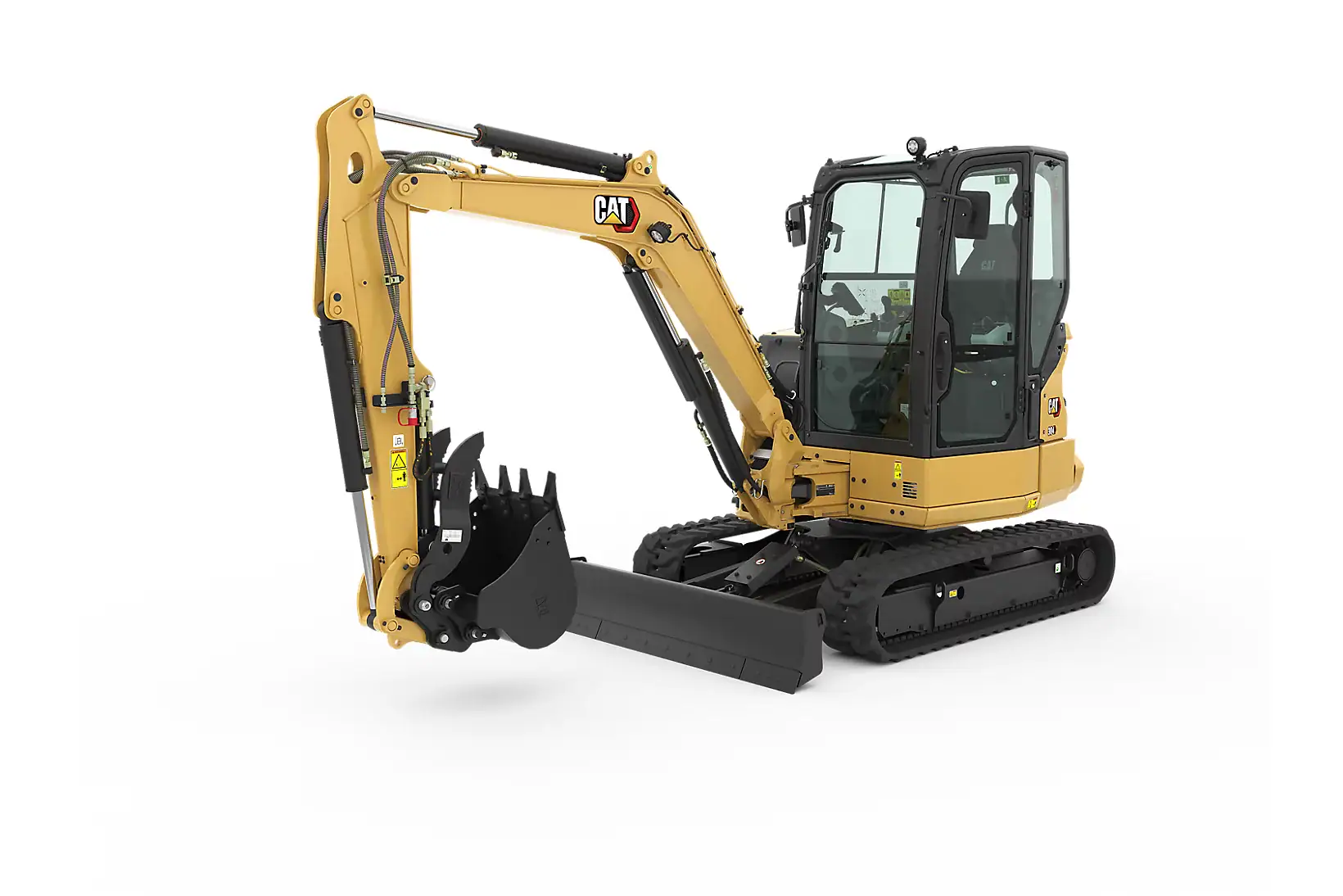
The Cat 304 is worth considering when a contractor needs more excavation capability than a very small access machine, but the route into the property still rules out a broad equipment package. Its useful buying question is whether the combination of a relatively narrow base and a larger working envelope improves the completed job. That includes access preparation, excavation, backfilling and restoration, not only the time spent filling buckets.
For Canadian acreage and landscape work, the 304 can be assessed as a primary excavator for suitable recurring jobs or as an access-conscious addition to a fleet. The guide below covers the North American C1.7 Turbo configuration documented by Caterpillar. It does not transfer these figures to older 304 CR, C, D or E-series advertisements simply because their names contain the same number.
On This Page
ToggleCat 304 specifications and configuration boundaries
Selected figures from the official Cat 304 product page:
| Item | Published specification |
|---|---|
| Engine; net power | C1.7 Turbo; 33.6 kW / 45 hp |
| Track width | 1,700 mm |
| Canopy operating weight range | 3,925–4,375 kg |
| Cab operating weight range | 4,025–4,475 kg |
| Depth, standard / long stick | 3,210 / 3,510 mm |
| Ground reach, standard / long | 5,200 / 5,445 mm |
| Rear radius, without / with counterweight | 1,205 / 1,300 mm |
| Stick force, standard / long | 21 / 19.2 kN |
The weight configurations exclude the bucket. An angle blade is optional. The product page’s auxiliary-flow row contains inconsistent metric and US units, so this guide does not use it to approve hydraulic attachments.
The most useful reason to shortlist the 304
Picture a hypothetical contractor working on established properties. A tiny machine gets through most entrances but may spend too much time repositioning on the regular excavation tasks. A larger candidate improves digging but requires expensive access alterations. The 304 deserves a measured comparison between those extremes rather than being selected from its class label alone.
Start with the jobs that appear repeatedly in the schedule. Write down the actual entrance restrictions, required work shape and material destination. Then identify which part of the current method costs time. If the delay is mostly waiting for a carrier to remove soil, another excavator may not solve it. If it is repeated repositioning within a suitable site layout, a different envelope might.
A property owner should make the same distinction between recurring work and a single major project. Owning around the largest one-time task can leave an unnecessarily demanding transport and maintenance arrangement afterwards. Compare a machine for regular work plus hired equipment for the exception.
Narrow tracks do not mean a narrow operating circle
The width and rear-radius figures belong on different parts of a site sketch. One describes the base passing through an opening; the other describes the rear of the rotating structure. A machine can fit down a route and still need substantially more room at its operating position.
Measure the real route, including latches, turns, overhangs and anything projecting into the path. Check the blade and fitted tools as well as the tracks. An opening with the same nominal measurement as the machine is not a practical clearance plan.
At the work area, include the front attachment path, rear sweep, material stockpile and vehicle movements. Identify the actual counterweight configuration before using a dimensional drawing. Do not infer that the shortest radius applies to a machine fitted with additional equipment.
This is particularly important when quoting restoration work. A machine that avoids removing a fence may still require protection or an alternative material route. Put those requirements into the project estimate rather than treating successful entry as proof that the entire site works.
Standard and long stick: buy useful working room
The long stick is valuable when its geometry reaches an area that matters to the regular job. It is not an automatic upgrade for every owner. Compare the force information and complete working-range drawing with the standard configuration, especially when bucket digging dominates the schedule.
On a shallow landscaping task, maximum depth may never be approached. Control of the cut, a suitable bucket and an efficient spoil arrangement can contribute more than extra reach. A different task with a restricted but appropriate machine position may give reach much greater value.
Plot required horizontal distance and depth together. Maximum ground reach is not available at maximum depth, and touching a point is different from cutting and removing material there. The bucket needs room to fill, curl and clear the excavation.
Aglist’s guide to excavator depth and reach explains that distinction in more detail. Use the correct drawing for the offered machine and attachment; where the task approaches a limit, a representative demonstration is more useful than optimistic arithmetic.
Consider the blade as part of the project method
A buyer who performs excavation and restoration should consider how material will be returned and surfaces finished. The blade decision belongs in that discussion. The optional angle arrangement may deserve a demonstration where repeated backfilling or material direction is important, but it should solve a named task rather than simply increase the equipment list.
Compare the intended blade configurations on similar work. Observe visibility, positioning and the number of passes required to achieve the specified result. Do not assume an excavator blade replaces every function of a separate grading machine or loader.
For a used machine, inspect the blade structure, joints, cylinders and any angle mechanism as part of the equipment assessment. A configuration premium is justified only when the installed system is suitable and functions properly. Obtain repair estimates for deficiencies before comparing the package with another offer.
Choose buckets by excavation and restoration requirements
A bucket package should follow the actual cut and material. Buying the widest available tool because it appears to carry more can create unnecessary excavation, more material to remove and additional restoration. Conversely, an unnecessarily narrow tool can add passes where a wider compatible bucket would suit the work.
Identify the digging and finishing tasks separately. Record each bucket’s dimensions, mass and mounting, then verify its suitability with the carrier and coupler. Pin diameter alone cannot establish a complete match; spacing, widths and linkage geometry also belong in the compatibility check.
Think about the order of work. If the job changes between digging and finishing frequently, attachment changes become part of the production method. Demonstrate the approved change procedure and assess where unused tools can be stored without blocking the route.
Price used attachments as individual items. A bundle containing several worn or incompatible buckets is not necessarily better value than a smaller, verified package. Include cutting-edge, tooth and locking-system condition in the purchase assessment.
Hydraulic tools: resolve the requirement before the purchase
For a powered attachment, obtain its acceptable flow, pressure, return and control requirements. Match those to confirmed information for the exact machine and installed circuit. The conflicting auxiliary units on the public specification page are a reason to obtain reliable configuration documentation, not a reason to select whichever number suits the tool.
Also check carrier mass, guarding and the attachment manufacturer’s approved use. A physically mountable tool is not automatically a suitable installation. If the attachment is central to the business, make a demonstrated compatible package part of the written quotation.
A thumb or other additional function can introduce another control requirement. Document what operates each function and what happens when changing tools. Avoid assuming that visible hoses prove the machine has every circuit or setting required for the proposed combination.
A project-cost comparison that reveals the real tradeoff
Use measured or quoted inputs for a real purchase. As an illustrative example, suppose one equipment arrangement saves 45 minutes of access preparation and 30 minutes of restoration on each of ten similar jobs. The combined saving would be 750 minutes, or 12.5 hours. Those are hypothetical values, not measured Cat results.
The example shows why entry and restoration deserve attention beside digging speed. It does not prove which excavator is cheaper. Tool costs, machine hire or ownership, transport, support equipment and the quality of the finished work still have to be included.
Record a complete trial job when possible. Separate active excavation, waiting, repositioning, attachment changes and finishing. That record helps determine whether the 304’s particular package solves the business problem or whether the next investment should be elsewhere.
Canadian ownership and transport planning
Match the operator environment to the months and conditions in which work is actually scheduled. A canopy can suit some planned work, while an enclosed machine may have greater value where weather delays affect coordinated jobs. Test the actual enclosure, visibility and installed climate equipment rather than assuming a generic cab description is enough.
Use the correct serial-specific manual for fluids, starting procedures and maintenance. Establish where the machine will be stored and serviced, and how parts and repairs will be handled locally. These arrangements are particularly important when the machine works far from support.
For transport, reconcile the machine’s documented weight with its fitted equipment. Include the bucket, coupler, additional tools and other cargo when not already accounted for. Avoid treating the model number or minimum operating-weight row as the total carried load.
Assess the complete vehicle and trailer combination, including available payload, ratings, loading arrangement and applicable requirements. A pickup’s informal size description is not a transport assessment. For occasional moves, compare professional delivery with the cost of owning a dedicated hauling setup.
Used Cat 304 inspection priorities
- Identify the serial number, generation, stick, enclosure, blade and counterweight before comparing specifications.
- Have undercarriage wear, linkage movement, structural repairs and hydraulic condition assessed by a competent inspector.
- Observe an appropriate cold start and warmed-up working demonstration; record warnings and irregular behaviour for diagnosis.
- Check every included attachment and locking arrangement, not only the base machine.
- Obtain written repair estimates and an exact equipment list before agreeing on the delivered package.
These checks address the individual machine rather than suggesting a model-specific defect history. A low hour reading is useful context but cannot replace evidence of maintenance or a proper inspection.
Alternatives worth comparing
The Kubota KX033-4 offers a nearby catalogue starting point, while the Bobcat E35 provides another configuration to research. Compare the exact generation, access envelope and work package rather than assuming adjacent class labels describe equivalent machines.
First reject offers that fail the essential route, task or transport requirement. Among suitable candidates, compare condition, tools, operator environment and support. This order prevents an attractive price or accessory from hiding a fundamental mismatch.
Frequently asked questions
Is the Cat 304 a zero-tail-swing machine?
Do not plan it as one. The documented design has a rear-clearance requirement that must be matched to its configuration and included in the site layout.
Can I use current 304 figures for an older 304 CR?
No. Establish the full model designation and serial-specific documentation. Similar names do not prove matching dimensions or equipment.
Should I select the angle blade?
Demonstrate it on the backfilling or finishing work you regularly perform. Its value comes from improving that method, not from being another option on the invoice.
Can this guide approve a hydraulic attachment?
No. Resolve the public-page unit discrepancy and obtain verified circuit information for the particular machine, then match the complete attachment requirements.
What should decide a purchase?
A measured improvement in the recurring job, supported by a suitable access plan, tool package, transport arrangement and inspection. The 304 should solve a specific work problem rather than merely occupy the next size category.
Share your experience
Help other Canadian buyers — leave a quick review for the
Cat 304
There are no reviews yet. Be the first one to write one.