Overview & Specs
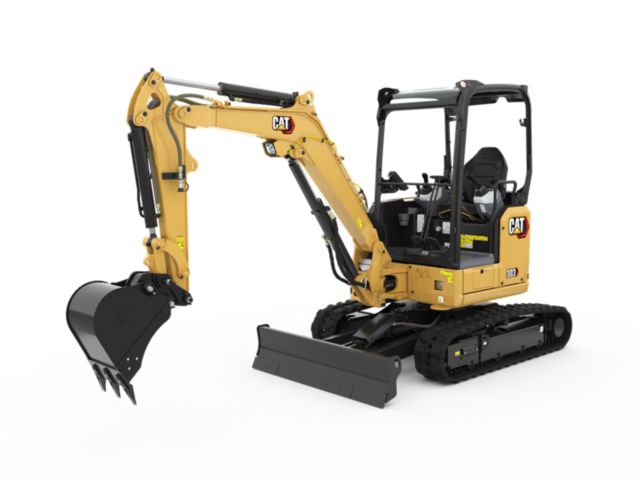
The Cat 303 CR is a useful machine to assess when compact excavation becomes repeat work rather than an occasional property project. At that point, the buying question changes. Reaching the bottom of an excavation is necessary, but the more revealing question is how effectively the machine repeats the whole cycle with the intended bucket, soil and material-removal arrangement.
For a Canadian landscape contractor, farm operator or acreage business, the important choices include standard versus long stick, working width, counterweight configuration and hydraulic attachments. This guide uses the documented North American 303 CR configuration and explains how to compare those choices without treating engine horsepower or maximum depth as a complete performance rating.
On This Page
ToggleCat 303 CR working specifications
The selected figures below come from Caterpillar’s 303 CR specifications.
| Item | Value |
|---|---|
| Engine; net power at 2,400 rpm | C1.1 Turbo; 17.6 kW / 23.6 hp |
| Track width | 1,550 mm |
| Stick length, standard / long | 1,260 / 1,560 mm |
| Dig depth, standard / long | 2,650 / 2,950 mm |
| Ground-level reach, standard / long | 4,830 / 5,110 mm |
| Stick force, standard / long | 16.6 / 14.8 kN |
| Primary auxiliary flow | 65 L/min |
| Tail radius, without / with extra counterweight | 775 / 890 mm |
| Canopy operating weight range | 3,025–3,425 kg |
| Cab operating weight range | 3,140–3,545 kg |
Published weight configurations exclude the bucket. Cat also cautions that maximum hydraulic flow and pressure are not simultaneously available. Match the figures to the offered configuration rather than combining convenient values from different rows.
The standard-versus-long-stick decision
Begin with the jobs you repeat most often. If their working area lies comfortably within the standard configuration’s envelope, additional reach may not be the factor that improves completion time. Bucket choice, ground conditions and where the material is discharged may matter more.
If the recurring difficulty is reaching the required area from an appropriate machine position, the long stick deserves a direct comparison. Its benefit is geometric. Evaluate the matching force figures and load chart at the same time, because a longer arm does not improve every aspect of the task.
The useful demonstration is not simply lowering each configuration to its maximum depth. Ask the operator to show the cut, bucket filling, extraction and discharge phases of a representative job. Record where repositioning becomes necessary and whether either configuration struggles with the intended tool or material.
Also distinguish a recurring need from an unusual job. A business can reasonably own a configuration suited to its normal work and hire different equipment for exceptional tasks. Paying for reach that is rarely used may be less attractive than keeping the regular digging arrangement straightforward.
Follow the material through the entire cycle
A productive excavation has several linked stages. Material must be cut, held in the bucket, moved clear, discharged and ultimately taken to its destination. The excavator’s maximum specification in any one stage cannot compensate for a bottleneck elsewhere.
Imagine a hypothetical job with 300 comparable bucket cycles. If one complete cycle takes 40 seconds and another takes 45 seconds under otherwise equal assumptions, the calculated difference is 1,500 seconds, or 25 minutes. These are illustrative numbers, not measured Cat performance. They show why modest repeated delays deserve attention.
Now imagine that the material-removal vehicle causes an hour of waiting during the same job. In that situation, solving the support-equipment problem could matter more than the cycle difference. This is why a comparison should record both active digging and interruptions rather than presenting a single speed claim.
Use the same operator, attachment type, material and task as far as practical when comparing machines. Record the configuration and conditions so that the result is meaningful. A fast demonstration with loose material does not predict every job in compacted or variable ground.
Ground reach and the shape of the excavation
Maximum ground reach is measured at a particular height in the working-range diagram. It is not the available horizontal distance at the deepest point. Plot the required working points on the matching drawing rather than subtracting a desired depth from one number and assuming the rest follows.
For a planned property excavation, define the finished shape and the machine positions available under the site plan. Check whether the bucket can work the required area, not just touch one point. Changes in the machine’s standing elevation also change the relative depth that the equipment must reach.
A contractor comparing quotations should ask which bucket and linkage arrangement the working-range information assumes. Couplers and other installed equipment can affect the relevant geometry. Where the task is close to a machine’s limit, obtain the applicable configuration information rather than relying on a generic drawing.
Do not turn a reach calculation into permission to place the machine closer to an excavation edge. The site plan establishes suitable positions; the equipment comparison then determines which machine can work from them.
Width and counterweight: two different site constraints
The track-width figure is an access measurement, while rear radius concerns the rotating upper structure. Both belong on the site sketch. An entrance can be passable while the work area lacks clearance for the actual rear configuration.
Identify the counterweight fitted to the sale machine. Use the corresponding dimensional and load information. A buyer should not assume the smallest rear envelope while evaluating a package with additional counterweight, or assume a load-chart benefit without the equipment and conditions associated with it.
In a farmyard, allow for the places where machinery, stored materials and buildings restrict movement. In a residential setting, assess fences, established planting and the route for removing spoil. The right compact machine is the one that suits the whole layout, not merely the narrowest opening.
Bucket package: avoid buying volume without a job
Choose the initial bucket package from named tasks. For excavation that will be measured and restored, the cut width can affect the amount of material handled and the finished work. For surface finishing, the desired result may call for a different tool. Neither decision should be made solely from the largest bucket included in a sales bundle.
Compare mass, mounting and suitability with the carrier and coupler information. Include any attachment that remains installed when assessing loads. A physical pin match does not establish that a tool is an appropriate combination for the machine.
A used package should be priced tool by tool. Inspect cutting edges, teeth, welds, pin areas and locking arrangements, then determine whether repair is worthwhile. Several worn attachments of uncertain compatibility may be less valuable than a smaller verified set that can begin work immediately.
Hydraulic tools and the difference between available flow and usable performance
Start with the intended attachment’s operating requirements. Compare its accepted flow range, pressure limits, return restrictions and control needs with the machine as equipped. The total pump figure and the auxiliary-circuit figure answer different questions; use the circuit that actually supplies the tool.
Do not calculate a guaranteed attachment output by multiplying unrelated catalogue maxima. Ask for a compatible installation and a representative demonstration under load where that tool is central to the purchase. The relevant question is whether the complete system does the required work, not whether two peak numbers look impressive together.
Plan simultaneous functions as well. If the work requires a thumb or another controlled function in addition to the primary tool, establish the installed circuit and control arrangement. Record required options in the quotation rather than leaving the attachment installer to discover missing provisions after delivery.
Loading and lifting need their own checks
When loading a receiving vehicle, check the complete bucket path and the required discharge location. A bucket that can clear the near edge may still be poorly positioned to place material where it is wanted. Vehicle position, machine elevation and the actual attachment all affect the arrangement.
For lifting, use the applicable manufacturer load chart and approved equipment and procedures. Maximum digging reach and bucket breakout force are not lifting capacities. The relevant chart depends on configuration, radius, height and the stated conditions.
If lifting is a major part of the work mix, include it explicitly in the buying brief. Do not let a successful digging demonstration stand in for an unverified lifting requirement. A different attachment or machine may be necessary even when the excavator digs the required area comfortably.
Canadian ownership: support the working schedule
Match the operator environment to the seasons and hours in which the machine will work. For a cab example, test the installed climate and visibility equipment; for a canopy example, consider whether the planned schedule can accommodate exposure to the weather. The value of shelter depends on the work pattern.
Build service planning around the serial-specific manual and local support. Establish how routine parts will be obtained, where inspections and repairs will take place and how downtime affects booked jobs. A service arrangement that is convenient for an urban contractor may be quite different from one that suits a remote property.
Keep records of configuration changes as well as maintenance. When a coupler, tool or counterweight arrangement changes, the information used for transport and equipment matching should be reviewed. This helps prevent an old equipment list from becoming the basis of a new job decision.
Transport is part of the configuration choice
Start with the actual machine and establish the meaning of its documented weight. Add separately carried equipment only when it is not already included. A ready-to-work package can differ substantially from a base-machine figure, especially when multiple tools travel to the same job.
Check the complete hauling arrangement: available trailer payload, axle and tyre ratings, hitch, tow vehicle and load distribution, together with applicable requirements. Do not infer suitability from a truck’s informal size category. Deck space and loading arrangements also need to match the actual equipment.
Where the excavator remains at one property for long periods, delivery may be an alternative to buying a transport setup. Where it moves several times a week, transport time and supporting equipment become central to the ownership calculation. Price both patterns using realistic local quotations.
Used-machine inspection and comparisons
Verify identity, stick, counterweight, operator enclosure and installed hydraulic provisions before comparing asking prices. Then have the undercarriage, linkage, structure and hydraulic system assessed by a competent inspector. Observe a cold start and warmed-up representative operation, and obtain estimates for identified deficiencies.
These checks establish the individual machine’s condition; they do not imply a known fault pattern for the model. Service documentation, repair quality and a properly demonstrated tool package can be more informative than an hour reading alone.
For alternatives, use the Bobcat E35 guide and Kubota KX033-4 guide to develop comparison questions. Verify the generation and configuration being offered, then compare the same work cycle, access route and supporting equipment. Similar market positioning does not make the specifications interchangeable.
Frequently asked questions
Is the long stick the best version of the 303 CR?
It is the appropriate version when its reach solves a regular problem and the complete configuration suits the task. Compare the standard stick too when repeated digging occurs well inside its range.
Does a compact radius remove the need for rear clearance?
No. Use the actual counterweight configuration and assess the full moving envelope. Compact geometry does not eliminate site planning.
Can auxiliary flow determine attachment compatibility?
It is one screening value. The tool also needs suitable pressure, return plumbing, controls, mass and carrier approval. Assess the complete installation.
What is the strongest reason to choose this machine?
A demonstrated fit with your recurring excavation cycle, site access and ownership arrangement. Choose it because the complete package performs the required work, rather than because one maximum figure leads a comparison table.
How can a demonstration reveal a material-removal bottleneck?
Record active digging separately from time waiting to discharge or for receiving equipment to return. If waiting dominates, compare support arrangements before assuming another excavator configuration will solve the delay.
Share your experience
Help other Canadian buyers — leave a quick review for the
Cat 303 CR
There are no reviews yet. Be the first one to write one.