Overview & Specs
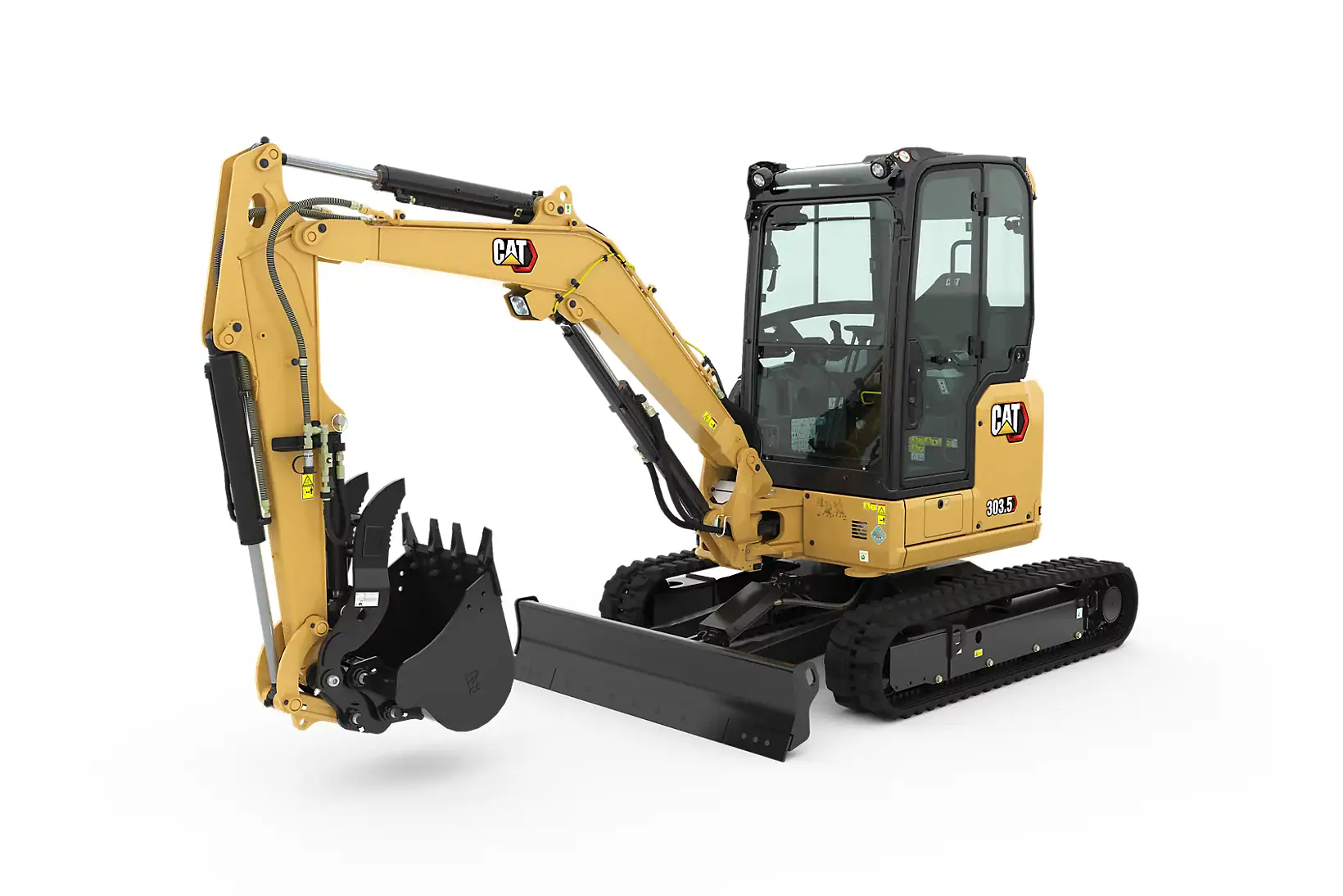
The Cat 303.5 CR belongs on the shortlist when a small excavator’s working envelope begins to shape the entire job. A Canadian buyer may be looking for more useful reach, a different loading arrangement or a machine that can complete repeated property and contracting work with fewer compromises. The purchase still has to fit the site’s access and the owner’s transport and support arrangements.
The key is to evaluate the actual package. The model designation does not describe its transport weight, and maximum depth does not describe every point the bucket can work. This guide uses Caterpillar’s North American 303.5 CR specifications to organize a practical assessment of geometry, attachments, configuration and ownership.
On This Page
ToggleSelected Cat 303.5 CR specifications
These figures are from the official 303.5 CR product specifications. Standard and long stick values refer to different equipment configurations.
| Specification | Published value |
|---|---|
| Engine; net power at 2,200 rpm | C1.7; 17.6 kW / 23.6 hp |
| Track width | 1,780 mm |
| Canopy operating weight range | 3,480–4,050 kg |
| Cab operating weight range | 3,620–4,190 kg |
| Dig depth, standard / long stick | 2,810 / 3,110 mm |
| Ground reach, standard / long stick | 5,130 / 5,380 mm |
| Dump clearance, standard / long stick | 3,490 / 3,600 mm |
| Stick force, standard / long | 18.9 / 16.9 kN |
| Primary auxiliary flow | 70 L/min |
| Rear radius, without / with extra counterweight | 890 / 1,005 mm |
The listed weight configurations exclude the bucket. Maximum hydraulic flow and pressure are separate limits, not a guaranteed simultaneous operating point.
When a larger working envelope earns its place
Start by identifying what currently interrupts the job. Is the machine repeatedly moving because the work is beyond comfortable reach? Is the receiving vehicle awkwardly placed? Is the bucket poorly matched to the material? Or is the excavator waiting for spoil removal? These problems do not all have the same equipment solution.
A different working envelope can help when geometry is the recurring restriction. It may contribute little if the real problem is an unsuitable bucket or an undersized material-removal arrangement. Before stepping up, describe the limitation in practical terms and plan a demonstration that tests it.
For a farm or acreage owner, distinguish recurring maintenance from a major one-time development project. An owned machine should be selected around the work that continues after the large project is finished. Hiring a contractor or renting different equipment for the exceptional task may leave a better long-term ownership arrangement.
The width decision comes before the accessory list
Measure the narrowest route and the working area before choosing optional equipment. Include turns, overhead clearance and space for moving material. A machine can be acceptable on a broad farmyard but unsuitable for one access route that accounts for a large share of a landscape contractor’s business.
Do not describe a machine as accessible merely because its track width is less than a gate’s nominal opening. Consider the actual blade, tools and protruding components, as well as alignment and the ground surface. The route should be planned with usable clearance rather than a theoretical exact fit.
Once inside, the rear and front equipment need room to move. Match the rear-clearance information to the installed counterweight configuration. A compact-radius label does not describe the entire machine envelope, and it does not replace separation and visibility planning around people and structures.
Standard or long stick: compare the work, not just the deepest number
The long-stick option should be selected for a task that benefits from its geometry. Read the corresponding force and load information alongside the working-range drawing. More reach is useful when it reaches the required area from an appropriate position; it is not an across-the-board increase in capability.
For example, a hypothetical property project may need access to several points beyond an established feature that cannot be disturbed. If a suitable machine position exists, reach could be the deciding issue. In another project, repeated digging within an open area may put greater emphasis on bucket fill, control and the entire cycle.
Mark required working points on the drawing for each configuration. Include depth and horizontal distance together. A maximum ground-reach figure cannot be used as the horizontal reach at maximum depth, and a bucket touching a point does not establish that it can cut and remove material efficiently there.
For a used machine, identify the installed stick rather than accepting the largest depth figure in an advertisement. If the arm has been changed, the relevant documentation and equipment matching need to follow the actual configuration.
Loading a truck: clearance is only the first test
A buyer who regularly loads material should assess the receiving vehicle as part of the excavator purchase. The bucket needs to clear the side and discharge in a useful position. Merely reaching above the nearest edge can leave an awkward loading arrangement.
Use the actual vehicle dimensions and the approved machine position. Relative ground height matters, as do the bucket and coupler. A demonstration should show the full path rather than only the highest point the equipment can reach.
Then examine the surrounding cycle. Where does the machine dig, how far must it swing, and how often does the receiving vehicle move? If loading is occasional, a workable arrangement may be enough. If it happens all day, delays in positioning and discharge deserve the same attention as excavation speed.
Do not confuse loading loose material in a bucket with lifting a suspended object. Those operations require different information. For lifting, use the applicable load chart, approved equipment and procedures; reach and digging-force figures are not substitutes.
Attachments: preserve useful capability in the complete package
Every item fitted between the machine and the material becomes part of the assessment. Couplers and specialist tools have mass and geometry, and they can change what the package can practically do. Verify compatibility and use the relevant manufacturer information for the assembled configuration.
For bucket work, choose dimensions around the required result and material. A large bucket that is poorly matched to the task may not improve the completed job. Consider how much material is disturbed, how it will be handled and what finishing work remains.
For a hydraulic attachment, record acceptable flow, pressure, return requirements, controls and carrier limits. The auxiliary-flow figure is an initial filter, not a complete approval. Demonstrate the intended combination under representative conditions when the tool is central to the business case.
If purchasing several tools, identify which are essential on day one and which can be added after actual demand is established. This keeps the initial package focused and leaves room for maintenance, transport and support costs that are easy to overlook.
Finishing and restoration affect the real job cost
A project is not complete when the last bulk bucket is removed. The specified shape, surface finish and restoration still have to be achieved. Include those stages when evaluating the machine and its tools, especially around finished properties where excess disturbance creates additional work.
A representative demonstration should therefore include a finishing task as well as digging. Observe whether the operator has a clear view and can make the required movements consistently. The goal is to evaluate the actual tool and control arrangement, not to claim a universal finishing advantage from a specification sheet.
For a contractor, record the labour and equipment used after excavation. If another machine is required to handle material or complete restoration, include it in the quotation and ownership calculation. A purchase decision based only on excavation time can hide substantial downstream costs.
A transparent own-versus-rent calculation
Use actual local quotations for a real decision. As a purely hypothetical example, suppose ownership creates CAD 12,000 in annual fixed costs, while the comparable rental-and-delivery alternative costs CAD 600 more per working day than the owner’s variable operating cost. Dividing 12,000 by 600 gives 20 working days.
That is a simplified break-even calculation, not a market price or recommendation. It assumes comparable equipment, equivalent job results and no additional ownership costs outside the stated figures. Financing, resale value, taxes, storage, maintenance risk and rental availability can change the result.
The exercise is useful because it exposes the assumptions. If the machine works only a few days a year, availability and convenience may still justify ownership, but that is a different reason from claiming it is automatically cheaper. If it works regularly, downtime and support can matter more than a modest difference in acquisition price.
Run the comparison for the complete package. An excavator without the required tools or transport arrangement is not equivalent to a delivered rental package that includes them.
Canadian working conditions and operator environment
Match the offered enclosure and installed equipment to the expected schedule. Planned fair-weather projects and recurring cold or wet work place different value on operator shelter. Test the actual visibility and climate functions of a cab example instead of assuming every enclosed machine is equally equipped.
Seasonal conditions also affect the site. Access and ground support can change after rain, thaw or freezing weather. A machine’s size does not establish that a particular work position is appropriate. Reassess the site plan when conditions change rather than treating last season’s access as permanent proof.
For maintenance and starting procedures, use the correct manual for the serial number. Identify local service arrangements and routine parts availability before buying, particularly if the machine will work far from support. Keep configuration and service records together so that later attachment and transport decisions use current information.
Transport: the model name is not a scale reading
Establish the actual machine’s equipment list and reconcile it with the weight documentation. Account for the fitted tool and separately carried attachments without counting components twice. A package with several buckets and additional equipment requires a different transport assessment from a base machine alone.
Check available payload after trailer weight, individual axle and tyre ratings, hitch and tow-vehicle limits, and the planned load distribution. Include applicable transport requirements. Do not assume a particular pickup class is suitable based only on the excavator’s name.
Deck space and loading arrangements also matter. Equipment must fit and be secured using the approved provisions. For infrequent moves, obtain a professional transport quote before deciding that ownership of a hauling setup is necessary. For frequent moves, include travel and loading time in the business calculation.
Buying a used 303.5 CR
Verify the serial number and identify the stick, counterweight, enclosure, tracks, coupler and hydraulic provisions. Compare that list with the advertisement. Current product information should not be applied indiscriminately to earlier machines bearing a similar designation.
Have the undercarriage, structural condition, linkage wear and hydraulic system inspected. Observe a proper cold start and warmed-up operation with representative movements. Investigate warning messages and irregular behaviour through competent diagnosis rather than guessing from appearance.
Review service records and the quality of documented repairs. Hour readings are useful context, but they do not establish the state of every component. Obtain estimates for identified work and include them in the comparison with other machines.
Inspect the attachments as separate assets. Worn locking parts, uncertain mounting compatibility or undocumented hydraulic modifications can change their value considerably. List the agreed equipment in the sale documentation so that delivery matches the package you evaluated.
Alternatives and the final selection
Use the Bobcat E35 and Kubota U35-4 guides to organize a broader comparison. The Kubota KX033-4 is another useful catalogue entry to research. Verify current, configuration-specific data before placing figures side by side.
First eliminate packages that fail access, working-range or transport requirements. Then compare the actual task, attachments, condition and local support. This order keeps an attractive accessory list or purchase price from outweighing a fundamental mismatch.
Frequently asked questions
Is a Cat 303.5 CR always a 3.5-tonne transport load?
No. The model designation is not the weight of the configured machine and everything travelling with it. Establish the complete load before selecting transport.
Does the long stick make it better at every job?
No. Select it for a useful reach requirement and assess the matching force and load information. The standard configuration may suit work that remains comfortably within its envelope.
Can dump clearance alone confirm truck compatibility?
No. Check the full bucket path and discharge position with the actual truck, attachment and machine elevation.
What should justify stepping up to this model?
A demonstrated improvement in the recurring job that remains worthwhile after access, transport and ownership costs are included. The strongest case is a specific problem the complete package solves.
When might renting be preferable to buying?
When the demanding work is occasional, compare a delivered, correctly equipped rental package with the full annual cost of ownership. Include availability and scheduling value, but keep those reasons separate from a claim that ownership must cost less.
Share your experience
Help other Canadian buyers — leave a quick review for the
Cat 303.5 CR
There are no reviews yet. Be the first one to write one.