

Introduction
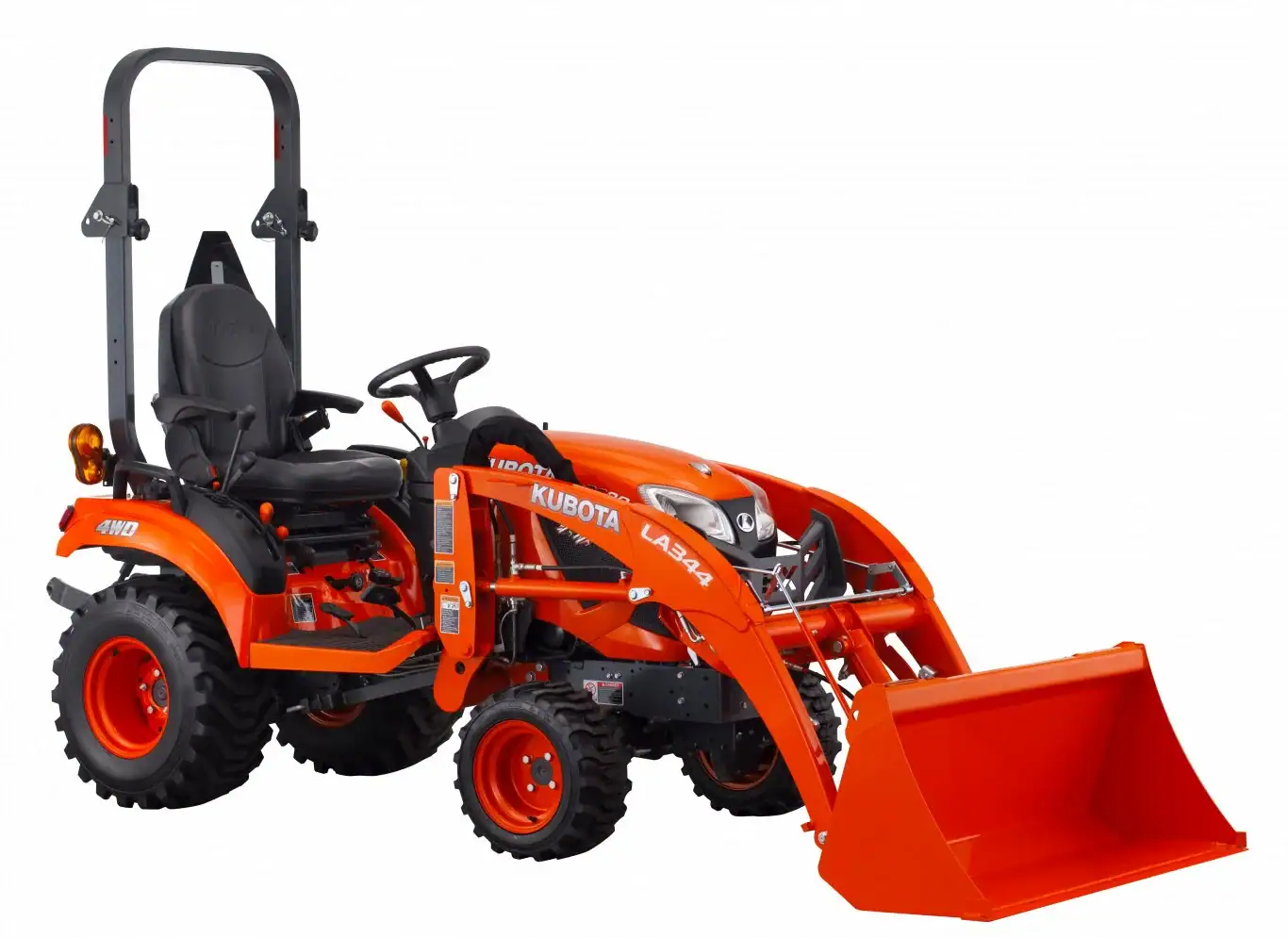
The BX2380 and BX2680 sit next to each other at the top of Kubota’s BX80 lineup, and the choice between them comes down to one thing: engine size, and whether the extra power justifies the price. They ride on the same chassis, use the same transmission, carry the same loader, and take the same mower decks. Line them up in a yard and you would struggle to tell them apart. The BX2680 costs a few thousand dollars more, and all of that money goes toward a larger engine.
So the real question is narrow and practical. You are not weighing two different tractors against each other. You are deciding whether roughly 13% more horsepower is worth roughly 20% more money, for the work you actually do. For some buyers it clearly is. For most, the honest answer is more complicated, and it depends on how hard you push the machine and what you plan to run on the back.
This guide lays out what the two share, where the engine difference actually shows up, and who each one suits, with Canadian acreage and property work in mind.
The short answer
Buy the BX2380 if your work is mowing, loader chores, snow, and light rear implements on one to five acres. It handles the same 60-inch deck and the same loader as the BX2680, and for most residential property work it does the job without breaking a sweat. The money you save is real, and there are better places to spend it than on horsepower you will rarely call on.
Buy the BX2680 if you mow larger acreage regularly, run a large snowblower or a heavy rear implement, or work hills and heavy ground where a bit more power gives you margin when conditions turn. The extra horsepower and PTO power are genuine, and if your work leans on them often, the premium earns its keep.
Here is the honest part most comparisons skip: the jump from the BX2380 to the BX2680 gives you proportionally less for your money than the jump from the smaller BX1880 to the BX2380 did. The big capability step in this lineup happens lower down. By the time you reach the BX2680, you are paying for incremental gains, not a transformation.
What the BX2380 and BX2680 share
Almost everything, which is the whole reason this comparison exists.
Both ride on the same BX80 chassis, use the same hydrostatic transmission, and run the same four-wheel-drive drivetrain. Both use the Kubota LA344 Swift-Tach front loader, which comes off without tools in under a minute, so loader capability and feel are the same. Both take the same 54-inch and 60-inch mid-mount mower decks, including the drive-over Easy-Over system, so they mow the same way with the same cut quality. Attachments and implements move freely between them. If you own a BX2380 and later trade up to a BX2680, your gear carries straight over.
Both engines are also refreshingly simple. Kubota’s BX diesels use mechanical injection and need no diesel particulate filter or diesel exhaust fluid, which means no regeneration cycles and less to maintain, a genuine advantage over larger compact tractors burdened with emissions plumbing. That holds for both models equally.
Strip the comparison down and you are left with one variable. The engine.
Where they differ: the engine
The BX2380 runs Kubota’s D902, a three-cylinder diesel displacing 898 cc, rated at 21.6 gross horsepower and 17.7 PTO horsepower. The BX2680 runs the larger D1005, displacing just over a litre, rated at 24.8 gross horsepower and 19.5 PTO horsepower. That works out to about 13% more engine power and about 10% more power at the PTO for the BX2680.
Where does that show up in real work? Mostly at the PTO, under sustained load. Running a 60-inch deck through thick, wet grass, driving a large snowblower through a heavy prairie fall, or turning a bigger brush cutter, the BX2680’s extra power gives it more margin before it starts to labour. On lighter tasks, mowing a tidy lawn, moving material with the loader, grading a driveway, the two feel much the same, because neither is working hard enough for the difference to matter.
The cost of that extra power is roughly $2,500 to $4,000 CAD, depending on configuration and dealer. That is the entire decision in one line: a few thousand dollars for a slice more power that shows up mainly when you are working the PTO hard.
Specs side by side
| Specification | Kubota BX2380 | Kubota BX2680 |
|---|---|---|
| Engine | Kubota D902, 3-cylinder diesel | Kubota D1005, 3-cylinder diesel |
| Displacement | 898 cc (54.8 cu in) | ~1,001 cc (61.1 cu in) |
| Gross horsepower | 21.6 HP | 24.8 HP |
| PTO horsepower | 17.7 HP | 19.5 HP |
| DPF / DEF | Neither required | Neither required |
| Transmission | Hydrostatic (HST) | Hydrostatic (HST) |
| Drive | 4WD | 4WD |
| Front loader | Kubota LA344 Swift-Tach | Kubota LA344 Swift-Tach |
| Mid-mount mower | 54″ / 60″ decks | 54″ / 60″ decks |
| Backhoe | Optional BT603 | Optional BT603 |
| Approx. price gap | Baseline | ~$2,500 to $4,000 CAD more |
Specs are drawn from Kubota’s published figures. Confirm exact numbers and current pricing with your dealer, since options and packages change by model year and market.
The traction question most buyers miss
There is a point experienced BX owners raise again and again, and it reframes the whole decision. On a tractor this light, you tend to run out of traction before you run out of horsepower.
The BX is a light machine. Ask either model to push a heavy pile or dig hard with the loader, and the limit you hit first is usually grip, not engine power. The tyres break loose before the engine bogs down. That means the BX2680’s extra horsepower often cannot fully express itself in loader and ground-engaging work, because the traction ceiling arrives first. Rear ballast helps both machines here far more than the engine difference does. Where the extra power genuinely pays off is at the PTO, spinning an implement, where traction is not the limiting factor.
This is why the seasoned advice on owner forums so often lands on the same recommendation: buy the BX2380, and put the saved money toward something that removes a real limitation, whether that is proper rear ballast, a set of better tyres, or a dedicated implement. One long-running forum thread on exactly this choice had owner after owner suggest the BX2380 plus a standalone generator over the BX2680 alone, on the logic that a dedicated generator outperforms a PTO unit and the tractor’s extra horsepower would rarely be missed. The specific purchase varies, but the principle holds: spend the difference where you will actually feel it.
An honest note on stepping up
If you are seriously considering the BX2680, there is one more machine worth putting on the table before you decide: the Kubota B2601.
The B2601 sits one class up, in the B01 series, and for a modest step beyond BX2680 money it brings a genuinely stronger machine, with a more capable loader, higher lift capacity, cast-iron axles, and a heavier build meant for more frequent, harder work. This matters because the BX2680 is the most expensive way to buy into the BX platform, and at that price the question quietly shifts. It is less “BX2380 or BX2680” and more “if I am spending BX2680 money, should I step into a B01 instead?” If your work is genuinely demanding enough to want the BX2680’s extra power, it may be demanding enough to justify the bigger machine. If it is not, the BX2380 was probably the right call to begin with. That squeeze from both sides is what makes the BX2680 a harder machine to recommend than its siblings.
Which one fits your work
The BX2380 fits the large majority of BX buyers. It mows with the same deck, loads with the same loader, and handles the general run of one to five acre property work without asking you to pay for headroom you will seldom use. For mowing, light landscaping, snow, and small trailer work on a budget, it is the rational choice, and the saved money is better spent on ballast, tyres, or an implement than on horsepower.
The BX2680 fits buyers who lean on the PTO. Regular large-acreage mowing, a big snowblower through heavy prairie winters, a large brush cutter, or steep and heavy ground where a bit more margin is welcome when conditions turn. If that is your work, the extra power is real and worth having. Just weigh it honestly against the B2601 one step up before you sign, because at this price the bigger machine enters the conversation.
The deciding question is simple: do you regularly work the PTO hard, or not? Answer that, and the choice falls into place.
Frequently asked questions
What is the difference between the Kubota BX2380 and BX2680?
The engine. The BX2380 uses Kubota’s D902 (898 cc, 21.6 gross HP, 17.7 PTO HP) and the BX2680 uses the larger D1005 (about 1,001 cc, 24.8 gross HP, 19.5 PTO HP), giving the BX2680 roughly 13% more horsepower and 10% more PTO power. Everything else, including the chassis, transmission, loader, and mower deck options, is the same. The BX2680 costs about $2,500 to $4,000 CAD more.
Is the BX2680 worth the extra money over the BX2380?
It depends on how hard you work the PTO. If you regularly run a large snowblower, a 60-inch deck through heavy grass, or a big brush cutter, the extra power earns the premium. If your work is mowing, loader chores, and light tasks on one to five acres, the BX2380 does the same job for less, and the saved money is better spent on rear ballast or a dedicated implement.
Do the BX2380 and BX2680 use the same loader?
Yes. Both use the Kubota LA344 Swift-Tach front loader, which removes without tools in under a minute, and they share the same chassis and hydraulics. Loader capability and feel are the same, and attachments carry across between the two models.
Can both the BX2380 and BX2680 use a 60-inch mower deck?
Yes. Both support 54-inch and 60-inch mid-mount mower decks, including the drive-over Easy-Over system, and they mow the same way with the same cut quality. Mower compatibility is not a reason to choose one over the other.
Does the BX2680 have a DPF or need DEF?
No. Like the BX2380, the BX2680 uses a mechanical injection diesel that needs no diesel particulate filter or diesel exhaust fluid, so there are no regeneration cycles and less to maintain. Both models share this simplicity.
Should I consider the Kubota B2601 instead of the BX2680?
It is worth a look. For a modest step beyond BX2680 money, the B2601 in the B01 series offers a more capable loader, higher lift capacity, cast-iron axles, and a heavier build for harder, more frequent work. If your work is demanding enough to want the BX2680’s extra power, it may justify stepping up to the B2601. If not, the BX2380 is likely the better value.
Why do people say to buy the BX2380 and save the money?
Because the BX is a light tractor, and in loader and ground-engaging work you usually run out of traction before you run out of horsepower. The BX2680’s extra power often cannot fully express itself in that kind of work, since grip is the limiting factor. Experienced owners frequently recommend the BX2380 plus spending the difference on ballast, tyres, or a dedicated implement, where it removes a real limitation.
Keep comparing
For the full Kubota BX80 range and how all four models stack up, see the Kubota BX Series comparison. You can also read detailed specs and owner reviews on the Kubota BX2380 and Kubota BX2680 model pages, or if a backhoe is on your mind, compare the BX23S against the BX2380.
Note: We try our best to keep specs and information accurate, but some details can be missing or different depending on the source. Before you buy, service, or repair equipment, please double-check key specs with the manufacturer, the owner’s manual, or your dealer.
About reviews: Reviews on Aglist are written by real users. We moderate them for spam and abuse, but opinions and claims are still personal, so use them as guidance, not as a guarantee.
