Overview & Specs
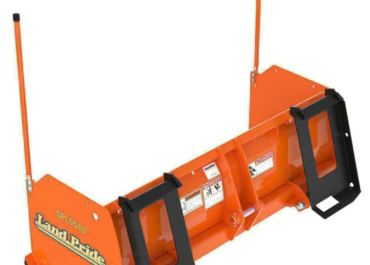
The Land Pride SSP1572 is worth considering when a six-foot snow pusher fits both your carrier and your snow-storage plan. Its boxed shape suits moving snow toward a chosen destination on an open yard. It is less attractive when the property offers nowhere to accumulate snow, or when a long narrow route is better served by moving material sideways or throwing it clear.
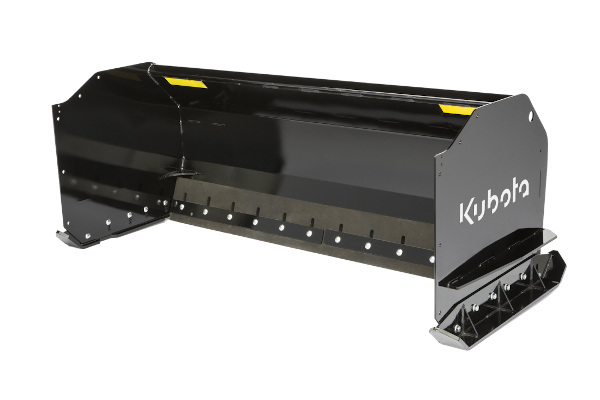
This guide covers the Land Pride machine documented in operator manual 303-348M dated January 11, 2017. That identity is important on the used market. Do not transfer these figures to a later Kubota AP-labelled attachment or assume a similar model name means identical construction, limits or accessories. Current availability and prices are not established here.
On This Page
ToggleStart with the destination, not the clearing width
A pusher retains snow ahead of the carrier so it can be moved to a storage area. The useful question is therefore where each pass ends. Draw the doors, gates, parking spaces and travel routes on a simple property plan, then mark where snow can accumulate without closing those routes. A wide open apron can be a good fit, but only if its disposal area remains usable as the season progresses.
A narrow driveway presents a different problem. Repeatedly carrying snow to one end can create long return trips and a growing obstruction at the destination. An attachment that moves snow sideways, or a blower with a suitable discharge plan, may better suit that layout. The SSP1572 should be judged by the complete route rather than how much snow it appears to hold in one photograph.
Include the space needed for the carrier to turn and back away from the pile. A storage location that works for the first snowfall may become awkward later. This is an operational planning issue; it cannot be solved by treating the pusher’s nominal capacity as a promise of daily output.
Which numbers apply to this SSP1572?
| 2017 manual specification | Meaning for a buyer |
|---|---|
| 72-inch working width | The nominal cleared swath is six feet. |
| 78½-inch overall width | Allow more space at gates, buildings and storage locations. |
| 521 lb with rubber edge | This is a defined configuration, not the weight of every option package. |
| 33.5 cubic feet approximate capacity | Volume does not establish the mass or resistance of a particular load of snow. |
| 30–60 hp carrier range | Power is one part of matching the machine. |
| 5,000 lb maximum carrier operating weight; 2,000 lb maximum carrier lift capacity | These stated carrier limits also matter; do not select solely by minimum lifting ability. |
The manual’s carrier lift-capacity limit should not be relabelled as a pivot-pin rating or converted to another reference point without supporting documentation. Obtain an appropriate match for the actual carrier and configuration. A large loader that can easily lift the attachment is not automatically an acceptable carrier for it.
For the width difference, the practical calculation is simple: 78½ minus 72 equals 6½ inches. Do not divide a gate’s width by the working width and call the result clearance. The entire attachment, carrier path and manoeuvring margin must fit.
Mounting and carrier weight deserve their own checks
The referenced SSP1572 uses a universal quick-attach arrangement for suitable tractor or skid-steer loaders. The interface name is a starting point. Inspect the actual engagement surfaces and locking arrangement, especially on a used attachment that may have worn, damaged or modified mounting components.
For a tractor, the loader, tractor, ballast and operating configuration form one package. For a skid steer, the carrier’s applicable attachment and operating limits still govern. Do not substitute a generic horsepower comparison for those checks. A compatible mount establishes a connection; it does not independently establish an acceptable working combination.
Aglist’s loader lift-capacity guide is useful for separating published lift figures from real attachment loads. With this pusher, also retain the attachment manufacturer’s maximum carrier limits. Both sides of the match must be satisfied.
Rubber and steel edges answer different surface questions
The manual documents a reversible, adjustable 1-by-8-inch rubber edge and an optional reversible ½-by-6-inch steel edge. It also identifies reversible, replaceable AR400 skid shoes. These are wear components, so the edge and shoe condition of a used unit can matter more to the immediate purchase than a tidy paint finish.
Begin by describing the surfaces rather than declaring one material universally better. A paved apron, an uneven lane and a gravel yard impose different priorities for contact, residual snow and disturbance. Adjustment and operating technique matter alongside edge material. A rubber edge should not be sold to yourself as a guarantee that nothing beneath the snow can be damaged.
Likewise, fitting steel does not make the attachment an ice-breaking tool or authorize impacts with hidden obstacles. Establish the appropriate setup for the surface and the exact equipment. If the property has raised joints or irregular transitions, include them in the pre-season site assessment rather than relying on the edge to absorb every encounter.
For a mixed-surface property, list which surface accounts for most work and where the difficult transitions occur. A setup optimized for the main apron may need a different approach at the gravel entrance. The cost of that operating compromise belongs in the purchase decision.
What the capacity figure does not tell you
The 33.5-cubic-foot figure describes approximate volume. It does not tell you the weight of wet snow, the resistance of an accumulated push, or how much material the carrier can manage on a particular surface. Those are different questions with changing conditions.
For planning, think in terms of shorter or longer pushes and the distance to the storage area. If snow accumulates faster than the carrier can move it appropriately, a narrower or shorter working bite may be needed under the operating instructions. More nominal box volume does not remove traction or control limits.
A useful comparison with another attachment records completed area, acceptable finish, travel distance and conditions. Counting only the time spent moving forward leaves out returns, turns and repositioning. That can make a large pusher look more productive than it is on a confined site.
When the pullback option has practical value
The documented pullback option provides a rubber edge for pulling snow away from suitable areas. It can be relevant where snow must first be drawn out from near a building before forward pushing becomes possible. Its value depends on how much of the property requires that sequence.
Walk the doorways and confined areas before assigning money to the option. If most of the job is open-yard pushing, it may have limited value. If access around buildings dominates the job, the ability to reorganize snow before the main push can be central to the workflow.
This guide does not assign a verified option weight to that assembly. Inspect the actual equipment and obtain the relevant configuration information before using the rubber-edge base weight as the final transport or carrier load. Do not borrow an option weight from the separate SPL model family.
Three Canadian property layouts
An open workshop apron
A broad paved area with a clear storage destination is the most straightforward planning case. Divide the area into passes that finish where the snow belongs and preserve access to the workshop. Include pedestrian routes and parked equipment in the plan so that clearing one area does not simply transfer the obstruction elsewhere.
A gravel farmyard
Here, the acceptable finish and tolerance for disturbing aggregate deserve attention. Mark changes in level and known obstacles before snow hides them. Evaluate the specified edge and shoe arrangement against the surface; do not assume that a pusher should scrape every patch down to bare ground.
A long residential access lane
Distance and storage can dominate the decision. If every load must travel a long way to a small stacking area, a pusher may become inconvenient even though its width suits the tractor. Compare a blade or blower through the entire lane-clearing sequence, including where the displaced snow will go.
Compare a lighter pusher and a blower by the work
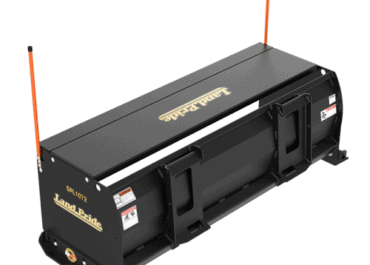
The Land Pride SPL1072 is a useful separate model to investigate when matching a pusher to a smaller tractor package. Do not transfer its mounting or carrier limits to the SSP1572. Compare each documented assembly with the carrier rather than treating all six-foot pushers as equivalent.
The Land Pride SB1064 represents a different snow-handling approach. A blower comparison introduces power, mounting and discharge considerations, but can also change the snow-storage problem. Its narrower nominal width alone cannot decide which system completes your property more effectively.
Request complete quotations if choosing between systems. Include required mounts, controls or driveline equipment, wear components, installation and seasonal changeover. An attachment with a lower purchase price can still be the more awkward system if it conflicts with how the property must remain accessible.
Used-machine inspection: concentrate on shape and wear
Confirm that the identification matches the Land Pride generation being evaluated. Photograph the mounting plate, side plates, edge, skids and any optional assembly. Ask for the operating documentation and records of repairs. A repaint can improve appearance without explaining whether the attachment has been altered.
Check whether the structure appears square and whether repairs or deformation require professional assessment. Examine the mount for wear and damage that could affect engagement. Look at the remaining usable edge and skid material, fastening condition and adjustment provisions with the unit safely supported and isolated.
These are inspection priorities, not claims that the SSP1572 commonly fails in particular places. The aim is to distinguish ordinary replaceable wear from an uncertain structural or mounting problem. Cost the identified work before comparing the used price with another package.
Storage arrangements also matter. The manual specifically addresses the unit’s tendency to tip backward when disconnected and the prescribed support arrangement. Establish a suitable storage location and follow that procedure; leaving a heavy attachment leaning wherever it happens to be unloaded is not a complete ownership plan.
A quotation that is actually comparable
Record the exact model identity, edge material, fitted options, actual package weight where established, mounting condition and included documentation. Separate required repairs from optional improvements. Then add delivery and any carrier setup to obtain the cost of an usable package.
For annual cost, use your own service expectations and local quotations. Avoid assigning a universal edge life: the amount and type of work, surface and setup change the result. A buyer clearing a small private apron has a different wear and downtime exposure from someone taking on repeated outside work.
Frequently asked questions
Is this the same as a current Kubota AP-SSP1572?
This guide does not establish that equivalence. It covers the Land Pride machine in the January 2017 manual. Verify the exact badge, serial information and applicable documentation.
Will it fit through a six-foot opening?
The documented overall width is 78½ inches, wider than six feet. Assess the entire carrier route and manoeuvring clearance, not only the 72-inch working width.
Does enough loader lift capacity prove suitability?
No. The attachment’s carrier limits, the actual mount and the complete machine configuration must also be satisfied.
Can I use the capacity figure to calculate snow weight?
Only with a justified density and fill assumption, neither of which is supplied by the volume rating. It is not a rated snow payload.
What is the strongest reason to choose a different tool?
A property layout without a workable snow-storage route can outweigh otherwise suitable width and carrier fit. Resolve that layout before buying.
Primary reference
Model specifications and equipment identity were checked against Land Pride manual 303-348M, January 11, 2017. Property examples are editorial planning scenarios, not field-test results or guarantees of clearing performance.
Share your experience
Help other Canadian buyers — leave a quick review for the
Land Pride SSP1572
There are no reviews yet. Be the first one to write one.