Overview & Specs
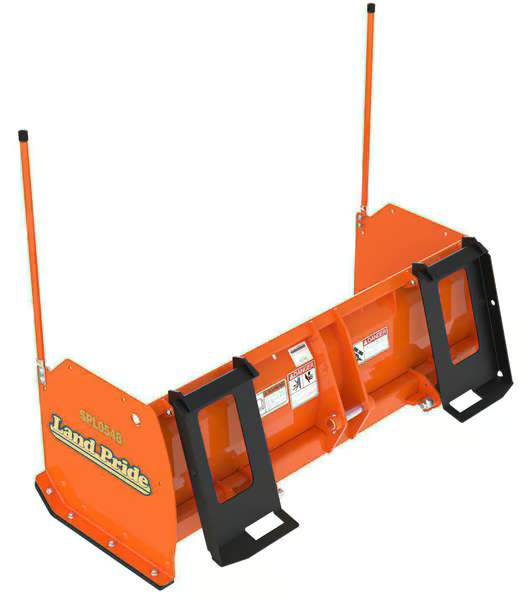
The Land Pride SPL0560 is a five-foot snow pusher for a specifically limited Kubota BX front-loader arrangement. It is worth considering when snow can be pushed to suitable nearby storage and the owner wants a contained pushing tool rather than a powered blower. The first decision is whether the actual carrier satisfies the attachment’s upper limits, not whether a larger tractor can physically connect.
For a Canadian acreage, the second decision is where the snow will remain after repeated clearings. A pusher can make a convenient first opening and still be the wrong seasonal choice if the pile soon blocks access. Evaluate the carrier and winter storage plan together before comparing blade options or price.
On This Page
ToggleThe SPL0560 has maximum carrier requirements
The January 10, 2024 operator manual specifies a maximum 28 hp, maximum 1,800-lb tractor weight and maximum 800-lb loader lift capacity at the pivot pins. It names the Kubota BX loader hitch, with or without BX6315 Quick Hitch. These are carrier-selection limits, not a snow-payload rating.
Its SPL0560 table lists 60-inch working width, approximately 12 cubic feet of volume, 208 lb with the poly blade and 214 lb with the steel blade. The optional pull-back adds 62 lb. The drawing gives 64 inches overall width but contains an erroneous metric conversion; 64 inches converts to about 1.63 metres.
Keep each label with its number. The 800-lb figure does not say how much snow to lift, and the approximate box volume does not establish a universal snow mass. The loader-rating guide explains why measurement points must remain explicit.
Why a more powerful tractor can be the wrong match
Buyers often ask whether a tractor is large enough. Here it is equally necessary to establish that it is not outside the permitted carrier class. Extra mass or hydraulic capability does not automatically improve the match to a relatively light pusher.
Use the actual operating tractor configuration when reviewing weight. Added equipment and ballast can change the total from a bare brochure figure. Resolve the requirements for the proposed setup rather than approving it from the BX family name alone.
The attachment’s carrier restrictions and the tractor’s own carrying requirements both apply. A tractor must be able to handle the equipped pusher while remaining inside the pusher’s stated limits. Passing only one side of that comparison is incomplete.
Do not confuse the documented BX connection with a universal skid-steer-style plate. Identify the exact loader and coupling arrangement on the offer. A seller’s generic phrase such as “fits compact tractors” is not enough to establish this model’s application.
Start with the winter pile, then draw the clearing route
Mark the driveway, parking area, doors and the access that must remain open. Then identify suitable snow-storage space. Draw how the collected snow reaches that destination without creating an obstacle for the next session.
A convenient nearby pile can become inconvenient as the season progresses. Consider the space needed by deliveries, emergency access and other routine movements. A tool chosen for the first snowfall may create repeated handling later if its destination was never planned.
Where appropriate piling space is limited, compare a blower or a suitable removal service. The SB1064 guide describes a different discharge method and its own tractor requirements. It is an alternative process to assess, not a claim that the blower fits the same BX combination.
For a mixed property, different zones may need different methods. A contained pusher can suit an open yard while a narrow section or doorway needs separate treatment. Decide whether the complete combination is manageable rather than insisting one attachment clear every square metre.
Five feet of work is not five feet of access
The 60-inch working strip and 64-inch overall envelope answer different questions. A five-foot opening cannot be approved from the model’s working width. Measure the actual equipped attachment and allow appropriate clearance for passage and positioning.
Include the tractor’s turn and approach, not only a straight passage through the narrowest point. The pull-back option and loader position can also affect the envelope being manoeuvred. A gate can be wide enough on paper yet awkward to approach after snowbanks accumulate.
For an invented layout example, a nine-metre-wide area and assumed effective pass spacing of 1.35 metres require seven traversals to span the width. Six cover only 8.1 metres. This calculation identifies geometric coverage, not snow volume, speed or the number of trips needed to the pile.
If each traversal fills the pusher before reaching the destination, the actual cycle plan differs from the simple width calculation. That is why observing a representative complete clearing is more informative than multiplying nominal width by an assumed travel pace.
Choose the edge around the surface and acceptable finish
The manual distinguishes poly and steel blade packages. Confirm the exact supplied edge and its condition. A photograph of a different configuration should not determine what the buyer expects to receive.
State the surface and desired cleared result before choosing. Paving joints, gravel, uneven areas and transitions create different questions about the prescribed setup. No edge-material label by itself guarantees that every surface can be scraped clean without damage.
Inspect and mark relevant obstructions before they disappear beneath snow. Include changes made during summer maintenance or construction. Familiarity with the driveway is useful, but it does not replace checking what is actually present this season.
For used equipment, identify the installed part rather than relying on a description such as “rubber-like blade.” Correct material, dimensions and mounting matter. An improvised edge should not be assumed equivalent to the documented option.
The pull-back option should solve a named task
A pull-back arrangement can be worth evaluating where snow must first be brought away from a close approach before it can be pushed elsewhere. Identify those locations and assess the permitted procedure with the actual tractor geometry.
The documented addition is 62 lb. Using the manual’s base figures, the poly package plus pull-back totals 270 lb and the steel package totals 276 lb before other additions. These are mass inventories, not approvals for the carrier.
Ask what work remains after pulling snow away from the obstacle. The released snow still needs a destination. A useful demonstration includes that second stage rather than ending with a small pile in front of the doorway.
On an open yard with few close approaches, the option may contribute little. On a property with several such areas, it may reduce a separate operation. Compare the actual routine instead of buying every accessory because it appears in the catalogue photograph.
Box volume does not predict a constant load
The approximate 12-cubic-foot figure describes space. Snow condition and the way material accumulates affect what that space contains. The same visible fill can represent different mass and resistance under different conditions.
As an arithmetic illustration only, 12 cubic feet is about 0.340 cubic metres. At invented densities of 100 and 250 kg per cubic metre, that volume would contain approximately 34 and 85 kg respectively. Those densities are not measured local snow or loading recommendations.
The calculation’s purpose is to prevent treating volume as a fixed payload. It cannot establish how much to push or lift. Use the documented operating method and actual carrier limits, and reassess conditions when the work changes.
Likewise, a larger box is not automatically faster. If it changes the tractor match, access or suitability of the routine, the extra nominal volume may be irrelevant. The smallest suitable complete process can be more useful than an oversized attachment selected from a capacity table.
Compare complete cycles and repeat handling
Break a session into gathering, moving to the pile, releasing, returning and treating boundaries. Add connection, inspection and parking. This makes the source of delay visible.
Suppose an invented clearing requires twelve suitable cycles at four minutes each, plus fifteen minutes of preparation and finishing. The session totals 63 minutes. A destination plan that removes thirty seconds from each cycle saves six minutes; a second handling stage taking twenty minutes would outweigh that gain.
These are planning inputs, not SPL0560 productivity data. The useful measurement is how the actual site can be cleared within the permitted operation. Do not improve the estimate by assuming faster travel or larger loads than the setup and conditions allow.
If a service is the alternative, compare the same route and response expectations. Ownership can offer scheduling control, but it also requires a usable tractor, storage and an operator available during the relevant weather. Those practical benefits and obligations deserve more attention than an unsupported hourly-output claim.
SPL0560 versus SPL1072 is a carrier decision first
The SPL1072 guide covers a larger pusher with different carrier limits, mass and mounting context. Do not read it as a simple wider version approved for the same tractor.
A wider strip only matters after compatibility is established. If the actual yard needs seven traversals with one suitable setup and six with another, determine how much of the whole session that removes. Trips to the pile and close-area work may remain unchanged.
Conversely, a narrower tool is not automatically preferable simply because it is lighter. It still needs to suit the tractor’s cleared path and the job. Choose between complete documented combinations rather than one isolated dimension.
Used condition: inspect the parts that contact snow and ground
Inspect the edge, skid shoes, side panels, frame, hitch and optional pull-back structure under the prescribed secured procedure. Look for uneven wear, deformation, cracks, missing fasteners and undocumented modifications.
Ask what configuration the previous owner used, but do not treat a history of apparently successful operation on a larger tractor as manufacturer approval. Condition and documented compatibility must each be checked.
Price wear parts and any missing installation equipment before comparing offers. A bare pusher lacking the edge or accessory required by the property is not directly comparable with a complete serviceable package.
Store the attachment where it can be connected when needed. Seasonal equipment buried behind unrelated implements can delay the first clearing. Keep the parking method consistent with the instructions and protect the access route to that location.
Frequently asked questions
Is 800 lb the snow capacity?
No. It is the maximum carrier lift-capacity figure at the pivot pins used in the manual’s matching requirements.
Will any BX tractor automatically fit?
No. Verify the actual loader hitch, operating configuration and all upper limits. A family name alone does not complete the check.
Does the pull-back weight belong in the tractor assessment?
Yes. Include its documented 62 lb along with the actual blade package and other fitted equipment.
Can the overall-width metric figure be copied from the drawing?
The cited drawing contains a conversion error. The 64-inch dimension corresponds to approximately 1.63 metres; measure the actual package for access.
What most strongly supports buying this pusher?
A verified carrier and a recurring winter route with suitable nearby snow storage, manageable boundaries and a practical plan for accumulation through the season.
Share your experience
Help other Canadian buyers — leave a quick review for the
Land Pride SPL0560
There are no reviews yet. Be the first one to write one.