Overview & Specs
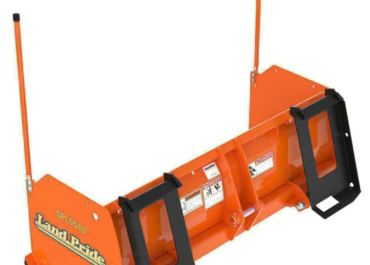
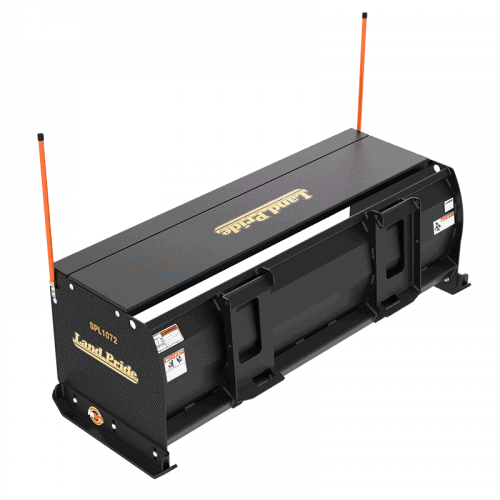
The Land Pride SPL1072 is a six-foot loader-mounted snow pusher for a restricted class of smaller carriers. Its defining purchase issue is not simply whether the mounting plate fits. The manufacturer specifies maximum carrier weight and maximum loader lift capability as well as a horsepower range. A larger tractor is not automatically an acceptable upgrade for this attachment.
A pusher collects snow between side panels and moves it toward a suitable nearby destination. That can fit an acreage yard with a workable piling plan. It is a different solution from throwing snow away from the route or continuously directing it sideways with an angled blade.
On This Page
ToggleRead the carrier limits before the box capacity
The December 27, 2023 manual specifies a maximum 3,000-lb carrier operating weight and maximum 1,200-lb carrier lift capacity at the pivot pins. Those are host-machine limits for selecting the pusher, not a promise that it can carry 1,200 lb of snow.
The same manual is inconsistent about horsepower: its specification table says 20–40 hp, while the tractor-requirements section says 20–45 hp. This guide does not approve the disputed 40–45-hp band. Obtain configuration-specific manufacturer confirmation rather than choosing the more permissive number because it accommodates the tractor.
The table lists a 72-inch working width, approximately 26 cubic feet of capacity, 348-lb weight with the rubber blade and 377 lb with the steel blade. Its drawing gives a 76½-inch overall width. The optional pull-back assembly adds 123 lb.
Record these as separate entries. Width, volume, attachment mass and host-loader limits answer different questions. Combining them into a single claim such as “six-foot pusher for any compact tractor” loses the information that matters most.
Why maximum carrier size is not a minimum requirement
Attachment listings often emphasise whether a tractor has enough power. Here the upper limits deserve equal attention. The frame and working arrangement are intended for a defined carrier class; additional tractor mass or capability can move the combination outside that intended match.
Do not compare the loader’s rated capacity at a different point with the manual’s pivot-pin limit and assume they are interchangeable. Obtain the appropriate documented rating for the actual loader. If only a different measurement is available, the comparison remains unresolved.
Similarly, use the carrier’s actual operating configuration when checking mass. Added equipment and ballast can change the figure from a bare-machine brochure value. The complete tractor configuration belongs in the fitment record.
The loader-capacity guide explains measurement points. For the SPL1072, the practical lesson is to check both the tractor’s ability to handle the equipped attachment and the attachment’s restrictions on the carrier.
Twenty-six cubic feet is not a fixed snow weight
The approximate volume describes a geometric quantity. It does not establish a universal snow mass, a permitted lifted payload or the amount that can be moved efficiently in every condition. Snow condition and the actual working arrangement affect the task.
Use volume cautiously when comparing boxes. A larger nominal box may reduce some repeated collection work, but it can also be a poor match for the carrier or route. Select from the documented complete combination rather than the largest number that fits through the gate.
For a simple illustration, two materials with hypothetical densities of 100 and 300 kg per cubic metre would have masses of 74 and 222 kg in 0.74 cubic metres. Those densities are invented inputs, not measured snow conditions or loading recommendations. The arithmetic shows why volume cannot stand in for weight.
Do not use the example to approve a load. The pusher’s operating instructions and the actual carrier limits still apply. A calculator cannot supply missing manufacturer approval.
Choose a destination that remains usable
A pusher works as part of a route from the collection area to a piling location. Plan that route before selecting width. The destination must remain practical as accumulation grows and must not block access needed later.
Draw the yard, entrances, parking areas and intended snow-storage zones. Identify the routes that must stay open and the points where a pile could interfere with sight lines or subsequent work. The best initial push direction may not be the best season-long plan.
If snow has to be moved repeatedly because the first pile is in the wrong place, the extra handling can dominate the session. A different staging plan or snow-removal method may solve more than an increase in box size.
Where there is little appropriate piling space, assess a blower or suitable removal service. A pusher should be chosen because contained movement toward a destination fits the property, not because it appears mechanically simpler than another category.
Rubber and steel configurations change the package
The cited manual distinguishes rubber and steel blade versions, while the public SPL10 family page uses steel and poly wording. Identify the exact offered edge material and applicable parts rather than assuming the terms refer to an identical component.
Discuss the actual surface and desired result with the equipment supplier. Edge selection, skid setup and working technique must be evaluated together. No material label alone guarantees a damage-free result on every surface.
Record what the quotation includes: blade, skid shoes, mounting equipment and any accessory. Photographs can show a different edge or additional equipment from the priced base package.
For used equipment, verify the installed part rather than relying on the seller’s memory. A replacement edge can change the configuration, and an improvised component should not be treated as equivalent to the specified option.
The pull-back option is a separate decision
The manufacturer describes the optional pull-back arrangement for bringing snow away from locations such as garage doors before moving it elsewhere. That capability can be valuable on a yard with many close approaches, but it is not automatically necessary on an open area.
Include its 123-lb listed addition in the equipped assessment. Using the manual’s figures, the rubber-blade package plus pull-back totals 471 lb, while the steel-blade version totals 500 lb before any other relevant additions. These are mass inventories, not carrier approvals.
Assess whether the actual geometry and prescribed procedure suit the approach. A demonstration should include the intended close-area task under appropriate conditions, not merely show that the attachment can be rotated.
Also identify what work remains afterward. Pulling snow out from a doorway is one stage; moving the resulting pile to its final location is another. Compare the complete sequence when valuing the option.
Width and clearance need separate measurements
The six-foot working width and 76½-inch overall dimension should not be used interchangeably. Measure gates, storage and the route with the whole attachment and tractor. Include space for turning and positioning rather than checking only straight-through access.
Compare the tractor’s actual tyre arrangement with the intended cleared strip. A nominal width that looks suitable on paper can produce an awkward routine when the working route is narrow or divided by obstacles.
For an invented rectangular yard 10 metres wide, an assumed effective pass spacing of 1.6 metres requires at least seven passes to span the width. That count says nothing about snow volume, travel speed or the number of trips needed to the pile. It is only one part of the work plan.
Use a site sketch to combine the width question with the destination question. Wide coverage is less useful if each pass ends where the collected material cannot be deposited appropriately.
Assess time per complete cycle
Break a representative session into collection, movement to the pile, release, return and close-area work. Observe the longest recurring stage. This makes it easier to identify whether width, attachment choice or route layout is actually limiting progress.
Suppose an illustrative routine involves fifteen suitable cycles at four minutes each: sixty minutes of cycle work. If a better destination arrangement reduces each cycle by thirty seconds, the assumed saving is 7½ minutes. If it eliminates a second handling stage, the benefit could be larger, but it must be measured.
Those figures are not SPL1072 performance claims. They demonstrate why a whole-session comparison is more useful than timing one straight push. Include connection, inspection and final cleanup consistently across alternatives.
Do not improve a time estimate by assuming more aggressive loads or speed. The relevant comparison stays within the permitted application and actual conditions. A faster-looking demonstration that ignores those limits is not evidence for a purchase.
Prepare the surface before it is hidden
Identify obstructions and changes in the surface before snow covers them. Mark relevant features and establish the appropriate operating route. A familiar yard can change after other maintenance, deliveries or construction activity.
The manual discusses skid adjustment in relation to surface obstructions. Apply the model-specific procedure to the actual site. A general recommendation for a different surface should not be copied without assessing what the owner wants to protect and what cleared result is acceptable.
Traction and visibility also belong in the winter assessment. The attachment does not make slippery ground suitable or remove the tractor’s limitations. Keep a workable alternative when conditions make the planned routine inappropriate.
If several operators share the equipment, retain the configuration and route notes. Consistency is easier when everyone understands where the snow should go and which areas need a different approach.
Used inspection and ready-to-work cost
Inspect the mounting plate, frame, side panels, blade, skid shoes and any pull-back structure. Look for distortion, cracks, uneven wear, missing hardware and undocumented repairs. These are general checks, not allegations of a recurring model defect.
Confirm that the carrier used by the previous owner was within the attachment’s requirements, but do not treat a history of apparently successful use as proof of approval. The actual condition and documented match still need assessment.
Price all identified work and missing components. A base pusher without the edge or accessory needed for the property is not directly comparable with a complete ready-to-use package.
For infrequent clearing, compare a suitable service on the same route and response expectations. Ownership can be justified by availability and control, but those benefits should be stated directly rather than supported by invented fuel or resale savings.
Questions to resolve before ordering
Is 1,200 lb the snow payload?
No. It is the cited maximum carrier lift rating at the pivot pins used in matching the attachment. It is not a pusher payload rating.
Can a 45-hp tractor be approved from this guide?
No. The manual’s horsepower entries conflict. Resolve the disputed range for the actual combination with the manufacturer.
Does the pull-back option add meaningful weight?
Yes. The table lists 123 lb for the SPL1072 option, which must be included in the equipped assessment.
Does approximate box volume predict clearing speed?
No. Snow condition, route, traction, destination and the complete operating cycle determine practical progress.
Who should shortlist the SPL1072?
An owner whose carrier meets every applicable requirement and whose property supports a practical contained-pushing and piling routine throughout the season.
Share your experience
Help other Canadian buyers — leave a quick review for the
Land Pride SPL1072
There are no reviews yet. Be the first one to write one.