Overview & Specs
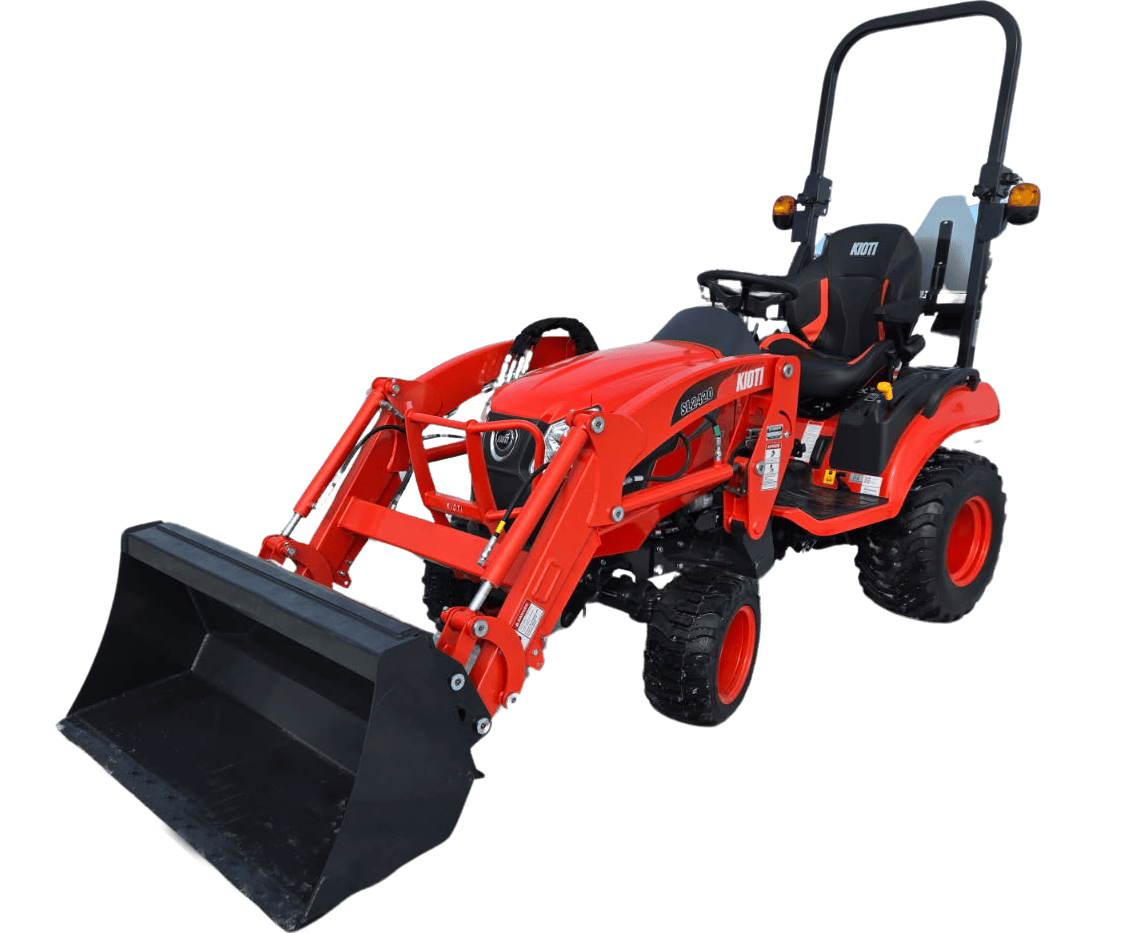
The KIOTI CS2520 makes the most sense when a property needs a small tractor that can move between lawn care, garden work and occasional material handling without occupying the space of a larger compact. Its buying case starts with the complete mowing and storage arrangement. If the main requirement is handling heavy deliveries or carrying a substantial rear implement, a similar engine horsepower figure on a larger tractor does not make the two machines interchangeable.
This guide covers the North American CS2520 subcompact. KIOTI’s Canadian product page currently labels it CS2520H; the older CS-series brochure uses CS2520. Confirm the identity on the actual machine and quotation. Features advertised elsewhere in the CS family, including cab equipment for other models, should not be assumed to belong to this tractor.
On This Page
ToggleThe specifications that shape the purchase
| Item | Published specification | Buying significance |
|---|---|---|
| Engine output | 24.5 gross hp | Different from power available to a driven implement |
| PTO output | 18.5 hp | Use for an implement’s PTO-power requirement |
| Transmission | Two-range hydrostatic | Variable travel within the selected range |
| PTO speeds | 540 rpm rear; 2,200 rpm mid | Attachments need the correct drive arrangement |
| Rear hitch | Category 1; 700 lb at 24 inches behind the hitch | Keep the measurement point with the capacity |
| Minimum-tread width | 45.9 inches | Does not include a mower’s wider envelope |
| Wheelbase | 55.1 inches | Useful for comparing the basic footprint |
The Canadian CS2520 product page and November 2020 North American brochure support these core figures. There is an engine-speed discrepancy: the current page lists 3,000 rpm and the older brochure 3,200. Use the applicable machine manual for operation; this guide does not resolve that difference by choosing whichever number seems preferable.
Choose the working envelope before the engine
A narrow tractor can still become a wide mowing package. The older brochure lists SM2454 and SM2460 decks for the CS20 series, with cutting widths of 54 and 60 inches and overall widths of 69.3 and 75 inches respectively. Those are different measurements for different purposes. Verify the deck revision and complete fitment for the tractor being offered.
For example, an opening wide enough for the bare tractor may prevent access with the mower attached. Measure the clear opening at the narrowest point, including hinge hardware, posts and anything protruding into the route. Then consider the turn immediately before and after it. A machine that passes straight through can still be awkward when the approach requires steering around a building.
Deck width also changes the uncut areas around trees, beds and fences. A larger cutting width can reduce passes in an open rectangle while adding manoeuvring in a landscaped yard. Sketch the areas that actually need mowing instead of using the total property acreage as the purchase specification. Land occupied by buildings, woodland or inaccessible ground is not part of the same mowing workload.
Storage deserves the same treatment. Check the assembled height with the protective structure in its operating position and the complete length with the attachments that will normally remain fitted. Do not plan routine operation with rollover protection folded simply because a garage opening is inconvenient. A storage decision should preserve the manufacturer’s protective-system instructions.
Where the hydrostatic transmission earns its place
The CS2520’s hydrostatic layout is particularly relevant to work involving repeated changes in travel speed: approaching a pile, repositioning at a garden edge, or adjusting pace as mowing conditions change. The useful question is whether the operator can comfortably modulate travel while observing the attachment and surroundings.
During a demonstration, use an approved working setup and try the tasks that occupy most of the year. Check pedal reach, the relationship between seat adjustment and steering, and how easily the operator can look behind without losing a comfortable position. A second family member who will use the tractor should perform the same assessment. Comfort judged from a showroom seat is only part of the answer.
Range selection remains a separate control decision. Hydrostatic does not mean that every range is equally suitable for every load or that additional pedal travel is a substitute for selecting the appropriate range. Learn the actual procedures at handover. Aglist’s tractor transmission comparison explains the broader differences when cross-shopping a geared compact.
Mowing productivity: count the interruptions
Suppose a hypothetical mowing route provides an effective cut of 1.3 metres at an appropriate travel speed of 4 km/h. The straight-line theoretical coverage is 5,200 square metres per hour, before turns, overlap and stops. These are assumed inputs, not tested CS2520 performance. The calculation helps identify what to observe in a demonstration.
If the property requires frequent reversing around obstacles, the theoretical figure will explain little of the actual completion time. Record uninterrupted cutting time separately from repositioning, trimming and attachment setup. That shows whether a wider deck would address the bottleneck or merely make the machine harder to thread through the property.
A tractor also has to justify its versatility. If nearly every operating hour will be finish mowing, compare the entire routine with a dedicated mower. If the same machine will prepare a garden and move materials regularly, the tractor’s additional functions may be valuable enough to accept a different mowing routine. Neither conclusion follows automatically from an acreage threshold.
Rear implements: modest power and a defined hitch rating
The 18.5-PTO-hp figure is the starting point for a rotary tool’s power requirement. A seller describing an implement as suitable for a “25 hp tractor” has not necessarily specified PTO horsepower. Obtain the exact requirement and match the tool’s duty as well as its connection. A finish mower, rotary cutter and tiller should not be chosen from width alone.
The rear hitch’s rating does not approve every implement weighing less than the listed number. Implement length, centre of gravity, mounting geometry, lift clearance and the required tractor configuration still matter. A long tool can present a different carrying problem from a compact one of the same mass. A quick hitch introduces another component and changes the mounting arrangement.
For a garden, define the soil preparation task first. An established cultivated plot differs from breaking unfamiliar ground. Select a tool intended for that work and then confirm the tractor match. Slowing down can be an operating adjustment within an approved combination; it is not permission to ignore minimum tractor requirements.
The PTO horsepower guide provides a fuller matching worksheet. Keep a copy for each driven implement rather than treating the first successful attachment as proof that every similarly sized tool will fit.
Loader work: useful assistance with clear boundaries
For mulch, compost and routine property supplies, the loader decision is about complete cycles: where material starts, the route, and where it must be discharged. A small tractor can be convenient around established landscaping, but convenience does not establish load capacity. Record the actual loader and bucket model in the quote.
Do not use the rear hitch rating as a loader rating, or a loader pivot-pin figure as a fork payload. Fork carriage mass, load centre, lift height and ballast requirements all belong to the handling question. The loader capacity explanation shows why a large headline number can be misleading.
A useful purchasing strategy is to separate ordinary chores from exceptional deliveries. If bulk materials arrive only occasionally, supplier unloading or hired equipment may handle that one demanding job while the CS2520 serves the routine work. Conversely, frequent heavy handling is a reason to assess a larger complete machine package from the beginning.
Planning a Canadian winter package
Winter suitability begins with the route and snow destination. A short driveway with room to store snow presents a different problem from a constrained approach where every cleared bank reduces future space. Decide whether pushing, collecting or blowing best addresses that layout before selecting the attachment.
A mid PTO does not, on its own, establish that a particular front snowblower fits. Mounting hardware, drive components, controls and clearance must form a compatible package. Put every required part on the quotation, especially when purchasing a used attachment advertised without its original tractor.
Plan cold-weather preparation from the machine’s applicable instructions: specified fluids, fuel suitability, battery condition, starting aids where approved and warm-up procedure. There is no supported universal minimum starting temperature for every CS2520 condition in this guide. An open station also makes clothing, visibility and the duration of exposure part of the working plan.
Before winter, decide where the summer attachments will stand so that seasonal changes do not require improvising on uneven or icy ground. A clear, stable storage area can contribute more to convenient ownership than a feature that saves a few seconds under ideal demonstration conditions.
CS2520 versus a larger compact
The strongest reason to stay with the CS2520 is a property layout that rewards its small envelope and a tool list that fits its documented capabilities. The strongest reason to move up is an identified requirement: a rear tool that cannot be carried appropriately, a handling task beyond the approved loader arrangement, or work for which more PTO output is necessary.
Aglist’s Kubota BX2380 page offers another subcompact starting point, while the Kubota L2502 introduces a compact alternative. Compare current manufacturer information for the exact packages. Brand-level impressions and engine horsepower alone are insufficient reasons to declare either one the better fit.
Buying used: inspect the package, not just the hour meter
Inventory everything supplied with the machine. An attractive tractor-and-mower listing may omit brackets, drive components, stands or manuals needed to make the package usable. Photograph the identification plates and compare the components against the relevant documentation before agreeing a price.
Inspect attachment connections, protective guards, tyres, hoses and signs of repair. Have leaks, unusual noise or control behaviour assessed independently. These are inspection priorities, not claims that the CS2520 has a particular pattern of defects. Service records are more useful than an unsupported promise of a certain lifetime.
Request a demonstration from a cold start where practical, followed by normal operation of the actual attachments. Do not use an oversized load to test capacity. Budget for identified repairs and missing equipment, and include delivery and initial servicing in the comparison with a new package.
Questions to settle before purchase
Does CS2520H mean a completely different tractor?
The current Canadian page uses that heading while the older brochure uses CS2520. Resolve the actual model and serial information; do not infer a generation change from the suffix alone.
Can the larger deck pass wherever the tractor passes?
No. Compare the full deck envelope and turning route with the opening. Cutting width and overall width answer different questions.
Will a rear tool attach without additional equipment?
Category is only the initial interface check. Confirm complete mounting, drive, lifting and operating requirements for that exact tool.
Should I buy all attachments immediately?
Prioritise the recurring jobs, but price future mounting and control requirements before buying the tractor. This prevents an apparently inexpensive first package from making the next essential tool impractical.
What makes a quote comparable?
List the tractor, loader, mower or rear tools, necessary controls, ballast, delivery and setup separately. Compare the same complete working outcome, with optional convenience items clearly identified.
Share your experience
Help other Canadian buyers — leave a quick review for the
KIOTI CS2520
There are no reviews yet. Be the first one to write one.