Overview & Specs
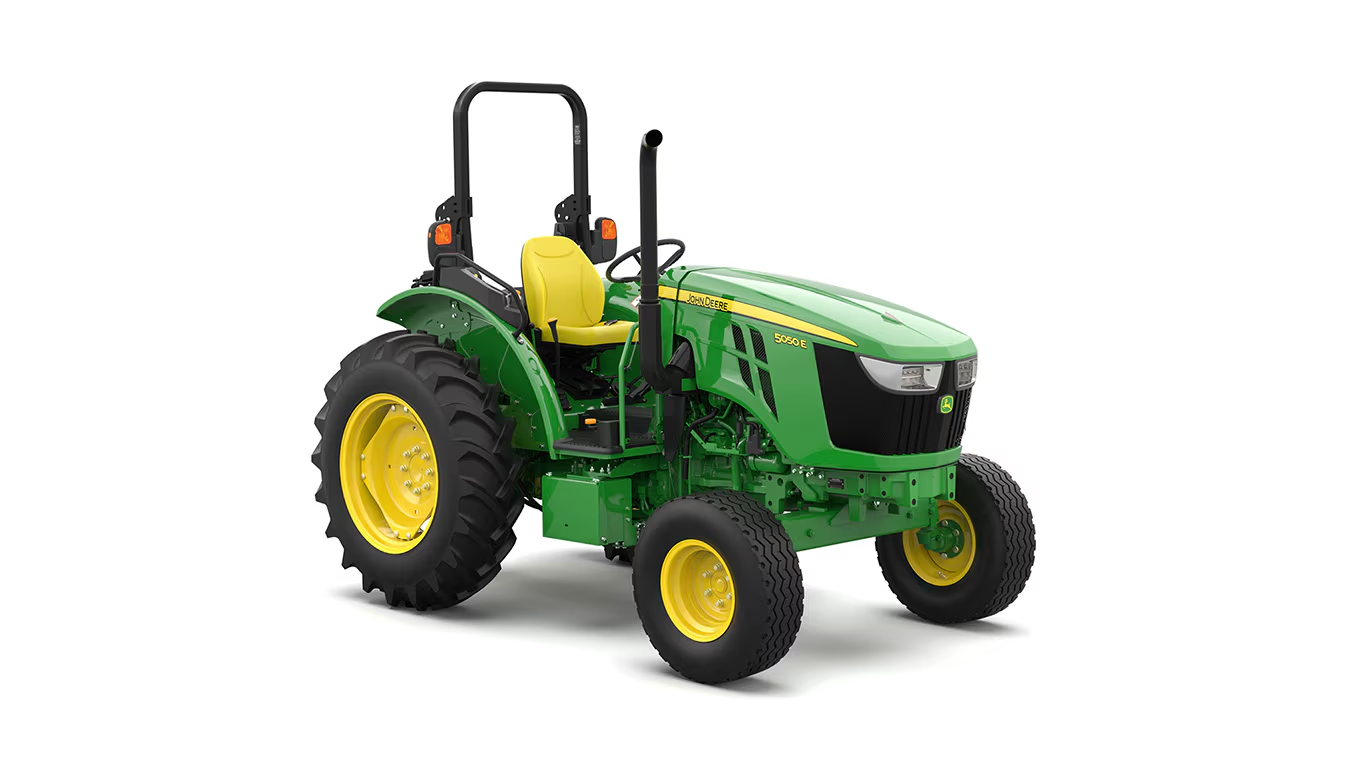
The John Deere 5050E is worth considering when an acreage needs a straightforward open-station utility tractor for recurring rear-implement work and occasional loading. Its attraction is not simply a larger number than a compact tractor carries on its hood. The useful question is whether its working gears, implement interfaces and physical package suit the jobs that actually occupy your year.
This guide uses the Canadian 5050E model specification table checked in October 2026, anchored to the SyncShuttle configuration shown there. Deere’s broader series overview mentions an additional transmission choice that is not described in that model table. Treat any different quoted configuration as a separate verification, particularly when shopping used. A model name reused over time is not a guarantee of identical equipment.
On This Page
ToggleThe reference configuration and its limits
The Canadian 5050E page supplies the following model-table references.
| Item | Published reference |
|---|---|
| Engine | Three-cylinder 2.9 L diesel, 50.1 hp at 2,100 rpm |
| Rated PTO output | 38 hp at 2,100 rpm |
| Transmission | SyncShuttle, 9 forward and 3 reverse |
| Rear PTO | Independent 540 rpm |
| Rear hitch | Category 2, convertible to Category 1 |
| Available flow at one rear SCV | 43.1 L/min |
| Base mass, 2WD / MFWD | 2,420 / 2,634 kg |
The current series overview has a different PTO figure, so retain the model-table basis and confirm the applicable serial documentation for a close power match. Base mass does not include every loader, attachment and ballast arrangement. The listed pump total is also a different quantity from the single-valve flow above.
Why compare this with a compact tractor?
Buyers often arrive at the 5050E after finding that a small property tractor feels stretched by a rear implement or a recurring farm chore. Before moving up, identify what is actually inadequate. A power shortage, an inconvenient transmission and an unsuitable loader are different problems. A larger utility chassis should solve the relevant problem without making everyday access unnecessarily difficult.
Measure the places where work happens: the storage doorway, a feed passage, the turnaround at the end of a lane and the route around trees. Repeat the assessment with the intended loader and rear implement included. The tractor alone is rarely the whole package, and a long rear tool can dominate the turning space.
If most work is landscaped mowing with occasional light material movement, a compact configuration may remain more convenient. If the recurring requirement is sustained work with suitable rear tools on open ground, the utility layout deserves a fair demonstration. Neither category wins because of its name.
The published KIOTI DK4520 guide offers a conventional compact-tractor comparison. Use it to organise the questions about controls and retained implements, then compare current quotations and exact specifications rather than assuming equal capability from similar engine classes.
Gear choice matters at the PTO operating speed
The meaningful transmission trial starts with a job, not a drive across an empty yard. A PTO implement needs its prescribed shaft speed while the tractor travels at a useful pace. Test whether the available working gears provide that combination in the material you normally encounter.
For rotary cutting, a comfortable gear in short grass may be too fast in heavier growth. The relevant question is whether a suitable lower pace is available and convenient under the permitted shifting procedure. Slowing the engine indiscriminately also changes PTO operation; it is not equivalent to selecting a more suitable ground speed.
For tilling, investigate the slow working range before assuming that nine forward choices cover every task. Gear count alone says little about the pace needed by a particular implement. A competent demonstration with a compatible tool can resolve more than a comparison of maximum travel speeds.
Three reverse ratios also deserve attention if a conventional rear snowblower is central to the purchase. Check the actual speed chart and working arrangement at the required PTO setting. Do not buy a tractor on the basis that it can reverse and discover later that the useful blowing pace is awkward.
The Aglist transmission guide explains the broader alternatives. For this 5050E, the acceptance question is whether the regular operator finds the specified controls practical throughout the recurring sequence, including turns and changes of direction.
Match implements against rated PTO power
The engine rating does not establish what is available at the implement drive. If a hypothetical cutter requires at least 40 PTO hp, the model table’s 38-rated-PTO-hp entry does not meet that screen. Its engine output cannot be substituted to make the comparison pass.
Do not use a separate maximum-power entry at another engine speed as an automatic replacement for the rating needed at the implement’s operating conditions. A minimum requirement is also only one part of matching. Shaft speed, mounting, carrying requirements and the tool’s permitted duty remain essential.
Start with the exact implement rather than a generic width. Two tools described as a six-foot cutter can differ in construction, mounting and intended vegetation. Keep the implement manual or specification with the tractor quotation so an equipment substitution cannot silently change the requirements.
For a property that already owns several attachments, classify them as confirmed compatible, unsuitable or unresolved. The engine versus PTO horsepower guide helps with the power terminology; the actual tool documents settle the matching details.
Convertible hitch category does not preserve every old tool
The Category 2 hitch’s ability to be configured for Category 1 is useful to investigate when retaining smaller implements. It does not mean every tool automatically suits the tractor. The complete geometry, required hardware, movement and driveline still need checking.
Record where the implement’s mass is carried relative to the linkage. A compact box blade and a long mounted machine can create different demands even if their weights look similar. Retain the manufacturer’s rating location when reviewing lift information, and establish the required tractor setup.
A quick hitch adds another component and can move the tool rearward. Do not assume that a driveline previously suitable on another tractor remains correct. Have the actual combination assessed through its permitted movement, with guarding and connection requirements intact.
Ground-engaging equipment introduces a separate question about control of depth and draft. Ask for the relevant hitch controls to be explained using the intended tool. More engine power does not correct a poorly adjusted implement or unsuitable working conditions.
Hydraulic functions: count tasks, not connectors
List what each implement needs the hydraulics to do. A cylinder that occasionally changes position is a different demand from a continuously driven motor. Identify pressure, flow, return arrangements and control behaviour, then match the installed equipment.
The single-rear-valve flow reference is more relevant to an individual tool than a combined pump total, but it is still not a universal attachment approval. Available performance in the intended combination must suit the tool’s requirements. Extra couplers do not prove independent functions or the correct valve operation.
For a loader grapple, determine how the additional opening-and-closing function will be controlled. Standard loader lift and curl do not answer that question. The hydraulic-control guide can help separate rear remotes, a third function and a diverter when specifying the package.
Loader work should justify its own equipment list
Describe the load, attachment, pickup point and final placement. A bucket of loose material and a pallet carried forward on forks are different arrangements. An engine rating or rear-hitch number cannot establish the permitted loader load.
Obtain the loader, carrier, attachment and prescribed ballast as an identified combination. For pallet work, retain the actual load centre and placement height. For bulky material, account for attachment mass and visibility as well as the load itself.
Assess manoeuvring with the regular operator. If a large share of the day involves repeated short reversals, transmission convenience may justify a different configuration even when this tractor’s power is adequate. Occasional loading and continuous loading should not receive equal weight in the purchase decision.
The loader capacity guide explains the measurement differences. It is a framework for reading the correct loader documentation, not a carrying allowance for this tractor.
Open-station ownership through a Canadian year
The open station should fit the work schedule as deliberately as the engine does. A machine used mainly for seasonal field passes has a different comfort requirement from one needed every morning on an exposed winter route. Estimate the longest routine session and whether work can wait for better weather.
A canopy can provide a different experience from a fully equipped cab, but it should not be priced as equivalent weather protection. Evaluate approved equipment and its effect on access. Measure storage clearance with the protective structure in the required configuration.
Cold-weather starting, fluids and preparation belong to the applicable manual. Avoid building a purchase case around an unsupported minimum starting temperature. The condition of the battery, approved starting equipment, storage arrangement and maintenance history are more useful evidence.
Choose tyres and ballast for the documented tractor arrangement and actual surfaces. MFWD is not permission to work on ground that cannot support the machine. Equally, the lowest base mass should not be mistaken for the best equipped setup for every job.
Used buying: identify what the quotation leaves out
Begin with the tractor’s serial identity and the loader’s separate identification. Ask for manuals and service records that apply to those units. An older 5050E advertisement should not inherit current equipment simply because the name matches.
Have the clutch, transmission, PTO, brakes, steering and hydraulics assessed under appropriate controlled conditions. Inspect the loader structure, linkage wear, attachment locks, tyres and guards. These are ordinary inspection priorities, not allegations of recurring model defects.
Price incomplete equipment explicitly. Missing ballast, an unsuitable attachment interface or a hydraulic function not yet installed can materially change the cost of putting the tractor to work. A low asking price becomes meaningful only after those items are resolved.
Transport needs an equipped weight and loading plan. Include separately carried tools, loader, ballast and trailer as applicable without double counting. Check the complete vehicle arrangement and relevant requirements rather than selecting a trailer from the base tractor mass.
Questions that should decide the purchase
Is the 5050E a 50-PTO-hp tractor?
No. The cited model table distinguishes 50.1 engine hp from 38 rated PTO hp. Verify the exact version when the tool requirement is close.
Does every current 5050E have the same transmission?
This guide is anchored to the model table’s SyncShuttle configuration. Resolve other quoted options with configuration-specific documentation rather than combining conflicting summaries.
Will my Category 1 tools transfer?
Only after checking the complete interface, power, carrying and driveline arrangement. Convertible category alone is insufficient.
When is a compact tractor the better comparison?
When access, variable-speed control or attachment convenience matters more than the utility package. Identify the constraint before moving up a class.
What would make this a strong purchase?
A repeatable match between the required rear tools, useful working gears and an acceptable open-station routine, supported by a complete quotation and demonstrated condition.
Share your experience
Help other Canadian buyers — leave a quick review for the
John Deere 5050E
There are no reviews yet. Be the first one to write one.