Overview & Specs
The KIOTI DK4520 is worth considering when a property needs a conventional gear tractor for mowing, rear implements and general material handling, and the operator is comfortable choosing gears and using a clutch. Its appeal is the combination of a compact footprint, a Category I rear hitch and useful PTO output. It should not be selected simply because the number on the hood resembles the horsepower requirement on an attachment advertisement.
This guide covers the Canadian-listed DK4520 with an open operator station and synchronized shuttle transmission. Hydrostatic DK SE models are different configurations. For a Canadian buyer, the decisive questions are how much of the working day involves steady travel, how often direction changes, and whether the implements already owned genuinely suit the tractor.
On This Page
ToggleStart with the work that repeats most often
A tractor used for several long mowing passes has a different control workload from one shuttling between a pile and a trailer throughout the afternoon. The DK4520’s gear transmission deserves a serious demonstration in both situations. Being able to drive a manual tractor is not the same as preferring that routine for every task.
List the recurring jobs before comparing equipment packages. Separate mowing and tilling from loader cycles, driveway grading, snow clearing and occasional lifting. Then estimate hours rather than giving each job equal importance. A task performed twice a year should not automatically dictate the controls used every week.
For an owner keeping existing Category I tools, the DK4520 can also be a useful starting point in the shopping process. However, retaining those tools still requires checking power, dimensions, driveline movement and carrying requirements. The category establishes an interface family, not complete compatibility.
DK4520 specifications that matter to the decision
The following core figures are supported by the KIOTI Canadian DK4520 page and the manufacturer’s DK20/DK20SE brochure. They describe the named configuration, not a promise about every used machine advertised as a DK.
| Item | DK4520 specification | Buying significance |
|---|---|---|
| Gross engine output | 44.9 hp | Do not substitute it for PTO output |
| PTO output | 38.9 hp | Use when screening driven implements |
| Transmission | Synchronized shuttle, 8 forward and 8 reverse | Evaluate actual working gears |
| Rear PTO | Independent, 540 rpm | Power and shaft speed must both suit the tool |
| Rear hitch | Category I, position control | Check complete implement geometry |
| Wheelbase | 71.3 inches | Useful footprint reference, not turning clearance |
| Minimum-tread width | 62.8 inches | Measure the fitted tyres and attachments |
| Listed height | 96.8 inches | Check actual overhead clearance |
The brochure’s headline rear-lift figure does not clearly preserve its measurement point. This guide therefore does not turn it into an approved implement weight. A carrying decision needs the applicable load reference, linkage arrangement and tractor setup, especially when a tool’s centre of gravity extends well behind its mounting pins.
Why 38.9 PTO horsepower is the useful implement number
A rotary cutter or snowblower may be advertised by width, but width alone does not describe its power demand. Two implements of similar width can have different construction, intended material and manufacturer requirements. Begin with the exact implement model and its stated PTO power range, then consider the work it must perform.
For a simple screening example, an implement requiring at least 40 PTO hp would not meet that minimum on the basis of the DK4520’s listed 38.9 PTO hp. Its 44.9 engine hp does not close the gap. This is a specification comparison, not a test of whether the tractor could make the implement move under light conditions.
Conversely, satisfying a minimum power figure does not establish acceptable performance in every crop or snow condition. Travel speed, material density and the implement’s own limits remain relevant. Aglist’s engine versus PTO horsepower guide explains how to keep these quantities separate.
Check shaft speed and the complete driveline at the same time. The presence of an independent PTO describes its control arrangement; it does not make attachment changes safe while machinery is moving. Use the machine and implement procedures, with the equipment stopped and secured before anyone approaches the connection.
Test the gear spacing at the engine speed the job needs
The most revealing demonstration is not a quick drive across an empty yard. For PTO work, assess the available travel speeds while maintaining the required PTO operating speed. A gear that feels comfortable at low engine speed may be too fast when the implement is running correctly.
For tilling, identify whether the available low working speed suits the intended soil and attachment. For mowing, look for a useful progression between a comfortable normal pass and a slower pass through heavier material. Avoid assuming that eight forward gears provide the exact speed needed simply because the total sounds sufficient.
The shuttle arrangement also needs to be understood on its own terms. Do not confuse synchronized shuttle with a power-shuttle transmission or assume that direction changes require no clutch procedure. Have the prescribed operation demonstrated and judge whether it remains comfortable during repeated loader cycles.
A buyer sharing the tractor with another operator should include that person in the assessment. Seat position, clutch reach and visibility can change the practical answer. Aglist’s tractor transmission comparison provides a broader framework, but the DK4520 demonstration should settle the personal fit.
Loader work: specify the task before the bucket
Describe what has to be picked up, where it starts, where it must be placed and the attachment used. Loose material in a bucket, a pallet on forks and a long object held out in front are different arrangements. The engine rating cannot establish a safe load for any of them.
Require a quote that identifies the loader, carrier, attachment and prescribed ballast. A loader’s pivot-pin figure is not automatically a pallet capacity at the fork load centre. Nor does a rear-hitch rating answer a front-loader question. The Aglist loader capacity guide explains the measurement differences.
On a small property, movement around the load may be as important as nominal lifting ability. Check the approach to a shed, room to turn away from a trailer and clearance with the attachment fitted. A compact tractor can still become an awkward package when a long rear implement is left attached during loader work.
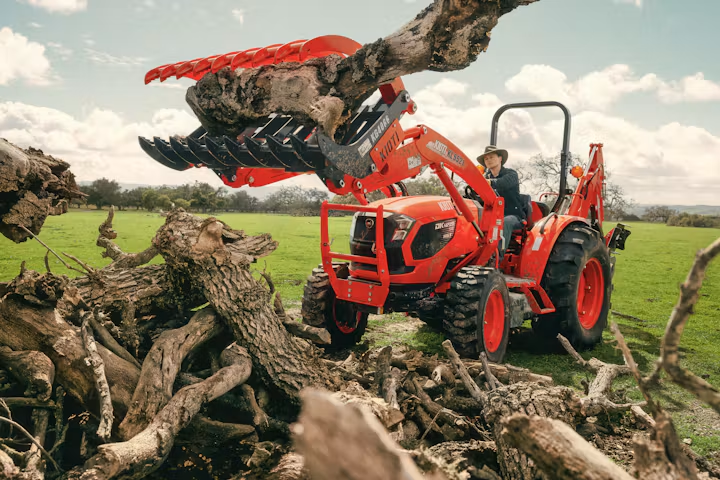
If a grapple is planned, its additional hydraulic control belongs in the equipment list from the beginning. A standard bucket’s lift and curl controls do not establish that grapple opening and closing is provided. Record the exact valve arrangement, couplers and compatible attachment rather than accepting “hydraulics included” as a complete description.
Keeping existing implements without creating new problems
For every retained tool, record its model, hitch arrangement, weight, working width and power requirement where applicable. Add any hydraulic or electrical controls. This converts a general intention to reuse equipment into a list that can be checked against the actual tractor package.
A quick hitch adds another interface and changes the position of the implement relative to the tractor. Even a Category I tool that connects directly may not suit a particular quick-hitch frame. Aglist’s Category I quick-hitch guide covers the mounting and PTO questions.
Position control is useful for selecting hitch position, but do not describe it as draft control. For ground-engaging work, understand how the chosen implement controls working depth and how the tractor’s actual hitch controls interact with it. Buying a more powerful tractor does not correct a poorly matched implement or unsuitable soil conditions.
Rear hydraulic equipment also needs a physical inventory. Count working control circuits, identify the valve behaviour and inspect which couplers are actually fitted. A used tractor may have optional equipment absent from another otherwise identical DK4520.
Canadian seasonal use and storage
An open station can be attractive for frequent entry and exit, but winter exposure is part of the ownership decision. Consider the length of the clearing route, wind exposure and whether work can wait for better conditions. A short sheltered driveway and a long exposed farm lane create different demands on the operator.
Do not assume that choosing a rear snowblower is just a horsepower decision. Mounting, driveline, working width, travel speed and chute controls all matter. With a gear tractor, the usable reverse working speed deserves particular attention for a conventional rear-facing blower.
Plan cold-weather preparation around the applicable manual and fitted equipment, including specified fluids and any approved starting aids. There is no basis here for promising a particular starting temperature or fuel consumption. A seller’s statement that the tractor “always starts” is less useful than service records and a competent demonstration.
Measure the storage route with the ROPS in its prescribed operating configuration. Include door hardware, lights and any canopy. The listed tractor height is only a starting point; tyre changes, floor irregularities and accessories can affect actual clearance.
Buying a used DK4520
Begin with identity and history. Match the serial information to the tractor, identify the loader separately and obtain the applicable manuals. Ask what implements were used and how the machine was stored. These details help target an inspection without assuming that a particular hour reading proves gentle or severe use.
Have a competent inspection assess clutch operation, gear selection, shuttle function, brakes and steering under appropriate controlled conditions. Inspect loader pins, attachment locking components, hoses and evidence of structural repair. These are general used-equipment checks, not claims of recurring DK4520 defects.
Look for completeness as well as wear. Missing guards, absent ballast equipment, mismatched tyres or undocumented hydraulic alterations may create work before the tractor can enter service. Price the required corrections from actual quotations instead of treating them as minor because the tractor runs.
For transportation, use the weight of the complete equipped combination. Tractor-only figures exclude some combination of loader, attachment, ballast, fuel and carried equipment depending on the source. Verify the trailer, ramps and tow vehicle against their applicable ratings and the actual load arrangement.
Compare alternatives by the compromise you want to change
If repeated direction changes dominate, compare a hydrostatic package rather than simply moving to a larger gear tractor. If most work is light property maintenance, the KIOTI CK4020 guide offers a smaller-series starting point. Compare the complete equipment and controls, not just engine numbers.
If weather protection is the unresolved issue, evaluate a factory-cab configuration and the consequences for access and cost. If heavy carrying is the issue, investigate the required chassis and loader combination. Those are separate reasons to change tractor, and one upgrade does not necessarily solve all three.
Questions to settle before signing
Is this the hydrostatic DK?
No. The DK4520 described here has an 8F/8R synchronized shuttle. A dealer package or used listing should identify the full model rather than relying on the series name.
Can a Category I implement be transferred automatically?
No. Verify its geometry, carrying requirements, power and driveline arrangement. A category match is an initial screen.
Will more engine power make the loader lift more?
Engine output is not a loader rating. Use the approved complete loader arrangement and its documented limits.
What should the demonstration prove?
It should establish suitable work speeds, manageable clutch and shuttle operation, useful sightlines and a complete attachment package for your recurring jobs.
What is the strongest reason to choose the DK4520?
A good fit between its conventional controls, PTO capability and the implements used regularly. That is a firmer basis than buying by a broad horsepower class or an incomplete base-tractor quotation.
Share your experience
Help other Canadian buyers — leave a quick review for the
KIOTI DK4520
There are no reviews yet. Be the first one to write one.